

8+ years growing brands on KPIs, now with AI
Scale your activewear brand past the plateau
When creative fatigues and CPMs spike, our testing system keeps activewear revenue climbing instead of stalling.
8+ years growing DTC brands · Google Ads, Meta & TikTok partner · Proven ecommerce results



Get your free Growth Gap Analysis
Senior strategist review · response within one business day
Prefer to reach out directly?
The Challenge
DTC Activewear Marketing Is a Problem Most Agencies Don't Understand
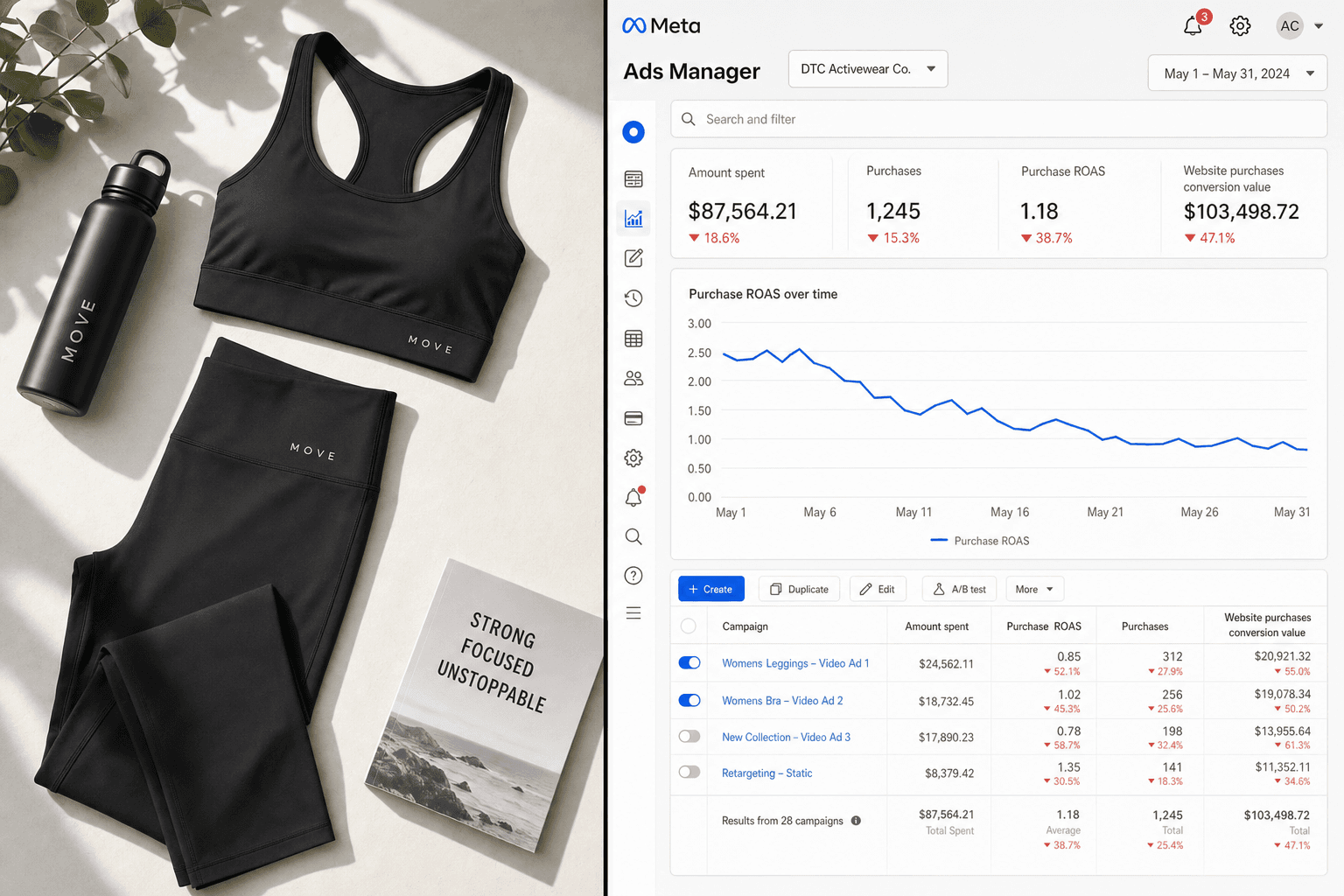
Activewear is an emotional purchase: your customer buys leggings for who she is in them, not thread count. A winning Reels or TikTok ad can burn out in days, yet losing brands run three creatives for 60 days as ROAS falls.
Beyond 50 other DTC activewear brands targeting your Meta audiences, you face Lululemon's creative budget, Alo's influencer roster, and Gymshark's community playbook. Those billion-dollar incumbents hold the top macro influencers, so you fight for micro-influencers and Millennial and Gen-Z women seeing 40 activewear ads daily.
Unit economics are brutal: AOV runs $85–$130 per legging or sports bra, and 12-month LTV rarely clears $200 without a loyalty loop. First orders rarely pay off alone; margin lives in returning cohorts, built only by keeping acquisition cost below $40–50 per new customer.
January is your cheapest window: CPMs run about 22% below annual average as resolution intent peaks. Q4 brings peak revenue and your costliest media, with November CPMs up 41%. Flat monthly agency budgets overpay in November and underinvest in January.
The Opportunity
Activewear Is Still Growing, but Share Is Concentrating Fast
Activewear is growing: in early 2025, US activewear sales rose 2% year-over-year while non-active apparel fell 2%. The brands capturing that growth have the best creative systems, disciplined media buying, and tight attribution, not the best product.
Customers repurchase fast: about 49% of gym-going Americans buy new activewear every quarter. Email and SMS flows can push a $110 first order's 12-month LTV past the $200 ceiling you'd hit without them, yet most brands' post-purchase emails stop at shipping confirmation.
Google Shopping and Performance Max (PMax) capture 'best leggings for running' and 'squat-proof leggings' searches at 3.4–4.5x ROAS, demand many Meta-first brands leave uncontested.
TikTok is the most underpenetrated channel for brands that haven't cracked it. Direct ROAS is lower (1.7–2.5x), but its awareness converts later through Meta retargeting and branded search. Blended ROAS captures that; last-click attribution misses it.
What Most Get Wrong
What Most Activewear Brands and Their Agencies Get Wrong
Refreshing creative monthly instead of testing weekly
A winning Reels ad can be exhausted before your agency reviews performance, so monthly batches leave ROAS on the table while CPMs climb.
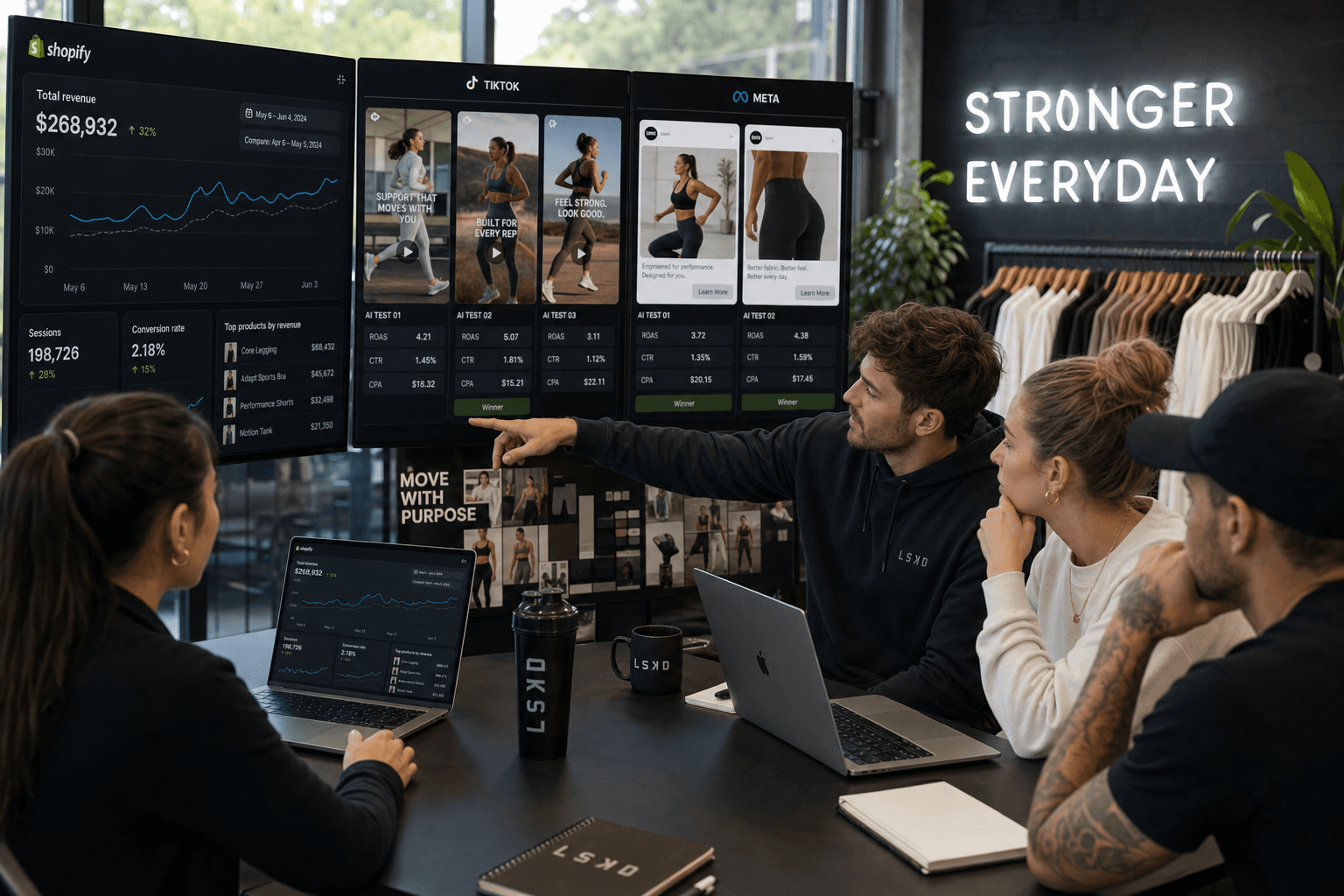
Running the same content on Meta and TikTok
Raw, native-feeling UGC performs on TikTok, where polished Instagram Stories creative looks like an ad: viewers scroll past and TikTok deprioritizes it. Agencies repurposing Meta assets burn budget on it.
Ignoring Google Shopping and PMax while over-indexing on Meta prospecting
Someone searching 'best leggings for hot yoga' has already decided to buy. Without Shopping campaigns, you cede that demand to competitors while paying higher CPMs for cold Meta audiences.
Flat monthly budgets that ignore the activewear calendar
January CPMs run 22% below annual average while resolution-driven intent peaks, and November CPMs jump 41%. A flat budget overpays in Q4 and underinvests in the year's cheapest window.
Klaviyo flows that stop at welcome and abandoned cart
A non-subscription brand with a 25% repeat purchase rate earns its margin on orders two and three. Without post-purchase education, replenishment nudges, and loyalty sequences, you never recover acquisition losses.
Why Now
Why Testing Before CPMs Peak Decides Your Activewear Year
Q4 makes or breaks your year: it brings roughly 42% of annual ecommerce revenue for apparel brands. Build your creative system ahead of it, testing angles for 6–8 weeks before CPMs peak.
Most competitors refresh Meta creative monthly, run a two-year-old Klaviyo setup, and haven't restructured Google for Performance Max. AI lets you test five times more angles per week than a manual workflow allows, without five times the production budget, so you can find Q4 winners before competitors start testing.
January is the other window: most competitors are recovering from Black Friday/Cyber Monday or running stale creative when CPMs hit their annual low. Brands adopting AI creative testing, blended attribution, and channel-specific strategies before their next peak will own their corner, ahead of those on a 2021 Meta playbook.
The Mechanism
Where AI Gives Activewear Brands a Concrete Edge
Real productivity, not AI theater. Here's where it actually moves a number for activewear brands.
Creative
What AI does: We use AI to generate hooks, copy variations, and visual concepts every week, then run structured tests to find winners before scaling spend behind them.
The result: You can test 5x more angles per week without a proportional rise in production cost, catching winners before fatigue drags ROAS down.
Why it matters here: Because a winning Reels ad can fatigue in days, the fastest-iterating brand wins, and brands on monthly refreshes pay more in paid social.
Analytics
What AI does: AI-powered blended attribution modeling reconciles Meta's reported ROAS with actual Shopify revenue, catches pixel misfires that inflate reported ROAS by 20–40%, and separates new-customer acquisition from retargeting existing buyers.
The result: When Meta reports 4.2x ROAS and Shopify disagrees, you know which number to trust and why before you move budget.
Why it matters here: Last-click models hide TikTok's contribution, so brands running TikTok for awareness and Meta for conversion risk cutting the channel seeding their Meta sales.
Social Media
What AI does: We use AI to source UGC, manage whitelisting, and adapt content for TikTok, spotting which activewear creator formats work and building a pipeline of whitelisted creator ads instead of one-off influencer posts.
The result: You get steady native-feeling paid creative for Meta and TikTok that beats brand-produced content on CPA because it doesn't look like an ad.
Why it matters here: Whitelisted creator ads, run through your account, consistently beat traditional paid social on CPA in apparel, yet most brands treat influencers as a brand play.
What AI does: We use AI to time Klaviyo post-purchase sequences to the repurchase cycle (90–120 days for leggings, 60 for sports bras), predict send times, and test generated subject lines and copy across segments.
The result: Email and SMS become a meaningful share of revenue by driving the second and third purchases.
Why it matters here: In non-subscription activewear, three-time buyers bring roughly $150–$200 more revenue than one-time buyers, so AI-optimized retention flows are the highest-ROI investment once you've solved acquisition.
Conversion Optimization
What AI does: AI spots fit-anxiety drop-off on product and collection pages and tests size guide formats, social proof placement, and bundle merchandising to lift AOV and cut returns, which run 24% in apparel ecommerce.
The result: Existing traffic converts better, and set merchandising more often turns a $95 single-legging purchase into a $180 set purchase.
Why it matters here: 58% of activewear shoppers bracket (order several sizes, return most); real-model size guides, video try-ons, and fabric detail ease fit anxiety and cut returns.
Ready to see what this looks like for your activewear brands business?
No obligation. A senior strategist will show you exactly where the wins are.
The Strategy
What a Purpose-Built Activewear Marketing Strategy Looks Like
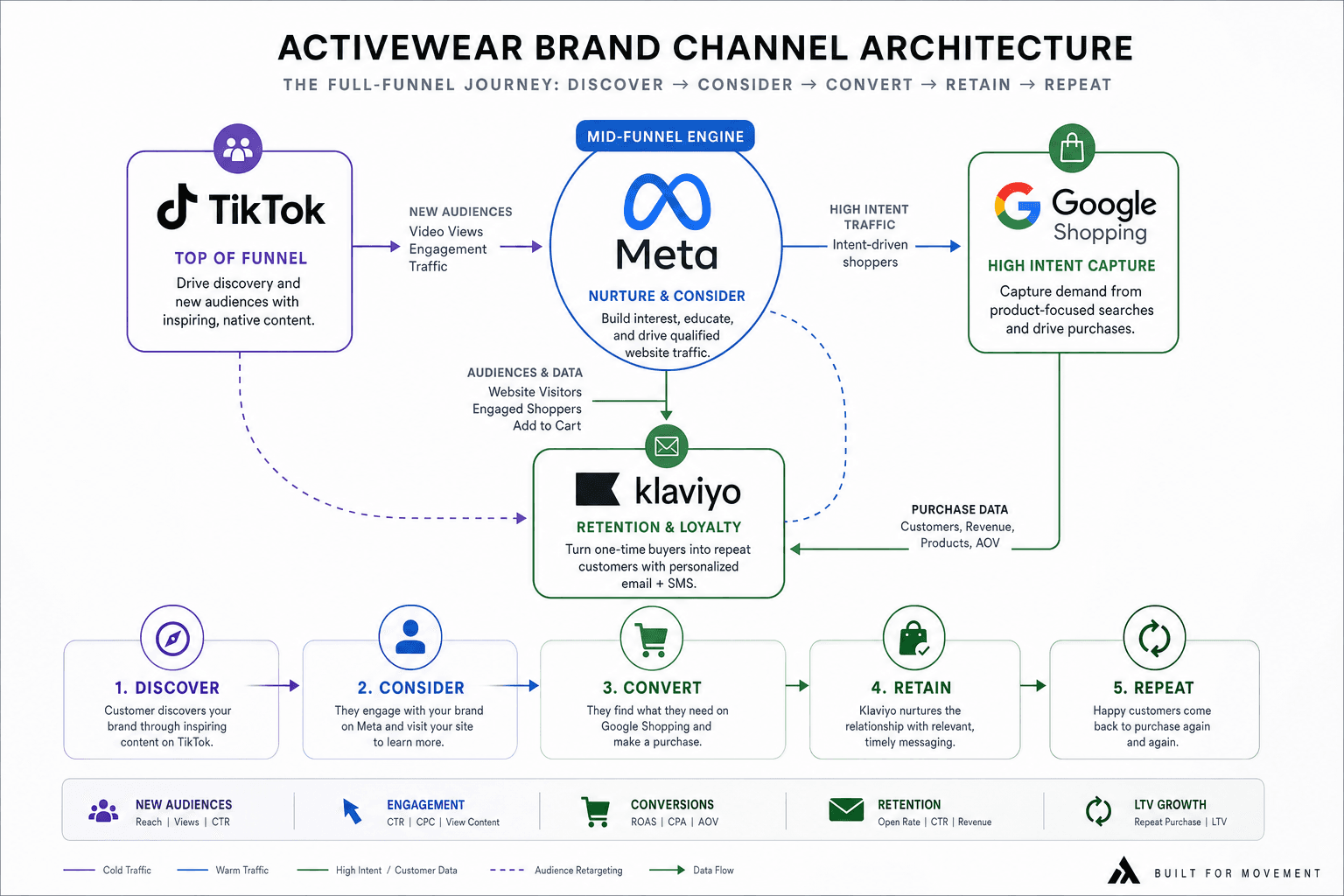
Judge every decision by blended ROAS: last-click attribution misleads you in activewear, since TikTok awareness converts on Meta and Meta retargeting takes credit for email-driven sales.
For a brand doing $500K–$5M in annual revenue, Meta is the workhorse and gets the largest budget share: Advantage+ sales campaigns (formerly Advantage+ Shopping) for the catalog, manual prospecting for new angles, and retargeting that skips last week's buyers.
TikTok runs top-of-funnel on native UGC and whitelisted creators at lower direct ROAS targets (1.7–2.5x).
Google Shopping and PMax capture high-intent and branded searches ('best squat-proof leggings', sports bra queries) at 3.4–4.5x ROAS. With optimized product titles, clean feed data, and segmented PMax, Shopping is frequently your highest-ROAS channel.
Klaviyo flows (welcome series, abandoned cart, post-purchase education, 90-day replenishment nudge, 180-day win-back) turn a 25% repeat rate into 35%. On a $1M brand, that 10-point gain beats most paid media optimizations.
Weight budget toward January, fund creative testing in August–September, and put peak November–December spend behind validated creative.
Creative is a performance function: each brief starts from a hypothesis about which emotional trigger or functional claim converts a segment, and we test weekly against a defined success metric, scaling winners and killing losers fast.
The one number that governs this
Blended ROAS (total revenue divided by total ad spend) governs every decision. Healthy activewear brands target 3–4x on paid channels and new-customer CAC below $40–50.
How We Help
How We'd Run This for Your Activewear Brand
We don't hand you a strategy deck and disappear. We build and run paid media, creative, email, and attribution as an extension of your team, in this order:
Attribution Audit & Blended ROAS Setup
Before touching a campaign, we audit your pixel, reconcile Meta-reported ROAS against Shopify actuals, and build a blended ROAS dashboard.
Meta Ads (Advantage+ & Manual Prospecting)
We restructure around Advantage+ sales campaigns for the catalog and manual prospecting for angle tests, tighten retargeting, and set a 3–4x Meta channel ROAS floor.
TikTok Ads & UGC Whitelisting
We run TikTok on native UGC and whitelisted creators with realistic in-platform targets, tracking its downstream contribution to Meta and branded search.
Google Shopping & Performance Max
We build or restructure Shopping with an optimized product feed, segmented PMax, and bids tuned for 'best leggings for [activity]' and branded queries.
AI-Powered Creative Testing
Each week we produce AI-assisted hooks, copy angles, and visual concepts and run structured tests, scaling spend only behind winners.
Klaviyo Email & SMS Retention Flows
We build or rebuild your core Klaviyo flows to move your repeat purchase rate from the 25% industry average toward 35%, where the margin lives.
Seasonal Budget Pacing
We replace flat monthly budgets with a calendar that front-loads January, funds August–September creative testing, and enters Q4 with proven creative.
Who's Behind This
Who we are, and what makes us different
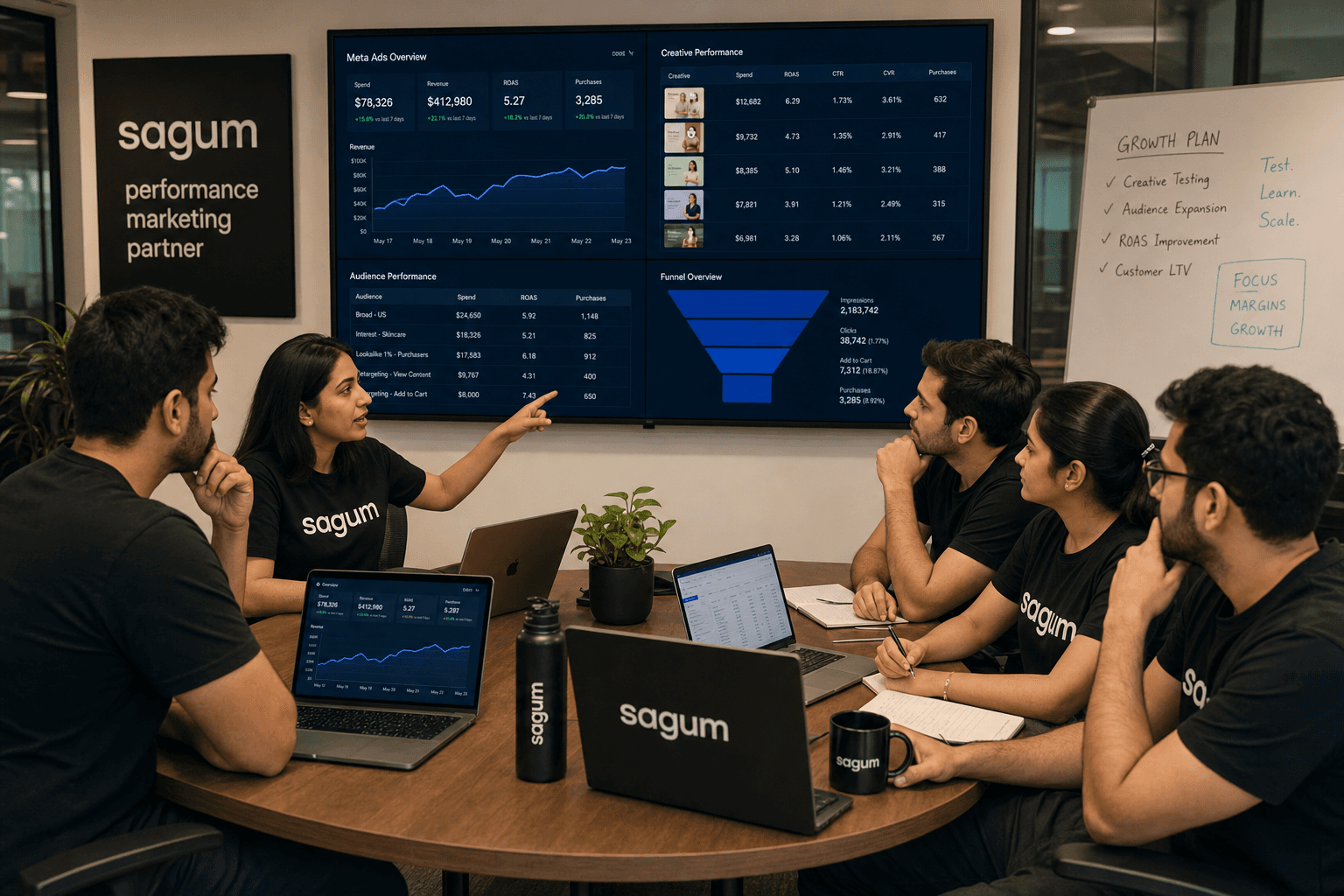
Sagum is a performance marketing agency founded in January 2017 in St. George, Utah. We've spent 8+ years growing real brands and being judged on KPIs, not vanity metrics.
We deliberately limit how many clients we take so each one gets senior attention. We treat your numbers like our own, we never run generic playbooks, and your strategy is built for your business, because shouldn't your brand's marketing be custom to your brand?
Sagum.ai is our AI arm: the same proven operators now build AI into the work wherever it creates real edge, not as theater, but as leverage applied with discipline.
- 8+ years growing brands on performance KPIs, not vanity metrics
- Limited client roster, with senior attention on every account
- An extension of your team; your success is tied to ours
- Custom strategy per brand, never a generic playbook
- AI built in where it moves a number; judgment over hype
“Sagum is a performance marketing agency that's spent 8+ years growing brands by treating their numbers like our own. We take on few clients, never run generic playbooks, and now build AI into the work wherever it creates real edge, not hype. Your strategy is built for your business, and our success is tied to yours.”
“Sagum roughly doubled our bottom line. They treat the work like it's their own business.”
Rachel Nilsson
CEO, RAGS
Proof
15:1 ROAS across all ad spend, plus hundreds enrolled in the Stevie Rep program
Shop Stevie
Challenge
Shop Stevie, an apparel brand, set out to establish a 15:1 ROAS, drive profitable new-customer acquisition, and generate leads for its Stevie Rep program.
What we did
We ran creative retargeting and remarketing across Facebook and Instagram, and built landing pages and a sales funnel with a dedicated creative campaign for the Stevie Rep program.
Result
Shop Stevie hit 15:1 ROAS across all ad spend, scaled sales with new expansion campaigns at positive ROI, and enrolled hundreds in Stevie Rep through reliable-CPL Instagram lead ads. That creative discipline transfers to activewear.
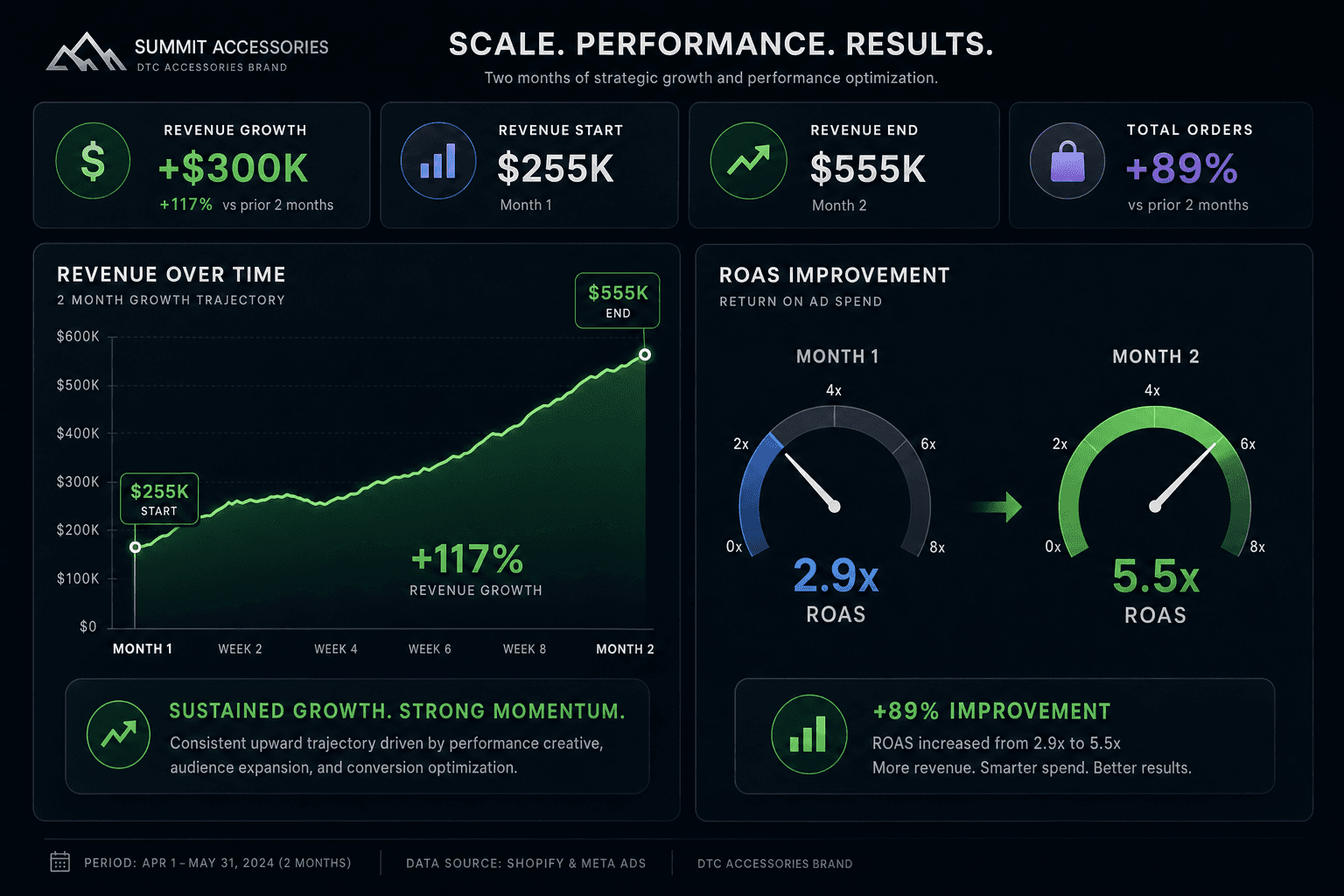
- ROAS
- 15:1
- Rep program
- Hundreds enrolled
- Sales
- Scaled at positive ROI
The Creative System and Paid Media Engine to Scale Your Activewear Brand
No obligation. We'll review your paid media setup, attribution, and creative cadence and give you an honest read on where your brand's growth lies and what it would take to capture it.
Sagum · January 2017 · St. George, Utah · 8+ years