
8+ years growing brands on KPIs, now with AI
More Assisted Living Move-Ins, Fewer Referral Fees
Owned channels that book tours at a fraction of what referral agencies charge per placement.
Google Ads Partner · Meta Partner · 8+ Years in Performance Marketing



Get your free marketing audit
Senior strategist review · response within one business day
Prefer to reach out directly?
The Challenge
Marketing Assisted Living Is Unlike Any Other Local Business
The family calling you is not browsing casually. In most cases, something just happened. A fall at 2 a.m. An ER visit that ended with a discharge planner asking hard questions. A holiday visit where the adult children looked at each other across the dinner table and knew they could not leave things the way they were. The person making the call is usually a daughter in her 50s, managing her own job and family while absorbing the grief of watching a parent decline. She is not comparison-shopping the way someone picks a contractor. She is trying to make an irreversible decision under emotional and financial pressure she was not prepared for.
That context shapes everything about how your marketing must work. She is not going to fill out a form and wait three days for a callback. She is going to call the first community that feels trustworthy, answers the phone, and gives her a straight answer about cost and care. If your Google Business Profile has 14 reviews and your last response to a negative one was six months ago, she has already moved on. If your paid search campaign sends her to a generic homepage instead of a care-level-specific page that speaks directly to memory care, you paid for a click that converted for a competitor.
The economics make the stakes even higher. At a national median of roughly $6,200 per month for assisted living, and more for memory care, each move-in can represent six figures in total resident revenue over a typical stay. Losing that resident to a community with better follow-up, a faster callback, or a cleaner online presence is not a small miss. And if that resident came through A Place for Mom or Caring.com, you also owe a referral fee that often runs close to a full month's rent.

The Opportunity
The Communities Winning Right Now Are Owning Their Own Pipeline
Assisted living occupancy reached 87.9% in Q1 2026, and new development has stalled on the capital side. Supply is tightening. That means communities with strong owned-channel marketing will have real pricing power over the next 18 to 24 months. Communities that remain dependent on referral aggregators will hand over a month of rent per move-in indefinitely, with no equity in the relationship.
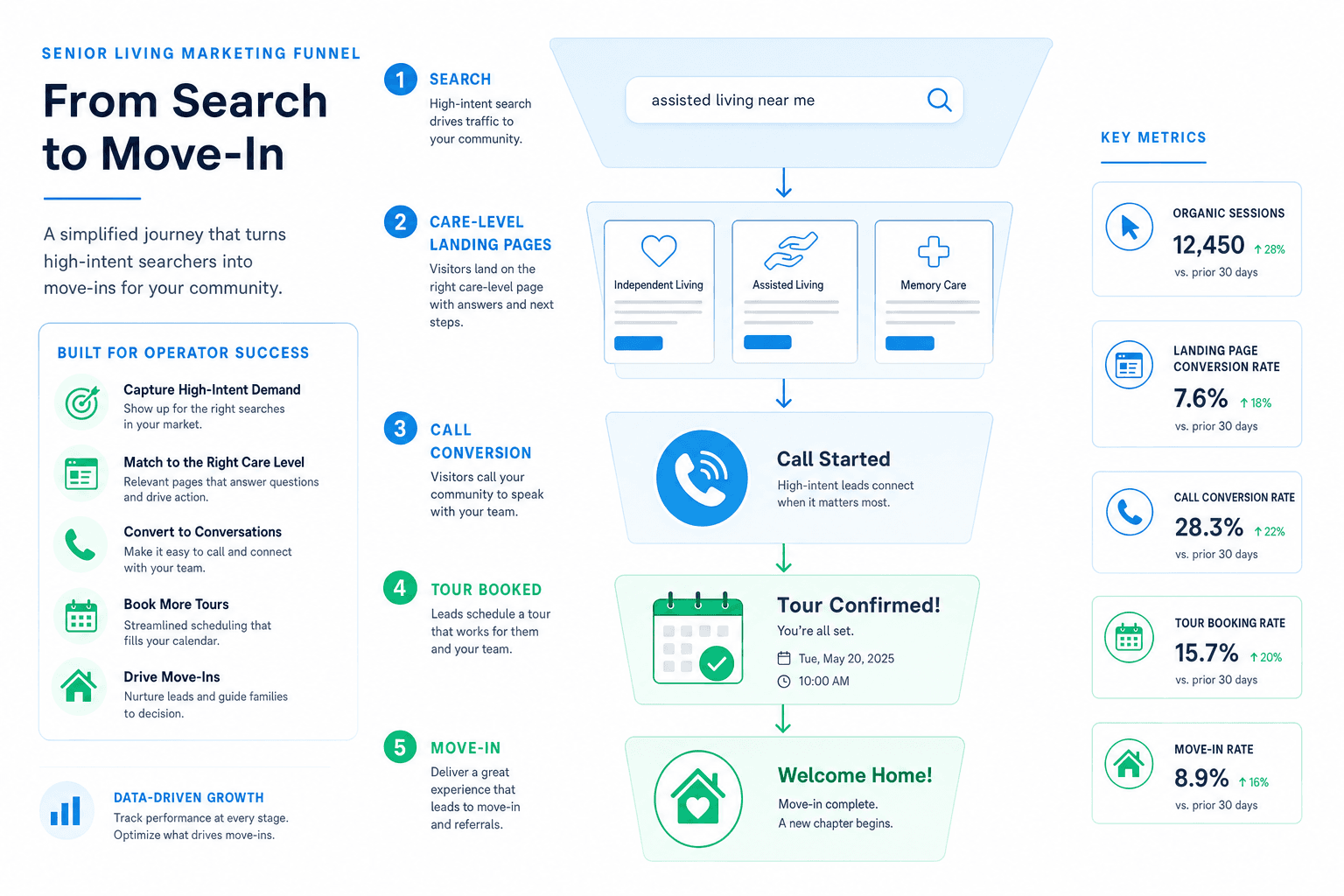
The opportunity is in the gap between how families actually search and how most communities have built their marketing. Organic search can deliver a cost per move-in that is a small fraction of what a referral agency costs once its fee is included. The families searching 'assisted living near me' and 'memory care [city name]' right now are your highest-intent buyers. They are already in the market. The question is whether they find you or find a referral aggregator that sells your lead back to you at a markup.
The same gap exists in referral relationships. A hospital discharge planner who trusts your community and has your direct number can send you a qualified, crisis-ready family with zero referral fee. That channel is almost entirely unworked by most communities because it requires a liaison, a fast-response protocol, and consistent relationship maintenance. The communities that build it own a pipeline no aggregator can touch.
Speed-to-response is the single most underexploited lever in this category. Next-day callbacks are common, and the odds of reaching and converting a family fall off sharply after the first few minutes. A community with a system that calls back a web inquiry within five minutes is not competing on the same terms as one that responds the next morning. That gap is closable with the right tools and process, and it compounds directly into tour rate and move-in rate.
What Most Get Wrong
What Most Assisted Living Communities Get Wrong With Their Marketing
Sending all paid search traffic to the homepage
A family searching 'memory care near me' lands on a page that talks about your community in general terms. They do not see memory care pricing, memory care staffing ratios, or a memory care tour booking option. They leave. The click cost you real money and produced nothing. Care-level-specific landing pages for assisted living, memory care, and respite are not optional. They are the difference between a page that books tours and one that burns clicks.
Treating A Place for Mom and Caring.com as a primary strategy
Referral aggregators dominate generic search terms by outspending every individual community on SEO and SEM, then sharing the same lead with several communities at once. You pay a fee that often runs close to a month's rent per move-in for a lead you competed for against your direct neighbors. That fee structure is not a partnership. It is a tax on communities that have not built their own pipeline. Agencies belong in a census-gap role, not a primary channel.
Ignoring Google Business Profile as a conversion asset
Map-pack placement for 'assisted living [city]' is driven by review count, review recency, photo quality, and response rate. A community with a slightly lower rating but many more recent reviews often outranks one with a near-perfect rating and a handful of reviews. Most communities treat their GBP as a set-it-and-forget-it listing. The ones treating it as a managed conversion asset are capturing the map-pack clicks their competitors are paying referral agencies to recover.
Calling leads back the next morning
A family that submitted a web inquiry at 9 p.m. after a difficult conversation about their parent is in an acute decision state. If you call them back at 10 a.m. the next day, three other communities have already spoken with them. The odds of converting fall off sharply after the first few minutes. The communities with same-hour response protocols are booking tours at rates that look like outliers but are simply the result of taking speed seriously.
Running one ad creative across assisted living, memory care, and respite
The family considering memory care is in a fundamentally different emotional and financial place than a family researching respite for a summer break. Memory care families are often post-diagnosis, managing a parent with Alzheimer's or another dementia, and the urgency and fear in their search is different from a respite inquiry. Serving them the same ad and landing page is a signal that you do not understand their situation. Separate campaigns, separate pages, and separate nurture sequences for each care level are how you earn trust before the first phone call.
Why Now
Why the Next 12 Months Are the Window to Build a Durable Pipeline
Most assisted living communities are still running marketing the same way they did five years ago: a modest paid search budget, a homepage that tries to cover every care level at once, and a referral agency relationship that quietly consumes a month of rent per move-in. The operators who are ahead right now are not spending more. They are spending more precisely, with better tracking and faster follow-up, and they are building owned-channel pipelines that compound over time.
AI gives a disciplined operator a real edge in this environment. Not in a vague productivity sense, but in specific, measurable ways. You can test three times as many ad angles per month, so you find the message that books tours faster. You can build care-level landing pages that are continuously reviewed for conversion leaks rather than sitting static for a year. You can set up automated nurture sequences for the families who are three to nine months out, so when their crisis moment arrives, your community is the one they already trust.
The timing factor in your category is the January inquiry spike. Families who visited parents over Thanksgiving and Christmas and saw decline for the first time flood local search in early January. That window is predictable, it is high-intent, and most communities are not prepared for it with the right campaigns, the right landing pages, or the right follow-up speed. A community that enters January with its tracking clean, its care-level pages live, its Google Business Profile managed, and its response protocol set is not competing against the same field as one that is still running a generic homepage campaign.
The Mechanism
Where AI Creates a Real Edge for Assisted Living Marketing
Real productivity, not AI theater. Here's where it actually moves a number for assisted living communities.
Digital Ads
What AI does: AI-driven bid management watches performance signals in real time and shifts budget toward the campaigns and care-level terms that are actually booking tours, not just generating clicks. During the January post-holiday inquiry spike, budget can be weighted automatically toward high-intent memory care and assisted living terms across your market area without manual intervention.
The result: More of your ad spend lands on the queries that convert to tours rather than informational clicks that never call.
Why it matters here: In a category where a single move-in is worth six figures in resident revenue, the gap between a lean and a bloated cost per move-in is not a rounding error. It is the difference between a sustainable owned channel and one that costs more than the referral agency you are trying to replace.
Analytics and Attribution
What AI does: AI-assisted attribution maps every tour booking back to the specific ad, keyword, or organic source that generated it, including phone calls. Most communities cannot answer which campaign booked last month's tours because call tracking is absent or broken. Fixing that gives you a real number to optimize against: cost per booked tour and cost per move-in by channel.
The result: You stop guessing which marketing dollars are working and start making decisions based on actual tour and move-in data.
Why it matters here: If you cannot separate the cost per move-in from organic search versus paid search versus referral agencies, you cannot make the case internally to shift budget away from agencies toward owned channels. Clean attribution is the foundation of that argument.
Conversion Optimization
What AI does: AI reviews your care-level landing pages continuously for conversion leaks: form fields that create friction, page speed issues that cause mobile drop-off, call-to-action placement that buries the tour booking option. It also informs the post-submission experience, triggering an immediate callback sequence so the five-minute response window is met consistently rather than depending on staff availability.
The result: Higher landing page conversion rates and faster lead response, which are the two highest-impact variables in your tour booking rate.
Why it matters here: A large share of assisted living tours start with a phone call. A landing page that does not make calling the obvious, friction-free next step is leaving much of its potential on the table. Page structure and response speed are not design preferences. They are conversion mechanics.
Creative
What AI does: AI enables testing of significantly more ad creative variations per month than a manual process allows: different headlines emphasizing safety versus socialization versus caregiver relief, different images reflecting the adult child's perspective versus the resident's experience, different calls to action for crisis-ready families versus those still in early research. Each test produces data on what resonates with families at different stages of the decision.
The result: Faster identification of the messages that book tours, and creative that speaks to the specific emotional state of a memory care family differently than an assisted living family.
Why it matters here: The family searching at midnight after a parent's ER discharge is not in the same state as the family that started researching three months ago after a dementia diagnosis. Generic creative that tries to serve both fails both. Testing at volume finds the right message for each segment faster than any manual approach.
Email and Nurture Automation
What AI does: AI-built nurture sequences segment inquiries by care level and urgency, then deliver a timed sequence of care guides, cost transparency content, staff spotlights, and family testimonials calibrated to where a family is in their decision. A family that is six months out gets a different cadence than one that just submitted a form after a hospitalization.
The result: Families who are not ready to move in this month stay connected to your community through a trust-building sequence, so when their crisis moment arrives, you are the first call.
Why it matters here: Some families move in within weeks, but many deliberate for months before a crisis compresses the timeline. A community with no nurture program for long-cycle prospects is invisible to those families at the moment they become ready to act.
Ready to see what this looks like for your assisted living communities business?
No obligation. A senior strategist will show you exactly where the wins are.
The Strategy
What a Purpose-Built Assisted Living Marketing Strategy Actually Looks Like
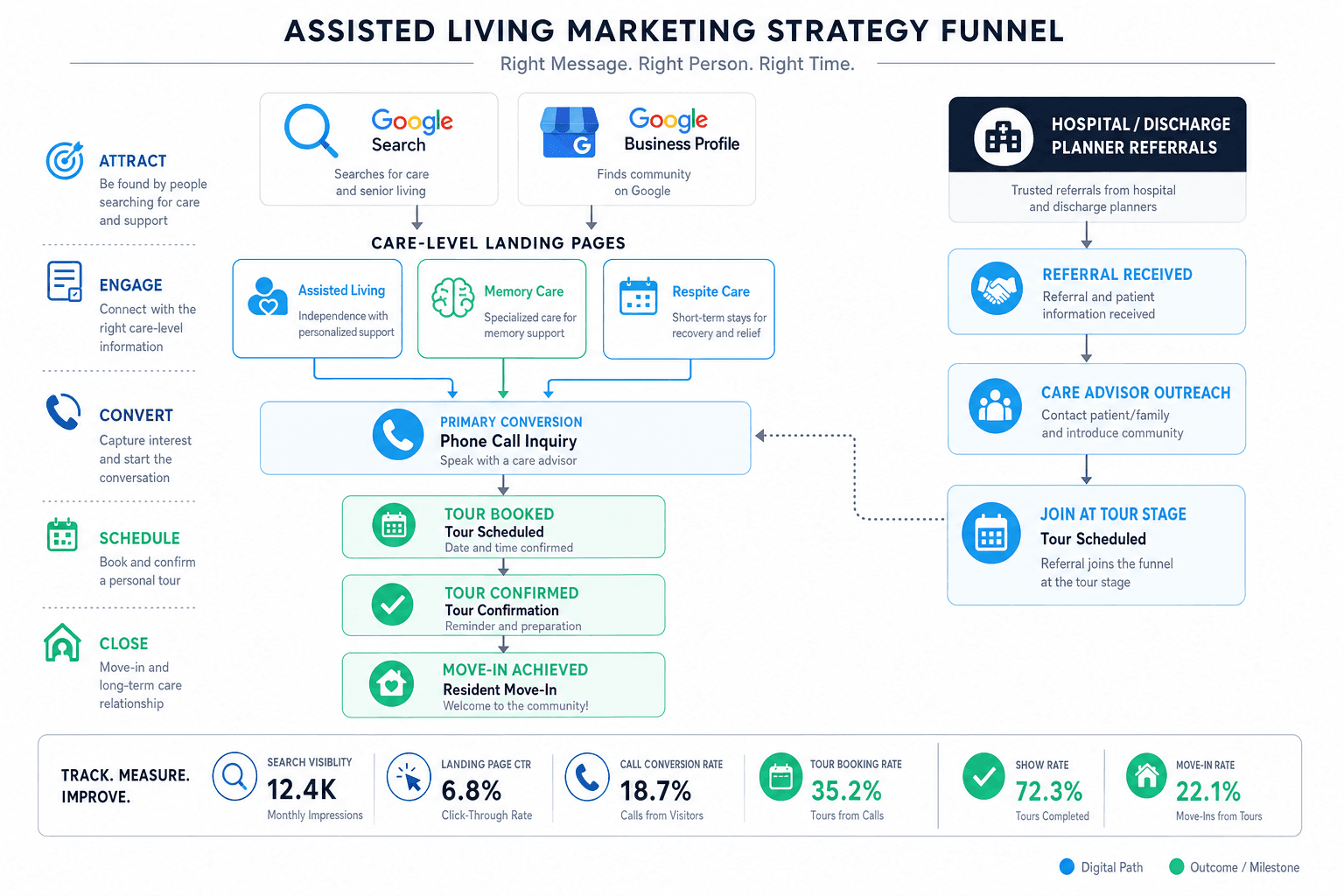
The governing principle is simple: every dollar of marketing spend should be traceable to a tour, and every tour should be traceable to a move-in. If you cannot draw that line, you are optimizing guesses. The strategy starts with getting that tracking infrastructure right before spending another dollar on acquisition.
Google Search is the primary acquisition channel for crisis-ready families. The money terms are 'assisted living [city],' 'memory care near me,' 'assisted living cost [city],' and branded terms for your community. Each care level gets its own campaign and its own landing page. Assisted living inquiries and memory care inquiries are not the same buyer with the same urgency and the same monthly budget, and they should never land on the same page. Every campaign gets call tracking so you know which keywords are booking tours, not just generating form fills.
Google Business Profile is treated as a managed conversion asset, not a listing. Review acquisition, photo updates, Q&A responses, and post frequency are on a maintenance schedule. Map-pack placement for local queries is the highest-volume, lowest-cost impression available to any assisted living community, and most communities are not working it.
Retargeting on Google Display and Meta, set up within each platform's housing and health-ad targeting rules, keeps your community visible to families who visited your site but did not convert. Memory care retargeting uses different creative than assisted living retargeting because the families are in different emotional and financial situations. Respite care gets its own retargeting segment because a respite inquiry is a proven trial-to-permanent-move-in funnel that most communities treat as a low-priority side channel.
Email nurture handles the 3-to-12-month prospect segment. A six-touch sequence of care guides, transparent cost content, staff introductions, and family testimonials keeps the community present without being intrusive. When a crisis event accelerates the family's timeline, your community is the one they already know.
The hospital and discharge planner referral program runs parallel to digital. A dedicated liaison, a same-day callback SLA for discharge referrals, and printed leave-behinds for physician offices create a zero-referral-fee pipeline that no aggregator can replicate. This channel is almost entirely unworked by most communities and represents the highest-quality leads available.
The one number that governs this
Governing KPIs: cost per booked tour, tour-to-move-in rate, and cost per move-in by channel. Every campaign decision is made against these numbers, not impressions, clicks, or form fills.
How We Help
How Sagum Executes This for Your Community
We start where the money is leaking: tracking. Before we touch a single campaign, we verify that every phone call, form submission, and tour booking is attributed to the source that generated it. From there, we build the strategy in the order that moves your census number, not in the order that looks impressive on a slide.
Attribution and Call Tracking Setup
Every tour must be traceable to a channel before you can optimize spend. We install call tracking, verify form attribution, and build a reporting dashboard that shows cost per tour and cost per move-in by source, including the true cost of referral agency placements.
Google Search Campaigns by Care Level
Separate campaigns for assisted living, memory care, and respite, each with its own keyword set, bid strategy, and landing page. We protect your branded terms and build non-branded campaigns around the high-intent local queries that crisis-ready families are using right now.
Care-Level Landing Pages with Tour Booking
Purpose-built pages for assisted living, memory care, and respite that address the specific buyer at each care level: their emotional state, their cost questions, their safety concerns, and a clear, friction-free path to booking a tour or calling directly. Pages are built to load fast on mobile, where most searches originate.
Google Business Profile Management
Ongoing management of your GBP as a conversion asset: review acquisition strategy, photo maintenance, Q&A responses, and post cadence designed to improve map-pack placement for the local queries that generate your highest-intent traffic.
Retargeting on Google Display and Meta
Segmented retargeting campaigns, built within Google and Meta housing and health-ad rules, that keep your community visible to families who visited but did not convert. Memory care, assisted living, and respite audiences receive separate creative sequences calibrated to their care-level context.
Email Nurture Sequences for Long-Cycle Prospects
AI-assisted nurture sequences segmented by care level and inquiry urgency. Care guides, cost transparency content, staff spotlights, and family testimonials delivered on a schedule that builds trust over a 3-to-12-month window without being intrusive.
Discharge Planner and Referral Program Development
Strategy and materials for building a hospital and physician referral channel: liaison outreach framework, same-day callback SLA design, and leave-behind content that positions your community as the trusted, fast-response option for discharge planners in your market.
Who's Behind This
Who we are, and what makes us different
Sagum is a performance marketing agency founded in January 2017 in St. George, Utah. We've spent 8+ years growing real brands and being judged on KPIs, not vanity metrics.
We deliberately limit how many clients we take so each one gets senior attention. We treat your numbers like our own, we never run generic playbooks, and your strategy is built for your business, because shouldn't your brand's marketing be custom to your brand?
Sagum.ai is our AI arm: the same proven operators now build AI into the work wherever it creates real edge, not as theater, but as leverage applied with discipline.
- 8+ years growing brands on performance KPIs, not vanity metrics
- Limited client roster, with senior attention on every account
- An extension of your team; your success is tied to ours
- Custom strategy per brand, never a generic playbook
- AI built in where it moves a number; judgment over hype
“Sagum is a performance marketing agency that's spent 8+ years growing brands by treating their numbers like our own. We take on few clients, never run generic playbooks, and now build AI into the work wherever it creates real edge, not hype. Your strategy is built for your business, and our success is tied to yours.”

“After six years, Sagum is our most important partner: trusted, communicative, and caring about our business as if it's their own.”
Proof
From a $20 CPL goal to $13 CPL and 300+ leads/mo
Rizzoli's Automotive
Challenge
Rizzoli's Automotive set a goal of 100 qualified leads per month at roughly $20 cost per lead.
What we did
Sagum rebuilt their paid search around high-intent service queries and launched a purpose-built, call-driving landing page.
Result
Cost per lead dropped to $13 against a $20 target, lead volume grew to 300 or more per month, and landing page conversion exceeded 60%. The client opened multiple new locations on the back of that lead volume. The same conversion-focused approach applies directly to assisted living communities working to reduce cost per tour and cost per move-in.

- Cost per lead
- $13
- Leads / month
- 300+
- Landing-page conversion
- 60%+
Find Out What Your Census Pipeline Actually Costs You Per Move-In
No obligation. We will look at your current channel mix, referral agency dependency, and tracking setup and tell you exactly where the gaps are. The analysis is built around your community, your care levels, and your census goals.
Sagum · January 2017 · St. George, Utah · 8+ years