

8+ years growing brands on KPIs, now with AI
Audio brands: win the buyer before the giants do
Your edge is brand and community, and we convert high-intent listeners before they default to a cheaper marketplace brand.
Google Ads · Meta · TikTok Partner | 8+ Years Growing DTC Brands | Blended ROAS-Obsessed



Get your free Growth Gap Analysis
Senior strategist review · response within one business day
Prefer to reach out directly?
The Challenge
Audio Brands Fight Two Wars: Premium Giants and Budget Challengers
Apple, Sony, and Bose have shelf deals, ecosystem lock-in (AirPods pair to iPhones in three seconds), and budgets that dwarf your annual revenue. Challengers like Anker/Soundcore, Moondrop, and FiiO undercut your Amazon price by $40 and hit 4,000 reviews before you get 50.
Your margin lives on DTC: 40–55% gross versus 25–35% after Amazon's cut. Buyers pick your site over Amazon only once they know your name, trust your sound signature, and believe you're worth the premium. That's a brand and measurement problem before an ads problem.
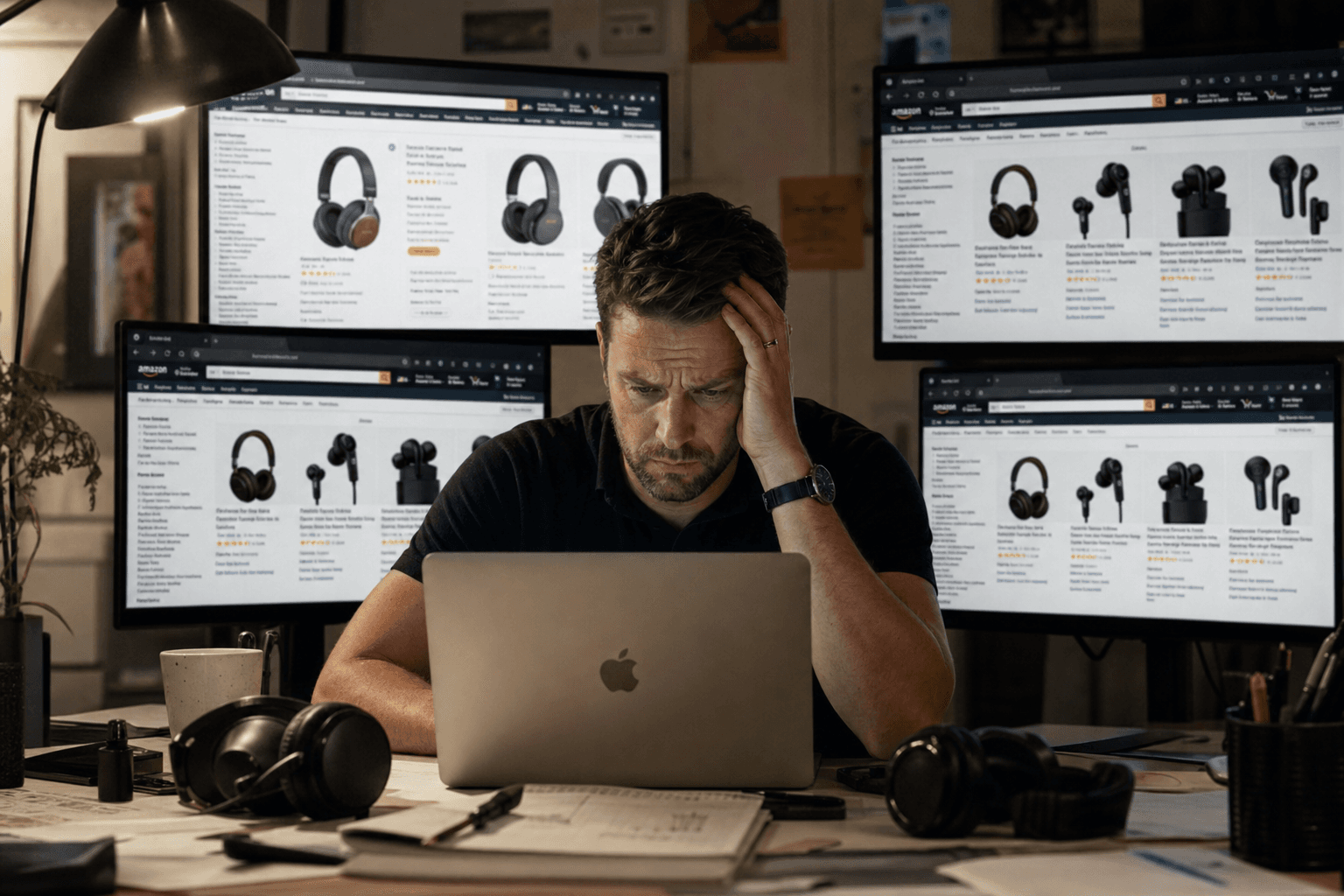
A buyer sees you on Z Reviews, Googles you three days later, reads Head-Fi for two weeks, and buys from a Meta retargeting ad. The last click gets credit, so you defund the channels that built intent (YouTube seeding, community, Meta prospecting) and overfund whatever sat at checkout.
A $200 over-ear takes 2–4 weeks of research; a $600 planar can take three months. Your buyer has watched six comparison videos before considering an ad, so creative built for a 48-hour consideration cycle fails.
The Opportunity
Mid-Range Is Audio's Center of Gravity, and Most Challengers Capture It Poorly
Mid-range ($150–$499), where you likely compete, held nearly 40% of the 2025 audio equipment market; its buyers want better than a $30 Amazon basic but not a $1,000 flagship.
Q4 is your biggest window: wireless headband headphones grew 28% year-over-year during Black Friday and Cyber Monday (BFCM) alone. Most audio brands stock late or pay peak CPMs instead of building audiences in cheaper pre-Q4 weeks.
Customers replace hero products every 18 to 36 months, but over-ear owners are natural buyers for a DAC/amp at six months, ear pads at eight, and a travel amp at twelve. An email and SMS upgrade path turns a $250 sale into $600+ LTV without more acquisition spend.
Spotify and Apple Music's lossless and spatial push gives millions of non-audiophiles an 'I need better gear' moment, sending them searching for what makes lossless sound better.
What Most Get Wrong
What Most Audio Brands, and Their Agencies, Get Wrong
Optimizing platform ROAS instead of blended ROAS
In a 2–4 week deliberation cycle, defunding Meta at 'only 2.1× ROAS' kills retargeting pools and lookalikes that convert on Google two weeks later. Most brands don't track blended ROAS.
One creative strategy for $79 TWS earbuds and $600 planars
Entry-tier sells on lifestyle, mid-to-premium on drivers, frequency response, and soundstage. At $400, lifestyle ads earn low CTRs at high CPMs with buyers who've read every Head-Fi spec sheet.
Ignoring the October research window, then panic-spending in November
October buyers wish-list, read reviews, and wait for Black Friday four to six weeks out. Brands that ramp on November 1 pay peak CPMs for a list they never built.
Treating YouTube and community seeding as unattributed 'brand awareness'
YouTube reviews and Head-Fi and Reddit presence are primary purchase drivers for mid-to-premium audio. Without attribution, you underfund them and overfund last-click search, which closes the sale a review started.
Letting Amazon cannibalize DTC without a plan
59% of social media-driven purchases happen on Amazon, where Prime and trust win first visits. Without prior email capture (review seeding, landing page offers, sound-profile quizzes), you cede customer LTV.
Why Now
Audio Brands That Build Audiences and Attribution Before Peak Season Pull Ahead
Most audio challengers run one or two static ads, a purchase-optimized Meta campaign, a Google Shopping feed untouched in six months, and an email sequence that only sends a discount code. Their measurement is broken, and their strategy ignores a 3-week consideration cycle.
With AI, a small team can test five creative angles a week instead of one and learn within weeks what moves Head-Fi buyers, casual gifters, and lossless streaming converts. AI-assisted attribution shows what YouTube seeding and Reddit presence add to revenue, and you can pace spend automatically into peak-intent weeks.
Audio brands that build this infrastructure now will own the retargeting pools, email lists, and creative learnings. Latecomers will pay higher CPMs for smaller audiences with less-tested creative in the year's most competitive ad window.
The Mechanism
Where AI Creates a Real Edge for DTC Audio Brands
Real productivity, not AI theater. Here's where it actually moves a number for audio brands.
Creative
What AI does: Generate and test multiple angles per week (lifestyle UGC for entry-tier earbuds, technical credibility content for mid-range over-ears, audiophile community language for premium planar headphones) instead of letting static ads fatigue.
The result: You find each segment's converting message faster, CPMs fall as relevance scores improve, and your creative library compounds quarter over quarter.
Why it matters here: A $79 TWS earbud buyer responds to color options and portability; a $600 planar headphone buyer responds to driver architecture and what Z Reviews said.
Analytics
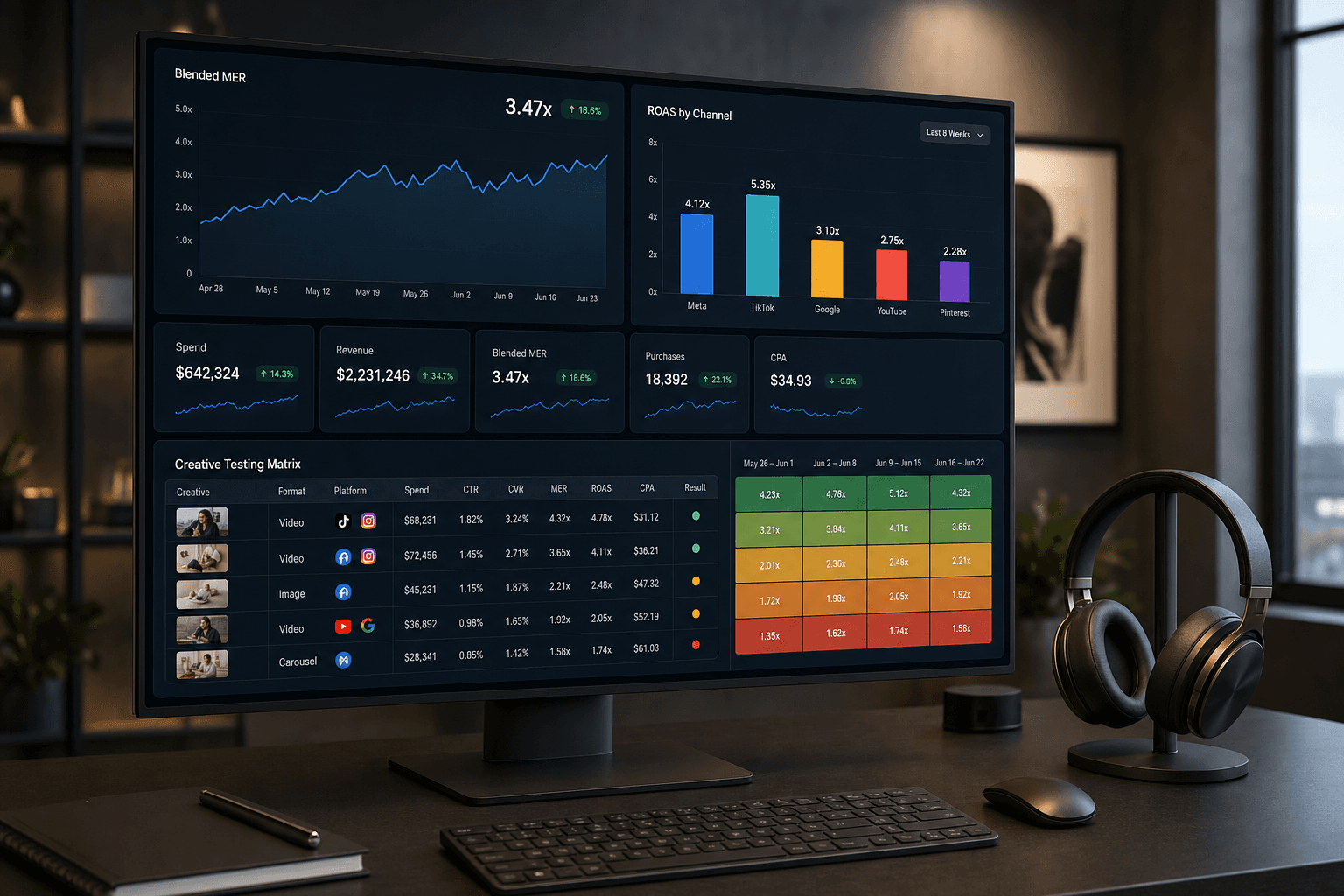
What AI does: Build a blended ROAS dashboard across Meta, Google, TikTok, and email that models how YouTube traffic, Reddit referrals, and organic search feed downstream conversion.
The result: You see which channels build purchase intent and which were only present at checkout, so you can fund the whole consideration journey.
Why it matters here: Judge channels on last click and you defund YouTube seeding, community presence, and Meta prospecting, the channels that create the intent Google Search closes.
Digital Ads
What AI does: AI-assisted pacing funds September list-building, October retargeting, BFCM conversions, and TWS earbuds at Back to School (July/August). It pulls back in January and defers conversion ads past October's pre-BFCM browse phase.
The result: Your ad dollars land in the weeks audio buyers are ready to purchase.
Why it matters here: Audio seasonality is among consumer electronics' most predictable, so pacing to it beats competitors spending flat monthly and paying peak CPMs before buyers are ready.
What AI does: Build AI-personalized post-purchase sequences on the upgrade path: accessories at 60 days (cables, cases), a DAC/amp at 6 months, ear pads at 8 months, firmware and feature updates, and competitor-launch campaigns.
The result: LTV climbs past the first purchase, you depend less on Amazon since you own the list, and the sequences run without manual work.
Why it matters here: Capture email at first purchase and run these sequences to own the customer; otherwise their next DAC comes from a competitor they found on Reddit.
Conversion Optimization
What AI does: Continuously test product page elements: spec presentation for audiophiles, Head-Fi and Reddit sentiment embedded beside standard reviews, return policy prominence for high-consideration purchases, and bundles for AOV expansion.
The result: More of the traffic you already pay for converts.
Why it matters here: A buyer 14 days into research wants specs, third-party validation, a return policy, and proof you're real; a lifestyle image alone loses them to Amazon.
Ready to see what this looks like for your audio brands business?
No obligation. A senior strategist will show you exactly where the wins are.
The Strategy
How DTC Audio Marketing Should Be Built
At a 45–50% DTC gross margin, you need blended ROAS of at least 3.5× to cover fulfillment, returns, and overhead. Premium brands at $500+ AOV with strong upgrade-path LTV can accept lower acquisition ROAS; entry-tier brands at $79–$149 ASP must run tighter.
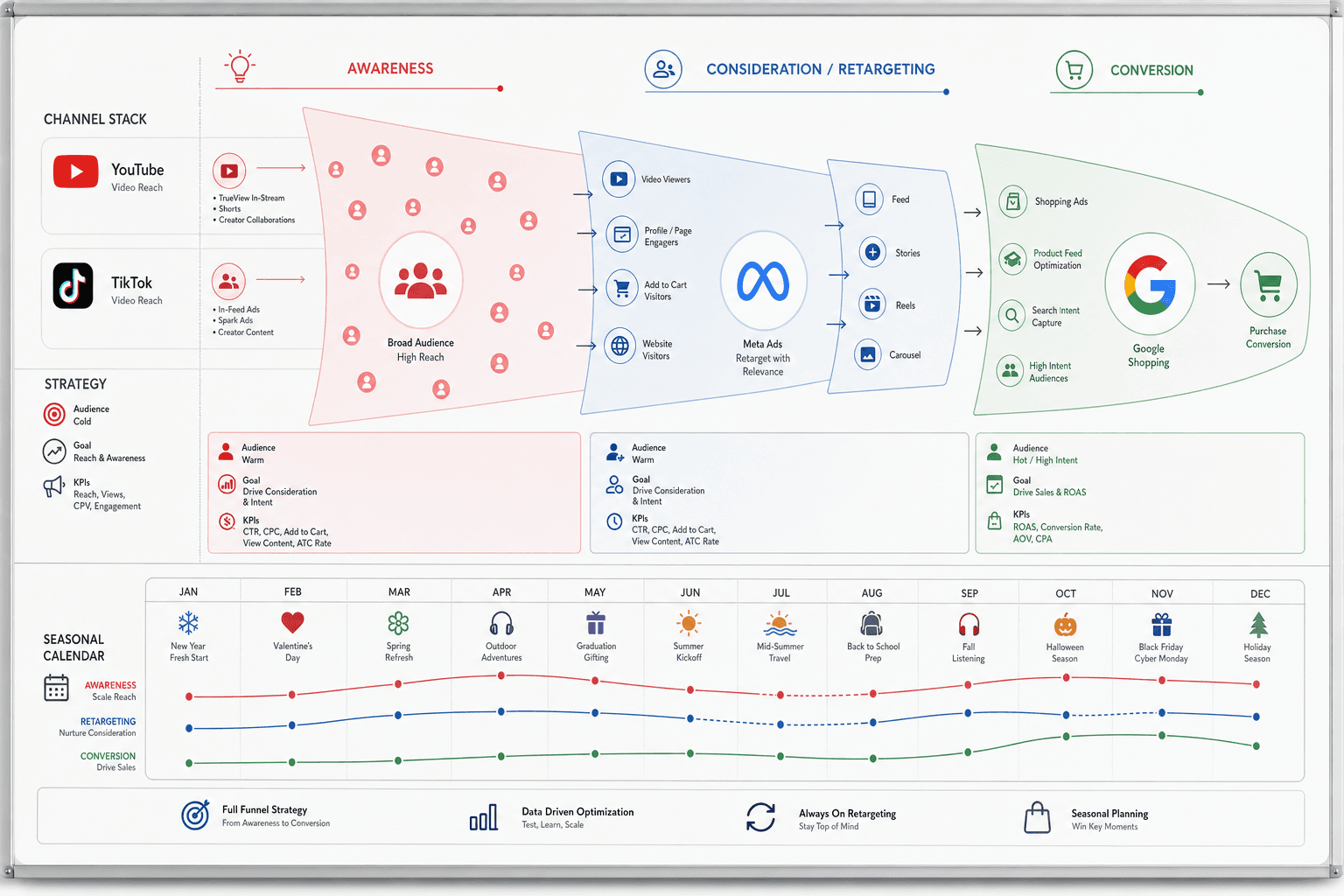
Google Shopping and Search are your highest-ROAS campaigns and budget floor; never underfund queries like 'best headphones under $300' or 'open-back headphones for home listening.'
Use Meta to reach lookalikes of your best customers and retarget the 2–4 week consideration window. TikTok ads for entry-tier and lifestyle SKUs feed retargeting pools.
September CPMs run below Q4, so audiences built then convert in November at a fraction of BFCM CPMs. October buyers wait for Black Friday, so build lists and retargeting pools that month. Stock hero SKUs by late September.
Back to School (July/August) is your second peak for TWS earbuds and portable speakers; pull back in January, electronics' lowest-ROAS month.
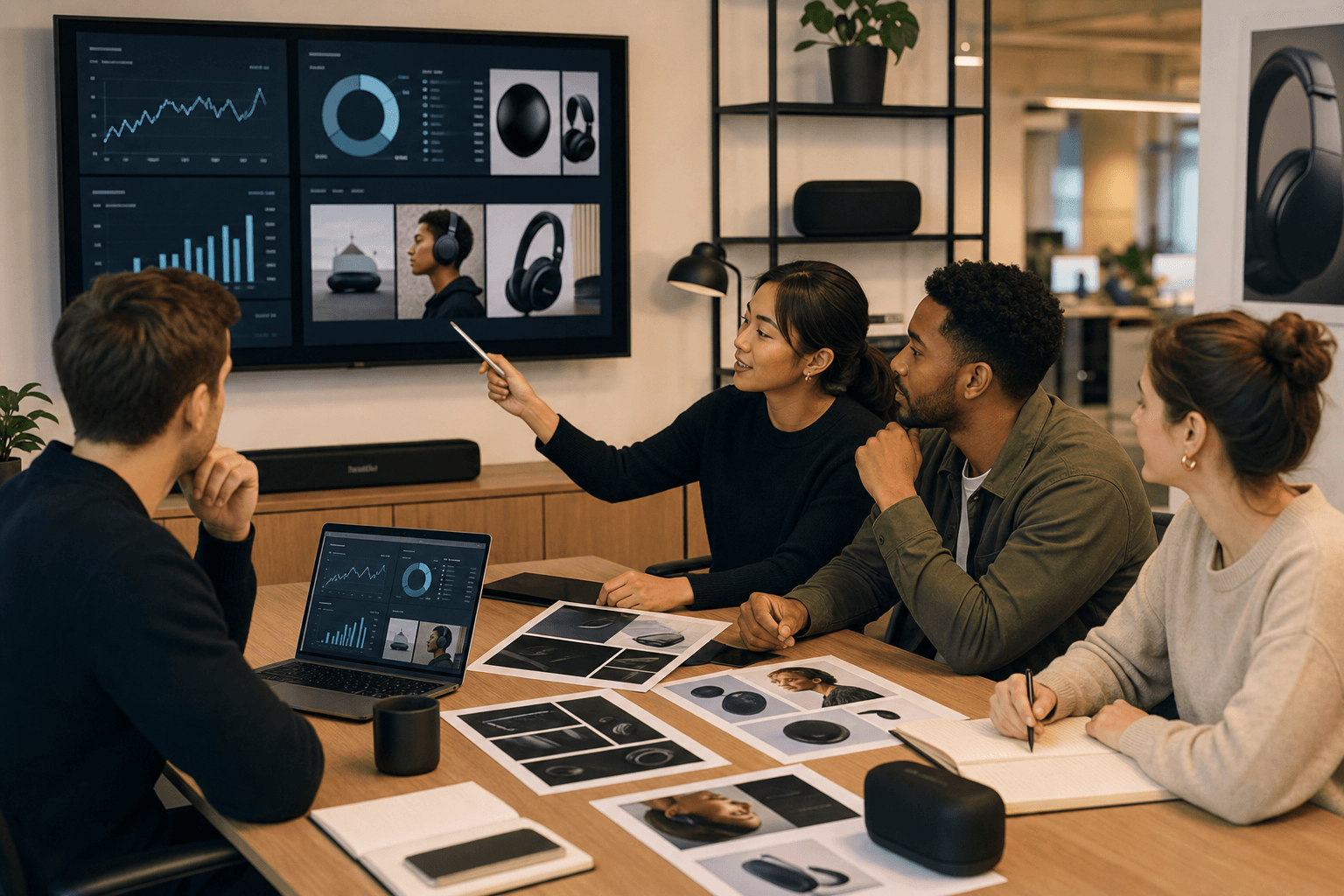
Split creative by tier: entry ($79–$149) gets short-form TikTok and Reels video, mid-range gets 'why not the Sony' comparison ads, and premium ($500+) gets forum language, longer-form video, and a prominent return policy with demo availability.
Fix attribution before scaling: a blended ROAS dashboard, incrementality tests on major channel decisions, and UTM discipline to trace the YouTube-to-Google-to-Meta path.
The one number that governs this
Blended ROAS (total revenue ÷ total ad spend) is your governing KPI. At 40–55% gross margins, its floor is 3.5–4.5×; treat platform-reported ROAS as directional.
How We Help
What We'd Do for Your Audio Brand
We take few clients; each gets senior attention, not a junior with templates. We plan around price tier, SKU mix, and seasonality, and tie our success to your blended ROAS.
Attribution & Blended ROAS Dashboard
Before we touch spend, we build a blended ROAS dashboard with UTM discipline across every channel.
Google Shopping & Search Campaign Management
We run Google on high-intent audio queries ('best open-back headphones under $300', brand plus model, competitor comparisons), judging every dollar by blended ROAS contribution.
Meta Paid Social: Prospecting & Retargeting
We run Meta prospecting with UGC-style creative to lookalikes of your highest-LTV customers and retarget the consideration window with technical credibility and review-based social proof.
TikTok Ads (Entry-Tier & Lifestyle SKUs)
For colorful TWS earbuds and portable speakers, we test TikTok creative and audiences; unboxing and reaction videos feed Meta retargeting and Google branded search.
Creative Strategy & Testing
We test multiple angles a week per price tier and find each segment's winner faster than a competitor running one ad for three months.
Email & SMS Automation
We automate the email and SMS upgrade path so you keep the customer relationship Amazon would otherwise take.
Conversion Optimization
We keep testing product pages so they match the research depth of a buyer who spent two weeks on Head-Fi.
Seasonal Budget Pacing
We pace budget to the audio calendar so you stop paying peak CPMs for buyers who aren't ready and convert audiences built at low CPMs.
Who's Behind This
Who we are, and what makes us different
Sagum is a performance marketing agency founded in January 2017 in St. George, Utah. We've spent 8+ years growing real brands and being judged on KPIs, not vanity metrics.
We deliberately limit how many clients we take so each one gets senior attention. We treat your numbers like our own, we never run generic playbooks, and your strategy is built for your business, because shouldn't your brand's marketing be custom to your brand?
Sagum.ai is our AI arm: the same proven operators now build AI into the work wherever it creates real edge, not as theater, but as leverage applied with discipline.
- 8+ years growing brands on performance KPIs, not vanity metrics
- Limited client roster, with senior attention on every account
- An extension of your team; your success is tied to ours
- Custom strategy per brand, never a generic playbook
- AI built in where it moves a number; judgment over hype
“Sagum is a performance marketing agency that's spent 8+ years growing brands by treating their numbers like our own. We take on few clients, never run generic playbooks, and now build AI into the work wherever it creates real edge, not hype. Your strategy is built for your business, and our success is tied to yours.”
“Sagum roughly doubled our bottom line. They treat the work like it's their own business.”
Rachel Nilsson
CEO, RAGS
Proof
Global ROAS from 2.32:1 to nearly 6:1, +40% YoY
Everyman
Challenge
Everyman, a menswear brand, needed to increase global ROAS, grow sales revenue, and successfully launch product line expansions.
What we did
Sagum ran Facebook and Google paid media tuned to ROAS targets, scaled an email program, and layered in affiliate campaigns and strategic product launches.
Result
Global ROAS rose from 2.32:1 in 2019 to nearly 6:1 in Q4 2020, with 40% YoY growth from 2020 to 2021 alongside successful product line launches. That approach transfers to audio brands fighting for margin.

- Global ROAS
- 2.32:1 → ~6:1
- YoY growth
- +40%
- Product lines
- Successfully launched
Audio Buyers Are Researching Now. Let's Make Sure They Find You First.
There's no obligation and no generic audit template: we'll bring a point of view on your price tier, channel mix, and the biggest measurement or creative gap we'd fix first.
Sagum · January 2017 · St. George, Utah · 8+ years