
8+ years growing brands on KPIs, now with AI
Are Your Bankruptcy Consults Becoming Retained Cases?
We build search and intake systems that turn garnishment-trigger searches into booked consultations your firm actually retains.
Google Ads Partner | Meta Partner | 8+ Years | Local Lead Gen Specialists



Get your free marketing audit
Senior strategist review · response within one business day
Prefer to reach out directly?
The Challenge
Marketing a Bankruptcy Firm Is Nothing Like Marketing a Law Firm That Sells Outcomes People Want
Your prospective client is not browsing. They opened a wage garnishment notice at 9 p.m., searched from the kitchen table, and they will hire one of the first firms that responds with a clear answer and a number they can afford. That is your entire acquisition window.
The emotional state they arrive in matters as much as the search term they used. Fear of losing the house or the car, shame about financial failure, distrust of anyone who might judge them. They have often already tried debt settlement, paid months of fees to a debt relief company, and discovered too late that it could not stop the garnishment or the foreclosure. They are burned, skeptical, and running out of time.
Chapter 7 and Chapter 13 are completely different products with different buyers, different fees, different cash-flow realities, and different search intent. A Chapter 7 prospect is in emergency mode, searching 'stop wage garnishment today' at 10 p.m. A Chapter 13 prospect is earlier in their research cycle, comparing options, and deliberating over weeks. One landing page cannot serve both, and one ad campaign cannot reach both profitably.
Layer on top of this: federal law requires your advertising to identify your firm as a debt relief agency under 11 U.S.C. 528, state bar rules govern what you can promise, and your fee collection model creates real cash-flow risk. For Chapter 7, a pre-filing fee left unpaid at filing is generally discharged, so most firms collect up front or use a bifurcated fee agreement where their court allows it. For Chapter 13, you may earn fees over a three-to-five-year plan. Most marketing agencies have never thought about any of this.

The Opportunity
Consumer Bankruptcy Filings Are Rising. Most Firms Are Still Marketing Like It Is 2018.
Total non-business bankruptcy filings rose 11.2% in the twelve months ending December 2025 and 11.9% in the twelve months ending March 2026. Consumer Chapter 7 filings alone increased 15% in 2025. This is structural demand growth, not a one-year blip driven by a single economic event.
The prospects filing today are not casual researchers. They have a garnishment notice, a foreclosure sale date, or a repossession letter in hand. High-intent search terms like 'stop wage garnishment,' 'stop foreclosure bankruptcy,' and 'Chapter 7 cost [city]' are generating real volume right now in your market, and most of that volume is being captured sloppily or not at all.
The firms winning this market are not the ones with the lowest advertised fee. They are the ones that show up first on high-intent searches, answer fast, pre-screen efficiently, and convert consultations to signed retainers at a rate that makes their ad spend profitable. Practices whose landing pages convert well generate a steady flow of qualified monthly leads from a modest local ad budget. That math works at Chapter 7 flat fees of $1,500 to $2,500, and it works very well at Chapter 13 fees of $3,000 to $6,000.
Tax refund season, specifically February through April, is the single most underexploited window in bankruptcy marketing. Many Chapter 7 prospects cannot afford the pre-filing attorney fee until their refund arrives. Firms that increase budget in February and run fee-transparency messaging during refund season capture a surge of prospects who have been ready to file for months and finally have the cash to do it.
What Most Get Wrong
What Most Bankruptcy Firms and Their Marketing Agencies Get Wrong
Running one campaign for both Chapter 7 and Chapter 13
Chapter 7 searches are urgency-driven. Chapter 13 searches are research-driven. A single landing page and a single ad group cannot serve both. You end up with a generic message that converts neither buyer well, and your cost per retained case climbs because your consultation-to-retention rate suffers.
Ignoring after-hours intent volume
Bankruptcy searches cluster in the evening, after work. If your intake process requires a prospect to call during business hours and wait for a callback the next morning, you are losing a large share of your high-intent traffic to whichever firm texts back within 90 seconds. A text-first protocol that replies within 90 seconds of lead receipt, with a three-touch reminder cadence over 48 hours, closes much of that gap.
Competing upstream against debt settlement companies on the wrong terms
Debt relief companies intercept your prospects earlier in the funnel with promises of settling debt without court involvement. Generic messaging about bankruptcy does not counter this. What does: direct, factual language explaining that debt settlement carries no automatic stay to halt a garnishment, a lawsuit, or a foreclosure sale, and that the months of payments a prospect made to a settlement company could have funded their filing.
Flat ad spend regardless of season
November and early December are low-intent months. Prospects delay filing to avoid disrupting the holidays. February through April, when tax refunds arrive and January's suppressed demand releases, is your highest-ROI window. Firms running the same monthly budget year-round overspend in slow months and underspend during the surge.
No tracking from ad click to retained case
Most firms can tell you their cost per lead. Almost none can tell you their cost per retained case by chapter type, by campaign, or by keyword. Without that data, you cannot cut the campaigns that generate consultations that never convert, and you cannot scale the ones that produce retained clients at a profitable cost.
Why Now
Why the Next Six Months Are the Right Time to Build This the Right Way
Filing volume keeps rising year over year. The macro environment, rising consumer delinquencies, higher credit card balances, and more households facing collection judgments that lead to wage garnishment, is pushing more qualified prospects into search right now. The firms that build the right intake and advertising infrastructure during this growth period will compound that advantage as volume increases.
Most of your local competitors are still running set-and-forget Google campaigns with a single landing page, no call tracking, and no ability to tell which keywords are producing retained cases versus consultations that go nowhere. The bar is low. A firm that invests in chapter-specific campaigns, a fast text-first intake, and conversion tracking from click to signed retainer will outperform the market significantly, not because the tactics are exotic, but because almost nobody in this vertical is executing the basics at a high level.
AI now makes it practical to test ad creative and landing-page copy at a pace that was not possible two years ago. Instead of running one version of your 'stop garnishment' ad for six months, a disciplined operator can test five to eight message angles in the same period, find what converts in your specific market, and shift budget accordingly. That kind of iteration speed is a real competitive advantage when your competitors are running the same ad they set up in 2022.
Tax refund season arrives every February in most markets. Prospects who have been ready to file since fall but could not afford the Chapter 7 pre-filing fee finally have cash. The firms with campaigns built and optimized before refund checks arrive will capture that surge. The firms scrambling to set up campaigns in March will pay higher CPCs and miss the first wave.
The Mechanism
Where AI Creates a Real Advantage for Bankruptcy Firms
Real productivity, not AI theater. Here's where it actually moves a number for bankruptcy attorneys.
Digital Ads
What AI does: AI-assisted budget pacing and bid management that shifts spend toward high-intent chapter-specific campaigns during peak windows, including the February-to-April refund surge and the post-holiday January spike, and pulls back during the November trough when intent volume drops.
The result: Ad spend follows actual demand patterns instead of a flat monthly budget, which means lower average cost per consultation during high-volume periods and less wasted spend during slow ones.
Why it matters here: Bankruptcy demand is not linear. It spikes when garnishment notices go out, when foreclosure sale dates are set, and when tax refunds arrive. A campaign that cannot respond to those patterns in near-real time is leaving qualified prospects to competitors who can.
Creative
What AI does: Rapid generation and testing of ad copy angles across chapter-specific campaigns, including urgency-based messaging for Chapter 7 garnishment and foreclosure intent, and comparison-based messaging for Chapter 13 prospects still evaluating debt settlement versus bankruptcy.
The result: Instead of running one ad version for months, you identify the message that books consultations in your specific market within weeks, not quarters.
Why it matters here: The emotional register that converts a prospect searching 'stop wage garnishment tonight' is completely different from the one that converts someone comparing 'debt consolidation vs Chapter 13.' Generic creative loses both. Chapter-specific, trigger-specific creative wins.
Conversion Optimization
What AI does: AI-assisted landing page review and iteration for chapter-specific pages, testing elements including fee transparency presentation, flat-fee callouts, payment plan language, and the placement and wording of the free consultation form and call-to-action.
The result: Landing pages tuned to the specific objections of a Chapter 7 prospect in garnishment mode, including fee clarity, speed of filing, and keeping a car or home, convert at materially higher rates than a generic firm overview page.
Why it matters here: A landing page that converts well turns a modest local budget into a steady flow of qualified leads. The difference between 10% and 20% conversion at the same spend is roughly double the consultation volume with zero increase in ad budget.
Analytics
What AI does: Full-funnel attribution tracking from keyword and ad click through consultation booking, consultation attendance, and signed retainer, with reporting separated by chapter type so you know your cost per retained Chapter 7 case versus Chapter 13 case.
The result: You stop optimizing for cost per lead and start optimizing for cost per retained case, which is the number that actually determines whether your marketing spend is profitable.
Why it matters here: At a $1,500 Chapter 7 flat fee, a $600 cost per retained case leaves thin margin. At a $4,000 Chapter 13 fee, the same cost per retained case is highly profitable. Without attribution by chapter, you cannot make that distinction, and you cannot allocate budget rationally.

Ready to see what this looks like for your bankruptcy attorneys business?
No obligation. A senior strategist will show you exactly where the wins are.
The Strategy
What a Properly Built Bankruptcy Marketing Strategy Actually Looks Like
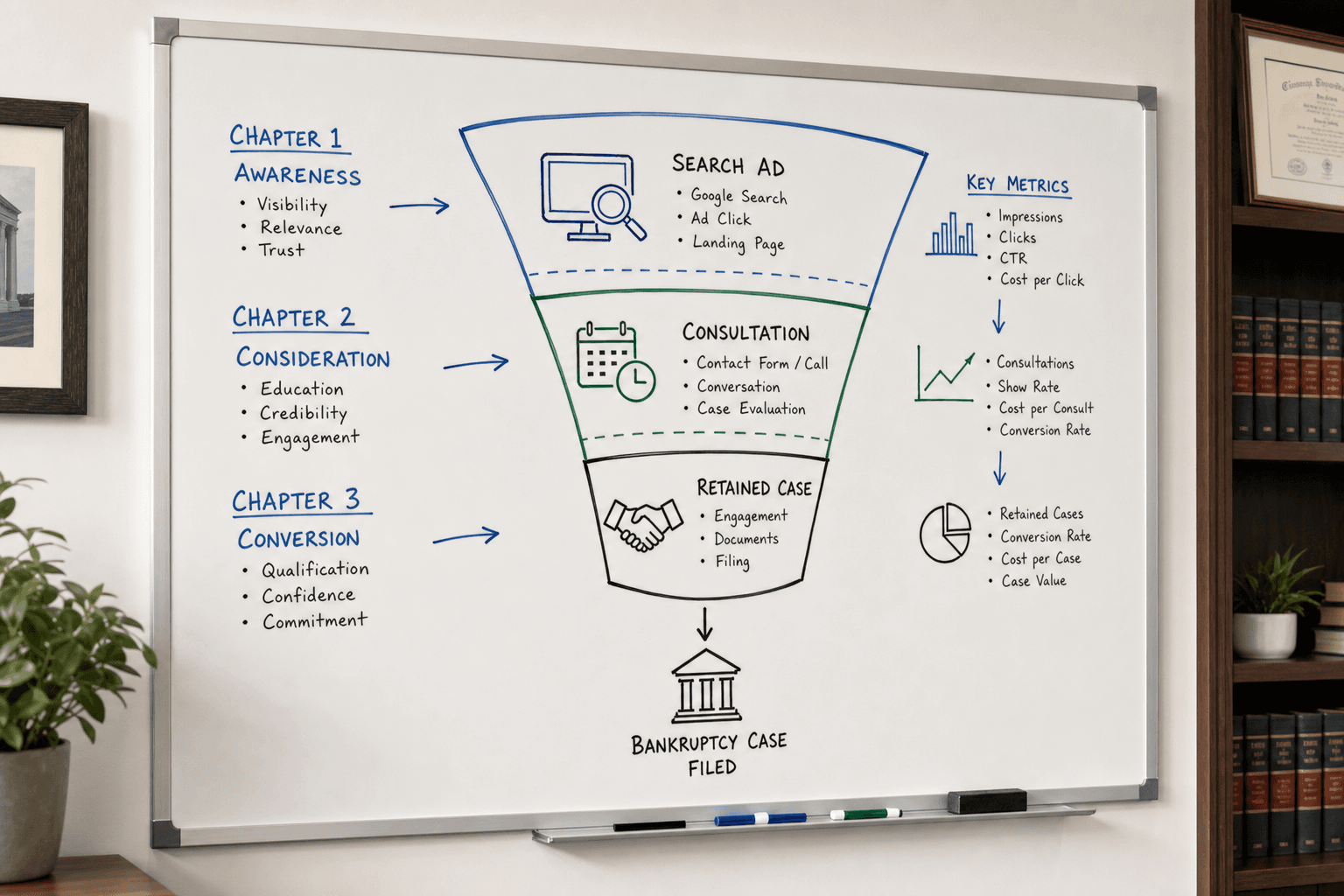
The foundation is Google Search, separated by chapter and by trigger. You need distinct campaigns for Chapter 7 high-intent terms, specifically 'stop wage garnishment,' 'stop foreclosure bankruptcy,' 'Chapter 7 cost [city],' and 'file bankruptcy fast,' and separate campaigns for Chapter 13 research terms, specifically 'Chapter 13 payment plan,' 'keep house bankruptcy,' and 'Chapter 13 vs debt consolidation.' These are different buyers at different stages. They need different ads and different landing pages.
Google Local Services Ads run alongside standard search campaigns. LSAs sit above standard PPC results and carry the Google Verified badge, which matters to a prospect who is already skeptical of anyone asking for money during a financial crisis. Building a solid base of Google reviews before LSA verification helps your ranking against competing firms, since rating and review count are LSA ranking factors.
Every landing page is chapter-specific and built around the buyer's actual question, not a firm overview. The Chapter 7 page answers: how fast can I stop the garnishment, what does it cost, can I keep my car, and what happens next. The Chapter 13 page answers: can I keep my house, how does the payment plan work, and what does it cost over time. Both pages include a clear flat-fee disclosure and the debt relief agency statement that 11 U.S.C. 528 requires.
Intake speed is treated as a conversion variable, not an operations afterthought. Leads that come in between 6 and 11 p.m., which is when many bankruptcy searches happen, receive a text response within 90 seconds and a three-touch follow-up cadence over 48 hours. Means-test pre-screening happens at the intake stage so the consultations your attorneys attend are with prospects who qualify and can pay.
Budget pacing follows the actual demand calendar. Spend increases in February through April to capture the tax refund surge. Spend holds or slightly reduces in November through mid-December when intent volume drops. Campaign performance is reviewed against cost per retained case by chapter type, not cost per lead, so budget flows toward the campaigns producing profitable retained clients.
The one number that governs this
The governing KPI is cost per retained case, separated by chapter type. Cost per consultation is the leading indicator. Cost per retained case is the number that determines whether the marketing is profitable.
How We Help
How We Build and Run This for Your Firm
We start with your numbers, not our assumptions. Before we write a single ad, we establish your current cost per consultation, your consultation-to-retention rate by chapter, and whether your tracking is accurate enough to trust. Many firms are optimizing against data that has attribution errors baked in. We fix that first, then build the campaigns on a foundation you can actually make decisions from.
Google Search Campaign Build and Management
Chapter-specific campaigns targeting high-intent garnishment, foreclosure, and filing-cost terms, with separate ad groups and landing pages for Chapter 7 and Chapter 13. Budget paced to the seasonal demand calendar, including the February-to-April refund surge.
Google Local Services Ads Setup and Optimization
LSA verification support, review-velocity planning to build a strong Google review base before verification, and ongoing bid management to maintain profitable position in your local market.
Chapter-Specific Landing Pages
Separate pages for Chapter 7 and Chapter 13 built around the buyer's actual questions, with flat-fee disclosure, 11 U.S.C. 528 debt relief agency language, free consultation form, and click-to-call optimized for after-hours mobile traffic.
Intake and Follow-Up Automation
Text-first lead response within 90 seconds, three-touch follow-up cadence over 48 hours, and means-test pre-screening questions built into the intake flow so your attorneys spend consultation time with qualified prospects.
Analytics and Attribution
Full-funnel tracking from keyword and ad click through booked consultation, attended consultation, and signed retainer, reported separately by chapter type. Call tracking on every campaign so you know which ads are ringing the phone.
Meta Retargeting
Empathy-first retargeting for site visitors who did not book, using fee transparency messaging and client review creative. Targeted to prospects in the pre-trigger research phase who have visited chapter-specific pages but have not yet converted.
Who's Behind This
Who we are, and what makes us different
Sagum is a performance marketing agency founded in January 2017 in St. George, Utah. We've spent 8+ years growing real brands and being judged on KPIs, not vanity metrics.
We deliberately limit how many clients we take so each one gets senior attention. We treat your numbers like our own, we never run generic playbooks, and your strategy is built for your business, because shouldn't your brand's marketing be custom to your brand?
Sagum.ai is our AI arm: the same proven operators now build AI into the work wherever it creates real edge, not as theater, but as leverage applied with discipline.
- 8+ years growing brands on performance KPIs, not vanity metrics
- Limited client roster, with senior attention on every account
- An extension of your team; your success is tied to ours
- Custom strategy per brand, never a generic playbook
- AI built in where it moves a number; judgment over hype
“Sagum is a performance marketing agency that's spent 8+ years growing brands by treating their numbers like our own. We take on few clients, never run generic playbooks, and now build AI into the work wherever it creates real edge, not hype. Your strategy is built for your business, and our success is tied to yours.”

“After six years, Sagum is our most important partner: trusted, communicative, and caring about our business as if it's their own.”
Proof
From a $20 CPL goal to $13 CPL and 300+ leads/mo
Rizzoli's Automotive
Challenge
Rizzoli's Automotive needed a steady flow of qualified local service leads at a cost that made their ad spend profitable. Their goal was 100 qualified leads per month at roughly $20 per lead.
What we did
We rebuilt the campaign around high-intent local search terms and built a purpose-specific landing page designed to drive phone calls from in-market buyers.
Result
Cost per lead dropped from a $20 target to $13 actual. Monthly lead volume grew to more than 300 leads. Landing page conversion exceeded 60%. The client opened multiple new locations on the back of that lead volume. The same principles, intent-specific campaigns and a landing page built around the buyer's real question, are how we would build your bankruptcy campaigns.

- Cost per lead
- $13
- Leads / month
- 300+
- Landing-page conversion
- 60%+
Find Out What Your Bankruptcy Marketing Should Actually Cost Per Retained Case
No obligation. We will review your current campaigns, your cost per consultation, and your intake process, and tell you exactly where the gaps are. If we are not the right fit, you will still walk away with a clearer picture of what is working and what is not.
Sagum · January 2017 · St. George, Utah · 8+ years