

8+ years growing brands on KPIs, now with AI
Bedding & bath brands need profitable customers
We chase profitable new customers, not just topline revenue, across paid media, creative, and retention.
Google Ads · Meta · TikTok Partner · 8+ years growing DTC brands



Get your free Growth Gap Analysis
Senior strategist review · response within one business day
Prefer to reach out directly?
The Challenge
Marketing a Bedding or Bath Brand Is Harder Than It Looks
Buyers can't feel the fabric, so a $200–$300 sheet set or bath bundle sells on photos, copy, and trust signals: certifications, UGC, sleep trials, return windows. That tactile gap costs you at checkout.
Bedding's 1.4–1.8% conversion rate, among ecommerce's lowest, reflects a high-consideration, semi-durable purchase, not bad marketing. A shopper who finds you on Instagram may Google you, see a retargeted ad, read three reviews, and search your name two weeks later. That 7–21-day window takes a multi-touch system.
DTC CAC rose 40–60% in the past two years. Surviving brands track per-order contribution margin, not just ROAS, and target 3:1 LTV/CAC with a 60–90-day payback. Recovering CAC in six orders instead of one or two is building on sand.
Amazon and Wayfair commoditize the mid-tier; Quince's manufacturer-direct model and Shein-era price anchoring squeeze the 'affordable premium' positioning most DTC bedding brands occupy. Brooklinen, Parachute, and Boll & Branch own authority and social proof. You fight for margin and positioning with a buyer who knows thread count is a marketing number.

The Opportunity
Bedding Buyers Are Moving Online, and the Category Is Still Fragmented
Fifty-four percent of consumers are open to buying bedding online, up from 27% in 2016 and still accelerating. Brands building acquisition and retention infrastructure now lock in customers worth a 24-month LTV of $400–$700, including bath, accessories, and gifting repurchases.
The global bedding and bath market is moderately fragmented: the top ten players hold about 28% of market revenue. A sharply positioned brand with strong creative and disciplined paid media can carve out authority before further consolidation.
Q4 is your biggest window (holiday gifting, BFCM, nesting season). Most brands underinvest in the February–May spike and ignore July–August back-to-college, an underrated driver for entry-level SKUs.
Brands winning now have built what most competitors haven't finished: landing pages whose trust signals close the tactile gap, Klaviyo flows that recover carts and cross-sell bath into bedding, and enough creative to sustain Meta prospecting.
What Most Get Wrong
What Most Bedding & Bath Brands (and Generic Agencies) Get Wrong
Running Meta as pure prospecting with no retention architecture
You pay $80–$120 CAC for a customer who never buys again. With a 2–4 year replacement cycle, brands without post-purchase, cross-sell, and winback flows subsidize one-time buyers with ad spend.
Chasing reported ROAS over blended ROAS and contribution margin
Without server-side CAPI and blended reporting, 4x platform-reported ROAS can hide 2.1x blended ROAS across your account, and you scale a loss. Agencies that don't flag this mislead you.
Running the same angles for months without structured testing
Visual bedding creative fatigues fast. Brands holding 5x+ in-platform ROAS on Meta test angles weekly; brands rerunning last Q4's three ads see CPMs rise, ROAS fall, and blame 'the algorithm.'
Ignoring the consideration window, treating bedding as an impulse buy
A $250 sheet set takes 3–5 touchpoints, so 3-day retargeting windows leave most warm traffic unconverted. Hold attention longer with creative that answers objections (durability, certifications, fabric feel).
Broad positioning instead of niche authority
'Premium bedding' positioning loses to incumbents. The fastest growers build creative and SEO around one lane: organic/OEKO-TEX, cooling, European linen, or deep-pocket fit. Agencies without bedding context write interchangeable copy.
Why Now
Why Bedding Brands Pull Ahead by Rebuilding Before Their Next Peak
The DTC bedding and bath market is at an inflection point: brands that built acquisition in 2019–2021 on cheap Meta CPMs and easy attribution must rebuild, and most are doing it slowly and reactively. That's your opening.
With an AI-assisted creative system, you can produce and test 5–8 ad angles a week, finding the hook that converts at 5x ROAS in weeks instead of quarters. Most competitors test one or two concepts a month.
Get clean tracking in place before you scale, and you'll optimize on real data while competitors argue over channel credit. Have creative, Klaviyo flows, landing pages, and paid media dialed in well before each peak, whether BFCM or the February–May spike; building mid-peak is too late.
The Mechanism
Where AI Moves the Numbers for a Bedding & Bath Brand
Real productivity, not AI theater. Here's where it actually moves a number for bedding & bath brands.
Creative
What AI does: AI helps you produce lifestyle angles, UGC-style scripts, material close-ups, certification hooks, and sleep trial messaging, then run weekly structured tests across Meta and TikTok at a volume no manual team matches.
The result: You test 5–8 angles per week instead of 1–2 per month, finding the hooks that hold ROAS above 4x before creative fatigue sets in.
Why it matters here: Bedding creative does the selling, neutralizing tactile anxiety, proving material credibility, and creating desire in one scroll-stop. With more at-bats, you find winning angles faster.
Analytics
What AI does: AI-assisted attribution modeling reconciles Meta in-platform data with actual revenue, server-side CAPI signals, and blended ROAS, flagging gaps between reported ROAS and true contribution margin in real time.
The result: Within 48 hours you know whether a campaign is profitable at contribution margin, not just at platform-reported ROAS.
Why it matters here: Post-iOS 14, every bedding brand on Advantage+ sees some inflated attribution. Catch 4x platform-reported ROAS masking 2.1x blended ROAS before scaling a loss into Q4.
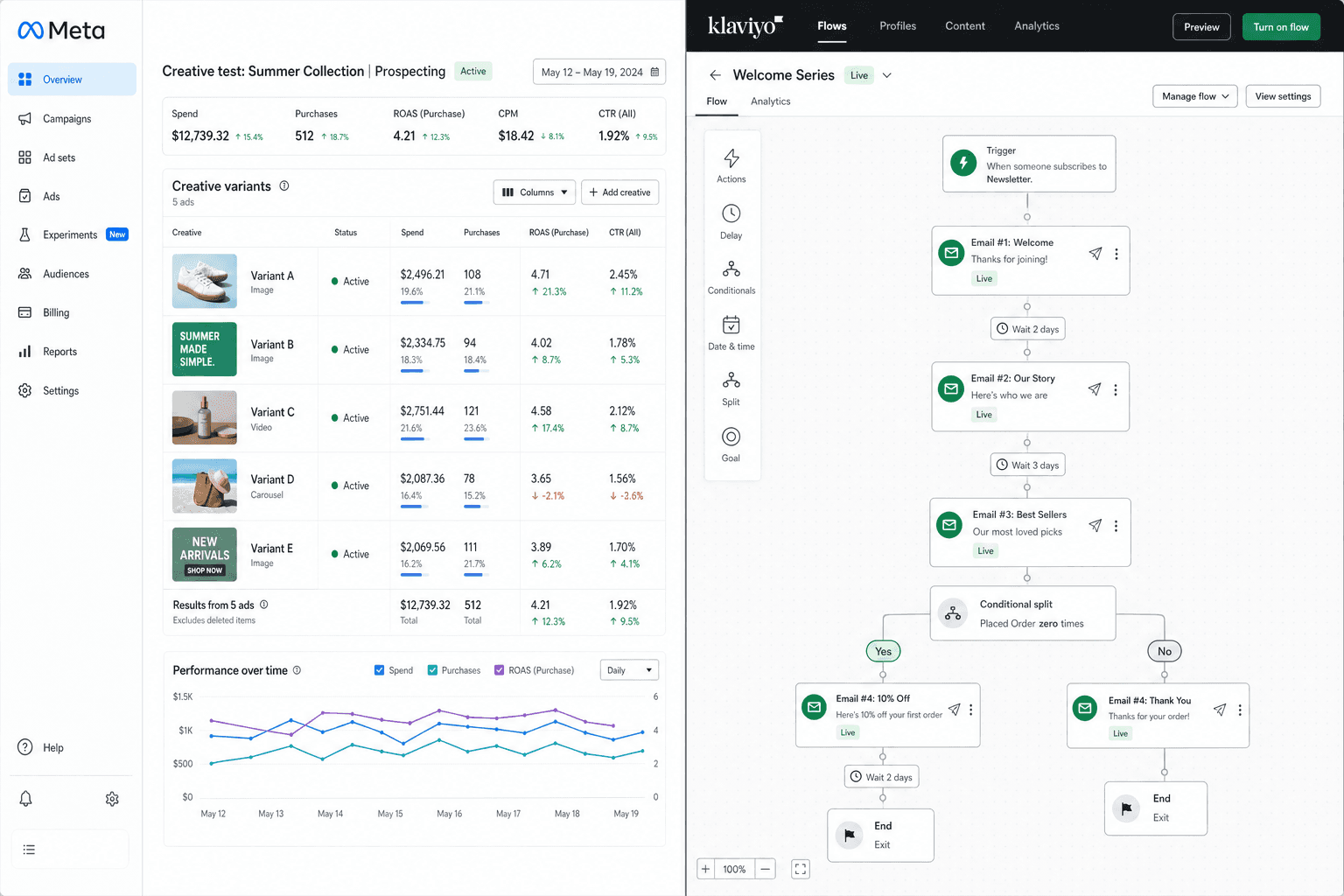
What AI does: AI optimizes your Klaviyo flows: abandoned cart sequences tuned to SKU price point, post-purchase bedding-to-bath cross-sell (and vice versa), and winbacks triggered by cohort LTV signals at D30 and D90.
The result: You recover 10–15% of abandoned carts, move 12-month repeat rate toward the 35–40% range leading bedding brands sustain, and grow email's revenue share without hiring.
Why it matters here: Email is where unit economics close: a sheet-set buyer adding a bath bundle six months later through a post-purchase flow makes the CAC math work.
Conversion Optimization
What AI does: AI analyzes landing pages and continuously tests copy and layout variants on real traffic, targeting the objections that kill bedding conversions: tactile anxiety, durability skepticism, certification credibility, and sizing/fit confusion.
The result: Lift your 1.4–1.8% category conversion rate; a 30–50% landing page conversion lift at the same ad spend separates profitable from unprofitable CAC.
Why it matters here: Bedding shoppers hesitate for good reasons. Surfacing sleep trial terms, OEKO-TEX certification, wash-test UGC, and deep-pocket fit callouts in the right order beats bid adjustments.
Digital Ads
What AI does: AI paces budget and bids across Meta Advantage+ sales campaigns and Google branded search and Shopping, shifting spend in real time toward campaigns and creative that lift blended ROAS into Q4.
The result: Budget follows performance instead of a static monthly allocation, so BFCM dollars meant for your highest-ROAS branded search terms don't sit in underperforming prospecting.
Why it matters here: Pacing matters most in Q4, when CPMs spike and brands weighting spend correctly extract two to three times the revenue of brands running static campaigns.
Ready to see what this looks like for your bedding & bath brands business?
No obligation. A senior strategist will show you exactly where the wins are.
The Strategy
How Paid Media Should Run for a DTC Bedding & Bath Brand
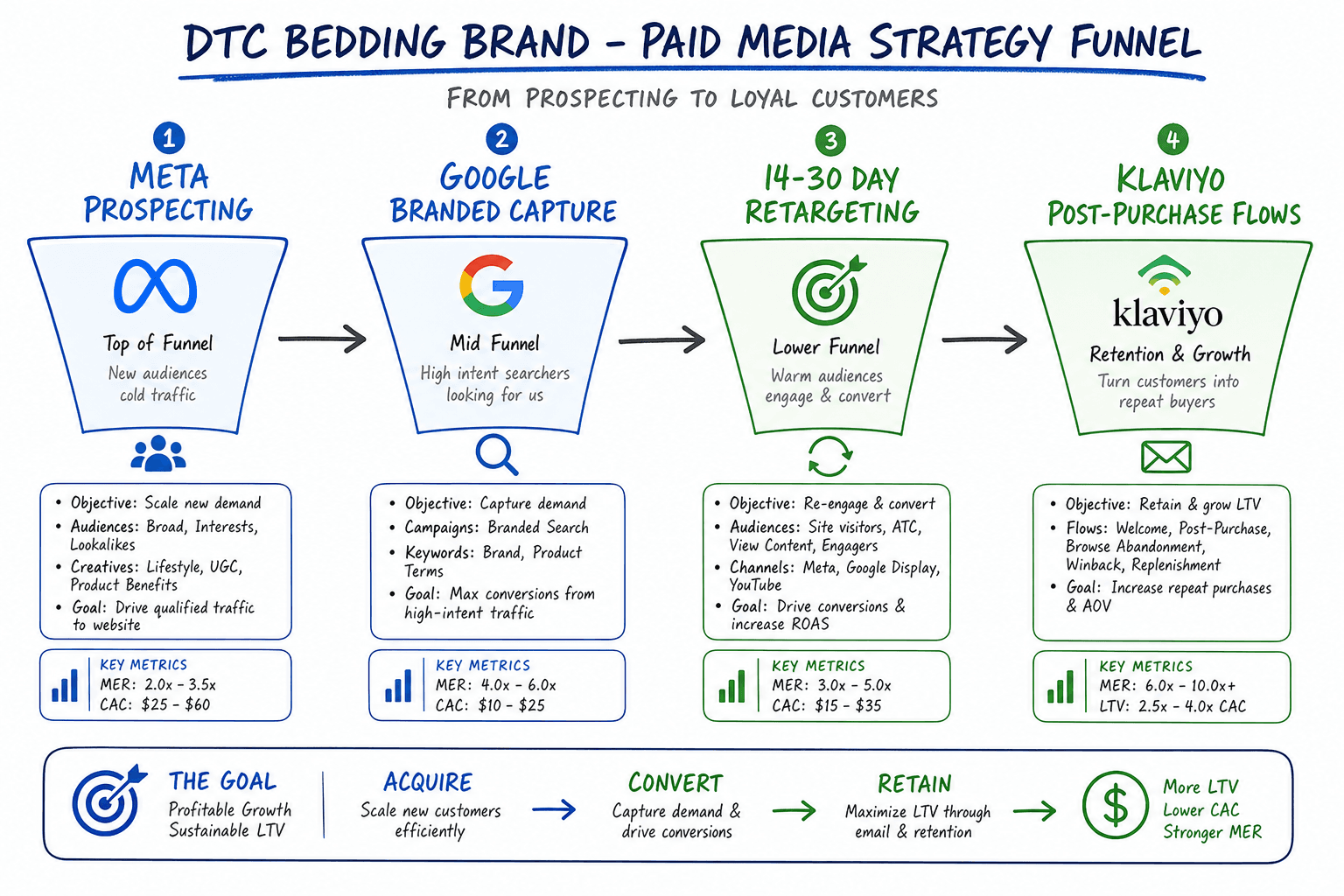
First, build clean measurement: server-side CAPI reconciled against Shopify revenue, blended ROAS across channels, and D0/D30/D90 cohort LTV reporting that splits new from returning revenue. Otherwise every budget decision is a guess.
Meta, your primary acquisition channel, gets the largest budget. At a $150–$300 AOV, run Advantage+ sales campaigns for prospecting fed by weekly creative testing: creative is the engine; structure is the container.
Google Branded Search captures shoppers who saw your Meta ads and search your name, and non-branded Shopping catches high-intent queries like 'organic linen sheets' and 'cooling duvet cover.' Both usually post your highest in-platform ROAS; protect them when budgets tighten.
Match retargeting to the consideration cycle: 14–30 days minimum for a $200+ purchase. Early creative builds desire, mid-funnel answers durability and certification, and late-funnel closes on the sleep trial and return policy.
Klaviyo email and SMS run parallel to paid as retention and LTV infrastructure: cart recovery, bedding-to-bath and bath-to-accessories cross-sell, and D90 winbacks drive the repeat purchases behind a 3:1 LTV/CAC ratio.
Pace budget to the category calendar: weight Q4 (October through December) heaviest, ramping from September, not the week before BFCM. February through May (Valentine's Day, Mother's Day, wedding registry, spring refresh) is the second window; June and January are for retention and seeding.
The one number that governs this
Blended ROAS governs: total revenue over total ad spend, tracked weekly against a contribution margin floor and 60–90-day CAC payback. In-platform ROAS is directional.
How We Help
What We'd Do for Your Bedding & Bath Brand
We'd sequence the work the way we'd run it at your stage, not as a service menu.
Attribution & Tracking Setup (CAPI + Blended ROAS Dashboard)
We fix measurement first. Within 48 hours you'll know whether current campaigns are profitable at contribution margin.
Meta Paid Media (Advantage+ Sales Campaign Management)
Your Meta Advantage+ sales campaigns get weekly-tested prospecting creative, retargeting sized to the consideration window, and budget paced to the category calendar.
Google Ads (Branded Search + Shopping)
We protect branded search and build Shopping around high-intent queries for your positioning (organic, cooling, linen) to catch shoppers who found you on Meta.
AI-Assisted Creative System
We run weekly AI-assisted creative tests to keep Meta fed with fresh signal and find your highest-ROAS hooks before fatigue sets in.
Email & SMS (Klaviyo Flow Architecture)
We build or rebuild your Klaviyo flows (abandoned cart, browse abandonment, cross-sell, D90 winback), tuned to AOV and cohort LTV, so email earns real revenue.
Conversion Rate Optimization (Landing Pages & PDPs)
Landing pages and PDPs get built and continuously tested against bedding's conversion-killing objections, so paid traffic converts at a rate the CAC math needs.
Who's Behind This
Who we are, and what makes us different
Sagum is a performance marketing agency founded in January 2017 in St. George, Utah. We've spent 8+ years growing real brands and being judged on KPIs, not vanity metrics.
We deliberately limit how many clients we take so each one gets senior attention. We treat your numbers like our own, we never run generic playbooks, and your strategy is built for your business, because shouldn't your brand's marketing be custom to your brand?
Sagum.ai is our AI arm: the same proven operators now build AI into the work wherever it creates real edge, not as theater, but as leverage applied with discipline.
- 8+ years growing brands on performance KPIs, not vanity metrics
- Limited client roster, with senior attention on every account
- An extension of your team; your success is tied to ours
- Custom strategy per brand, never a generic playbook
- AI built in where it moves a number; judgment over hype
“Sagum is a performance marketing agency that's spent 8+ years growing brands by treating their numbers like our own. We take on few clients, never run generic playbooks, and now build AI into the work wherever it creates real edge, not hype. Your strategy is built for your business, and our success is tied to yours.”

“Sagum roughly doubled our bottom line. They treat the work like it's their own business.”
Rachel Nilsson
CEO, RAGS
Proof
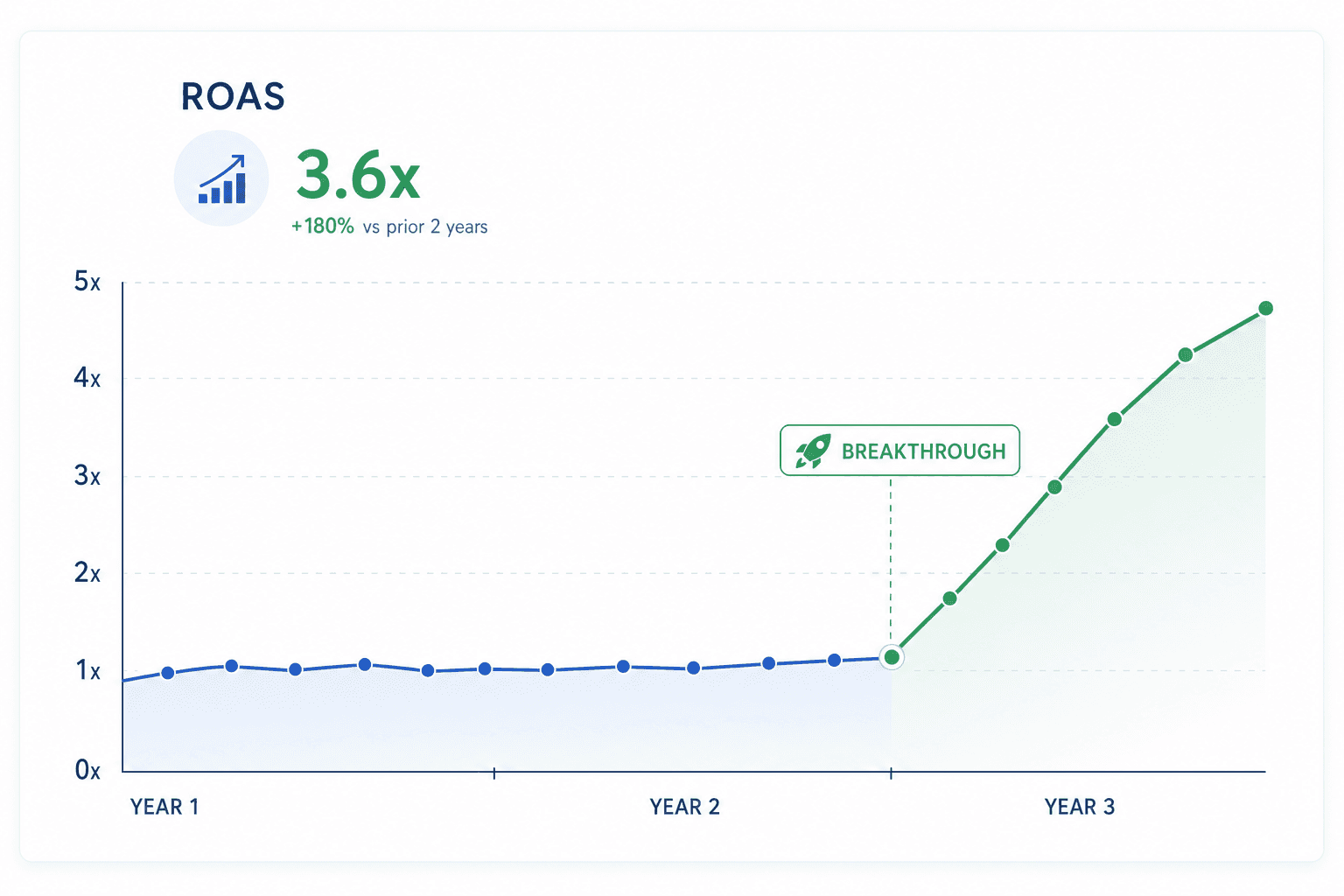
Broke a 2-year ROAS plateau with +115% ROAS at the same spend
House of Jade
Challenge
House of Jade, a home goods ecommerce brand, was stuck on a two-year ROAS plateau.
What we did
We restructured the brand's strategy without increasing ad spend, the same discipline we'd bring to your bedding or bath account.
Result
The brand broke the plateau with 115% higher ROAS at the same ad spend and its biggest, most profitable Q4. If your bedding or bath brand has plateaued, see the full case study at sagum.com/case-studies/.
Let's Build Your Bedding & Bath Brand's Acquisition and Retention System
No obligation. We'll come to the session having thought through your category, seasonality, and current channel mix, with a real point of view on where your growth is and what capturing it takes.
Sagum · January 2017 · St. George, Utah · 8+ years