

8+ years growing brands on KPIs, now with AI
Make the math work for your beverage brand
We turn brutal first-order economics into subscribers whose repeat purchases finally make CAC worth paying.
8+ years growing DTC brands · Google Ads, Meta & TikTok partner · Performance-judged, not retainer-comfortable



Get your free Growth Gap Analysis
Senior strategist review · response within one business day
Prefer to reach out directly?
The Challenge
Beverage Math Is Unforgiving, and Most Marketing Agencies Don't Know It
A $45 CAC on a $35 AOV first order doesn't pay for itself after COGS and $8–12 to ship liquid weight cross-country. DTC beverage works only if buyers come back, ideally on subscription and before day 30, when 50% of this category's repeat purchases happen.
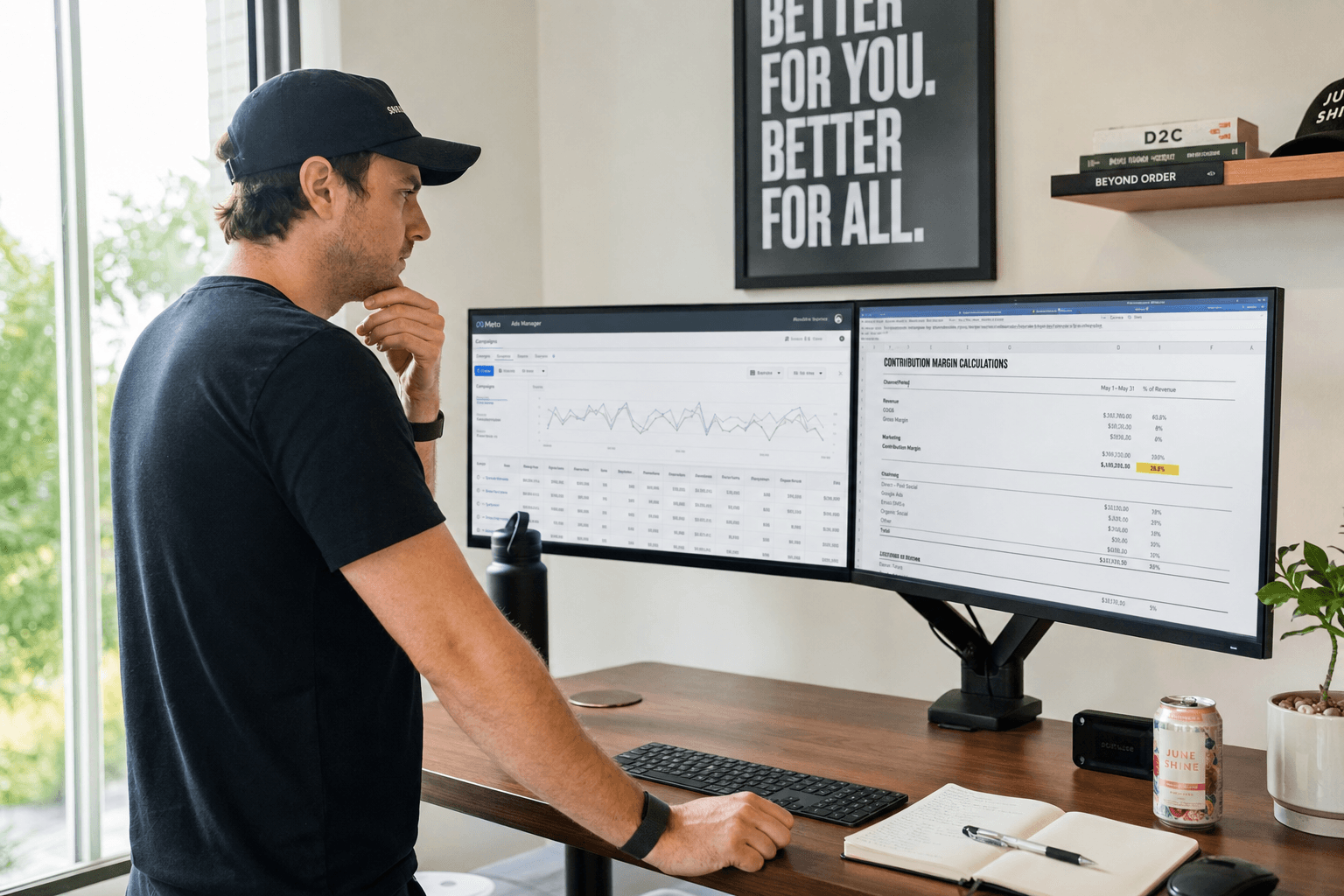
If you run a tight ship, gross margin probably sits around 48% and contribution margin after fulfillment and shipping lands at DTC's low end, so you can't spend like a beauty or apparel brand. A healthy-looking 2.5x Meta ROAS that counts repeat orders can hide a $45 new-customer CAC and sit underwater after shipping.
Attribution hides the damage: founders who've scaled past $1M on paid social often describe pulling back spend and watching revenue barely move, a sign Meta was taking credit for sales they'd have made anyway.
Olipop and Liquid Death out-created the market. Every sub-category (functional beverage, RTD, better-for-you soda) has a challenger with a point of view, a creator network, and a retention engine, so generic paid media doesn't cut through.
The Opportunity
Low CAC and Subscription LTV Put Beverage Margin Within Reach
Used well, acquisition economics favor you: food and beverage DTC has the lowest CAC of any ecommerce category ($45–53, well below the all-DTC average) and the highest conversion rate on Meta.
The first order is a liability; the subscription is the asset. A $50/month subscriber retained 18 months is worth $900 in LTV; a one-time buyer is worth $35 minus your CAC.
New Year is the biggest acquisition window for functional, wellness, and better-for-you brands, BFCM is your subscription launch, and summer brings the hydration and RTD spike. Brands that align spend, creative, and email to those peaks, and build cheap lists in February and September, compound faster than flat-budget brands.
One in three US consumers has already bought on TikTok Shop, but it's still early enough that brands building micro-influencer pipelines now lock in a real cost-per-sale edge.
What Most Get Wrong
What DTC Beverage Brands (and the Agencies They Hire) Keep Getting Wrong
Optimizing for ROAS instead of contribution margin
At $35 AOV, $10 shipping, and 48% gross margin, 3.5x ROAS is a slow bleed. Optimize platform ROAS alone and you scale losing campaigns while your bank balance stays flat.
Treating the first order as the win
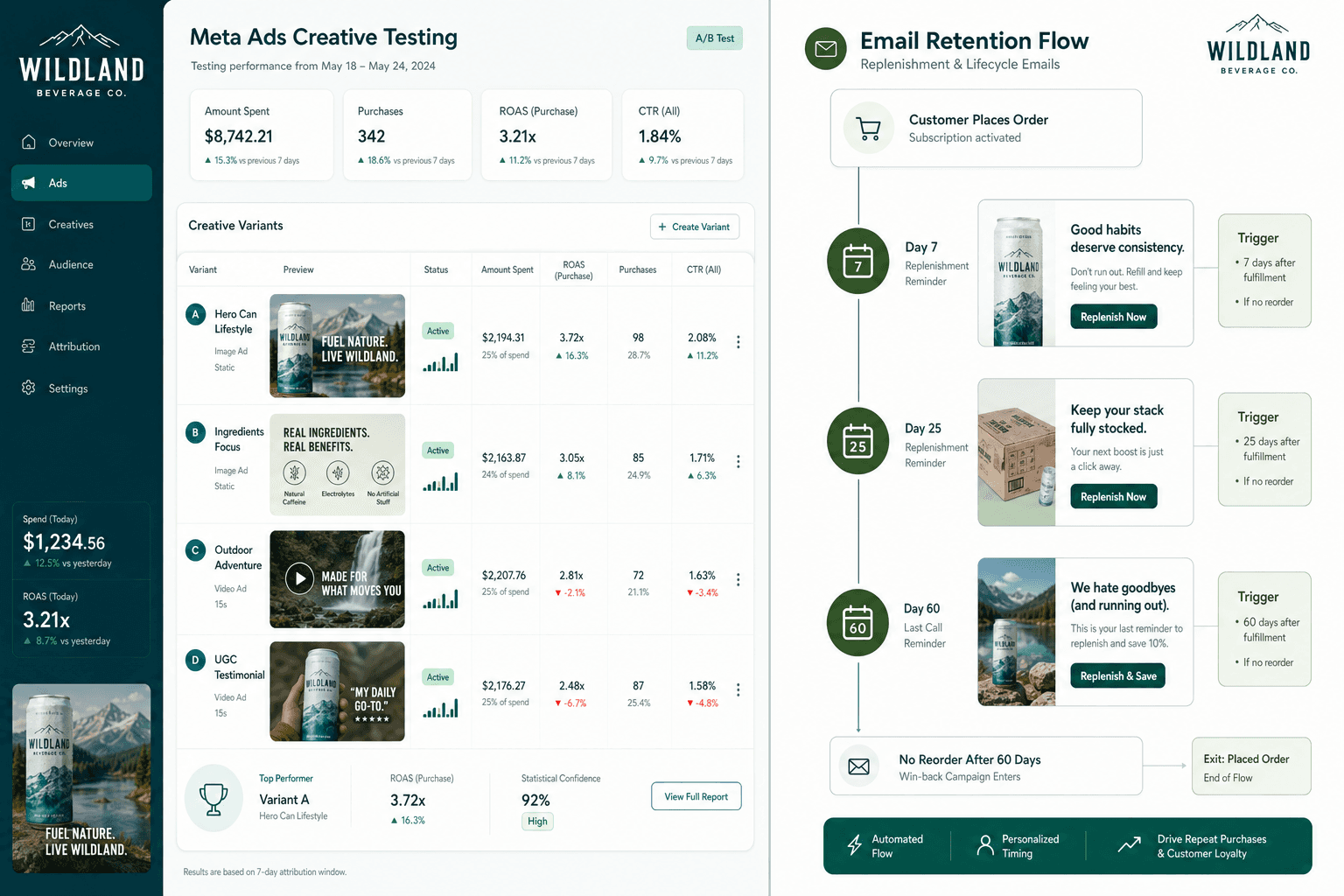
Without a replenishment flow before day 30, you miss roughly half your repeat potential. Most beverage brands run welcome and discount emails but nothing timed to their product's consumption rate.
Trusting platform-reported attribution numbers
Meta's reported ROAS commonly runs 2–3x above true incremental ROAS, and some channels show 5–10x inflation. Scale on those numbers and you often pay for conversions you'd have gotten anyway.
Running undifferentiated creative in a category that raised the bar
Olipop, Liquid Death, and Athletic Brewing won on creative and creator distribution, not budget. Static product shots against competitors with 200-creator UGC pipelines earn generic CPMs and below-average CTR.
Ignoring the subscription attach moment at checkout
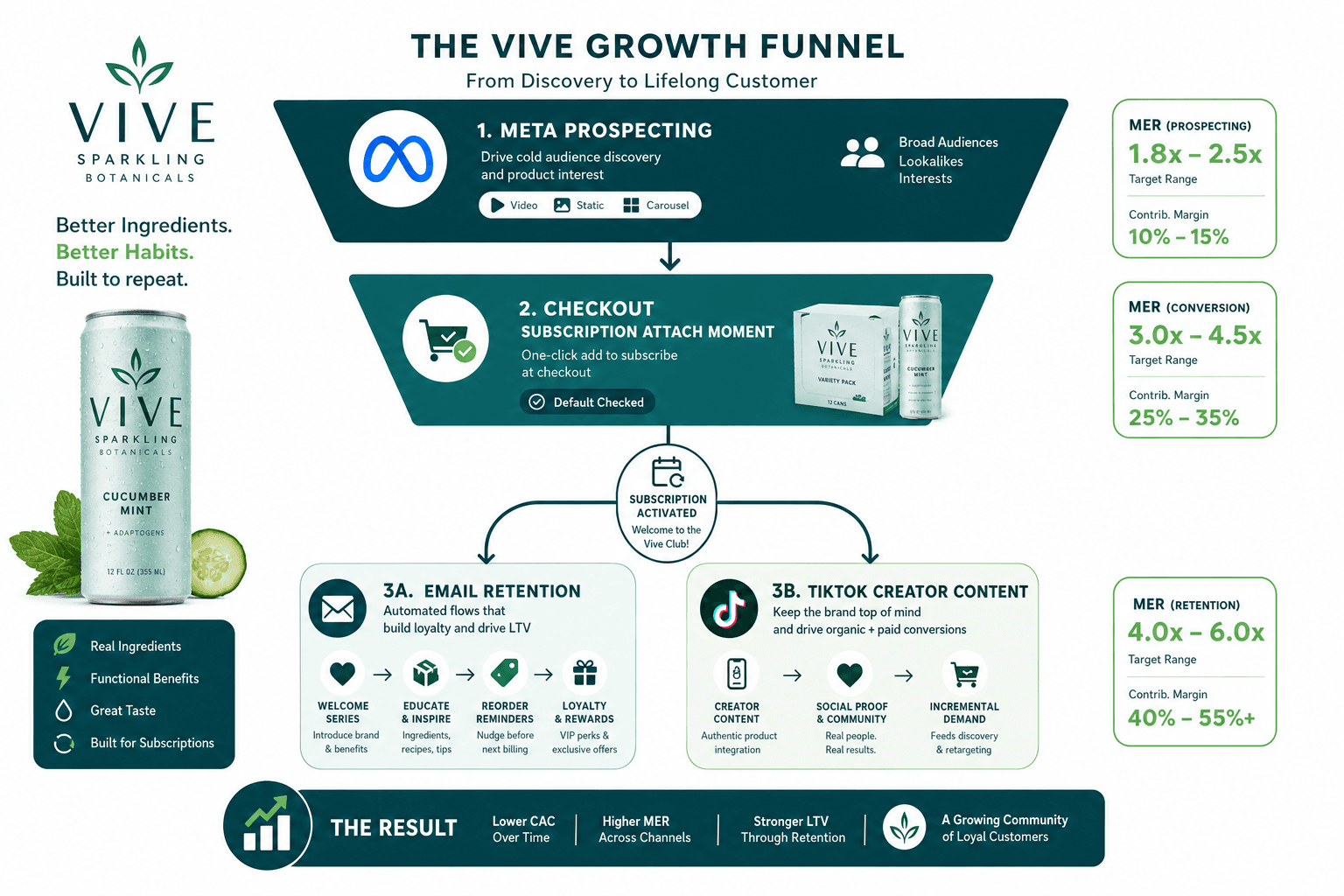
Pitch the subscription by email three days later instead of with a clear discount at checkout, and you forfeit a 30–50% attach lift, then pay for win-back campaigns.
Why Now
AI Testing and the Retail Shift Favor Beverage Brands Building Now
AI lets a disciplined operator test creative at volumes once reserved for in-house teams. Testing five angles a week instead of one compounds: find a winning hook in week two and scale it while competitors test one angle a week.
In NuORDER's 2024 survey, brands selling wholesale expected it to outgrow DTC. The first to go omnichannel with DTC velocity data, regional sales heatmaps, and a proven acquisition story win shelf space at Whole Foods and Sprouts before rivals submit a buyer deck.
PepsiCo's $1.95 billion Poppi acquisition in 2025 showed a DTC-first brand with proven regional velocity is an acquisition target. Brands that fix attribution, build retention, and scale creative now will own beverage's next two years; brands on set-and-forget Meta with no subscription strategy will watch CAC climb.
The Mechanism
Where AI Creates Real Edge for a Beverage Brand
Real productivity, not AI theater. Here's where it actually moves a number for beverage brands.
Creative
What AI does: AI-assisted production generates hooks, headlines, and visual concepts weekly, and we systematically test which message (functional benefit, flavor experience, lifestyle identity, social proof) drives the lowest cost-per-subscription-start in your sub-category.
The result: You test 5x more angles per week without proportional production cost, find winning hooks faster, and keep the pipeline moving between campaign cycles.
Why it matters here: In beverage, where the creative bar is high, brands that find their message fastest compound the lead over rivals testing one concept a week.
Analytics
What AI does: AI-assisted attribution modeling checks platform ROAS against blended ROAS (total revenue ÷ total ad spend) and contribution margin per order, flagging campaigns profitable on the dashboard but not on your P&L.
The result: You make budget decisions from one source of truth, since platform dashboards systematically overstate their own contribution.
Why it matters here: Beverage founders have been burned by scaled Meta spend that looked efficient until they pulled back. Fixing attribution comes before every other investment decision.
What AI does: AI times retention flows to your product's consumption rate: a first-month replenishment flow, a subscription upsell triggered by second-purchase behavior, and churn prediction that flags at-risk subscribers before they cancel.
The result: Repeat purchase rises in the first 90-day window, more one-time buyers subscribe, and automatic payment-failure recovery cuts involuntary churn.
Why it matters here: Beverage economics depend on repeat purchase, and email and SMS decide whether the subscription math works.
Digital Ads
What AI does: AI paces budget into peaks (New Year for functional beverages, summer for hydration, BFCM for subscription bundles) and shifts to list-building in the February and September troughs, when intent and CPMs drop.
The result: Spend follows demand, blended CAC falls across the year, and each peak starts with a larger owned audience.
Why it matters here: A beverage brand spending the same in February as in January overspends when intent is low and underspends at the annual peak.
Conversion Optimization
What AI does: AI-assisted tests on landing pages and product detail pages target subscription attach: offer framing, discount presentation, subscription vs. one-time default, and checkout friction.
The result: Subscription attach at checkout rises 30–50%, immediate AOV climbs, and effective CAC falls as more paid traffic becomes high-LTV subscribers.
Why it matters here: Checkout is the highest-impact moment in a beverage funnel. A 30% lift in attach rate changes the unit economics of every paid campaign above it.
Ready to see what this looks like for your beverage brands business?
No obligation. A senior strategist will show you exactly where the wins are.
The Strategy
How DTC Beverage Marketing Should Be Built
In beverage, unlike apparel or beauty, every marketing decision flows from one constraint: your first order probably doesn't pay for itself.
Meta is your primary prospecting channel: food and beverage converts at about 2% there, the highest of any vertical, and Meta's targeting and creative tools have the most reach for cold audiences. Without a subscription offer at checkout and a replenishment flow, Meta is half a funnel.
Google Search catches your highest-intent demand (category, competitor, and functional-benefit searches), though not your highest volume. Protect branded search, because competitors will bid on your name once you build awareness.
TikTok and creator-led content is where the next CAC advantage is being built. On cost-per-sale, a pipeline of 50–200 micro-influencers (10,000–100,000 followers) at 5–12% engagement beats one mega-influencer at 1–3%. It also feeds your paid creative library, so influencer marketing becomes an acquisition engine.
Email and SMS is your retention engine, and brands investing in it see LTV rise 64% versus acquisition-only strategies. Give win-back flows an offer worth returning for.
Blended ROAS holds up because it doesn't depend on inflated platform attribution, so we build measurement first and scale only the channels we trust.
The one number that governs this
Manage to blended ROAS, not platform ROAS, measured against contribution margin per order. A 3:1–5:1 target means nothing if shipping pushes margin negative.
How We Help
What We'd Build for Your Beverage Brand
We start with measurement so every later decision runs on numbers you trust, then build the acquisition and retention systems that make beverage unit economics work.
Attribution & Analytics Audit
We audit your pixels, flag platform ROAS inflation, set a blended ROAS baseline, and track contribution margin per order to see what's profitable before scaling.
Paid Media (Meta, Google, TikTok)
We pace Meta prospecting to your seasonal peaks, protect your brand on Google Search, and build your TikTok creative and acquisition strategy.
Creative Strategy & Testing
We test multiple angles weekly to find the hooks with the lowest cost per subscription start; winners feed paid channels and your organic content library.
Email & SMS Retention Systems
We build a retention engine beyond a welcome series: consumption-timed replenishment, second-purchase upsells, churn prediction and win-back, and sequences that launch your subscription at BFCM.
Conversion Optimization (Checkout & Subscription Attach)
We test the subscription offer at checkout so more first-time buyers subscribe before they leave.
AI Systems & Automation
We add AI where it moves a number: seasonal budget pacing, higher-volume creative testing, and retention triggers fired by behavioral signals rather than time-based defaults.
Who's Behind This
Who we are, and what makes us different
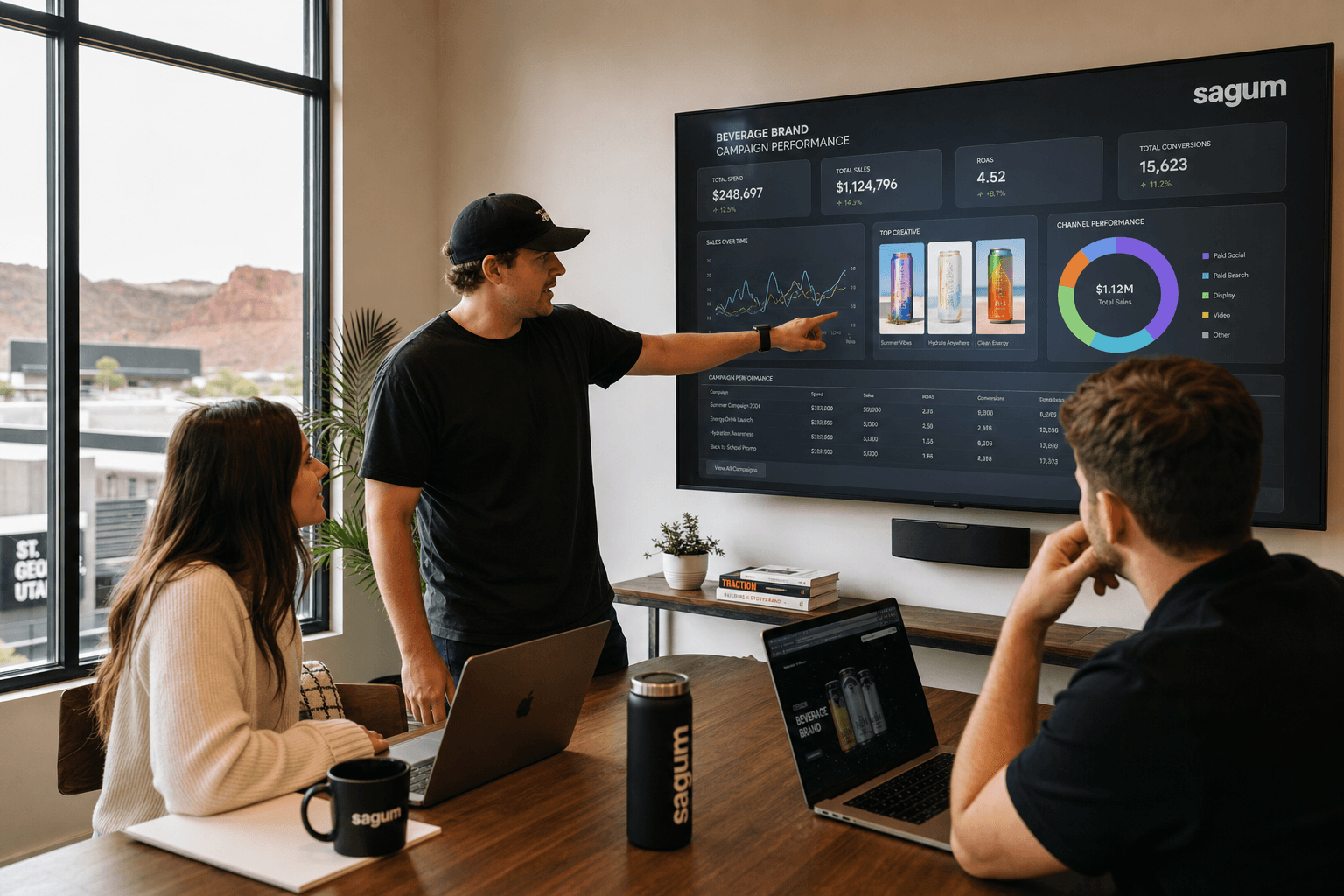
Sagum is a performance marketing agency founded in January 2017 in St. George, Utah. We've spent 8+ years growing real brands and being judged on KPIs, not vanity metrics.
We deliberately limit how many clients we take so each one gets senior attention. We treat your numbers like our own, we never run generic playbooks, and your strategy is built for your business, because shouldn't your brand's marketing be custom to your brand?
Sagum.ai is our AI arm: the same proven operators now build AI into the work wherever it creates real edge, not as theater, but as leverage applied with discipline.
- 8+ years growing brands on performance KPIs, not vanity metrics
- Limited client roster, with senior attention on every account
- An extension of your team; your success is tied to ours
- Custom strategy per brand, never a generic playbook
- AI built in where it moves a number; judgment over hype
“Sagum is a performance marketing agency that's spent 8+ years growing brands by treating their numbers like our own. We take on few clients, never run generic playbooks, and now build AI into the work wherever it creates real edge, not hype. Your strategy is built for your business, and our success is tied to yours.”
“After six years, Sagum is our most important partner: trusted, communicative, and caring about our business as if it's their own.”
Long-term partner
6-year client
Proof
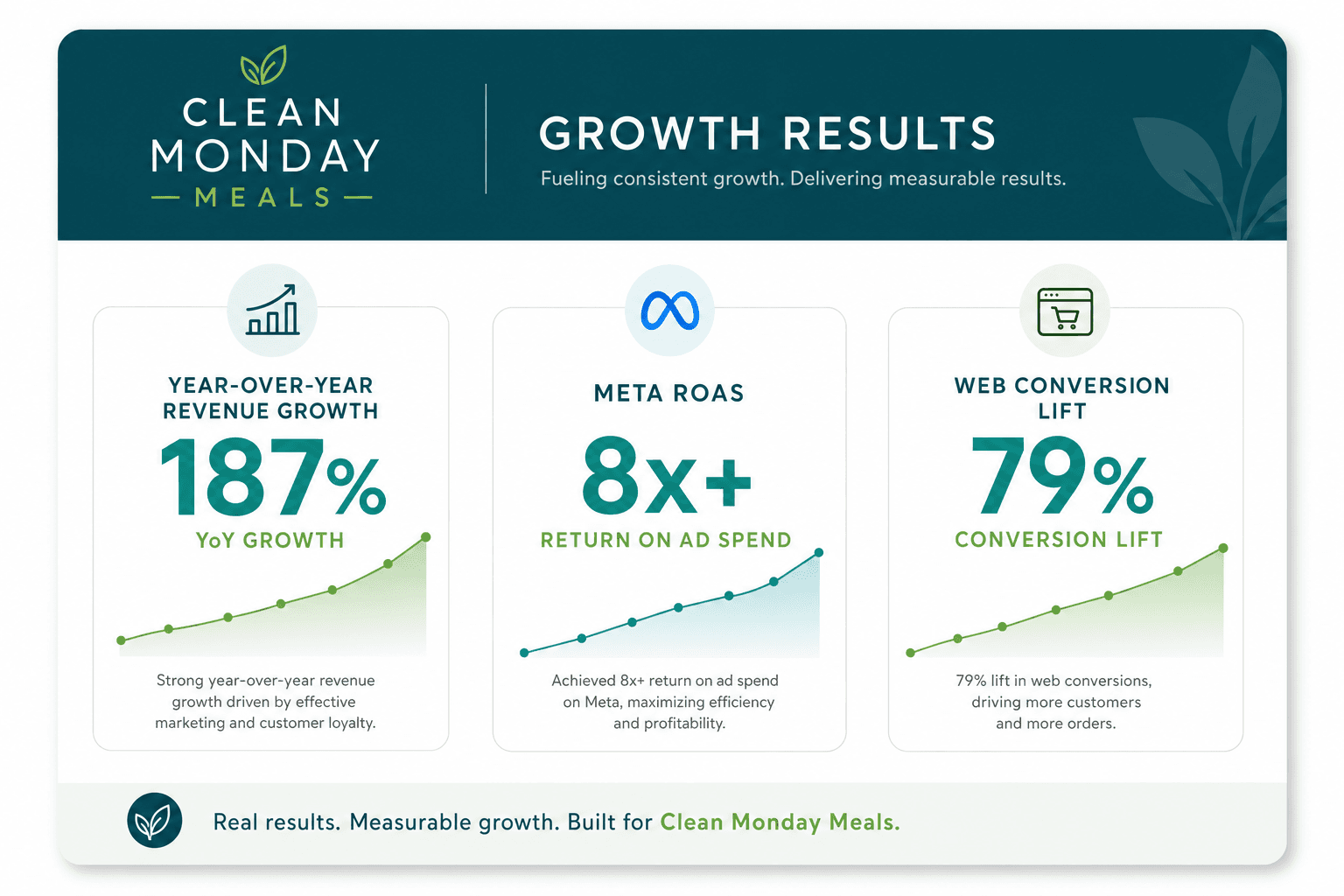
187% YoY, $8+ ROAS on Meta, +79% web conversion
Clean Monday Meals
Challenge
Clean Monday Meals, a food DTC brand, needed to grow across channels, a goal most beverage brands share.
What we did
We scaled Meta and took over email and Amazon, the same channel mix a beverage brand can run.
Result
Clean Monday Meals grew 187% year-over-year, hit $8+ ROAS on Meta, and lifted web conversion 79%.
Your Beverage Brand's Unit Economics Can Work, With the Right Marketing Stack
No obligation. In one call we'll walk through your numbers (CAC, contribution margin, retention rate) and where your real growth lever is. We take on few clients; every engagement gets senior attention from day one.
Sagum · January 2017 · St. George, Utah · 8+ years