

8+ years growing brands on KPIs, now with AI
More Cabinet Appointments, Less Wasted Ad Spend
We build performance marketing systems that fill your design calendar with qualified homeowners ready to commit.
8+ years growing local service businesses · Google, Meta & TikTok partner



Get your free marketing audit
Senior strategist review · response within one business day
Prefer to reach out directly?
The Challenge
Cabinet Marketing Is Nothing Like Selling a Product You Can Ship
Your buyer pins kitchen inspiration for 18 months before calling, with a rough budget, a list of fears, and three or four other showrooms shortlisted. When she searches 'custom cabinets near me,' she's close to deciding, and whoever earns her trust first usually wins.
Your business runs on appointments. A $25,000 to $50,000-plus custom kitchen sale can take 90 to 180 days from first contact to signed contract, through an in-home measurement, a CAD drawing session, a proposal, and a deposit conversation.
Demand is lumpy. January through March is your best window to fill spring and summer installs, yet most cabinet companies spend the same every month; when spring CPCs spike and designer capacity fills, you turn away jobs or scramble for staff.
Her fears (fit, matching the photo, an installer vanishing mid-project) make trust signals, portfolio proof, and a clear process narrative decisive, so generic ads fail. You need a system that qualifies buyers, earns trust before the first call, and turns that call into a design consultation.

The Opportunity
Ready-to-Buy Cabinet Customers Are Searching, and Most Find Your Competitors
Homeowners searching 'kitchen cabinet replacement cost' are ready to call. A mature local SEO and Google Business Profile presence alone can deliver 60-plus cabinet leads a month under $11 each, cheaper than any shared lead marketplace. Most showrooms in mid-size markets haven't built one.
Refacing is growing fast and local marketing underserves it. Buyers with solid boxes and dated doors close faster and spend $5,000 to $15,000 on average. Weighing refacing against a $40,000 full gut, they're less price-sensitive than they look. Without a dedicated campaign, competitors get them.
Custom and semi-custom buyers carry your highest LTV: a satisfied custom-kitchen client often comes back for a bath, home office, or laundry room and refers neighbors, so one client can be worth several projects over a few years. Most cabinet companies don't systematically capture referrals or retarget past clients.
What Most Get Wrong
What Cabinet Companies and Their Agencies Keep Getting Wrong
Running every cabinet lead through one campaign, page, and follow-up
'Cabinet refacing near me' and 'custom inset cabinets [city]' searchers differ in budget, timeline, trust needs, and margin. You qualify neither properly; blended cost per lead (CPL) hides segment profitability.
Bidding on cheap 'cabinet ideas' clicks to inflate lead volume
'Kitchen renovation inspiration' clicks rarely book, while 'custom cabinet installation cost [city]' and 'kitchen cabinet refacing quote' go underbid or excluded, leaving a full CRM and an empty install schedule.
No call tracking or project-type attribution
You can't name the campaign, keyword, or ad behind the projects you closed, so you optimize for form fills, not signed contracts, and fund busy campaigns that don't grow revenue.
Spending the same in February as in June
January through March, homeowners plan, designers have capacity, and CPCs run 20 to 30 percent below April. Miss that window and you overpay at a crowded peak, when conversion falls.
Generic agencies skip your portfolio and run manufacturer stock photos
A KraftMaid catalog image answers none of a homeowner's fears; your local before-and-afters, with plywood boxes she can see in your showroom, answer them. Stock imagery tanks landing page conversion.
Why Now
Why January Through March Decides Your Cabinet Install Calendar
Homeowners who delayed cabinet projects keep returning, partly because prices aren't falling and partly because the home sale market pushed renovation into primary residences. Material costs rose 8 to 12 percent year-over-year in 2024 and 2025.
To have a new kitchen by summer, homeowners must decide by February or March to clear 2-to-4-month manufacturing and installation lead times, so companies advertising 'book now, install by summer' in January fill spring calendars. Local SEO takes 6 to 12 months to mature, so start it a year ahead.
Most local competitors run set-and-forget Google campaigns with no seasonal budgeting, project-type segmentation, or cost-per-sold-project measurement. An AI-assisted agency tests five creative angles a week; competitors' campaigns get checked monthly. A tracked, appointment-focused system built ahead of competitors is hard to displace once mature.
The Mechanism
Where AI Gives a Cabinet Company a Real Edge
Real productivity, not AI theater. Here's where it actually moves a number for cabinet companies.
Digital Ads
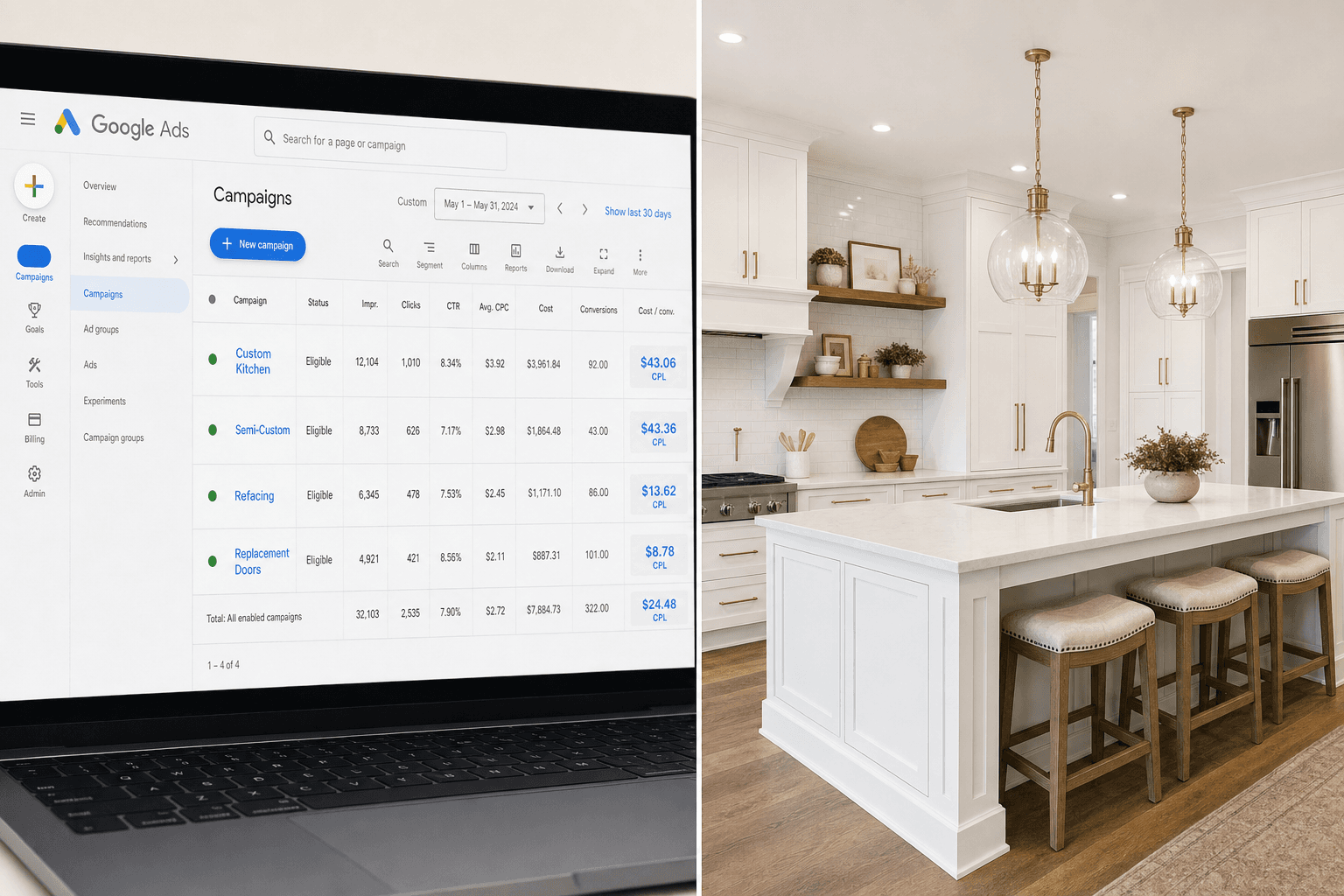
What AI does: AI-assisted bid management and budget allocation shift spend in real time toward the segments (custom, semi-custom, refacing, replacement doors) generating qualified design appointments.
The result: Spend follows performance by project type, so cost per qualified appointment drops and your highest-margin segments get the most budget.
Why it matters here: Refacing and full custom kitchen leads differ in value. Segmented campaigns show what each sold project type costs to acquire, and you optimize each independently.
Creative
What AI does: AI generates and tests multiple angles per week from your completed local projects (before-and-after transformations, dovetail drawer boxes and soft-close hinges, two-tone shaker finishes) instead of one static creative for months.
The result: You find the visual and message that books design consultations faster, because you test five angles in the time a competitor tests one.
Why it matters here: An ad showing a homeowner a kitchen two neighborhoods away, in the style she's pinned, outconverts a 'get a free quote' banner and lowers CPL.
Conversion Optimization
What AI does: AI builds landing pages by project type (custom kitchen, refacing, builder and trade work), each answering that buyer's trust questions and driving one action: book the design consultation.
The result: Conversion rates rise because a homeowner on your refacing page sees refacing before-and-afters, refacing pricing context, and a refacing consultation offer.
Why it matters here: Refacing and custom buyers have different measurement, lead-time, and material-quality worries. A generic page makes either buyer hit the back button and call your competitor.
Analytics
What AI does: Call tracking and attribution tie every inbound call and form to its campaign, keyword, and ad, then follow the lead through appointment booked, proposal sent, and contract signed.
The result: You know cost per qualified design appointment and per sold project by segment, not just per form fill, so you optimize for revenue.
Why it matters here: Without attribution across a months-long cycle, you defund campaigns that close projects. AI catches misattributed calls, broken pixels, and cross-channel conversions that inflate reported CPL.
Ready to see what this looks like for your cabinet companies business?
No obligation. A senior strategist will show you exactly where the wins are.
The Strategy
How a Cabinet Company's Marketing Should Be Built
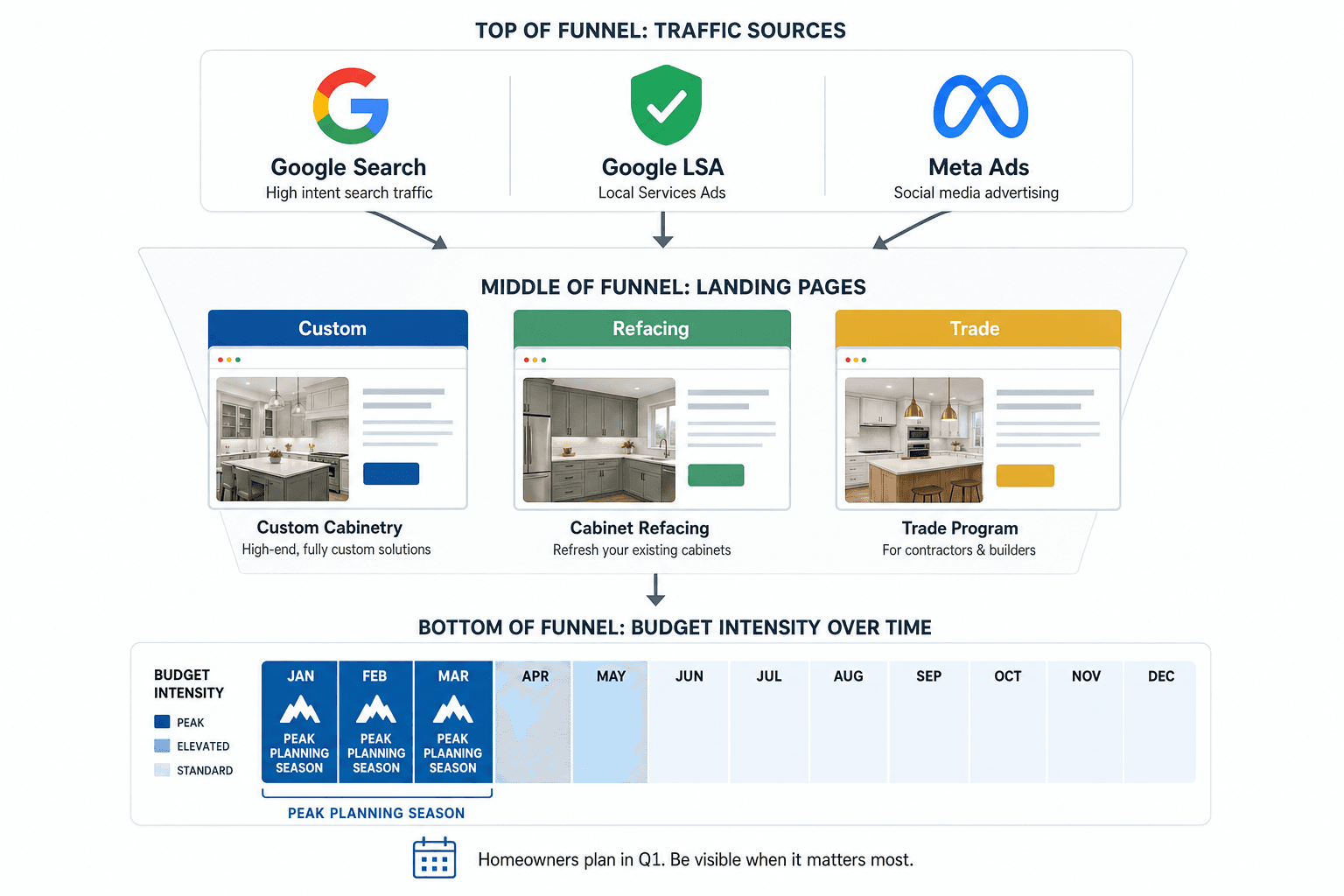
Google Search comes first, segmented by project type: custom and semi-custom campaigns bid aggressively on 'custom kitchen cabinets [city],' 'cabinet installation quote [city],' and 'inset cabinet maker near me,' with call extensions.
Refacing campaigns target 'kitchen cabinet refacing cost' and 'replace cabinet doors only.' Each segment has its own page, qualification path, CPL target, and call tracking tied to signed contracts.
Google Local Services Ads, billed per lead, put your showroom and in-home measurement above organic results for '[city] cabinet company' and '[city] kitchen remodeler,' and Google's verification badge answers part of the trust objection.
Meta and Instagram campaigns show local before-and-afters to nearby homeowners, targeted by age, homeownership, and household income. They offer free design consultations or in-home measurements, never 'learn more,' and retarget portfolio visitors by the style they viewed.
Local SEO covers three content clusters (custom cabinets, refacing, kitchen remodeling), each with its own page, review strategy, and Google Business Profile category. Run the profile as a lead channel: post project photos monthly, answer measurement and lead-time questions in Q&A, and request reviews when projects finish.
Spend is heaviest January through March, then strong but appointment-focused April through August. September to November, a secondary planning window, targets holiday and new-year projects. December is retargeting and content only.
The one number that governs this
Cost per qualified appointment and cost per sold project, by segment. Equal CPLs on $40,000 custom kitchens and $7,000 refacing jobs aren't equal outcomes.
How We Help
What We'd Do for Your Cabinet Company
Measurement comes first, then campaigns built for cabinet buyers. Our limited roster keeps senior people on your account, and we answer to cost per sold project, not impressions.
Call Tracking & Attribution Setup
Before launch, we install call tracking with dynamic number insertion, tracing each call from campaign, keyword, and ad to booked appointment and signed contract.
Google Search Campaigns (Segmented by Project Type)
We build separate custom, semi-custom, refacing, and replacement door campaigns, each with its own keyword set, bid strategy, and CPL target.
Google Local Services Ads
We manage your LSA profile and bids for the highest-intent local searches on a pay-per-lead model, with Google verification answering part of the trust objection.
Project-Type Landing Pages (Conversion Optimization)
We build the project-type landing pages around each buyer's trust questions, with your local project photos and one goal: a booked design consultation.
Meta & Instagram Campaigns (Visual Portfolio Creative)
We run before-and-afters from your completed projects with a free design consultation offer, and retarget portfolio visitors with style-matched creative.
Local SEO & Google Business Profile
We build the three content clusters and run your profile as a lead channel, with monthly photos, Q&A, and review requests at each project's completion.
Seasonal Budget Pacing & AI-Assisted Optimization
We pace budget to the cabinet buying calendar and use AI bid management to shift spend in real time toward appointment-producing project types.
Who's Behind This
Who we are, and what makes us different
Sagum is a performance marketing agency founded in January 2017 in St. George, Utah. We've spent 8+ years growing real brands and being judged on KPIs, not vanity metrics.
We deliberately limit how many clients we take so each one gets senior attention. We treat your numbers like our own, we never run generic playbooks, and your strategy is built for your business, because shouldn't your brand's marketing be custom to your brand?
Sagum.ai is our AI arm: the same proven operators now build AI into the work wherever it creates real edge, not as theater, but as leverage applied with discipline.
- 8+ years growing brands on performance KPIs, not vanity metrics
- Limited client roster, with senior attention on every account
- An extension of your team; your success is tied to ours
- Custom strategy per brand, never a generic playbook
- AI built in where it moves a number; judgment over hype
“Sagum is a performance marketing agency that's spent 8+ years growing brands by treating their numbers like our own. We take on few clients, never run generic playbooks, and now build AI into the work wherever it creates real edge, not hype. Your strategy is built for your business, and our success is tied to yours.”
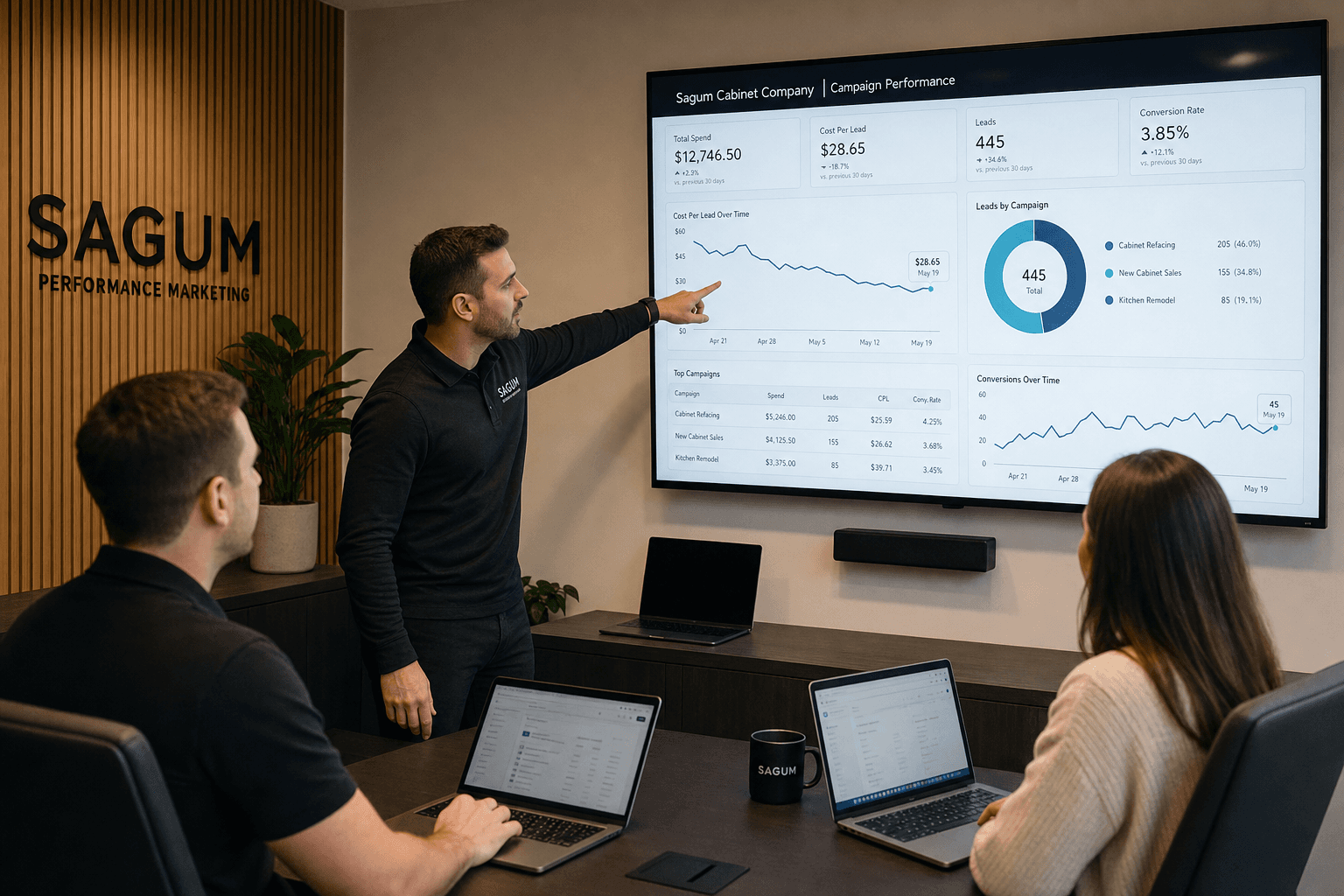
“After six years, Sagum is our most important partner: trusted, communicative, and caring about our business as if it's their own.”
Long-term partner
6-year client
Proof
From a $20 CPL goal to $13 CPL and 300+ leads/mo
Rizzoli's Automotive
Challenge
Rizzoli's Automotive, an auto service business, set a goal of 100 qualified leads a month at roughly $20 per lead. For a cabinet company, we'd hold the same work to cost per sold project.
What we did
We built a custom, call-driving landing page and rebuilt paid search around high-intent service queries, the same mechanics a cabinet showroom needs to book design appointments.
Result
CPL hit $13 against a $20 target, leads passed 300 monthly, landing page conversion topped 60 percent, and the client opened multiple new locations. The same search approach fits custom, semi-custom, and refacing pipelines.
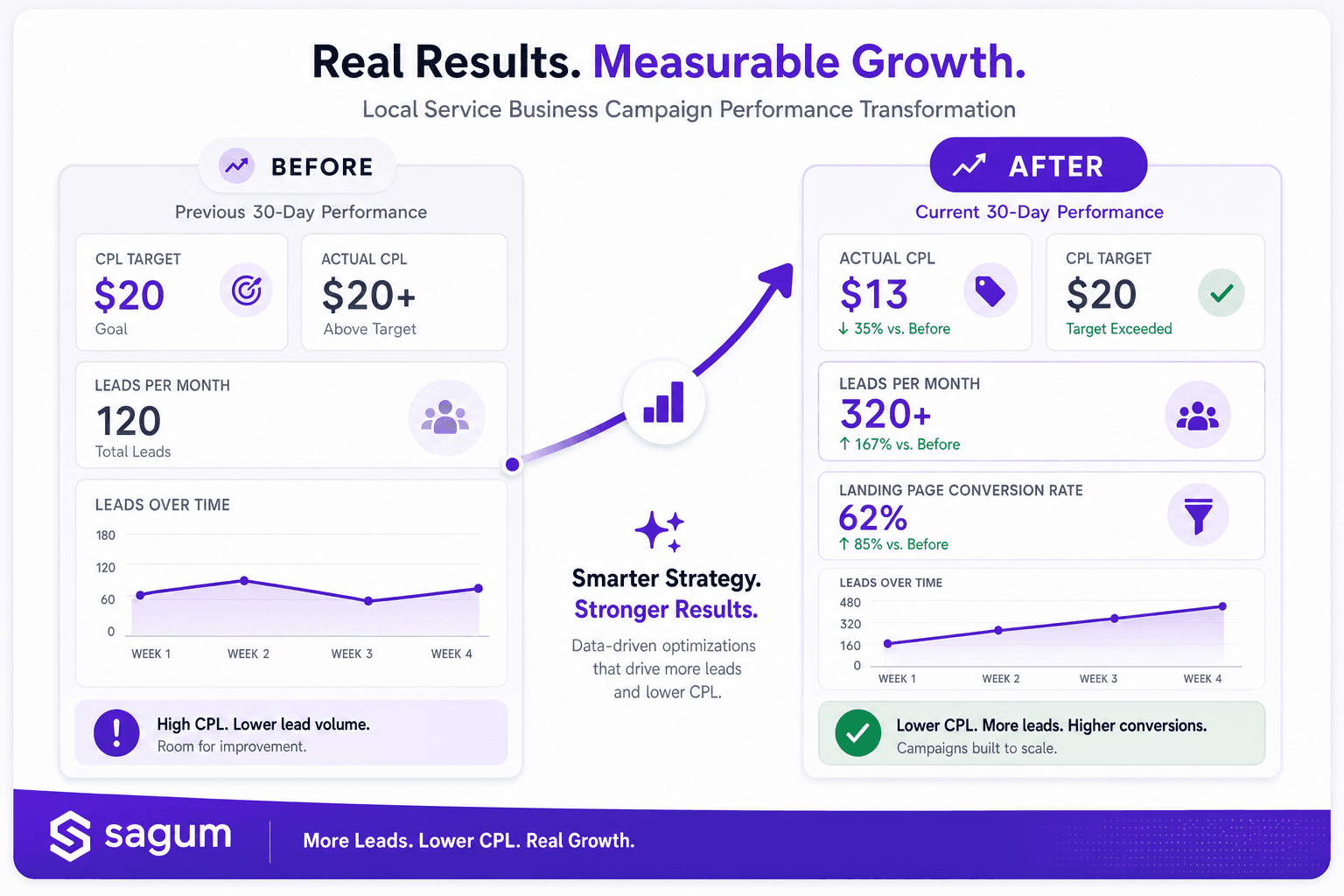
- Cost per lead
- $13
- Leads / month
- 300+
- Landing-page conversion
- 60%+
Find Out Exactly Where Your Cabinet Marketing Is Leaking Appointments
No obligation. Factoring in your service area, project mix, and install calendar, we'll review your campaigns, attribution setup, and landing pages against what a cabinet company at your stage needs and show you the gaps.
Sagum · January 2017 · St. George, Utah · 8+ years