

8+ years growing brands on KPIs, now with AI
Defend consumer electronics ROAS
We keep margins intact as you scale new-customer acquisition, before product cycles erode your returns.
Google Ads Partner · Meta Partner · TikTok Ads · 8+ Years · KPI-judged, not vanity-metric-managed



Get your free Growth Gap Analysis
Senior strategist review · response within one business day
Prefer to reach out directly?
The Challenge
Consumer Electronics Marketing Works Differently From Almost Any Other Ecommerce Category
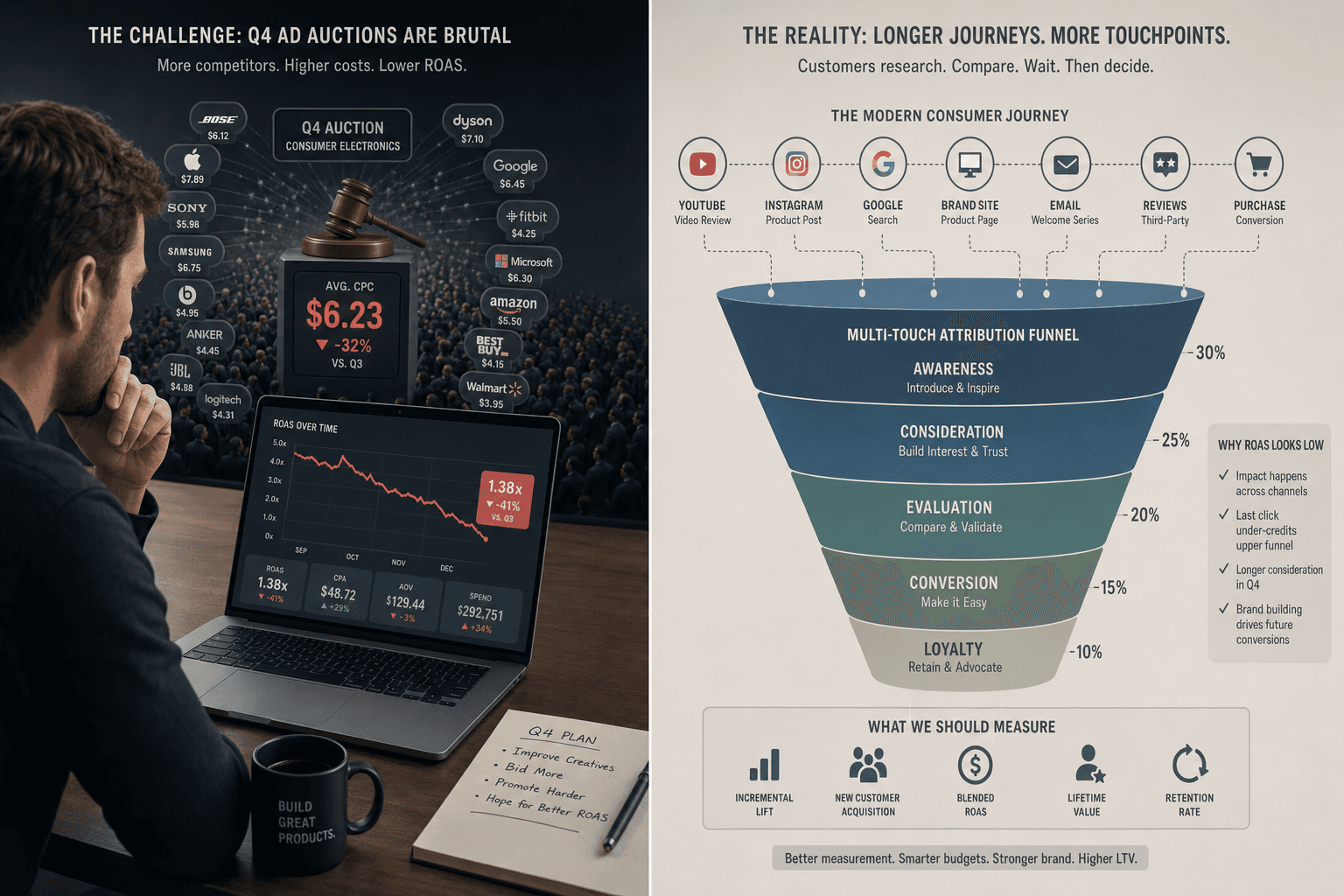
Your category converts at 1.58%, among ecommerce's lowest: buyers research $120 gadgets on YouTube, Amazon reviews, Reddit, and three competitor sites before a second ad click. Nearly 72% of consumers say they almost always start electronics searches online, so your long, multi-touch funnel is costly to attribute.
Your gross margins probably run 20–35%. At 25%, 4:1 ROAS only breaks even on product and ad costs, before agency, warehouse, or returns. A roughly 18% repeat rate, also among the lowest, means LTV can't rescue bad first-purchase CAC, unlike in apparel or consumables.
Q4 is make-or-break: electronics search peaks in December, CPMs surge 25–66%, and over 30% of annual revenue can ride on six weeks, so underbuilt BFCM creative or a leaky landing page costs the quarter. Brands starting in October miss back-to-school, electronics' second-largest season, which most competitors ignore.
Since iOS 14, your Meta dashboard, GA4, and bank account disagree, so winning brands steer by blended ROAS (total revenue over total ad spend) and triple-attribution (platform, GA4, post-purchase survey).
The Opportunity
Consumer Electronics Brands Using September, Advantage+, and TikTok Well Are Pulling Away
Demand is large: US consumer technology retail revenue was projected at $537 billion for 2025, up 3.2% year-over-year. Run inefficient ads and competitors capture it.
September is electronics' most underexploited month: for many merchants it's a top-three traffic month, without Q4's margin-compressing discounts, with a fraction of the competition. Brands warming audiences and retargeting pools in September enter BFCM with lower CPMs, higher conversion rates, and proven creative.
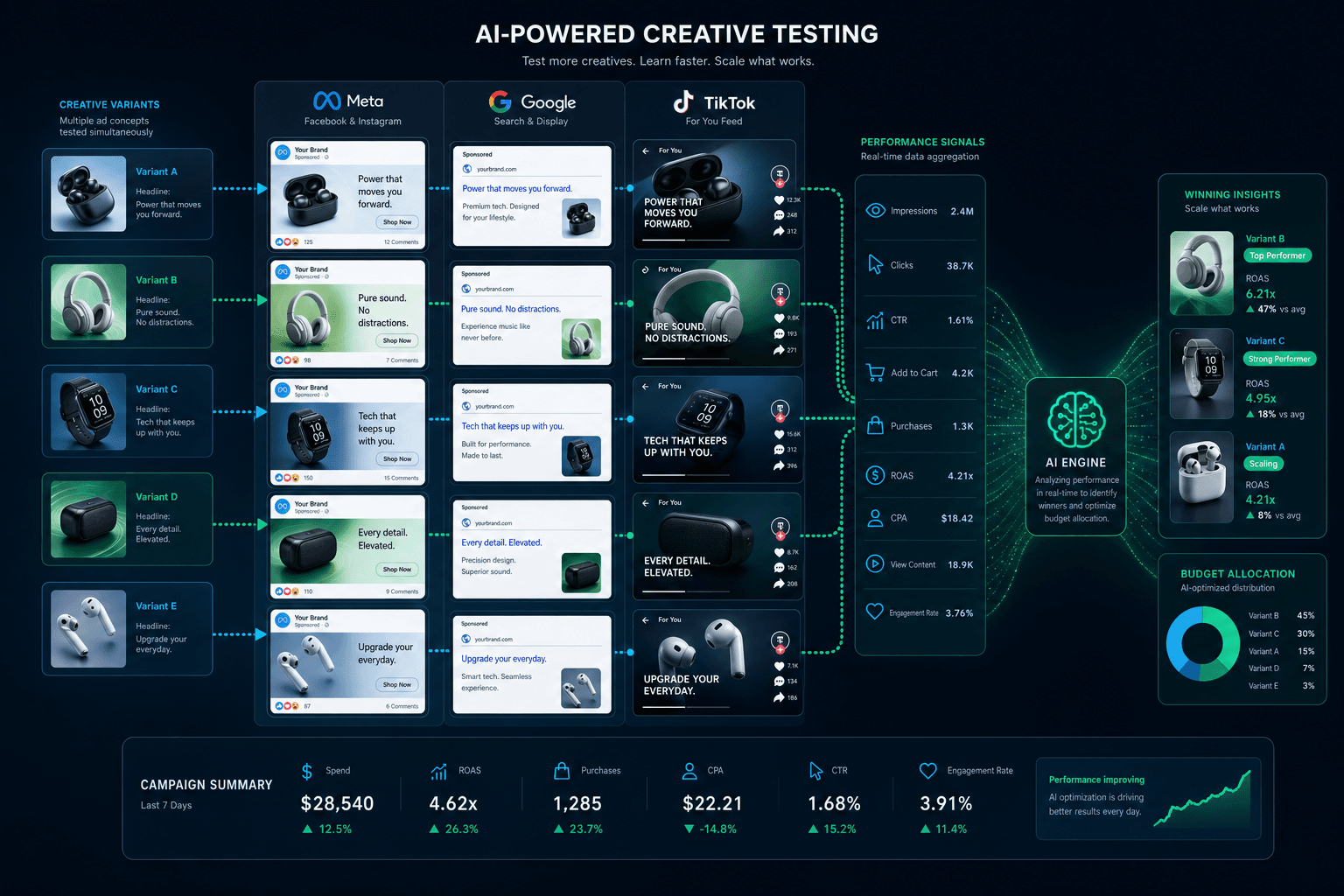
Meta's Advantage+ sales campaigns (formerly Advantage+ Shopping) average 4.52:1 ROAS, 22% above manual, at 17% lower CPA. Most electronics brands starve them of creative. Testing 20+ new creatives monthly yields 65% higher ROAS than cycling the same three ads.
TikTok UGC-style ads increase conversions 38% over polished brand creative at CPMs roughly 1.4x cheaper than Meta. Under-40 demand there is underpriced; most competitors treat TikTok as an experiment without real budget.
What Most Get Wrong
What Most Consumer Electronics Brands and Their Agencies Get Wrong
Optimizing blended ROAS alone instead of new-customer ROAS (nROAS)
Blended ROAS alone credits ads for repeat and organic buyers who'd convert anyway. Most agencies don't track nROAS separately or don't surface it, because blended looks better in monthly reports.
Running the same three creatives until fatigue collapses performance
High-spend Meta accounts typically see creative degrade after two to three weeks. Your product needs demonstration: without weekly new hooks, demo angles, and UGC, CPMs rise and hook rate drops.
Treating Q4 as the only season worth investing in
Ramping spend only in October and November puts you in the year's priciest auction with untested creative and cold audiences. BFCM winners built retargeting pools and proved creative in September.
Trusting platform numbers after iOS 14
Meta's reported ROAS can diverge 30–50% from incremental revenue. Without blended ROAS and triple-attribution, you budget on data that may be inflated and scale channels that aren't driving growth.
Siloing Amazon Sponsored Products, the highest-converting ad platform, from DTC
Sponsored Products convert at 9.96% because marketplace search carries purchase intent. Siloing them misses the halo effect: DTC drives branded Amazon search; Amazon reviews and velocity convert cold DTC traffic.
Why Now
Consumer Electronics Brands That Build on AI Before Back-to-School Enter Q4 Ahead
In consumer electronics ecommerce, CAC rose an estimated 40–60% from 2023 to 2025. Brands absorbing that without a structural response see LTV:CAC deteriorate, while brands building one (AI-assisted creative production, algorithmic budget pacing, real attribution) are widening their lead.
Before AI-assisted production, testing 20+ creative angles a month took a production team most sub-$20M electronics brands couldn't afford. Now an operator using AI for creative iteration, copy testing, and performance analysis can run that volume without proportionally scaling headcount, and that velocity compounds into ROAS.
Back-to-school and Q4 both reward brands that prepare a quarter ahead. Brands that fix attribution, prove creative, and warm audiences before each season enter it with an operational and data advantage that last-minute starters can't replicate.
The Mechanism
Where AI Creates an Edge for Consumer Electronics Brands
Real productivity, not AI theater. Here's where it actually moves a number for consumer electronic brands.
Creative
What AI does: AI-assisted production generates hook variations, demo script angles, and UGC-style ad concepts in parallel, and early test data feeds the next production cycle, prioritizing angles with the highest hook and hold rates.
The result: Testing 20+ concepts a month, up from 3–5, gives Meta's algorithm enough signal to find buyers efficiently, and fatigue stops capping scale.
Why it matters here: Buyers judge a $150 wireless speaker on sound, build, and use case. Finding the right demo angle first beats competitors' single hero videos on CPM.
Analytics
What AI does: AI triangulates your three attribution sources against blended ROAS to show what drives incremental revenue, flagging dashboard discrepancies before they compound into bad budget decisions.
The result: You allocate budget on real incrementality and can stop funding channels that only look like they're working in inflated platform numbers.
Why it matters here: At 20–35% gross margins, a 30% overestimate in Meta-reported ROAS can hide a channel that's quietly destroying margin while the dashboard shows green.
Digital Ads
What AI does: AI pacing watches Advantage+ sales, Google Shopping, and TikTok live, shifting spend toward campaigns hitting nROAS targets and away from those showing early creative fatigue or rising CPAs before any weekly review.
The result: Spend follows performance signals, so when Q4 performance can swing 3x either way, budget goes to the days and placements hitting target ROAS.
Why it matters here: Electronics CPMs can surge at peak and creative can fatigue within weeks, so brands optimizing in near-real-time hold a cost advantage over those optimizing monthly.
Conversion Optimization
What AI does: AI analyzes landing pages for the friction points that make electronics buyers bounce mid-research (demo gaps, review volume, return policy visibility, spec presentation), then generates and tests variants that address them.
The result: Your ATC rate rises and drop-off before checkout falls. From a 1.58% baseline, a 0.3–0.5 percentage point lift meaningfully improves effective ROAS without more spend.
Why it matters here: Forty-four percent of electronics shoppers prefer to handle a device before buying. AI tests whether video demos, AR, or trust signals best narrow that gap.
Social Media
What AI does: AI mines TikTok and Meta engagement data for the use cases, creator styles, and formats with your category's highest watch-through rates and lowest CPAs, then feeds them into UGC and paid-amplification briefs.
The result: Your UGC-style ads follow what wins in the auction, not what looks good in a brand presentation, and lower-CPM TikTok prospecting fills your retargeting pool.
Why it matters here: TikTok skews toward under-40 buyers, the main purchasers of wireless audio, smart home, and portable tech. Brands running it only for awareness miss new-customer revenue.
Ready to see what this looks like for your consumer electronic brands business?
No obligation. A senior strategist will show you exactly where the wins are.
The Strategy
How Performance Marketing Should Be Run for a Consumer Electronics Brand
Every allocation, creative, and pacing decision runs against nROAS and blended ROAS, not platform-reported or last-click ROAS. Channels that can't show incremental new-customer revenue at target margin get no more budget.
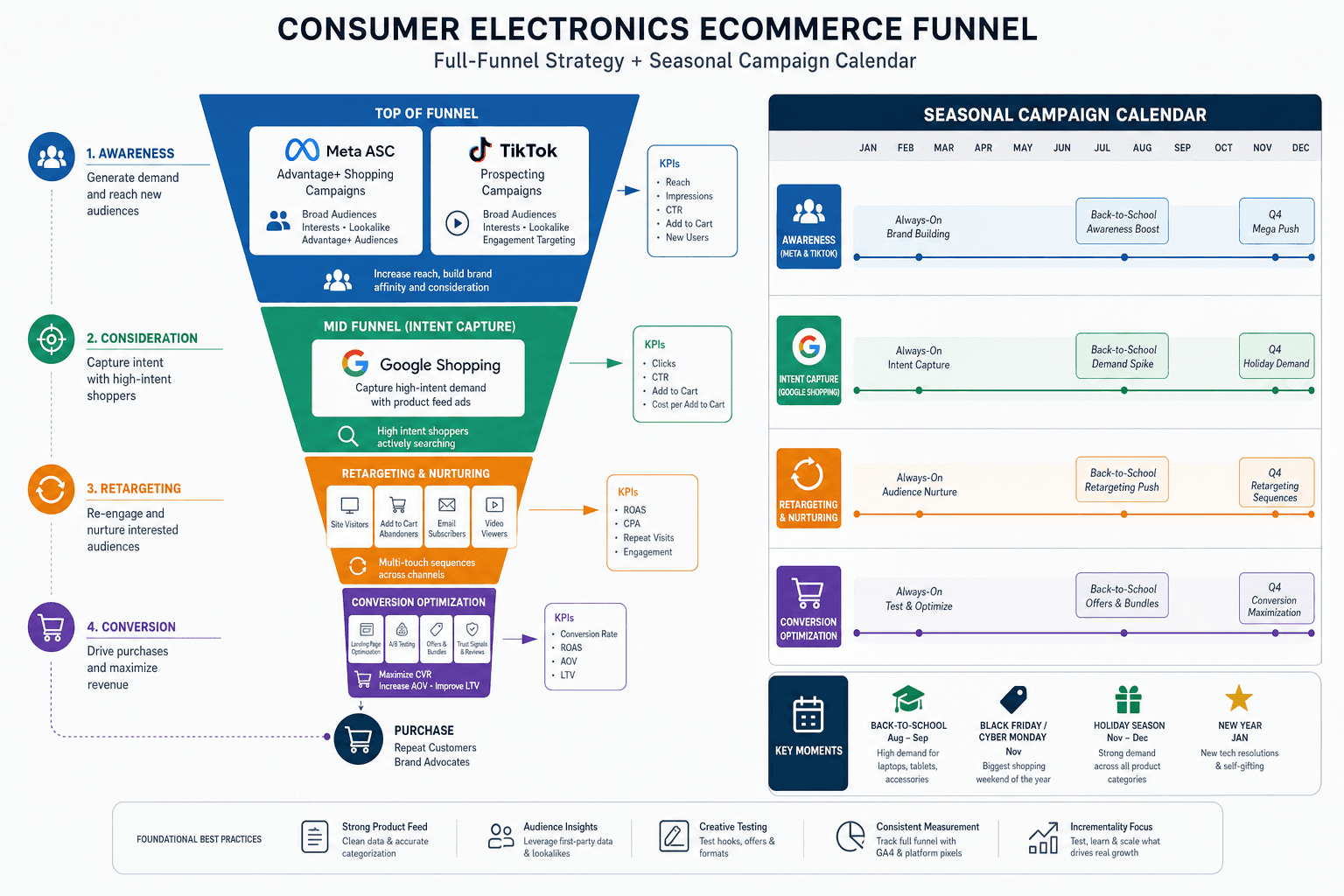
At $5M–$20M revenue, Advantage+ sales is the primary prospecting engine, fed 20+ new concepts monthly and judged on hook and hold rates before scaling.
Google Shopping closes decided buyers on late-research queries like 'product name + buy' and 'best [category] under $X'. TikTok runs lower-CPM, UGC-style prospecting for younger buyers.
Retargeting follows the research cycle, not a 7-day window: a cart abandoner may deliberate 14–21 days. Sequences answer objections that stall the sale (reviews, return policy, spec comparison) instead of only discounting.
Seasonality is budgeted from day one: back-to-school (late July–early September) gets dedicated spend and creative to build retargeting pools and prove angles at lower CPMs.
Q4 budget is pre-committed and creative pre-built before November. January and February are cheap months to test creative and audience structures for next year.
Attribution is triple-tracked: platform ROAS as a directional signal, GA4 as the session-level source of truth, and a post-purchase survey ('how did you hear about us?') as the incrementality check. We calculate blended ROAS weekly and investigate before scaling if it diverges from platform ROAS by over 20%.
The one number that governs this
Your north star is nROAS and blended ROAS, tracked weekly rather than monthly, with triple-attribution so you can trust the numbers behind every decision.
How We Help
What We Would Do for Your Consumer Electronics Brand
We take a limited number of clients so each gets senior attention. We skip generic playbooks and map this strategy to your margin structure, seasonal calendar, and attribution gaps.
Attribution & Analytics Setup
Before spending, we verify Meta's pixel and Conversions API, track the full GA4 funnel, and survey buyers post-purchase, so new-customer revenue reconciles with blended ROAS.
Paid Media: Meta Advantage+ Sales Campaigns
We run Advantage+ sales campaigns with 20+ new concepts a month, reading hook and hold rates before committing budget and pacing spend to performance.
Paid Media: Google Shopping & Search
We target 'best wireless earbuds under $150,' 'noise canceling headphones review,' and category + brand comparisons, splitting brand from non-brand to expose true new-customer cost.
Paid Media: TikTok
We build TikTok as a performance channel: UGC-style creative in formats and use-case angles that convert, with CPM targets for cost-effective prospecting that feeds retargeting.
Creative Production & AI-Assisted Testing
We use AI to produce hooks, demo angles, and UGC briefs at the volume of a full in-house production team; each cycle feeds the next.
Conversion Optimization
We audit product and landing pages for the friction points that stall electronics buyers and test fixes.
Seasonal Campaign Planning
We build back-to-school and Q4 campaigns early and use off-season months to test creative cheaply for next year.
Who's Behind This
Who we are, and what makes us different
Sagum is a performance marketing agency founded in January 2017 in St. George, Utah. We've spent 8+ years growing real brands and being judged on KPIs, not vanity metrics.
We deliberately limit how many clients we take so each one gets senior attention. We treat your numbers like our own, we never run generic playbooks, and your strategy is built for your business, because shouldn't your brand's marketing be custom to your brand?
Sagum.ai is our AI arm: the same proven operators now build AI into the work wherever it creates real edge, not as theater, but as leverage applied with discipline.
- 8+ years growing brands on performance KPIs, not vanity metrics
- Limited client roster, with senior attention on every account
- An extension of your team; your success is tied to ours
- Custom strategy per brand, never a generic playbook
- AI built in where it moves a number; judgment over hype
“Sagum is a performance marketing agency that's spent 8+ years growing brands by treating their numbers like our own. We take on few clients, never run generic playbooks, and now build AI into the work wherever it creates real edge, not hype. Your strategy is built for your business, and our success is tied to yours.”

“After six years, Sagum is our most important partner: trusted, communicative, and caring about our business as if it's their own.”
Long-term partner
6-year client
Proof
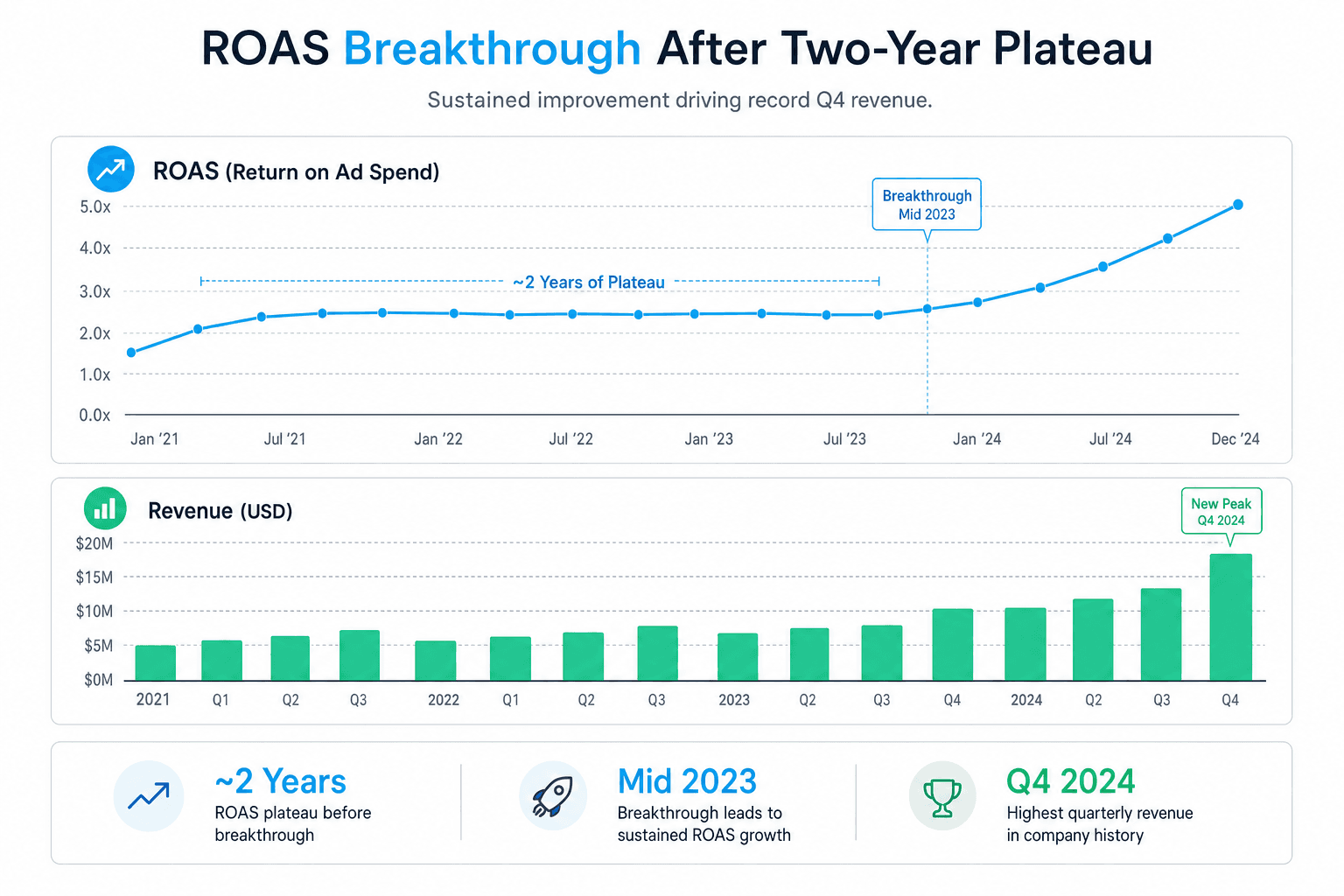
Broke a 2-year ROAS plateau with +115% ROAS at the same spend
House of Jade
Challenge
House of Jade, a home-goods ecommerce brand, had been stuck on a ROAS plateau for two years.
What we did
We restructured its strategy without increasing spend. Restructuring before adding budget is the method that carries over to an electronics brand on a plateau.
Result
House of Jade broke its two-year plateau, improving ROAS 115% at the same spend, then posted its biggest, most profitable Q4.
If ROAS Is Plateauing or Attribution Doesn't Add Up, Let's Talk
No obligation. We'll bring a specific read on your channel mix, attribution setup, and creative velocity, and name your biggest nROAS opportunity. If we're not a fit, you'll still leave with something useful.
Sagum · January 2017 · St. George, Utah · 8+ years