
8+ years growing brands on KPIs, now with AI
CPG growth that survives real attribution
We fix the measurement, build the creative engine, and scale spend only when unit economics allow.
8+ years growing DTC brands · Google, Meta & TikTok partner · CPG-specific playbooks, not generic agency templates



Get your free Growth Gap Analysis
Senior strategist review · response within one business day
Prefer to reach out directly?
The Challenge
The Real Problem with Scaling a CPG Brand Isn't the Product. It's the Math
You already know your product works. The problem is that the economics of selling it online are brutal in ways most agencies never acknowledge.
Your AOV is probably somewhere between $58 and $91 depending on your sub-vertical, and your first-order CAC is likely $75 to $130 or more once you factor in agency fees, creative production, and influencer costs alongside your ad spend. The platform dashboard might show a $38 CAC. The real number, fully loaded, is often $61 or higher. That gap is where DTC CPG brands quietly die.
Meanwhile your margin stack is getting squeezed from every direction. A product with 55% contribution margin on DTC might land at 32% on Amazon after FBA fees and marketplace discounts. Private label competition from the retailers you're trying to get into is accelerating: McKinsey found 79% of global consumers say they're trading down in 2025. And the CPG incumbents with 40% of revenue to spend on ads can simply outbid you on CPMs all day.
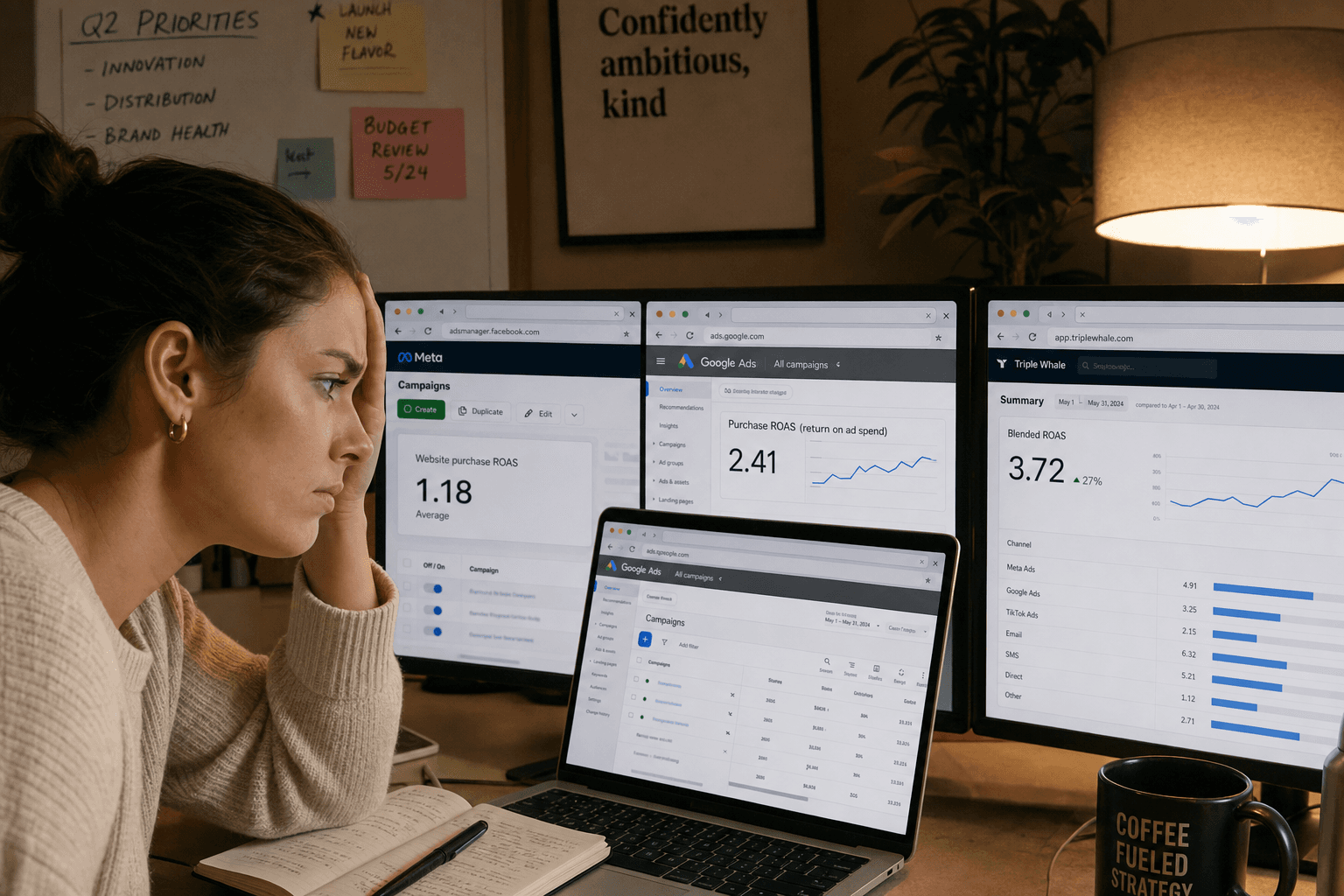
On top of all that, your attribution is a mess. Meta's in-platform ROAS says one thing. Your MTA tool says something 20 points lower. Your blended MER tells a third story. You're data-fluent enough to know the numbers don't agree, but you're not sure who to trust, so you make budget decisions on instinct and hope.
The result: you cut spend when you should be scaling, scale when you should be cutting, and never quite trust whether the growth is real or a measurement artifact. That's not a creative problem or a channel problem. It's a measurement and strategy problem, and it has to be solved before anything else.
The Opportunity
The Brands That Win in CPG Ecommerce Know One Number Everyone Else Ignores
The brands pulling away from the pack right now aren't the ones with the biggest ad budgets. They're the ones who know their true blended ROAS and contribution margin per order, and use that number to make every spend decision with confidence.
When you know your real CAC payback period and your cohort LTV by acquisition month, you stop guessing. You can afford to scale Meta spend into Q4 because you know the math holds. You can kill the six SKUs that are contribution-negative before they quietly drain $200K in margin. You can see that moving monthly churn from 18% to 14% on your subscription base fully offsets a rising CAC, and you actually do it.
The opportunity right now is significant. U.S. DTC ecommerce is projected to hit $186 billion in 2025. TikTok Shop alone drove over $100 million during BFCM 2024. Almost half of consumers purchased directly through social media last year, up from 21% in 2019. The discovery surface for CPG has never been larger.
But most CPG brands are leaving that demand on the table because they can't trust their numbers enough to invest aggressively. Fix the measurement, build a creative engine that feeds TikTok and Meta with enough volume to find what actually converts, and protect your 20% DTC contribution margin while you scale. That's the playbook. It's not complicated. It's just rarely executed well.
What Most Get Wrong
What Most CPG Brands (and the Agencies They Hire) Get Wrong
Trusting platform-reported ROAS as the governing number
Meta says it drove 40% of revenue. Your MTA tool says 22%. A media mix model says 31%. Brands that optimize to the platform number end up over-investing in channels that look good in dashboards and under-investing in what's actually driving contribution margin. You make worse decisions the more you trust a single source.
Ignoring contribution margin at the SKU level
A CPG brand at $18M revenue with 24 SKUs can have 6 of them contribution-negative, losing money on every unit sold, while the brand cross-subsidizes them without knowing it. Running ads to a loss-making SKU at any ROAS is still losing money. Most agencies never look at the margin stack; they just optimize for purchase volume.
Treating Q4 as the whole strategy instead of a multiplier
CPG brands over-index on BFCM and December for new customer acquisition, then coast. But the January resolution window (critical for supplements, food, and wellness brands) is often completely underfunded. And brands that haven't locked in their ad strategy and creative by August feel it badly in November when CPMs spike and there's no time to test.
Building the entire growth engine on one channel
Brands that built their acquisition strategy around TikTok's organic algorithm face real platform risk, and brands that went all-in on Meta paid acquisition are now watching CPMs approach TikTok parity at $14 median. A single-channel CPG brand is one algorithm change or policy shift away from a ROAS cliff.
Underestimating the real CAC and running out of runway
A $25 supplement brand with a $130 fully-loaded CAC is underwater from day one on first-order profitability. When agencies report CAC from the ad platform alone (stripping out creative costs, agency fees, and influencer spend), founders scale into a cash flow crisis they didn't see coming. Real CAC typically runs 30–60% higher than what the dashboard shows.
Why Now
Why the Next 6 Months Are the Window for CPG Brands That Get This Right
Two things are converging right now that create a real edge for CPG brands willing to move with discipline.
First, the creative bar on TikTok and Meta has risen sharply, but the testing capacity of most brands hasn't. The brands winning on TikTok Shop and Meta right now are running 15 to 30 creative variations per month, finding the angles that convert at acceptable CAC, and killing the losers fast. Most CPG brands are still producing 3 to 5 pieces of creative per month and hoping one works. AI-assisted creative production and testing changes that math dramatically, not by replacing good creative judgment, but by compressing the time between hypothesis and answer.
Second, Q3 is the decision window for Q4. Inventory commitments are being made now. Brands that lock in their measurement infrastructure, creative pipeline, and channel strategy before August will enter BFCM with a tested, optimized system. Brands that wait until October are running cold creative into the most expensive CPM environment of the year with no data to guide them.
Most of your CPG competitors are still running the same Meta campaigns they ran last year, trusting platform ROAS, and hoping the TikTok situation resolves itself. An operator who fixes attribution, builds a real creative testing engine, and knows exactly which SKUs are worth scaling (right now, before the peak) will own the margin that everyone else leaves behind.
The Mechanism
Where AI Actually Creates an Edge for CPG Ecommerce (and Where It Doesn't)
Real productivity, not AI theater. Here's where it actually moves a number for cpg brands.
Creative
What AI does: AI-assisted creative production and structured testing frameworks that generate 15–30 ad variations per month across hooks, formats, and UGC angles, then systematically identify which combinations drive the best contribution margin per order, not just click-through rate.
The result: You find the creative angles that actually convert at your target CAC in weeks instead of quarters, and you stop spending months on a single ad concept that might not work.
Why it matters here: CPG purchase decisions on TikTok and Meta are driven by the first three seconds of a video and the social proof in the comments. The brand that tests 20 hooks finds the one that converts at $75 CAC while competitors are still running the one hook they shot in January. For a category where creative fatigue sets in fast, especially around BFCM, volume of tested creative is a direct competitive advantage.
Analytics
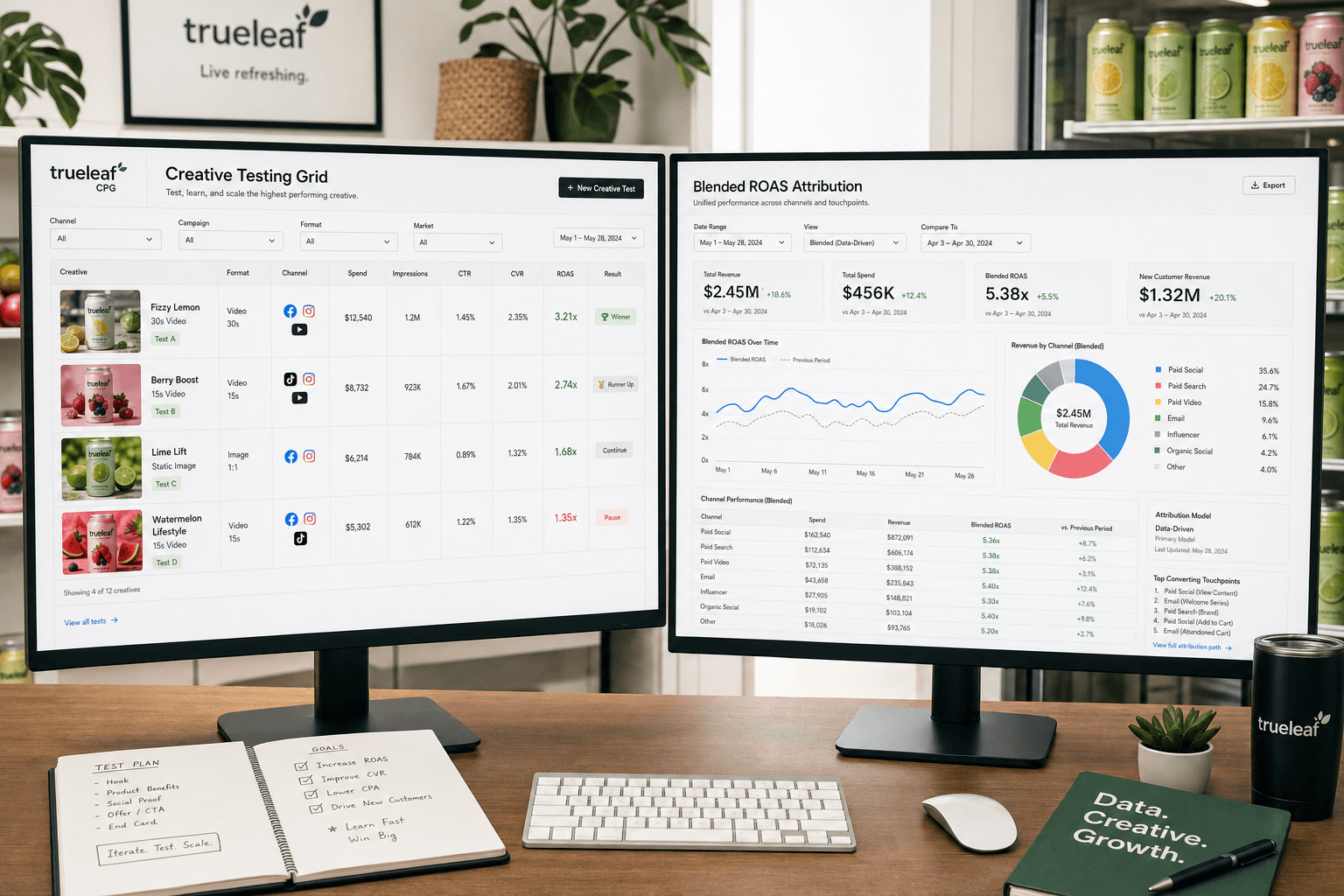
What AI does: AI-assisted attribution modeling that triangulates platform-reported ROAS, blended MER, and cohort LTV data to produce a single decision-ready number, and flags when platform reporting is inflating results due to pixel misconfiguration, overlap, or view-through overcounting.
The result: You stop making budget decisions based on numbers that disagree with each other, and you catch the attribution errors that are making underperforming channels look profitable.
Why it matters here: The gap between Meta's reported ROAS and true blended MER is where CPG brands lose the most money, not to bad creative, but to bad measurement. A misfiring pixel can make a channel look 2x better than it is, leading to scaled spend that destroys contribution margin. Fixing this is the prerequisite to scaling anything else confidently.
Digital Ads
What AI does: AI-driven budget allocation across Meta, TikTok, and Google Shopping that shifts spend in real time based on blended ROAS signals, scaling into channels where contribution margin is healthy and pulling back before CAC payback extends past 12 months.
The result: Ad spend follows the math instead of a monthly budget plan that was set before anyone knew how the creative or the season was going to perform.
Why it matters here: CPG brands have hard inventory and cash flow constraints. Spending $50K in the wrong channel in September because the budget was set in July means you enter Q4 underfunded on the channels that are actually working. Dynamic allocation, anchored to contribution margin signals rather than platform ROAS, is how you protect working capital while still scaling into peak.
What AI does: AI-built email and SMS automation sequences segmented by subscription status, reorder probability, and cohort LTV, with send-time optimization and churn-risk triggers that identify subscribers approaching cancellation before they leave.
The result: Monthly churn drops measurably, subscription attach rate improves, and email becomes a reliable 30–40% of revenue rather than a batch-and-blast afterthought.
Why it matters here: For a CPG subscription brand, moving monthly churn from 18% to 14% can fully offset a rising CAC. It's the highest-leverage math in the business. Email and SMS are the only channels where you own the relationship and pay no CPM. An AI-optimized retention sequence is not optional for a brand trying to hit a 3:1 LTV:CAC ratio.
Conversion Optimization
What AI does: AI-assisted landing page and product detail page testing focused on AOV lift (bundle recommendations, subscribe-and-save prompts, free shipping threshold messaging, and social proof placement) with continuous analysis of where the funnel is leaking contribution margin.
The result: AOV increases without increasing ad spend, which directly improves first-order contribution margin and compresses CAC payback period.
Why it matters here: For a CPG brand where first-order profitability is often negative, a $12 lift in AOV through a bundle or subscription prompt can be the difference between a 14-month CAC payback and a 10-month one. That math compounds across every customer you acquire. Most CPG brands run the same product pages for years without testing. AI-assisted CRO finds the leaks fast.
Ready to see what this looks like for your cpg brands business?
No obligation. A senior strategist will show you exactly where the wins are.
The Strategy
What a Real CPG Ecommerce Marketing Strategy Actually Looks Like
Before any channel strategy, you need clean measurement. That means a properly configured pixel across DTC and any Shopify or headless storefront, a blended MER calculation you trust, and SKU-level contribution margin data that tells you which products are actually worth scaling ad spend against. Without this foundation, every channel decision is a guess.
Once measurement is clean, the channel stack for a DTC CPG brand at meaningful scale looks like this: Meta is the workhorse for acquisition, with unmatched targeting depth for finding buyers who look like your best subscription customers. TikTok is the discovery engine, particularly for food, beverage, beauty, and wellness brands where micro-creator content and UGC outperform polished brand ads. Google Shopping captures the replenishment intent that Meta and TikTok create: the customer who saw your protein bar on TikTok and is now searching to reorder. Email and SMS own retention and subscription management, the highest-margin revenue you have.
The creative strategy has to feed all of this with enough volume to actually learn. That means 15 to 30 new creative variations per month, structured around hook testing, format testing (Reels vs. static vs. UGC), and offer testing, with a clear kill threshold so you're not running creative that's been losing for six weeks.
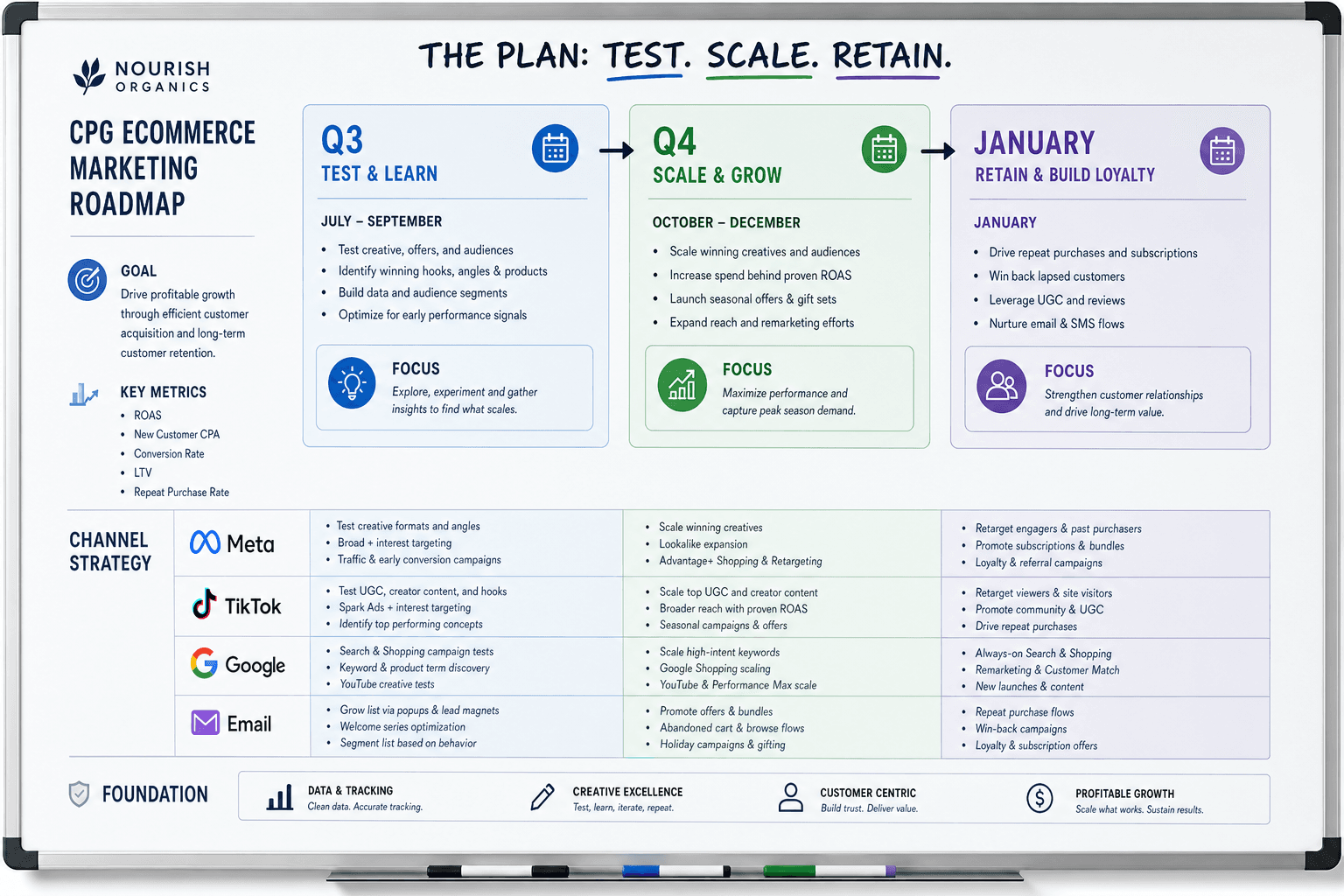
Budget pacing is tied to your inventory position and your CAC payback ceiling, not to a flat monthly spend. In Q3 you're building the creative library and testing. In Q4 you're scaling what's proven. In January you're capturing the resolution window with a retention-focused offer for new customers acquired in BFCM. In February you're protecting margin and planning the next peak.
Every decision is anchored to one number: blended ROAS expressed as contribution margin per order, not platform ROAS, not revenue, not impressions.
The one number that governs this
Governing KPI: Blended ROAS / Marketing Efficiency Ratio (total revenue ÷ total ad spend), expressed alongside contribution margin per order. Platform-reported ROAS is an input, not the answer.
How We Help
Here's Exactly How We'd Run This for Your CPG Brand
We don't hand you a channel plan and disappear. We run the execution, and we treat your contribution margin like it's our own. Here's the sequence we'd follow for a CPG brand coming into the engagement:
Attribution & Measurement Audit
Before we touch ad spend, we audit your pixel configuration, cross-reference platform ROAS against your blended MER, and identify any attribution errors inflating your numbers. We've caught misfiring pixels that were making a channel look twice as good as it was. Fixing that first is what makes every downstream decision trustworthy.
SKU-Level Contribution Margin Analysis
We work with your margin stack (COGS, variable costs, DTC vs. Amazon channel margins) to identify which SKUs are worth scaling ad spend against and which are contribution-negative. We don't run ads to products that lose money at your target CAC.
Paid Social (Meta & TikTok)
We build and manage your Meta and TikTok acquisition campaigns anchored to blended ROAS targets, with dynamic budget allocation that follows contribution margin signals rather than a fixed monthly plan. Campaign structure is built around your best-margin SKUs and subscription attach opportunities.
Creative Production & Testing Engine
We build a structured creative testing system (15 to 30 variations per month across hooks, formats, and UGC angles) with clear kill thresholds and a weekly learning loop. We use AI to compress production time so you're testing more angles per week than competitors test per quarter.
Google Shopping & Search
We capture the replenishment and branded search demand that your Meta and TikTok spend creates, making sure the customer who discovered you on social actually converts when they search to reorder, and that you're not ceding that intent to Amazon or a competitor.
Email & SMS Retention Automation
We build or rebuild your post-purchase sequences, subscription onboarding flows, and churn-risk triggers, segmented by cohort LTV and reorder probability. The goal is a measurable reduction in monthly churn and a subscription attach rate that improves your CAC payback period.
Conversion Optimization (AOV & Subscription Attach)
We run structured tests on your product pages and cart experience focused on AOV lift (bundle offers, subscribe-and-save prompts, free shipping threshold messaging) with AI-assisted analysis identifying where the funnel is leaking contribution margin.
AI Systems & Ongoing Performance Intelligence
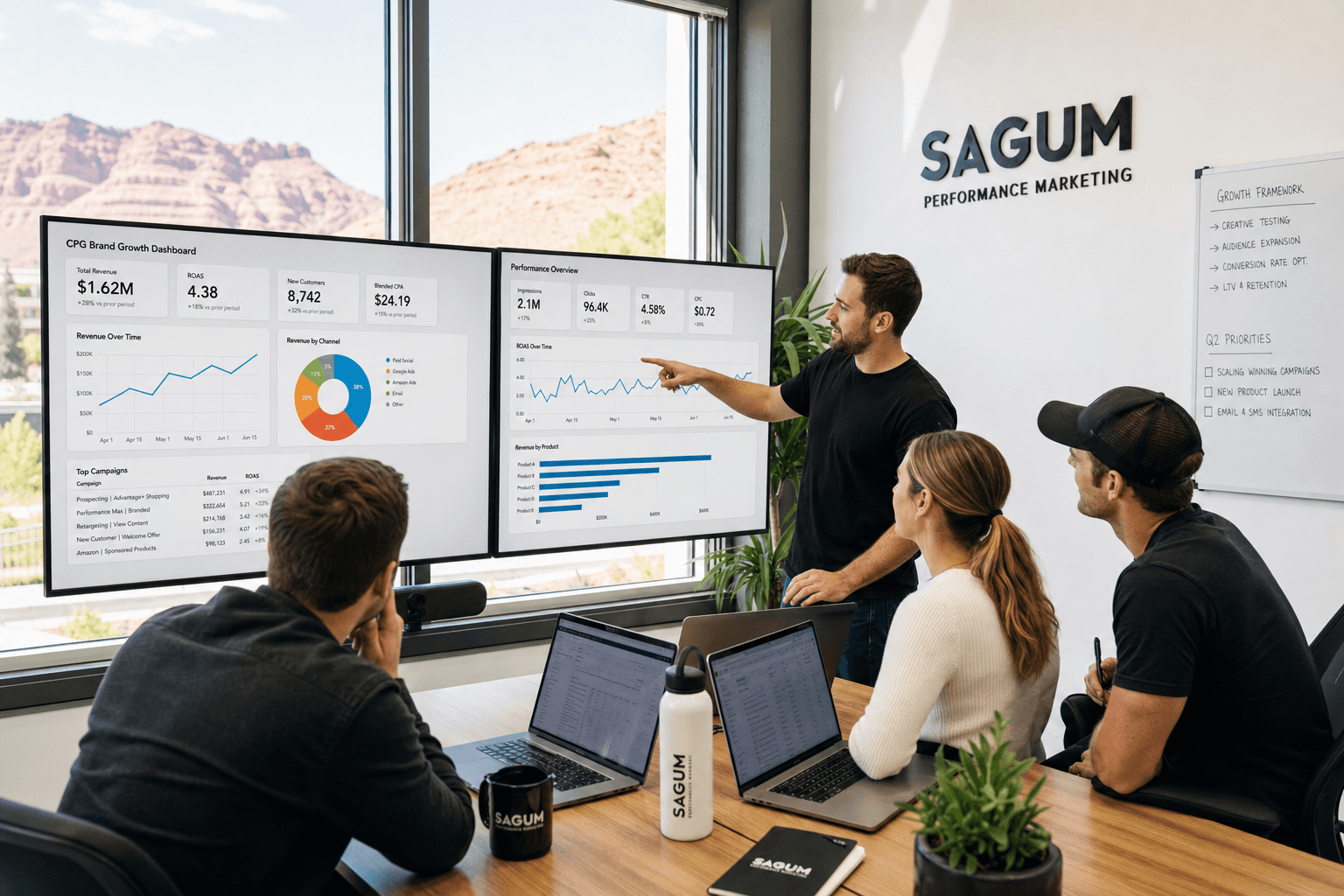
We build AI into the reporting and optimization layer, not as a gimmick, but as the infrastructure that lets a lean team catch attribution drift, creative fatigue, and margin leaks faster than a manual weekly review ever could. You get a dashboard that shows blended MER, CAC payback, and cohort LTV in one place, updated continuously.
Who's Behind This
Who we are, and what makes us different
Sagum is a performance marketing agency founded in January 2017 in St. George, Utah. We've spent 8+ years growing real brands and being judged on KPIs, not vanity metrics.
We deliberately limit how many clients we take so each one gets senior attention. We treat your numbers like our own, we never run generic playbooks, and your strategy is built for your business, because shouldn't your brand's marketing be custom to your brand?
Sagum.ai is our AI arm: the same proven operators now build AI into the work wherever it creates real edge, not as theater, but as leverage applied with discipline.
- 8+ years growing brands on performance KPIs, not vanity metrics
- Limited client roster, with senior attention on every account
- An extension of your team; your success is tied to ours
- Custom strategy per brand, never a generic playbook
- AI built in where it moves a number; judgment over hype
“Sagum is a performance marketing agency that's spent 8+ years growing brands by treating their numbers like our own. We take on few clients, never run generic playbooks, and now build AI into the work wherever it creates real edge, not hype. Your strategy is built for your business, and our success is tied to yours.”
“Sagum roughly doubled our bottom line. They treat the work like it's their own business.”
Proof
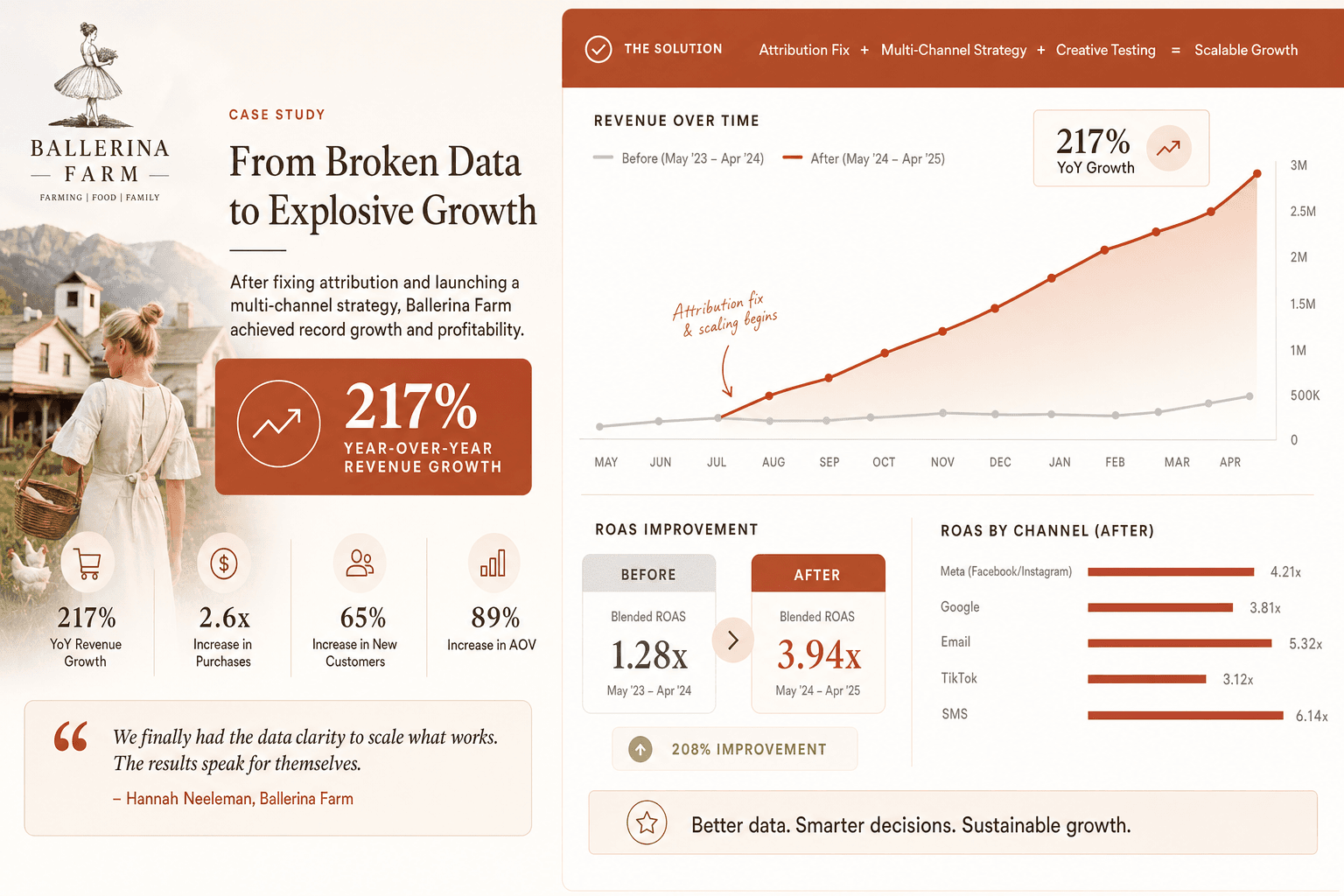
95% growth in 6 months, 217% YoY after fixing a misfiring pixel
Ballerina Farm
Challenge
Ballerina Farm was scaling spend across TikTok, Google, and Pinterest but couldn't trust their numbers: a misfiring pixel was inflating reported performance and masking where the real contribution margin was coming from. They needed clean attribution before they could scale confidently.
What we did
We audited and corrected the pixel configuration, rebuilt the attribution model to reflect true blended performance, then scaled spend across TikTok, Google, and Pinterest with budget allocation anchored to verified ROAS rather than the inflated dashboard numbers.
Result
The result was 95% growth in 6 months and 217% year-over-year growth, with a 64% improvement in ROAS versus the original plan. The measurement fix wasn't a side project; it was the prerequisite that made the growth possible. Full details at sagum.com/case-studies/.
Your Blended ROAS Is Probably Not What Your Dashboard Says It Is. Let's Find Out What It Actually Is.
No obligation. No generic audit template. We'll look at your actual numbers (attribution setup, SKU-level margin, CAC payback) and tell you honestly where the real growth is and what's standing in the way. Built around your brand, not a CPG playbook we recycle.
Sagum · January 2017 · St. George, Utah · 8+ years