
8+ years growing brands on KPIs, now with AI
Discreet Divorce Attorney Marketing That Books Consults
We build family law marketing around the way distressed prospects actually search, compare, and decide to hire.
8+ years growing service-business leads on Google, Meta, and TikTok



Get your free marketing audit
Senior strategist review · response within one business day
Prefer to reach out directly?
The Challenge
Marketing a Divorce Practice Is Nothing Like Marketing Any Other Service
Your prospective clients are not browsing casually. They are sitting in a parked car at lunch or lying awake at 11 PM on a phone they share with no one, searching 'divorce attorney near me' while their spouse is in the next room. They are frightened, private, and often in the middle of the most destabilizing event of their adult life.
That emotional reality shapes everything about how you have to market. The wrong creative on a retargeting ad can surface on a shared family tablet and blow up a client's safety. The wrong intake process, one that takes 48 hours to call back, hands that prospect to the firm down the street. Because 79% of legal consumers expect a response within 24 hours, and many firms never reply at all.
Your best cases, the contested custody fights, the high-asset divorces with business interests to value, the modifications where a parent's financial future is on the line, are not won at the top of a Google search. They are won in the 15 minutes after someone fills out your intake form. Most firms have no system for that window.
Add to this the hyper-local reality of family law: you practice in specific counties, before specific judges, under state bar advertising rules that vary materially from California to Texas to Florida. A national agency running generic 'divorce lawyer' campaigns has no idea what bench your client is headed to, what retainer your market supports, or what the bar in your state will and will not allow you to say.
The January surge is real, a reliable jump in inquiries every year in the weeks after New Year's Day, but the actual filing peak does not arrive until March. Firms that cut ad budgets in February because 'January is over' miss the second half of their biggest season. And the secondary late-summer spike, when couples who held together all summer for the kids finally stop, goes almost completely unserved by competitors running flat, set-and-forget campaigns.

The Opportunity
The Demand Is There. Most Firms Just Let It Walk Out the Door.
A contested divorce with a custody dispute or significant marital assets generates $15,000 to $50,000 or more in total attorney fees. High-conflict cases involving business valuation routinely exceed that. The initial retainer alone on a moderately contested matter runs $3,000 to $5,000. On a high-asset case, $10,000 to $15,000 at signing is common.
Those cases are being searched for in your county right now. Google Search CPCs for terms like 'divorce lawyer near me' and 'child custody attorney' run high in competitive metros because the economics justify it. The question is not whether the demand exists. The question is whether your firm is the one capturing it, or whether it is going to the firm that answers the phone faster.
In Clio's 2024 secret-shopper study, only 40 percent of law firms answered the phone and just 33 percent replied to emails. Every unanswered inquiry is a lead that simply disappears. A firm with a disciplined intake system, one that calls back within 15 minutes, screens for matter type and ability to fund a retainer, and follows up through touch three, four, and five, can realistically convert a far larger share of qualified inquiries into signed clients than the typical firm does.
That conversion gap is not a marketing problem. It is a marketing-plus-operations problem, and it is exactly where the right strategy creates compounding advantage. More qualified consultations booked at a lower cost per retained client, with intake systems that do not let good prospects go cold.
What Most Get Wrong
What Most Family Law Firms and Their Agencies Get Wrong
Running one campaign for all matter types
A prospect searching 'child custody modification attorney' and a prospect searching 'uncontested divorce flat fee' are not the same buyer, do not have the same urgency, and cannot fund the same retainer. Lumping them into one campaign means your ads, landing pages, and intake scripts are wrong for both. You pay $80 a click to land a prospect on a page that does not speak to their specific situation, and they leave.
Ignoring the January-to-March window or cutting budget too early
The January surge is well documented, but the actual filing peak arrives in March. Firms that treat January 31 as the end of the season and reduce spend in February abandon the second half of their highest-demand period. Competitors who stay in the auction through March own the market during the exact weeks when prospects are moving from 'I decided' to 'I signed a retainer.'
Privacy-blind retargeting that alarms prospects on shared devices
Pixel-based retargeting that serves 'divorce attorney' ads to someone who searched on a shared browser can surface on a family tablet, a shared laptop, or a spouse's phone. Beyond the personal harm this can cause, it destroys trust in your firm instantly. Where retargeting is allowed at all (Google bars remarketing lists for divorce services), generic creative ('family legal questions?') with strict frequency caps is not optional in this vertical. It is a basic obligation.
Slow or absent intake follow-up
Leads contacted within five minutes are 21 times more likely to qualify than those contacted after 30 minutes. Most firms call back the next business day, if at all. That prospect, who was emotionally ready to hire at 10 PM on a Tuesday, has had a full night to reconsider, found two other attorneys through a Google search the next morning, and is now comparing retainers. You lost a $15,000 case because no one called within the hour.
Buying shared leads from aggregators and calling it a marketing strategy
Shared-lead vendors often sell the same inquiry to several competing firms at once. You are not buying a lead. You are buying a race. Exclusive leads cost more per unit and convert at dramatically higher rates because you are the only firm calling. Firms that build their own inbound pipeline through search and LSAs own the relationship from the first click.
Why Now
Why the Next 90 Days Are the Right Window to Build This
December 26 through March 31 is the highest-demand period in family law, full stop. Inquiries spike in January. Filings peak in March. Firms that enter this window with campaigns already segmented by matter type, landing pages already tuned to drive consultation bookings, and intake systems already tested are the ones who set their retained-client numbers for the year.
Most of your local competitors are running the same campaigns they ran last year. Static budgets, one landing page for all matter types, no call tracking, no intake automation. They will be in the same auction as you in January, spending more per click, converting fewer of those clicks into consultations, and losing retained clients to whoever answers the phone first.
The AI inflection point matters here in a specific way. The firms winning right now are not the ones with the biggest ad budgets. They are the ones testing more creative angles per week, catching attribution errors before they inflate their CPL numbers, and using AI-assisted intake tools to respond to after-hours inquiries within minutes instead of the next business day. These are operational advantages that compound over a season.
Building this takes time. Landing pages need to be live. Tracking needs to be clean. Intake needs to be tested before volume hits. The firms that start now own January. The ones that wait until January 2 are playing catch-up through March.
The Mechanism
Where AI Creates a Real Advantage in Family Law Marketing
Real productivity, not AI theater. Here's where it actually moves a number for divorce attorneys.
Digital Ads
What AI does: AI-assisted campaign segmentation and bid management by matter type, county, and time of day, with automated budget shifts toward the campaigns booking consultations rather than just generating clicks.
The result: Your budget follows actual consultation-booking performance in real time rather than a monthly guess. High-intent 'child custody attorney [county]' campaigns get more budget when they are converting. Broad, low-intent traffic gets less.
Why it matters here: Family law CPCs run high in competitive metros. At that cost, every dollar misallocated to the wrong campaign, the wrong county, or the wrong time of day is a meaningful loss. Manual campaign management at that CPC level is expensive guesswork. AI-assisted allocation is how you hold your cost per retained client at a number that makes the economics work.
Analytics and Attribution
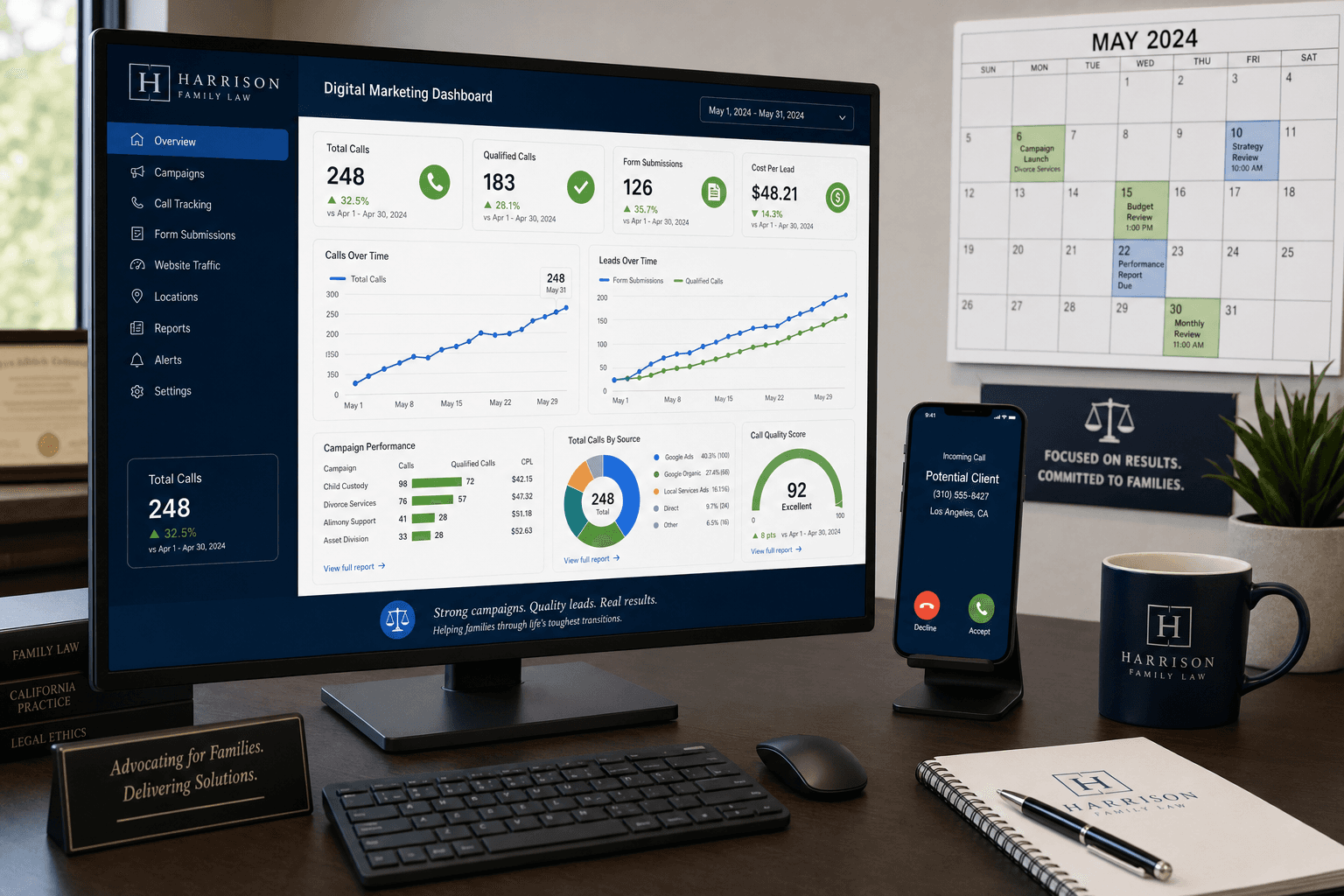
What AI does: AI-assisted attribution auditing that traces every booked consultation and signed retainer back to the specific campaign, ad, keyword, and landing page that produced it, with call tracking integrated so phone conversions are not invisible.
The result: You know which matter-type campaigns are producing retained clients and which are producing unqualified consultations. You stop optimizing toward the wrong signal.
Why it matters here: Most family law firms optimize toward form fills. Form fills include unqualified inquiries, wrong-county prospects, and people who cannot fund a retainer. Without call tracking and proper attribution, you are making budget decisions based on noise. The real KPI is cost per retained client, and you cannot manage what you cannot see.
Conversion Optimization
What AI does: AI-assisted landing page builds and continuous testing, one page per matter type (divorce, custody, support modification, high-asset), each designed to drive a single action: book a consultation or call now. AI reviews pages for conversion leaks, form friction, and mobile experience on an ongoing basis.
The result: Matter-specific pages that speak directly to the prospect's situation convert at higher rates than a generic firm homepage. A custody page that addresses parenting plans and school-district decisions speaks to a different emotional state than a high-asset page that addresses business interests and retirement accounts.
Why it matters here: Your prospect is on a phone, often late at night, emotionally activated, and comparing you to two other firms they have already visited. A page that immediately mirrors their specific situation, uses their language, and makes booking a consultation feel easy and private is the difference between a retained client and a bounce.
Creative
What AI does: AI-assisted generation and testing of ad creative across gender-differentiated messaging angles (asset protection and fathers' rights framing versus child safety and financial security framing), matter-type-specific copy, and seasonal urgency messaging for the January and late-summer peaks.
The result: Instead of running one or two ad variations for months, you test five to ten angles per week. The messages that book consultations get more budget. The ones that do not get retired quickly.
Why it matters here: Men and women searching for divorce representation respond to meaningfully different messages. A firm running one set of ads for all prospects is leaving consultations on the table every day. Faster creative testing means you find the right message for each segment before your competitor does.
Ready to see what this looks like for your divorce attorneys business?
No obligation. A senior strategist will show you exactly where the wins are.
The Strategy
The Marketing Strategy That Actually Works for a Family Law Practice
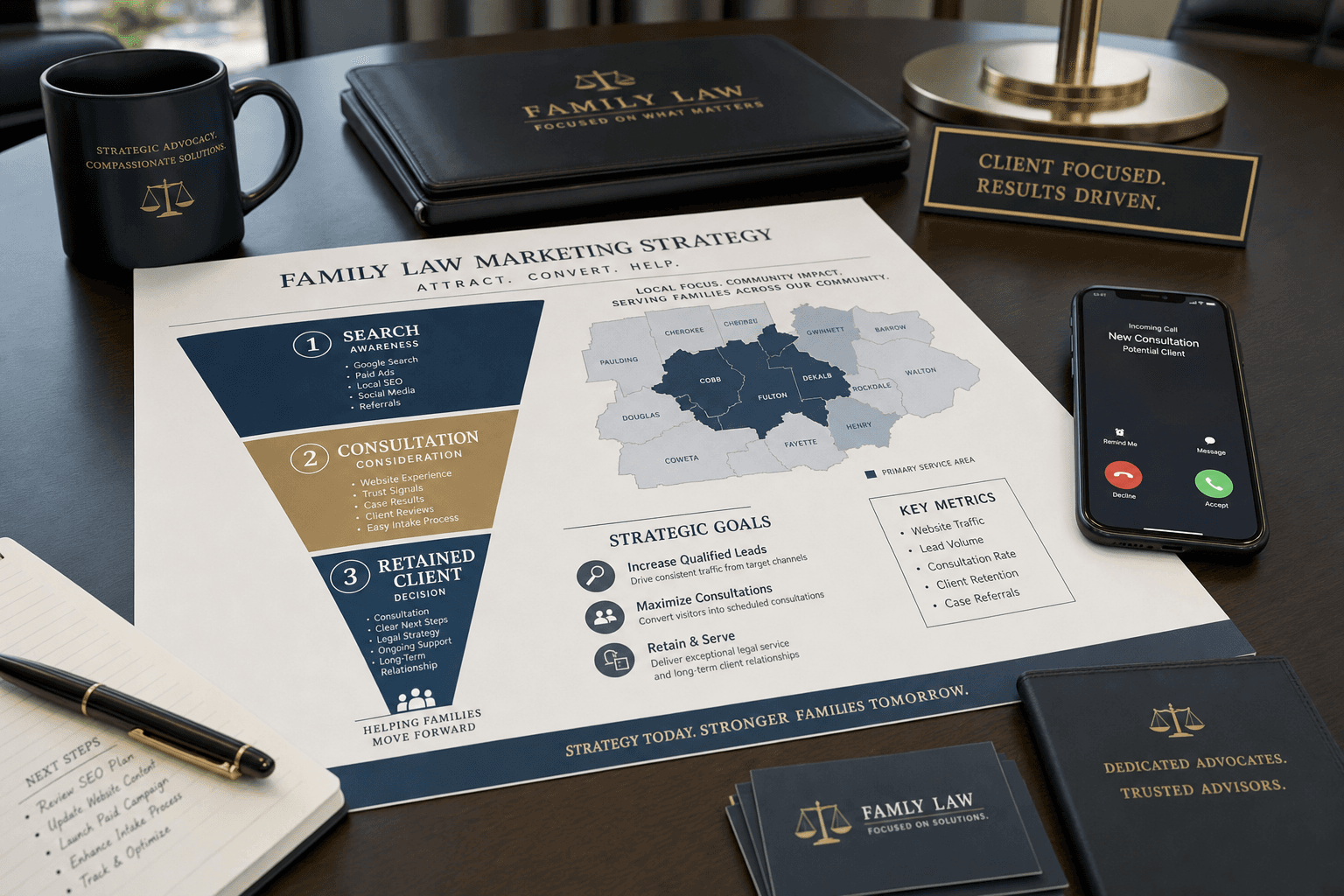
The foundation is Google Search, segmented by matter type. You run separate campaigns for contested divorce, child custody, support modification, high-asset divorce, and mediation because the intent, the urgency, the retainer size, and the right message are different for each. Each campaign has its own ad group, its own landing page, and its own intake path. You bid at the county level, not the metro level, because family law is practiced county by county.
On top of Search, Google Local Services Ads earn top-of-page placement on a pay-per-validated-lead model and require state bar verification, which filters out non-attorneys and signals credibility to prospects. Rating and review count are among Google's LSA ranking factors, so a systematic review-generation process is part of the strategy from day one.
Every dollar is measured against cost per consultation booked and cost per retained client, not impressions, not clicks, not form fills. Call tracking is on every campaign and every landing page so that phone conversions, which make up a large share of high-intent family law inquiries, are visible in the data. Budget is front-loaded into December 26 through March 31 for the January-to-March peak and elevated again in late summer for the secondary spike. Flat monthly budgets are a waste of money in a vertical with this much seasonality.
Retargeting runs only on platforms that permit it (Google does not for divorce services), with privacy-aware creative and strict frequency caps. No 'divorce attorney' copy in retargeting ads. Generic family legal messaging only, so a shared device does not create a crisis for a prospect who has not yet told their spouse they are considering filing.
Referral relationships with financial advisors, CPAs, and therapists are built in parallel because those referrals arrive pre-qualified and at near-zero cost per lead. And intake is treated as part of the marketing strategy, not separate from it, because a 15-minute callback window and a disciplined three-to-five-touch follow-up sequence are what convert an $80 click into a $15,000 retained client.
The one number that governs this
Every decision is measured against cost per consultation booked and cost per retained client. Not clicks. Not form fills. The number that actually runs your practice.
How We Help
What We Would Actually Do for Your Firm
Here is how we would build and run this for a family law practice. We start with the foundation, clean tracking and attribution, so every decision you make is based on real numbers. Then we build the campaigns and intake infrastructure that turn qualified prospects into retained clients.
Paid Search (Google Ads, LSAs)
We build segmented campaigns by matter type, divorce, custody, support modification, high-asset, and mediation, each with county-level targeting, matter-specific ad copy, and dedicated landing pages. We manage LSA setup and optimization including the review-generation process that drives LSA ranking. Bids and budgets are adjusted for the January-to-March peak and the late-summer secondary spike.
Analytics and Call Tracking
We instrument every campaign and landing page with call tracking so phone conversions are visible in the data alongside form fills. We build attribution to the retained-client level, not just the lead level, so you know which campaigns are producing signed retainers and which are producing unqualified consultations.
Conversion Optimization
We build matter-specific landing pages, one per campaign type, designed to drive a single action: book a consultation or call now. Pages are tested continuously for conversion rate, mobile experience, and form friction. We also audit and improve your intake flow, callback speed, and follow-up sequence, because the page that converts is only valuable if the intake system closes.
Creative Strategy and Testing
We develop and test gender-differentiated messaging, matter-type-specific copy, and seasonal urgency creative for the January and late-summer peaks. We run multiple creative angles per week so the messages that book consultations get more budget and the ones that do not are retired quickly.
Privacy-Aware Retargeting
We configure retargeting only where platform policy permits it (Google does not for divorce services), with generic family legal creative, strict frequency caps, and audience exclusions that protect prospects on shared devices. Retargeting stays in the strategy because the deliberation cycle for contested matters often runs for weeks. But it runs safely.
Who's Behind This
Who we are, and what makes us different
Sagum is a performance marketing agency founded in January 2017 in St. George, Utah. We've spent 8+ years growing real brands and being judged on KPIs, not vanity metrics.
We deliberately limit how many clients we take so each one gets senior attention. We treat your numbers like our own, we never run generic playbooks, and your strategy is built for your business, because shouldn't your brand's marketing be custom to your brand?
Sagum.ai is our AI arm: the same proven operators now build AI into the work wherever it creates real edge, not as theater, but as leverage applied with discipline.
- 8+ years growing brands on performance KPIs, not vanity metrics
- Limited client roster, with senior attention on every account
- An extension of your team; your success is tied to ours
- Custom strategy per brand, never a generic playbook
- AI built in where it moves a number; judgment over hype
“Sagum is a performance marketing agency that's spent 8+ years growing brands by treating their numbers like our own. We take on few clients, never run generic playbooks, and now build AI into the work wherever it creates real edge, not hype. Your strategy is built for your business, and our success is tied to yours.”

“After six years, Sagum is our most important partner: trusted, communicative, and caring about our business as if it's their own.”
Proof
From a $20 CPL goal to $13 CPL and 300+ leads/mo
Rizzoli's Automotive
Challenge
Rizzoli's Automotive, a local auto service business, set a goal of 100 qualified leads per month at roughly $20 per lead. Like a family law practice, it needed volume only at a cost the economics could carry.
What we did
We restructured paid search around high-intent service queries and built a dedicated, call-driving landing page focused on conversion.
Result
Cost per lead dropped to $13 against a $20 target. Monthly lead volume grew to 300-plus. The landing page converted at over 60%. The client expanded operations. The same principles, segmented campaigns and a landing page built to drive one action, apply directly to a family law practice optimizing for cost per consultation booked and cost per retained client.

- Cost per lead
- $13
- Leads / month
- 300+
- Landing-page conversion
- 60%+
Find Out What Your Practice Should Be Paying Per Retained Client
No obligation. We will look at your current campaigns, your intake process, and your cost per retained client and tell you exactly where the gaps are. Built around your practice, your counties, and your matter types.
Sagum · January 2017 · St. George, Utah · 8+ years