
8+ years growing brands on KPIs, now with AI
Marketing built for how fashion actually sells
Strategy around seasonal drops, trend cycles, and returns-adjusted AOV, not a one-size playbook.
Google Ads · Meta · TikTok · 8+ years growing DTC brands · KPI-obsessed



Get your free Growth Gap Analysis
Senior strategist review · response within one business day
Prefer to reach out directly?
The Challenge
Running a Fashion Brand Is a Different Kind of Hard
You are not selling a commodity people search for when something breaks. You are selling aspiration on a deadline: a new collection that needs to move before it becomes last season, a BFCM window where CPMs jump 40% and every dollar has to work harder, and a customer who makes a split-second decision in a feed moving at 60 miles per hour.
The economics are brutal in ways most agencies never acknowledge. Your stated AOV might be $120, but after a 30% return rate, your net AOV is $84, and you are paying acquisition costs on the gross number. Gross margin in premium DTC can reach 60–70%, but only if you are not running promotions that compress net AOV to the point where a $100 sale becomes a $70 net sale at worse margin.
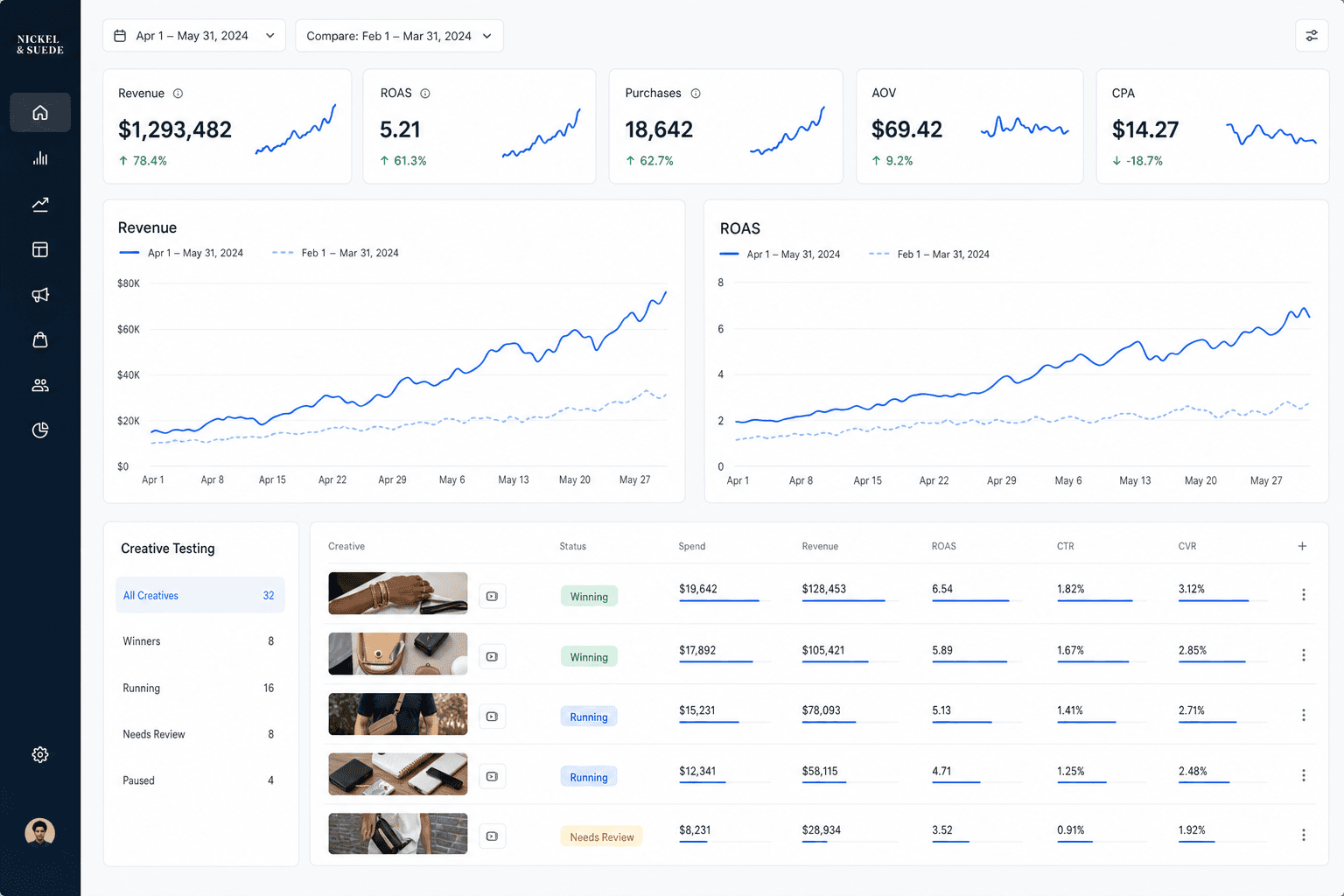
Your creative has a shelf life measured in days, not months. Fashion ad creatives lose effectiveness within five to seven days on Meta, which means a brand testing one new ad a month is running on fumes by week two. The brands winning at 5x–6x ROAS are launching twenty or more new creative angles every month, finding the one that resonates, and scaling it before it dies.
On top of that, you are managing a 3PL relationship, a Klaviyo flow, an influencer calendar, and a Shopify backend, often as the same person who is also the creative director. The moment a collection launch underperforms or a BFCM campaign craters, the post-mortem lands entirely on you.
And since iOS 14, you have been operating with attribution data you cannot fully trust. Inflated ROAS numbers from a misfiring pixel or a platform's self-reported conversions have burned enough founders that skepticism is now the default, and rightfully so.

The Opportunity
The Brands That Get This Right Are Building Durable Advantages
January CPMs run 22% below the annual average, the most cost-efficient window of the year to acquire new customers. Most fashion brands go quiet after the holiday hangover. The ones building real market share are prospecting hard in January, filling their funnel at discounted acquisition costs before spring drops.
Email and SMS remain the highest-ROAS channel in fashion, not because they are novel, but because they are systematically underleveraged. A brand with well-structured Klaviyo flows and a healthy list is recapturing revenue from customers it already paid to acquire. That is pure margin improvement, not incremental spend.
The creative gap is wider than it has ever been. The top 10% of fashion advertisers on Meta are achieving 6x ROAS versus a 2.18x median, and the primary differentiator is creative volume and testing cadence, not budget. A brand that can generate and test more angles per week than its competitors will find the winning creative faster and scale it while competitors are still running the same three ads they launched in September.
TikTok Shop generated over half a billion dollars in US sales over the 2025 holiday period. For trend-driven fashion brands with product under $100, the channel is underpriced relative to the purchase intent it captures. Early movers are building audiences before the platform saturates.
The brands that will win the next three years are the ones that solve the LTV problem now. Fashion averages fewer than two orders per customer. A brand that moves repeat purchase rate from 20% to 30% (through better post-purchase email sequences, loyalty mechanics, and retention-focused creative) has effectively changed its unit economics without touching its ad spend.
What Most Get Wrong
What Most Fashion Brands (and the Agencies They Hire) Get Wrong
Measuring ROAS on gross AOV and ignoring returns
A 4x ROAS on a $120 AOV sounds healthy until you net out a 30% return rate and a promotional discount. Your real number might be 2.2x on $84 net AOV, and you are scaling a campaign that is quietly losing money.
Running the same creative for weeks because 'it's still spending'
Fashion ad creative fatigues in five to seven days on Meta. Continuing to run a fatigued creative does not just underperform: it trains the algorithm on the wrong audience and inflates your CPMs for everything else in the account.
Treating Q4 as the time to start preparing for Q4
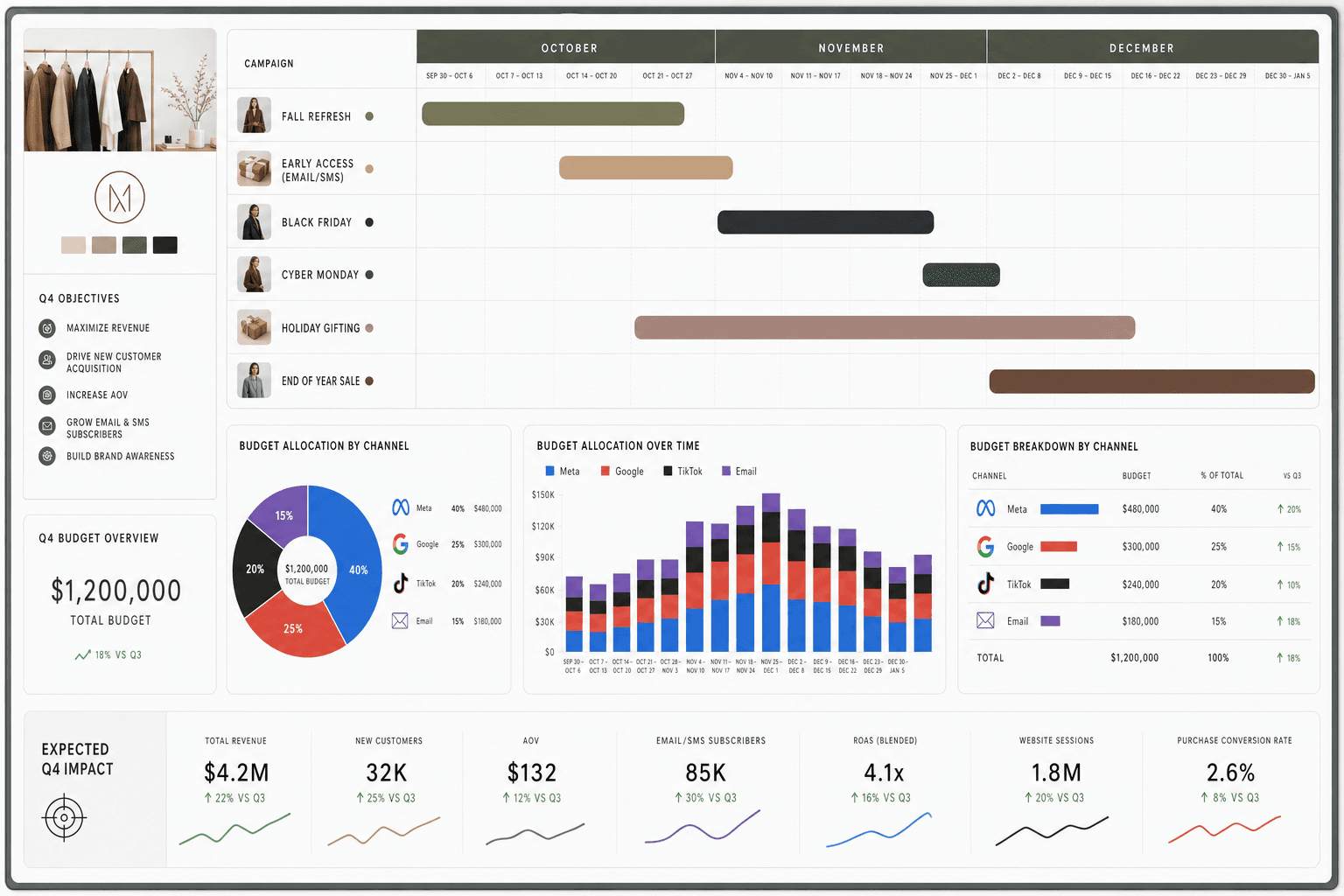
You need six to eight weeks of creative testing before BFCM to know what messaging converts. Brands that start building and testing creative in August enter November with proven winners. Brands that start in October are guessing at the most expensive CPMs of the year.
Letting email become an afterthought behind paid
Email to an engaged list is the highest-ROAS channel in fashion, because the customer acquisition cost is zero. Brands that treat Klaviyo as a broadcast tool instead of a retention engine are leaving recoverable margin on the table every single month.
Hiring a generalist agency that brings a generic ecommerce playbook
An agency that cannot speak to contribution margin after returns, creative fatigue cycles, or the inventory trap (where a stockout pushes a customer to a competitor and triggers an emergency rush order at double cost) is not equipped to run your account. They will optimize for the metrics the platform shows them, not the ones that actually determine whether your brand is profitable.
Why Now
Why Right Now Is the Window, and Why It Closes
The structural cost of customer acquisition in fashion has risen 25–40% over the past three years. Platform saturation, the permanent loss of third-party data signals post-iOS 14, and Shein and Temu compressing the mid-market from below have made the old playbook (launch a campaign, set a budget, check in monthly) genuinely unprofitable for most brands.
The brands pulling ahead are not spending more. They are operating faster. AI now makes it possible for a lean team to generate and test five times more creative angles per week, catch attribution errors before they corrupt decision-making, and shift budget toward the campaigns actually driving contribution margin, not just platform-reported ROAS.
Most fashion brands and their agencies are not running this way yet. The Meta and Google accounts at the majority of DTC fashion brands are still managed with weekly or biweekly check-ins, static creative rotations, and attribution setups that have not been audited since before iOS 14.
The window is the gap between what disciplined AI-augmented operators can do today and what the average account is actually doing. That gap will close. The brands that close it on their side, before their direct competitors do, will have lower CAC, higher creative throughput, and better attribution clarity going into Q4 2026. The ones that wait will be competing on a level field at higher CPMs.
If you are approaching a spring collection drop or building toward BFCM, the time to fix the foundation is now, not in October when the CPMs are already running.
The Mechanism
Where AI Actually Creates an Edge in Fashion Ecommerce
Real productivity, not AI theater. Here's where it actually moves a number for fashion brands.
Creative
What AI does: AI accelerates the generation of ad creative concepts, copy variations, and UGC-style angles, so your team can brief, produce, and test 15–20 creative variants per week instead of three or four.
The result: You find the winning hook before creative fatigue kills your CPMs, and you enter every seasonal peak with proven creative rather than a guess.
Why it matters here: In fashion, the creative IS the targeting. The same audience responds completely differently to a lifestyle flat-lay versus a founder talking to camera versus a customer UGC clip. The brand that tests more angles per week finds the winner faster, and the winner at the right moment in a trend cycle is worth 10x the runner-up.
Analytics
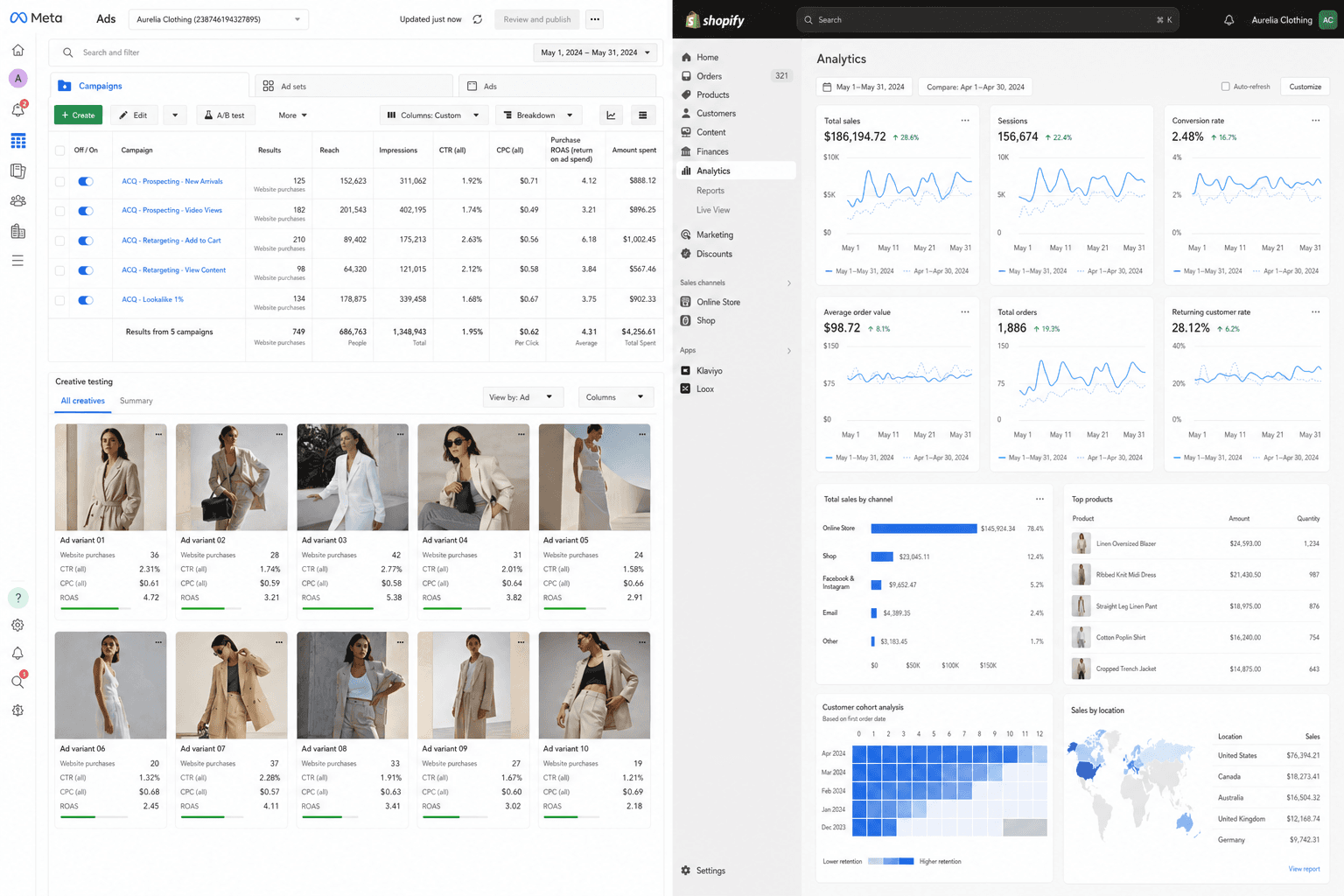
What AI does: AI audits your attribution setup, catches pixel misfires and event duplication, and builds a blended MER view that reconciles platform-reported ROAS against actual Shopify revenue, so you are making decisions on real numbers.
The result: You stop scaling campaigns that look profitable in Meta Ads Manager but are quietly losing money when you net out returns, discounts, and fulfillment costs.
Why it matters here: Post-iOS 14, every fashion brand is operating with some degree of attribution noise. The brands that have clean, audited data make better scaling decisions, especially during BFCM when a wrong call at high CPMs is expensive.
Digital Ads
What AI does: AI monitors campaign performance continuously (not on a weekly check-in schedule) and shifts budget toward the ad sets and creatives driving contribution-margin-positive purchases, while flagging creative fatigue before it inflates CPMs.
The result: Budget follows real performance in near-real-time rather than trailing a weekly review cycle, which matters most during the high-velocity windows of a new collection launch or a BFCM sale.
Why it matters here: A fashion brand running a seven-day collection drop cannot afford to wait until next Tuesday's agency call to reallocate budget away from a fatigued creative. The margin for error during peak windows is too thin.
What AI does: AI maps your Klaviyo flow architecture against your actual customer LTV curve (which in fashion typically flattens around month five) and identifies the sequences where you are losing repeat buyers and the moments where a well-timed trigger email would have converted them.
The result: A meaningful lift in second-purchase rate, which in a category where only one in five customers buys again is the single highest-leverage retention move available.
Why it matters here: Fashion averages fewer than two orders per customer. Every percentage point of improvement in repeat purchase rate is pure margin improvement. You already paid to acquire that customer.
Conversion Optimization
What AI does: AI reviews your product pages and collection landing pages for friction points specific to fashion buying decisions (size confidence, return policy visibility, social proof placement, and mobile checkout flow) and surfaces the highest-impact fixes.
The result: A higher percentage of the paid traffic you are already buying converts to a first purchase, lowering effective CAC without increasing ad spend.
Why it matters here: Fashion has one of the highest cart abandonment rates in ecommerce, driven by size uncertainty and return anxiety. A 10% improvement in conversion rate on existing traffic is worth more than a 10% increase in ad spend, and it compounds into every future campaign.
Ready to see what this looks like for your fashion brands business?
No obligation. A senior strategist will show you exactly where the wins are.
The Strategy
What a Real Fashion Ecommerce Strategy Looks Like
The foundation is clean measurement. Before a dollar of paid spend is adjusted, your attribution setup needs to be audited: pixel events verified against Shopify order data, a blended MER baseline established, and returns netted out of your unit economics. You cannot make good scaling decisions on bad data, and most fashion accounts have at least one attribution error inflating their numbers.
Paid social is the primary acquisition engine, with Meta carrying the bulk of prospecting spend and TikTok as the creative-testing and trend-capture channel for sub-$100 product. Google Shopping and branded search capture the high-intent demand that Meta creates: people who saw the ad, got interested, and searched your brand name or a product term. These channels work together; running them in silos creates attribution confusion and missed scale.
Creative is the variable that determines whether the paid channels work. The strategy is a weekly creative testing cadence (new angles briefed, produced, and launched on a rolling basis) with AI accelerating the generation and analysis of variants so the team can test at a volume that would otherwise require a much larger headcount. Every seasonal peak (spring drop, BFCM) gets a dedicated pre-peak testing window of six to eight weeks so you enter the high-CPM period with proven creative.
Email and SMS are the retention engine. The goal is to move your second-purchase rate meaningfully above the 20% industry baseline through post-purchase sequences built around your actual LTV curve, browse and cart abandonment flows tuned for fashion's size-uncertainty objections, and win-back campaigns timed to your collection drop calendar.
Budget allocation is not static. Spend paces with the season: heavier prospecting in the low-CPM January window, ramp into spring collection, pull back and test through summer, then scale into Q4 with proven creative and a healthy email list to amplify paid performance.
The one number that governs this
The governing KPI is blended ROAS / MER: platform-reported ROAS reconciled against actual Shopify revenue with returns netted out. Every channel decision is made against contribution margin, not gross revenue.
How We Help
How We Execute This for Your Fashion Brand
We take on a limited number of clients so every brand gets senior attention, not a junior account manager running a templated playbook. Here is how we would build this out for a fashion brand at your stage, sequenced the way we would actually run the engagement.
Attribution Audit & MER Baseline
Before touching ad spend, we audit your pixel setup, reconcile platform-reported ROAS against Shopify revenue, and net out returns, so every decision that follows is made on clean numbers.
Paid Social (Meta & TikTok)
We rebuild or restructure your Meta campaigns around a disciplined creative testing cadence: new angles weekly, budget following proven performers, fatigue caught before it inflates CPMs. TikTok is layered in for trend-driven product and sub-$100 items where the channel's purchase intent is underpriced.
Google Shopping & Branded Search
We capture the high-intent demand your social campaigns create: Shopping campaigns structured around your margin tiers, branded search protecting your name, and Performance Max managed with the guardrails it needs to not cannibalize your other channels.
Creative Strategy & AI-Accelerated Testing
We brief, produce, and test creative at a volume most in-house teams cannot sustain, using AI to generate more angles per week, analyze performance patterns faster, and identify winning hooks before competitors running monthly creative rotations have even seen the data.
Email & SMS (Klaviyo)
We audit your current flow architecture against your LTV curve, rebuild the sequences where you are losing repeat buyers, and build a collection-drop email calendar that amplifies your paid campaigns instead of running parallel to them.
Conversion Optimization
We review your product pages and checkout flow for the friction points specific to fashion (size confidence, return policy visibility, social proof placement) and implement the fixes that move conversion rate on existing traffic.
Ongoing Analytics & AI-Powered Reporting
Weekly reporting built around MER and contribution margin, not platform vanity metrics. AI monitors campaign performance between check-ins and flags anomalies (a creative fatigue spike, a sudden CPM increase, a conversion drop on a key product page) before they become expensive problems.
Who's Behind This
Who we are, and what makes us different
Sagum is a performance marketing agency founded in January 2017 in St. George, Utah. We've spent 8+ years growing real brands and being judged on KPIs, not vanity metrics.
We deliberately limit how many clients we take so each one gets senior attention. We treat your numbers like our own, we never run generic playbooks, and your strategy is built for your business, because shouldn't your brand's marketing be custom to your brand?
Sagum.ai is our AI arm: the same proven operators now build AI into the work wherever it creates real edge, not as theater, but as leverage applied with discipline.
- 8+ years growing brands on performance KPIs, not vanity metrics
- Limited client roster, with senior attention on every account
- An extension of your team; your success is tied to ours
- Custom strategy per brand, never a generic playbook
- AI built in where it moves a number; judgment over hype
“Sagum is a performance marketing agency that's spent 8+ years growing brands by treating their numbers like our own. We take on few clients, never run generic playbooks, and now build AI into the work wherever it creates real edge, not hype. Your strategy is built for your business, and our success is tied to yours.”

“Sagum roughly doubled our bottom line. They treat the work like it's their own business.”
Proof
15:1 ROAS across all ad spend, plus hundreds enrolled in the Stevie Rep program
Shop Stevie
Challenge
Shop Stevie, a DTC fashion brand, set an aggressive 15:1 ROAS target while needing to acquire new customers profitably and stand up a referral engine through its Stevie Rep ambassador program.
What we did
We ran disciplined creative retargeting and remarketing across Meta and Instagram, then built dedicated landing pages and a sales funnel with its own creative campaign to recruit and convert Stevie Reps.
Result
Shop Stevie hit a 15:1 ROAS across all ad spend, scaled sales with new expansion campaigns that held positive ROI, and enrolled hundreds of members into the Rep program through reliable-CPL Instagram lead ads.
- ROAS
- 15:1
- Rep program
- Hundreds enrolled
- Sales
- Scaled at positive ROI
Ready to Build a Fashion Marketing Strategy That Actually Scales?
No obligation. We will look at your current ROAS, attribution setup, and creative cadence, and give you a clear picture of where the real growth is. Built around your brand, not a template.
Sagum · January 2017 · St. George, Utah · 8+ years