

8+ years growing brands on KPIs, now with AI
Footwear growth when CAC keeps climbing
We grow contribution margin and blended returns, not just the revenue line your dashboard celebrates.
8+ years growing ecommerce brands · Google, Meta & TikTok partner · Results measured in ROAS, not impressions



Get your free Growth Gap Analysis
Senior strategist review · response within one business day
Prefer to reach out directly?
The Challenge
DTC Footwear Marketing Is a Problem Most Agencies Misread
Your buyer knows Nike, Adidas, and Amazon, with Zappos one tab over offering free two-day shipping and easy returns. To win, you must out-niche the giants on story, fit, and community while keeping unit economics working.
DTC acquisition costs in fashion and footwear rose 222% over eight years, plus 24.7% in 2025 alone. Shoes aren't consumables, so your repeat curve trails apparel: a mid-market DTC footwear brand's realistic 12-month LTV runs $250–$400, assuming 1.5–2 purchases per year. First orders must be profitable.
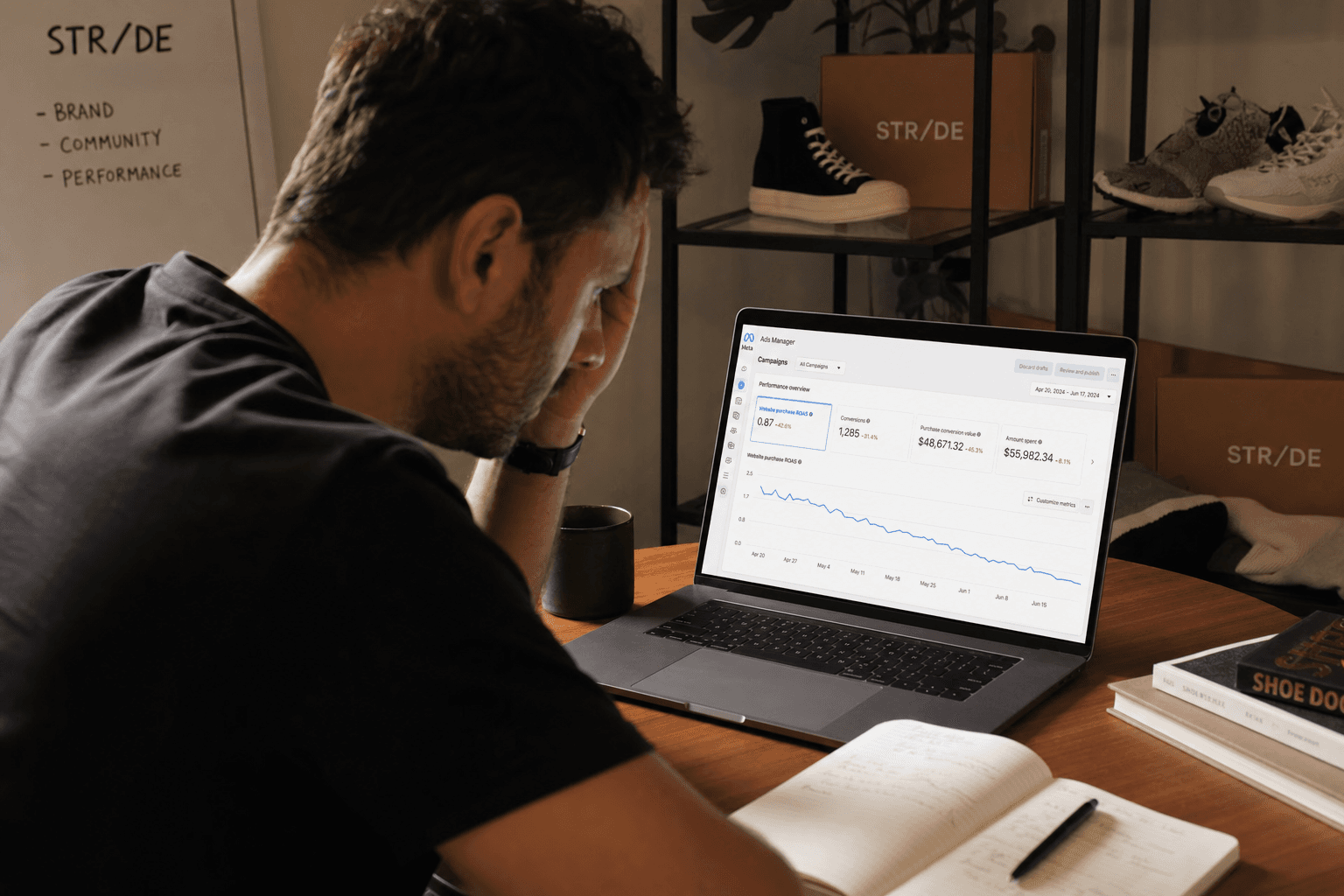
Post-iOS 14 attribution is broken: Meta reports a ROAS you don't fully trust, you can't fully see inside Google PMax, and blended ROAS disagrees with both. You know campaign ROAS isn't contribution margin, so 'we'll scale your ads' pitches that ignore nCAC, payback period, and BFCM planning don't land.
Each season's shoe searches peak the season before. Meta CPMs spike 41% in November and 35% in December, when you most need to spend. Lock Q4 creative and budget 8–10 weeks before BFCM, or it turns expensive and reactive.
The Opportunity
Footwear Demand and Margin Are There. Most Brands Capture Them Inefficiently.
Global online footwear sales hit $128 billion in 2024, yet only 31.2% of footwear sales happen online. DTC is still taking share from brick-and-mortar, and buyers increasingly skip the try-on.
Shoe sizing is more standardized than apparel's, so returns run 15–20% versus 24–26% for clothing. That 5–10 point gap, calculated correctly, is real contribution margin most brands underplay.
Most brands write off the January–February trough, when CPMs average 22% below the annual rate. Smart brands put 35–40% of annual acquisition budget into Q1 to buy customers, build LTV cohorts, and test creative at a fraction of Q4 cost, then enter BFCM with customers and a creative library competitors lack.
Winning brands coordinate Meta Advantage+ sales campaigns with Google Shopping, measure blended ROAS, not platform ROAS, and treat creative as a performance variable, opening a margin gap at equal spend.
What Most Get Wrong
What Most DTC Footwear Brands and Their Agencies Get Wrong
Optimizing for platform ROAS instead of contribution margin
Meta can show 3.5x ROAS while per-order contribution margin after returns, shipping, and ad spend is negative. Brands that don't separate nCAC from returning-customer revenue are scaling a leak.
Building Q4 creative after the testing window closes
BFCM creative needs testing before you lock it 8–10 weeks out. Brands that start later pay November's peak CPMs to learn what earlier-testing competitors already know.
Running Meta and Google as separate budgets
Meta drives low-CPC discovery; Google Shopping closes intent. Split them and you double-count conversions, misallocate budget, and leave the funnel's bottom leaky. Most brands ignore blended ROAS and miss it.
Ignoring the pre-season search curve
Brands that launch spring sandal campaigns in April buy clicks at peak competition, while brands that started in February already own the top of the funnel.
Hiring agencies that reuse apparel playbooks
Footwear's return rates, LTV curve, sizing anxiety, and seasonal calendar differ from apparel's. Agencies that ignore this leave footwear-specific margin on the table, and your payback period shows it.
Why Now
Why Footwear Brands That Build Their Edge Before BFCM Win
Most footwear competitors run campaigns like it's three years ago: static creative tested once a month at best, flat monthly budgets, platform-reported ROAS as the north star. They aren't testing creative at AI speed, catching attribution errors live, or holding Meta and Google to one blended ROAS target. That gap closes as AI tools become table stakes.
Brands that test angles, validate audiences, and model budget pacing before locking Q4 creative own BFCM. Use the run-up for creative tests and attribution fixes to enter BFCM with a cost-per-acquisition edge competitors can't close in-season.
Run five creative concept tests per week with AI, check blended ROAS daily, and you'll learn more in weeks than competitors in a year. That compounding edge shows in your BFCM numbers and January LTV cohorts.
The Mechanism
Where AI Gives Footwear Brands a Real Edge
Real productivity, not AI theater. Here's where it actually moves a number for footwear brands.
Creative
What AI does: AI generates briefs for 10–15 distinct ad concept angles per week, each structured for A/B or multivariate testing; the five strongest briefs go live as tests in Meta Advantage+ sales campaigns.
The result: You find the thumb-stop creative with your lowest nCAC in weeks, before CPMs spike for BFCM.
Why it matters here: Creative fatigues fast, and winning angles vary by SKU ('lifestyle' beats 'product' for some, 'fit confidence' beats 'style' for others). Faster testing finds them cheaper.
Analytics
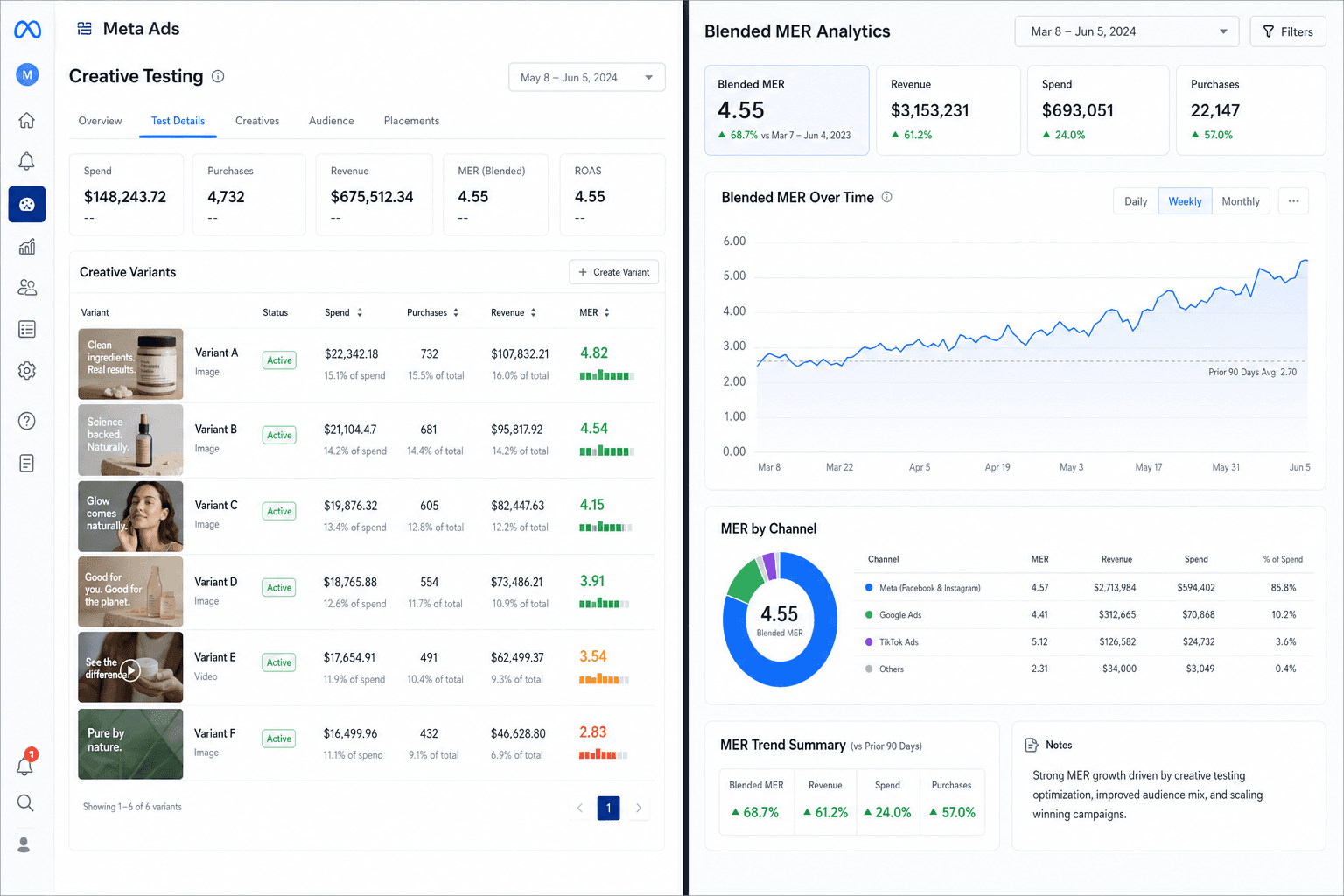
What AI does: AI checks blended ROAS daily against a contribution margin target, flags pixel misfires and platform ROAS drifting from blended ROAS, and tracks cohort LTV:CAC against targets at 30, 60, and 90 days.
The result: You scale the channels building profitable LTV cohorts, using numbers you trust.
Why it matters here: Post-iOS 14, budgeting on blended ROAS and contribution margin beats trusting Meta's numbers, especially as return rates shift by SKU and season.
Digital Ads
What AI does: AI watches Meta Advantage+ sales and Google Shopping/PMax in real time, shifts budget between channels as blended ROAS moves, and flags creative fatigue before CPAs climb.
The result: Budget follows current performance, and you catch fatigued creative early instead of after ten days of inflated nCAC.
Why it matters here: Meta builds the awareness that Google Shopping converts. Weekly manual reviews miss signals AI catches daily, and at BFCM spend, one misallocated week is expensive.
Conversion Optimization
What AI does: AI audits mobile product pages and checkout for sizing confidence signals, return policy placement, social proof format, and mobile load speed, then prioritizes fixes that lift blended ROAS without more spend.
The result: Paid mobile traffic converts better. Over 60% of footwear purchases are mobile; 62% of consumers are less likely to convert after a bad mobile experience.
Why it matters here: Returns run below apparel's, but sizing stays footwear's defining objection: 57% of online shoe buyers have returned ill-fitting shoes. Generic CRO audits miss it.
What AI does: AI builds email and SMS flows for footwear's repeat curve: post-purchase sequences timed to the 90-day repurchase window, win-backs triggered by LTV cohorts, and seasonal reactivation tied to pre-season search.
The result: Email and SMS revenue grows as a share of total, reducing paid dependence and moving LTV:CAC toward the 3:1 target.
Why it matters here: Repurchase is seasonal, so spring and fall flows that land before buyers search competitors beat generic promos. First-party data is increasingly the only trustworthy attribution.
Ready to see what this looks like for your footwear brands business?
No obligation. A senior strategist will show you exactly where the wins are.
The Strategy
What a DTC Footwear Marketing Strategy Should Look Like
Footwear strategy differs from apparel, CPG, or home goods: first-purchase contribution margin is non-negotiable, brands that lead demand by 4–6 weeks win, and post-iOS, blended ROAS is the only number you can fully trust.
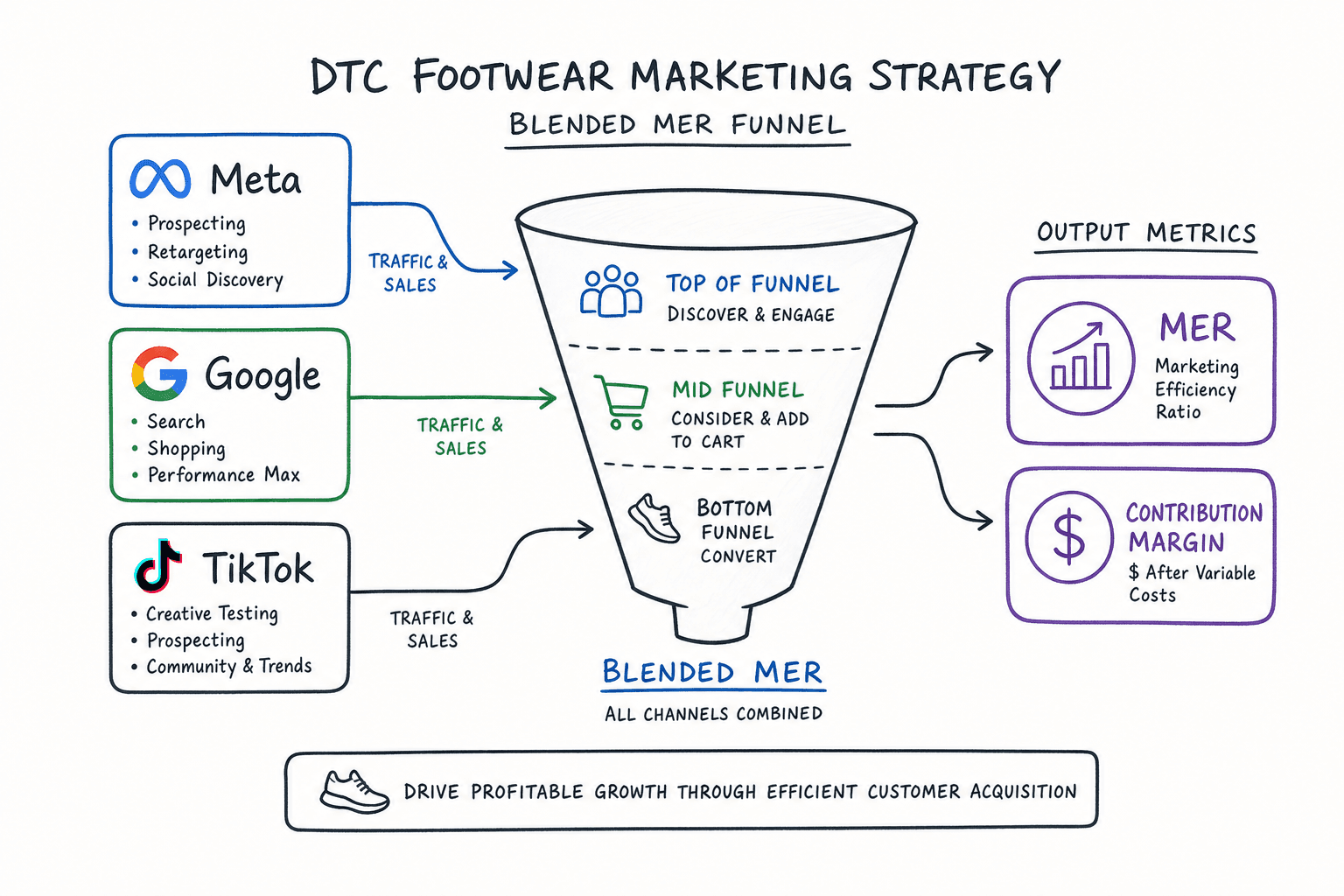
Meta Advantage+ sales campaigns are the volume engine: low CPCs (~$0.45 for fashion), broad reach, and creative testing at scale. Google Shopping and PMax close buyers searching 'minimalist running shoes' or 'wide-width leather boots' at 3.4x–4.5x ROAS.
TikTok is the discovery layer for brands with UGC creative and younger buyers; its direct ROAS is lower, but its top-of-funnel value shows in blended ROAS. All three run as one system.
Pace budget to the calendar: heavy Q1 spend, a July–August back-to-school ramp for athletic and kids' SKUs, and Q4 creative proven before BFCM spend goes behind it.
Every week we test hook variations, UGC-style versus product-feature formats, and sizing-confidence messaging versus lifestyle frames. Winners feed BFCM; losers get cut before they inflate nCAC.
Blended ROAS is the north star, contribution margin per order is the guardrail that keeps scaling from turning into losing money faster, and platform-reported ROAS is only directional. LTV cohorts by acquisition channel show which spend builds a business and which buys revenue.
The one number that governs this
Blended ROAS (total revenue ÷ total ad spend across all channels) governs every decision: it sidesteps attribution noise and shows whether marketing works overall.
How We Help
What We'd Do for a Footwear Brand Like Yours
We fix measurement before touching ad spend, then build the channel system, creative engine, and retention layer, in the order an operator would run them.
Attribution & Analytics Foundation
Start with a pixel audit, blended ROAS dashboard, and LTV cohort tracking by acquisition channel.
Paid Media: Meta Advantage+ & Google Shopping / PMax
Run Meta Advantage+ sales campaigns and Google Shopping/PMax as one system, paced to your seasonal calendar against a single blended ROAS target.
Creative Strategy & Testing
Run structured creative tests weekly to find the angles with your lowest nCAC; winners feed Q4 and losers get cut early.
TikTok Paid Social
For brands with UGC creative and discovery-oriented buyers, build TikTok campaigns judged by their contribution to blended ROAS rather than last-click ROAS.
Conversion Optimization
Audit mobile product pages and checkout for sizing confidence, return policy placement, and load speed to lift conversion on traffic you already buy.
Email & SMS Automation
Build post-purchase, win-back, and seasonal reactivation flows timed to footwear's repurchase window and pre-season search calendar to grow owned-channel revenue and improve LTV:CAC.
AI Systems & Ongoing Optimization
Use AI to watch blended ROAS and creative daily, shift budget in real time, and flag attribution anomalies and fatigue.
Who's Behind This
Who we are, and what makes us different
Sagum is a performance marketing agency founded in January 2017 in St. George, Utah. We've spent 8+ years growing real brands and being judged on KPIs, not vanity metrics.
We deliberately limit how many clients we take so each one gets senior attention. We treat your numbers like our own, we never run generic playbooks, and your strategy is built for your business, because shouldn't your brand's marketing be custom to your brand?
Sagum.ai is our AI arm: the same proven operators now build AI into the work wherever it creates real edge, not as theater, but as leverage applied with discipline.
- 8+ years growing brands on performance KPIs, not vanity metrics
- Limited client roster, with senior attention on every account
- An extension of your team; your success is tied to ours
- Custom strategy per brand, never a generic playbook
- AI built in where it moves a number; judgment over hype
“Sagum is a performance marketing agency that's spent 8+ years growing brands by treating their numbers like our own. We take on few clients, never run generic playbooks, and now build AI into the work wherever it creates real edge, not hype. Your strategy is built for your business, and our success is tied to yours.”

“Sagum roughly doubled our bottom line. They treat the work like it's their own business.”
Rachel Nilsson
CEO, RAGS
Proof
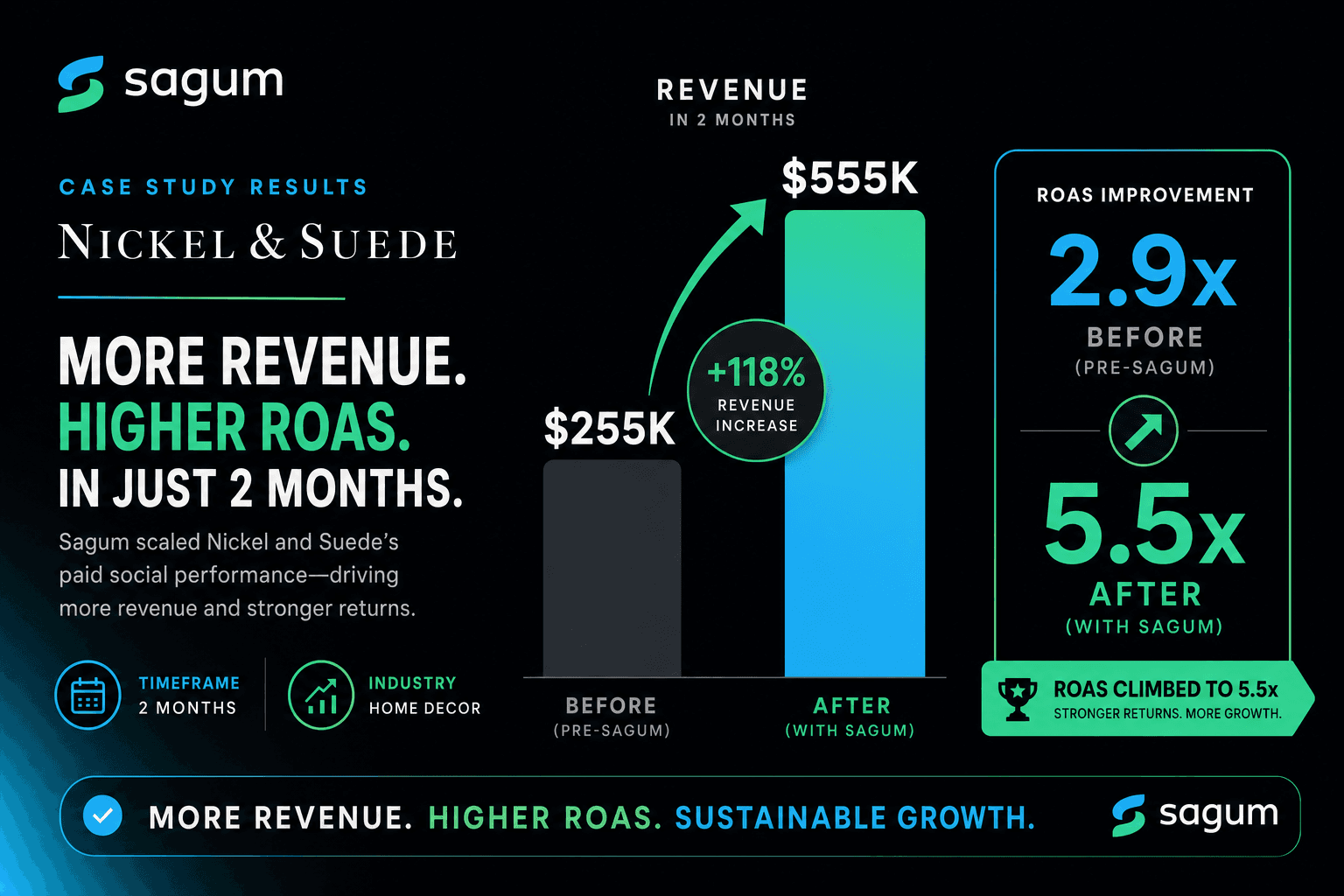
$255k → $555k in 2 months, ROAS 2.9x → 5.5x+
Nickel & Suede
Challenge
Nickel & Suede, an apparel and accessories brand, needed to scale revenue profitably on paid social.
What we did
We ran Meta and TikTok creative testing at volume, the same discipline we'd bring to a footwear brand.
Result
Revenue went from $255k to $555k in two months, ROAS from 2.9x to 5.5x+ (peaking at 7.95x), and site conversion lifted 34%.
- Revenue
- $255k → $555k (2 mo)
- ROAS
- 2.9x → 5.5x+ (peak 7.95x)
- Site conversion
- +34%
Build a Footwear Growth System That Wins Every BFCM
There's no obligation or generic pitch deck. We'll review your blended ROAS, creative testing cadence, and seasonal calendar, then pinpoint your margin gap and how a footwear-specific plan would close it.
Sagum · January 2017 · St. George, Utah · 8+ years