

8+ years growing brands on KPIs, now with AI
From discovery to full-bottle fragrance sales
We turn scent obsessives into repeat buyers and gift sets into your most profitable Q4.
8+ years growing ecommerce brands · Google, Meta & TikTok partner · Judged on ROAS, not vanity metrics



Get your free Growth Gap Analysis
Senior strategist review · response within one business day
Prefer to reach out directly?
The Challenge
Selling fragrance online is harder than most agencies admit
Fragrance's original sin is that people can't smell it through a screen, so bergamot and vetiver top notes mean nothing to someone who's never worn it, add-to-cart rates trail every other beauty category, and generic playbooks fail.
Buyers build a scent wardrobe (office EDPs, weekend EDTs, date-night Extrait) and watch #perfumetok reviews of rival launches, so retention sits around 16.7%, among beauty's lowest. Dupes undercut you: a $12 Zara dupe of a $220 niche EDP gets three million TikTok views in a week, so answer with identity-driven storytelling that makes dupes irrelevant.
Roughly 40% of annual fragrance sales land in Q4, Christmas week can top earlier weeks by 25% to over 100% (NPD, 2021), and over 25% of Q4 prestige fragrance sales are gift sets. Have creative, inventory and paid media live before November or risk your best weeks.
With Meta's median CPA at $38 in 2025, a $70 AOV EDP at 65% gross margin leaves thin first-order contribution margin, so you depend on LTV from email and SMS retention.
The Opportunity
Fragrance brands that crack conversion own a category growing 18% annually
Indie fragrance DTC grows online an estimated 18.4% yearly versus 11% for overall beauty ecommerce, and ecommerce took 38.6% of indie perfume revenue in 2025, from 28.4% three years earlier.
TikTok is fragrance's new discovery engine: #perfumetok, #fragrancecommunity and #nicheperfume have billions of views, Beauty and Personal Care leads TikTok ROAS at 3.5×, and one founder-led post can trigger a sell-out.
Paid samples seed full-bottle sales and build scent-qualified email lists below cold-acquisition cost; the fragrance subscription-box market hit €1.2 billion in 2024, growing 16.2% annually. Retention compounds: long-standing customers can spend 67% more than in their first months (Bain).
Most indie brands underexploit Valentine's and Mother's Day, though online fragrance sales spiked 77% the week before Valentine's (pre-pandemic). Gift buyers decide fast and buy online, so gift-set bundles and creative live before January 31st can win outsized share.
What Most Get Wrong
What most fragrance brands and their agencies get wrong
Running static creative on TikTok and expecting Meta-level returns
Fragrance sells on sensory video: the uncapping ritual, a founder explaining the oud accord. Agencies recycling Meta statics burn budget; one brand's ROAS rose 122% in three days after switching.
Asking cold audiences $150 for a scent they've never smelled
Fragrance's consideration cycle runs longer than in most beauty categories, so skipping the sample or decant as a first purchase raises CPA and CAC, lowers LTV and tanks retention.
Treating Q4 as a sprint instead of an October campaign
November launches are already late. Brands that spike spend in December bid at peak CPMs against every beauty brand, with no warm audience, gift-set social proof or primed email list.
Answering the dupe objection with ingredients instead of identity
Generic agency copy about natural musks and phthalate-free accords can't answer 'why pay $200 when the Zara dupe smells 80% the same.' Provenance, the founder's story, community and self-image can.
Running nothing but a welcome flow in a low-retention category
Without scent education at day 7, a scent-wardrobe cross-sell at day 30 and a replenishment nudge when the bottle runs low, you pay to acquire buyers you'll never see again.
Why Now
Fragrance brands that move now will own #perfumetok and gift-set season
Most indie fragrance brands still market the old way, with one Meta campaign, a basic Klaviyo welcome flow and whatever TikTok content the founder can film. Their testing is slow, attribution messy and email thin.
AI changes the economics of testing: a brand using it to test five times more angles weekly (hooks for sillage obsessives, clean-beauty buyers, gifters and scent-wardrobe builders) finds the winning message in days, not months. A rival testing one ad concept a month enters Q4 with the wrong creative.
Start Q4 work two to three months before the gifting peak to launch with warm audiences. TikTok's fragrance community is still growing, so consistent founder-led storytelling and community engagement now build compounding algorithmic and social proof. Brands that wait for saturation pay more for less reach.
The Mechanism
Where AI creates a real edge for fragrance brands
Real productivity, not AI theater. Here's where it actually moves a number for fragrance & perfume brands.
Creative
What AI does: Generates and tests multiple angles a week across TikTok and Meta, from sillage and longevity testimonials to gift-set reveals and 'what does this smell like' hooks, faster than a human team alone.
The result: You find the message and format that drive add-to-carts within days and enter Q4 with creative that has already won tests.
Why it matters here: Fragrance creative must make people smell through a screen, so the hook, sensory language and emotional framing need rapid iteration, and AI shortens that cycle.
Social Media (TikTok & Paid Social)
What AI does: Reads #perfumetok performance signals (watch time, saves, shares, comment sentiment on longevity and sillage) to spot which scent stories and angles gain traction, then informs paid amplification in near real-time.
The result: You make paid decisions on organic signals within hours, so you're already scaling spend when a scent goes viral.
Why it matters here: TikTok fragrance sell-outs happen within 24 to 48 hours of a viral post, so brands that can't move budget that fast leave growth to chance.
Email & Automation
What AI does: Builds retention sequences: scent education in the first two weeks, a day-30 cross-sell matched to the buyer's first scent, a 'running low' nudge at days 90–107, Valentine's and Mother's Day gift-set campaigns.
The result: Repeat purchase rate and LTV climb as first-time buyers become long-standing customers, without extra ad spend.
Why it matters here: With fragrance retention around 16.7%, each point of repeat purchase rate has an outsized effect on LTV:CAC and payback period.
Analytics & Attribution
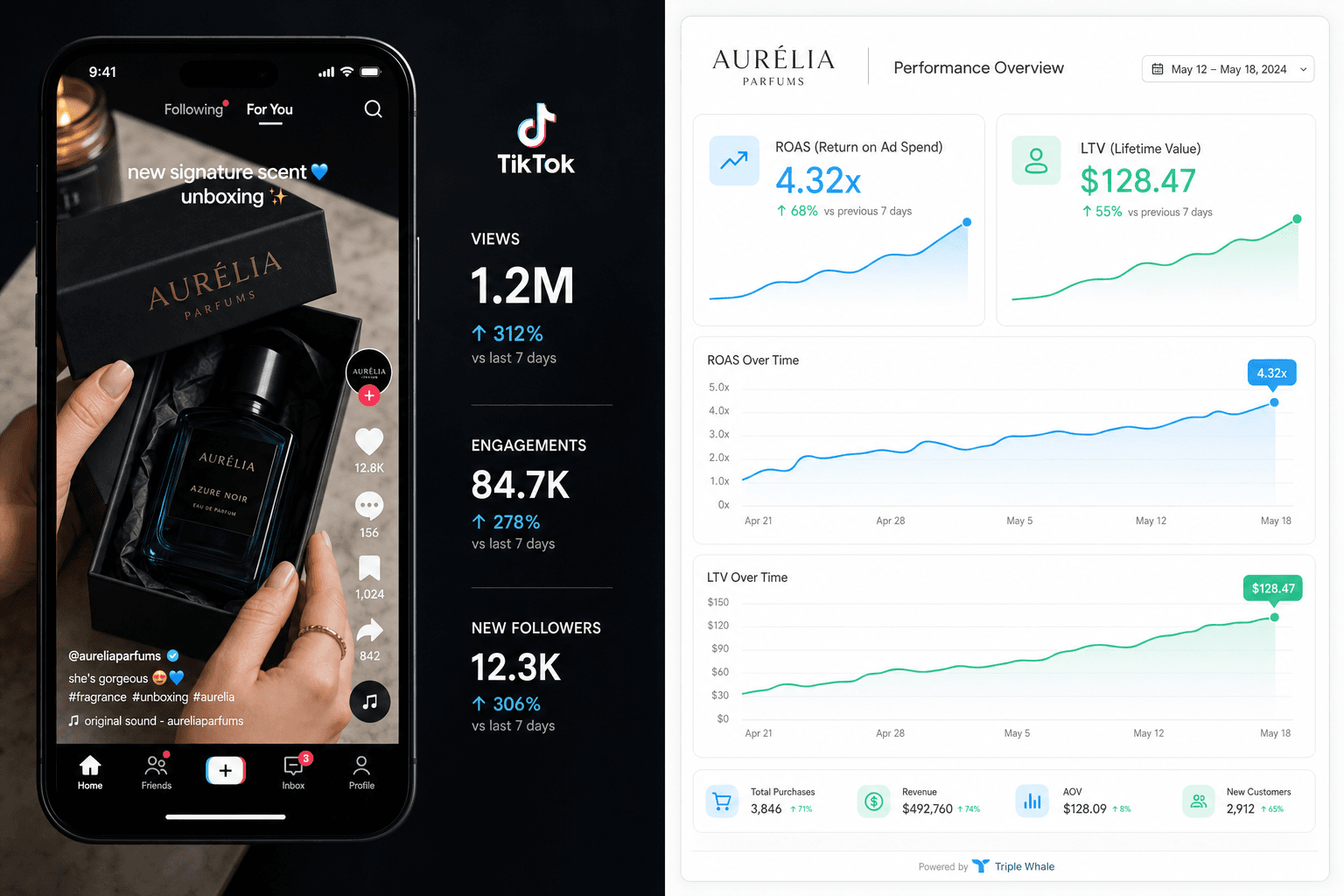
What AI does: Audits pixel and conversion tracking for misfiring events and double-counted conversions that inflate ROAS, then builds a blended ROAS view accounting for TikTok view-through, Meta retargeting overlap and email's last-click overclaiming.
The result: You make budget calls on numbers you can trust, not a dashboard claiming 4× ROAS your bank account contradicts.
Why it matters here: Fragrance brands' TikTok, Meta and email all claim the same sale. You see which drives profitable first purchases and which retargets buyers who'd convert anyway.
Conversion Optimization
What AI does: Reviews your pages for fragrance-specific conversion leaks (weak scent descriptions, missing sillage and longevity proof, no sample or decant path for cold traffic, gift-set layouts that bury AOV) and tests variants continuously.
The result: Cold TikTok traffic converts to a sample or full bottle at a meaningfully higher rate, lowering CAC without more spend.
Why it matters here: The page has to do a tester strip's work, and most fragrance pages don't; fixing that is often the highest-impact move before scaling paid spend.
Ready to see what this looks like for your fragrance & perfume brands business?
No obligation. A senior strategist will show you exactly where the wins are.
The Strategy
The marketing strategy that works for a DTC fragrance brand
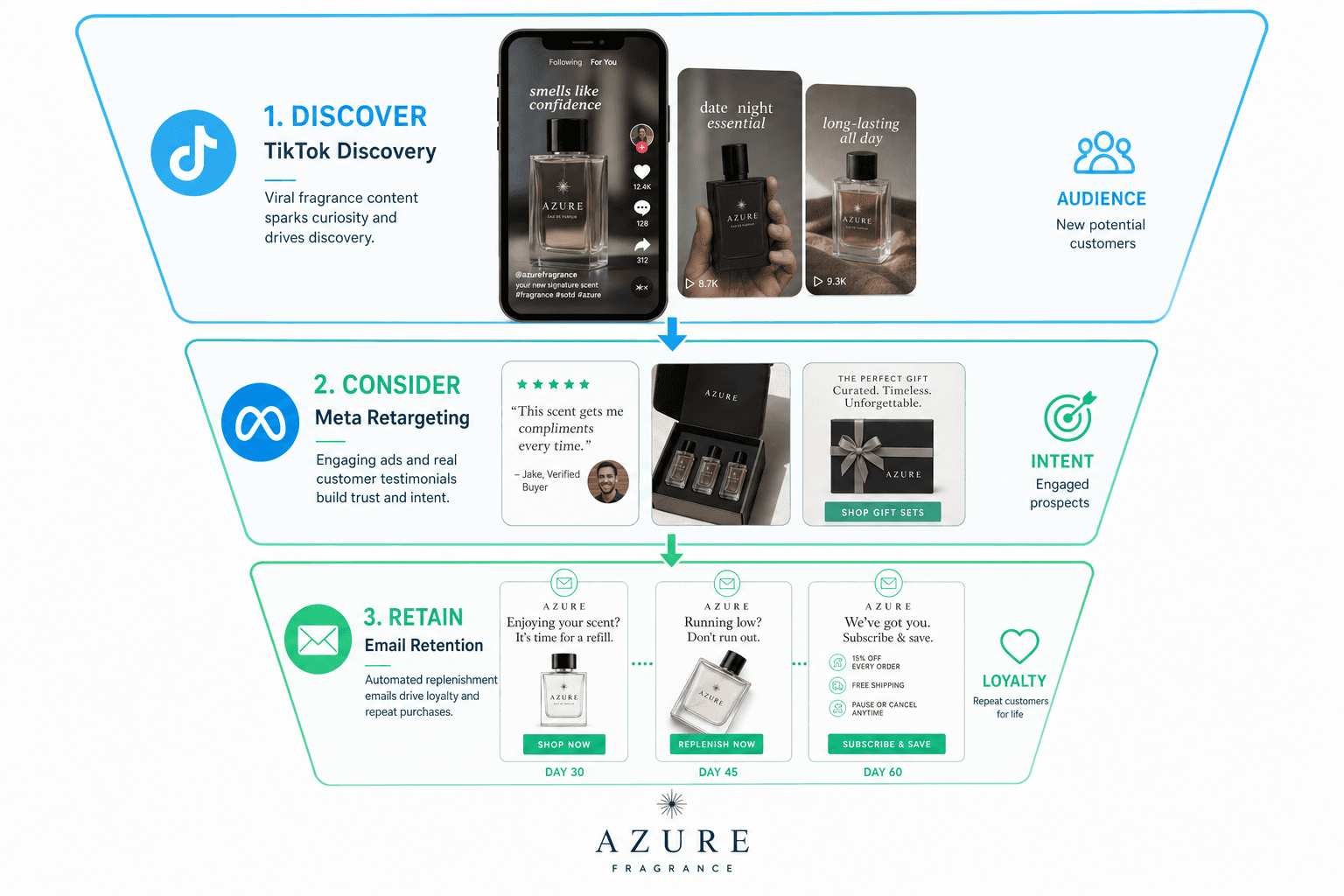
Your funnel's three stages need distinct channels, creative and KPIs; collapsing them into 'run ads and see what happens' is the most common reason brands plateau at $500k to $1M annually.
Stage one, discovery and sampling, runs on TikTok, indie fragrance's discovery engine. Founder-led posts on a scent's inspiration, olfactive pyramid and provenance build trust, and paid amplification follows organic engagement. The goal is a sample or email capture, not a cold full-bottle sale.
Stage two, conversion, runs on Meta: you retarget TikTok discoverers and email subscribers with sensory scent descriptions, sillage and longevity testimonials, and unboxing UGC, countering dupes with identity, not price. Tiered gift-set incentives push AOV above $100, where contribution margin becomes meaningful.
Stage three, retention, runs on email and SMS timed to replenishment (beauty averages 107 days between orders), with scent-wardrobe cross-sells and seasonal campaigns built early.
Google Search, a small, high-converting channel most indie brands underinvest in, catches branded and category queries ('best niche perfume for women,' 'long-lasting EDP under $150,' 'fragrance gift set') from buyers past discovery.
Budget follows the calendar: build warm audiences and test creative August–September, scale gift-set campaigns October–December, run sampling acquisition January–March while CPMs and search volume are low, and treat Valentine's and Mother's Day as secondary spikes.
The one number that governs this
The governing KPI is blended ROAS, not platform-reported ROAS: a 3× target, first-purchase payback under 90 days, and LTV:CAC checked at 90 and 180 days.
How We Help
What we'd build for a fragrance brand like yours
We start with attribution, confirming your pixel fires and blended ROAS is calculable. Then we build discovery creative, conversion architecture and retention sequences, and scale spend behind what's proven.
Analytics & Attribution Audit
Sets the clean blended ROAS baseline every budget decision starts from.
TikTok Paid Social & Creative Strategy
Builds and tests stage-one creative, from founder-led scent storytelling to dupe rebuttals, with paid amplification behind organic posts already working.
Meta Ads (Retargeting & Warm Audience Conversion)
Retargets TikTok discoverers and email subscribers with unboxing UGC, identity-driven positioning and gift-set offers, optimized to blended ROAS and first-purchase payback.
Google Search Ads
Captures high-intent searches like 'best niche EDP' and 'fragrance gift set for her,' where CPCs are manageable and buyers are ready.
Email & SMS Automation
Builds retention sequences on the replenishment cycle: scent education, a running-low nudge, scent-wardrobe cross-sells and seasonal gift-set campaigns.
Conversion Rate Optimization
Audits and iterates product and landing pages to close fragrance-specific conversion leaks, from weak sensory copy to a missing sample pathway for cold traffic.
Creative Production & Testing
Produces and tests multiple angles weekly across TikTok and Meta, far beyond what a single in-house creative can make.
Who's Behind This
Who we are, and what makes us different
Sagum is a performance marketing agency founded in January 2017 in St. George, Utah. We've spent 8+ years growing real brands and being judged on KPIs, not vanity metrics.
We deliberately limit how many clients we take so each one gets senior attention. We treat your numbers like our own, we never run generic playbooks, and your strategy is built for your business, because shouldn't your brand's marketing be custom to your brand?
Sagum.ai is our AI arm: the same proven operators now build AI into the work wherever it creates real edge, not as theater, but as leverage applied with discipline.
- 8+ years growing brands on performance KPIs, not vanity metrics
- Limited client roster, with senior attention on every account
- An extension of your team; your success is tied to ours
- Custom strategy per brand, never a generic playbook
- AI built in where it moves a number; judgment over hype
“Sagum is a performance marketing agency that's spent 8+ years growing brands by treating their numbers like our own. We take on few clients, never run generic playbooks, and now build AI into the work wherever it creates real edge, not hype. Your strategy is built for your business, and our success is tied to yours.”
“Sagum roughly doubled our bottom line. They treat the work like it's their own business.”
Rachel Nilsson
CEO, RAGS
Proof
$255k → $555k in 2 months, ROAS 2.9x → 5.5x+
Nickel & Suede
Challenge
Nickel & Suede, an apparel and accessories brand, needed to scale revenue profitably on paid social.
What we did
We ran Meta and TikTok creative testing at volume, the same discipline we'd bring to a fragrance brand.
Result
Revenue went from $255k to $555k in two months, ROAS rose from 2.9× to 5.5×+ (peaking at 7.95×) and site conversion lifted 34%. See sagum.com/case-studies/.
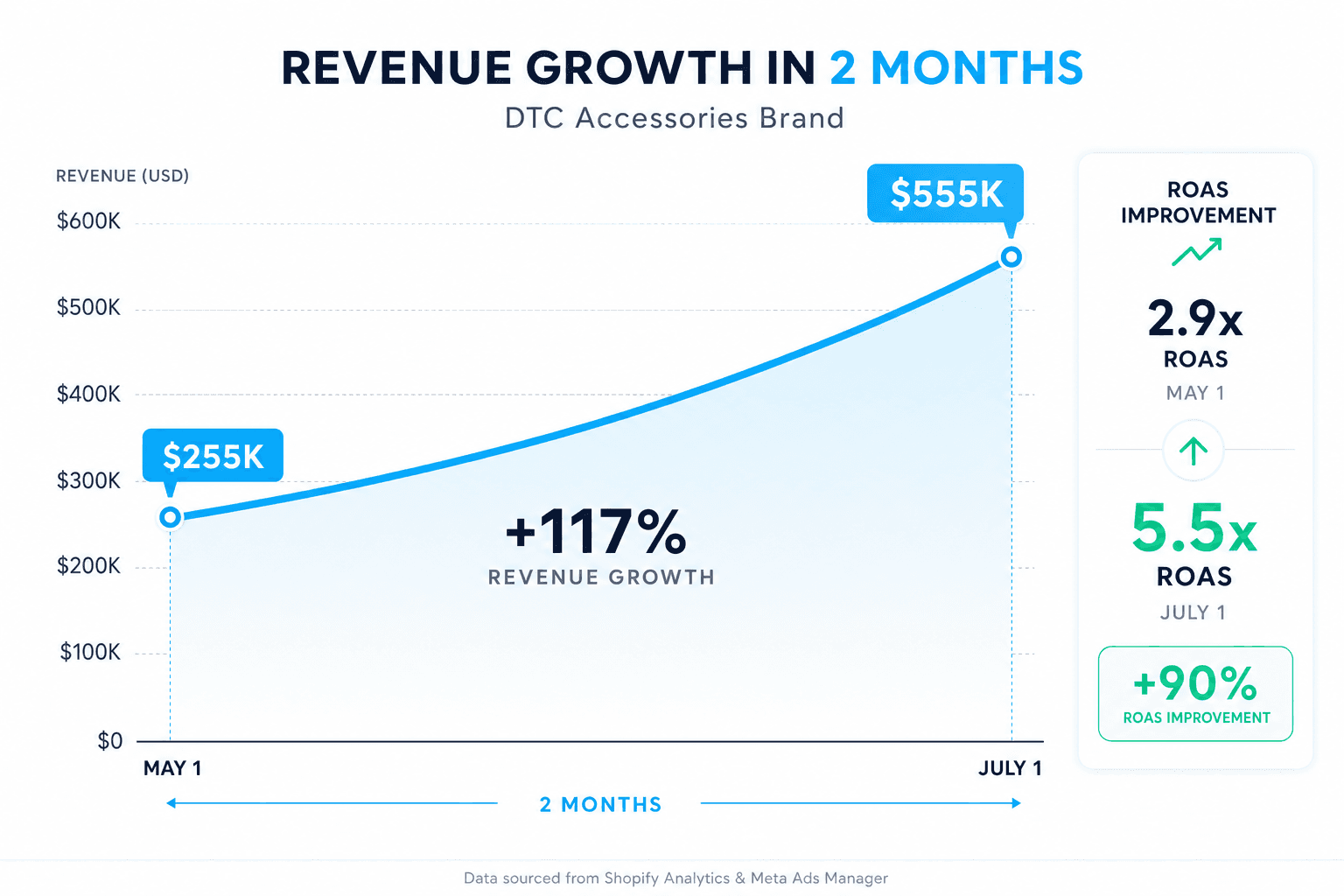
- Revenue
- $255k → $555k (2 mo)
- ROAS
- 2.9x → 5.5x+ (peak 7.95x)
- Site conversion
- +34%
Build a fragrance growth system that wins every gifting season
No obligation and no generic audit template: we'll bring a point of view on where ROAS is leaking, where the retention opportunity is and what we'd build first, tailored to your brand, seasonality and numbers.
Sagum · January 2017 · St. George, Utah · 8+ years