

8+ years growing brands on KPIs, now with AI
Home improvement growth judged on blended ROAS
We build paid media, creative, and attribution around how homeowners actually shop, not how platforms report.
Google Ads · Meta · TikTok Partner · 8+ Years Growing DTC Brands



Get your free Growth Gap Analysis
Senior strategist review · response within one business day
Prefer to reach out directly?
The Challenge
Home Improvement Ecommerce Punishes Generic Marketing
Home Depot and Lowe's lead the category, and 63% of shoppers start searching on Amazon. Your DTC brand has a fraction of their budget, review counts, and logistics.
Customers buy when a fixture breaks, a project starts, or rising mortgage rates turn a planned move into a renovation, so demand spikes unpredictably. Anything over $150 has a 3-to-14-day consideration window across devices and sessions, so attribution misreports the closing touchpoint.
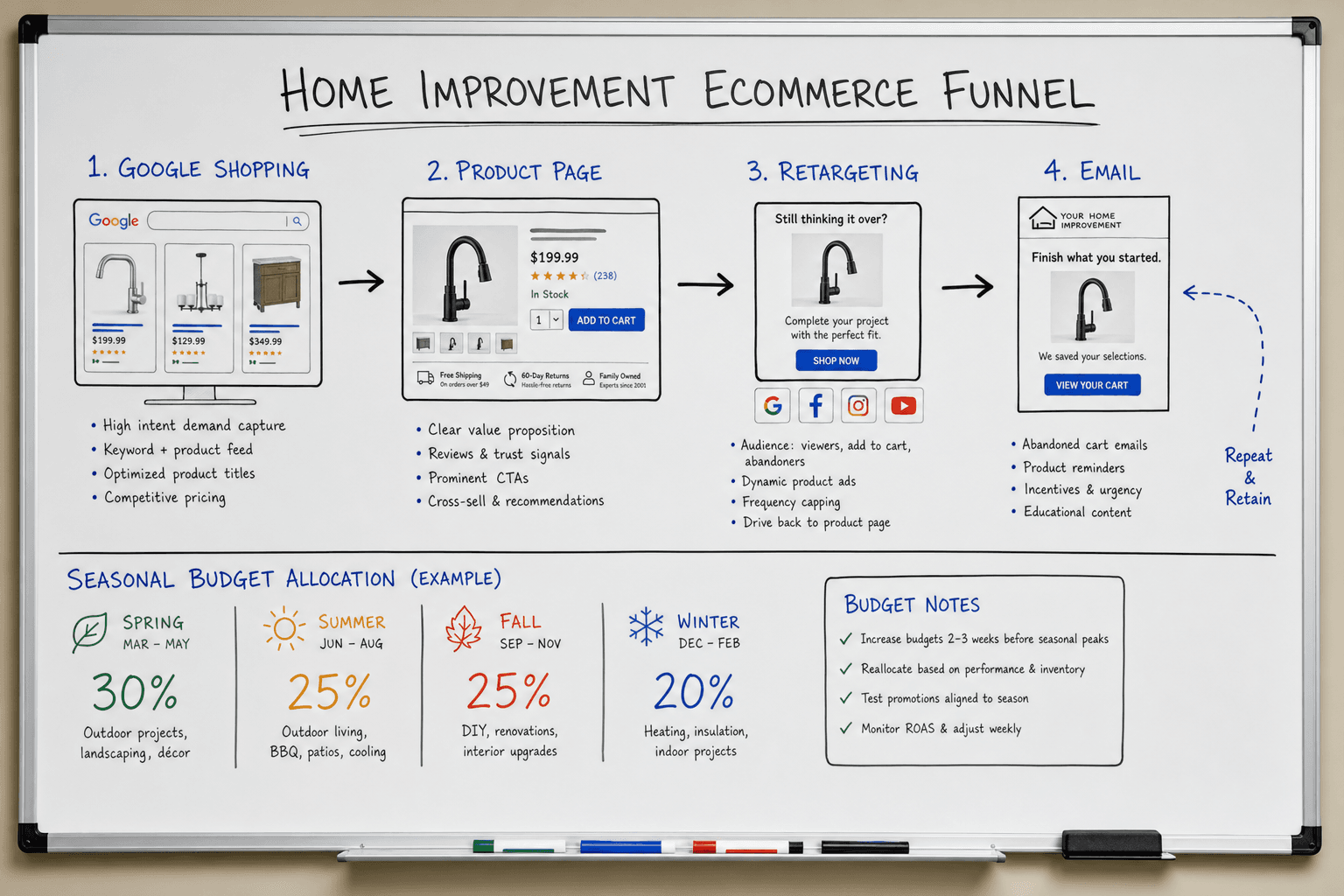
Spring (March through May) is your biggest acquisition window; if your campaigns aren't funded and live by mid-February, you've ceded ground. July is home and garden's most efficient paid media month, with blended ROAS peaking around 5.3x. January and February are dead for acquisition: Meta CPMs stay high while intent collapses.
Fixtures, power tools, and lighting carry $200 to $600 AOVs, but CAC can run $127 to $462 depending on the product. The math depends on extending LTV, yet 43% of your power tool buyers won't rebuy until something breaks. Winning brands raise second-purchase rate with accessories, consumables, and bundling.

The Opportunity
Where Lean Home Improvement Brands Can Win on Ad Efficiency
In A2X's benchmark of 2025 DTC results across categories, brands under $10M in revenue grew ROAS about 16.5% while $10M+ brands saw ROAS fall about 9%. A2X credits the smaller brands' gains to fast, founder-led testing of ad creative and email flows, not bigger budgets.
Millions of mortgage-locked homeowners renovate instead of moving, and they spend 72% more on tools and home improvement than renters.
In this category, Google Shopping and Performance Max (PMax) click-through rates are up 13.95% year-over-year. Profiting from those high-intent clicks takes clean feeds, strong retargeting creative, and pages that resolve three objections: compatibility anxiety, shipping cost sticker shock, and not seeing the product in person.
Email and SMS, the category's highest-ROAS owned channel, can lift second-purchase rate 20 to 35% through a disciplined post-purchase sequence without new acquisition spend.
What Most Get Wrong
What Home Improvement Brands and Their Agencies Get Wrong
Trusting platform ROAS instead of blended ROAS
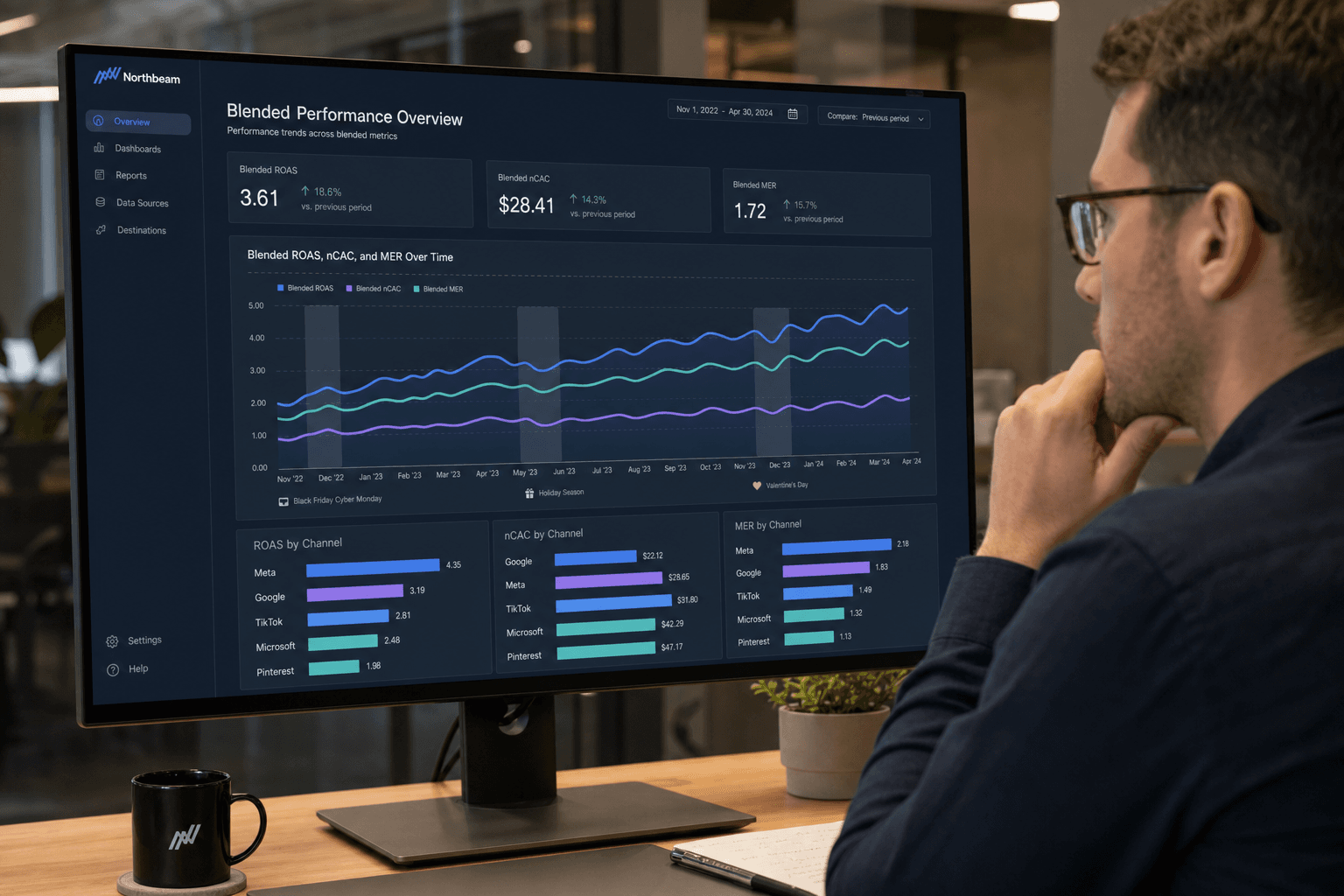
Post-iOS 14, Meta reports 4x, Google 6x, both claiming the same sales, so brands scale unprofitable campaigns. Run the business on blended ROAS: total revenue divided by total ad spend.
Running July's budget and creative in January
Home and garden ROAS drops to 2–2.5x in January and February. Brands that don't shift acquisition spend to creative testing and email nurture burn margin and enter March underfunded.
Ignoring the compatibility objection on product pages
Compatibility anxiety tops cart abandonment drivers for fixtures, hardware, and tools. Without measurement guides, compatibility checkers, or specs answering 'will this work with my setup,' shoppers you paid for leave.
Running PMax without brand exclusions or brand/non-brand segmentation
PMax spends heavily on branded queries you'd win organically, reports them as new acquisition, flatters new customer acquisition cost (nCAC), and hides that new-customer growth is slower than you think.
Treating email as a broadcast channel, not an LTV engine
Your post-purchase sequence is the whole LTV strategy. One 'thanks for your order' email and monthly newsletters forfeit second-purchase lift from accessory, consumable, project completion, and seasonal reactivation prompts.
Why Now
Why the Months Before Spring Decide Your Home Improvement Year
Spring demand for outdoor projects, deck and patio, exterior paint, and roofing starts in March. Funded brands with proven creative and clean attribution get the year's best CPMs; brands launching in April pay a premium for the same clicks.
High-velocity testing used to take a 10-person in-house performance team. AI-assisted production now lets a lean team test ad creative and email flows at the speed behind smaller brands' ROAS gains.
Most competitors still test 1 to 2 ad angles a month, optimize to platform ROAS, and hope PMax sorts itself out. Their nCAC shows it. Build and test spring campaigns before mid-February; brands that enter March with proven creative and clean measurement will acquire customers at a cost reactive brands can't match.
The Mechanism
Where AI Gives Home Improvement Brands an Edge
Real productivity, not AI theater. Here's where it actually moves a number for home improvement brands.
Creative
What AI does: Generates and tests ad concepts weekly across product categories, seasonal triggers (spring outdoor, fall indoor), and objections (compatibility, shipping, returns), then reads performance signals to scale what works.
The result: You can test 5 to 8 angles weekly, not 1 to 2 a month, finding which message brings in profitable new customers faster and cheaper.
Why it matters here: Per A2X, brands under $10M grew ROAS 16.5% in 2025 through faster creative and email testing, which matters when ads answer compatibility objections pre-click.
Analytics
What AI does: Reconciles platform ROAS with blended ROAS, flags Meta or Google overclaiming revenue, and separates new-customer acquisition from retargeting and brand from non-brand in PMax.
The result: You stop optimizing to a misleading number and move budget to campaigns driving profitable nCAC, not the best-looking ones in the platform dashboard.
Why it matters here: With post-iOS 14 signal degraded, brands with clean measurement make better budget calls than those trusting platform attribution, and that edge compounds each peak season.
Digital Ads
What AI does: Tunes campaign structure and bids to the season: scaling before the spring and July peaks, pulling back in the January–February trough, and holding retargeting through high-AOV consideration windows.
The result: Spend follows demand instead of a flat monthly budget, so peak-season campaigns are funded and tested before CPMs rise.
Why it matters here: Home improvement ROAS swings from 2–2.5x in January to 5.3x in July, among ecommerce's most predictable curves, so matching spend to it beats static budgets.
Conversion Optimization
What AI does: Finds where compatibility anxiety, shipping costs, or insufficient imagery drive drop-off on your pages, then tests fixes: measurement guides, compatibility callouts, free-shipping threshold placement, and video or 360° imagery.
The result: Higher conversion on high-AOV traffic you already pay for raises blended ROAS without more ad spend.
Why it matters here: Unexpected shipping costs drive 55% of ecommerce cart abandonment, and compatibility anxiety is the top objection in fixtures, hardware, and tools; retargeting can't offset either.
What AI does: Builds post-purchase flows: accessory recommendations timed to project completion, seasonal reactivation (spring outdoor projects for fall buyers of indoor hardware), and second-purchase prompts by product category.
The result: A 20 to 35% second-purchase lift extends LTV in a category where repeat purchases are infrequent and profitable acquisition depends on them.
Why it matters here: Since 43% of power tool buyers won't rebuy until something breaks, disciplined post-purchase email separates 2:1 LTV:CAC from 3:1+, where paid acquisition turns sustainably profitable.
Ready to see what this looks like for your home improvement brands business?
No obligation. A senior strategist will show you exactly where the wins are.
The Strategy
How to Run Home Improvement Ecommerce Marketing
Blended ROAS across every channel matches your P&L. Calculate it weekly, treat Meta and Google ROAS as directional diagnostics, and separate new-customer revenue from returning-customer revenue so you know your true nCAC.
Google Shopping and PMax come first in the channel stack, capturing high-intent searches like 'cordless drill under $200,' 'matte black bathroom faucet,' and 'deck stain for pressure-treated wood,' where feed quality and product titles matter more than bids. Segment brand from non-brand on day one.
Meta does two jobs: prospecting with creative that resolves compatibility, fit, and shipping objections, and retargeting the consideration window with social proof and urgency. Prospecting ROAS will run 2 to 3x and retargeting can reach 8 to 15x, so report them separately to avoid bad scaling decisions.
Get spring campaigns funded and live by mid-February, raise July's budget, and use January and February for creative testing, catalog expansion, and email nurture.
Email and SMS are the LTV engine: post-purchase sequences follow the category bought, the likely project timeline, and the accessory or consumable that extends the purchase.
The one number that governs this
Blended ROAS, measured weekly, is the governing KPI. Secondary KPIs are nCAC and second-purchase rate.
How We Help
How Sagum Runs This for Home Improvement Brands
We verify your attribution before touching a campaign, then build the paid media, creative, email, and conversion systems that move blended ROAS and nCAC.
Paid Media: Google Shopping & PMax
We segment brand from non-brand so PMax isn't flattering nCAC with brand-search conversions, and treat feeds (titles, attributes, imagery) as a primary lever.
Paid Media: Meta Ads
We run prospecting creative that answers the category's objections and retargeting designed to close high-AOV buyers' consideration window, measuring each against its own ROAS benchmark.
Creative Production & Testing
We test seasonal, objection, demo, and social proof angles weekly with AI-assisted production, outpacing brands that test 1 to 2 creatives a month.
Analytics & Attribution
We build blended ROAS reporting, reconcile it weekly against platform numbers, and flag attribution errors before you scale on them.
Conversion Optimization
We audit product and landing pages for compatibility, shipping cost, and visualization objections, testing fixes against conversion and add-to-cart rates.
Email & SMS Automation
We build post-purchase accessory sequences by category, seasonal reactivation flows, and second-purchase prompts timed to project windows, tracking second-purchase rate alongside nCAC.
Seasonal Budget Planning
We plan an annual budget that scales for spring and July and shifts January–February spend into creative testing.
Who's Behind This
Who we are, and what makes us different
Sagum is a performance marketing agency founded in January 2017 in St. George, Utah. We've spent 8+ years growing real brands and being judged on KPIs, not vanity metrics.
We deliberately limit how many clients we take so each one gets senior attention. We treat your numbers like our own, we never run generic playbooks, and your strategy is built for your business, because shouldn't your brand's marketing be custom to your brand?
Sagum.ai is our AI arm: the same proven operators now build AI into the work wherever it creates real edge, not as theater, but as leverage applied with discipline.
- 8+ years growing brands on performance KPIs, not vanity metrics
- Limited client roster, with senior attention on every account
- An extension of your team; your success is tied to ours
- Custom strategy per brand, never a generic playbook
- AI built in where it moves a number; judgment over hype
“Sagum is a performance marketing agency that's spent 8+ years growing brands by treating their numbers like our own. We take on few clients, never run generic playbooks, and now build AI into the work wherever it creates real edge, not hype. Your strategy is built for your business, and our success is tied to yours.”

“After six years, Sagum is our most important partner: trusted, communicative, and caring about our business as if it's their own.”
Long-term partner
6-year client
Proof
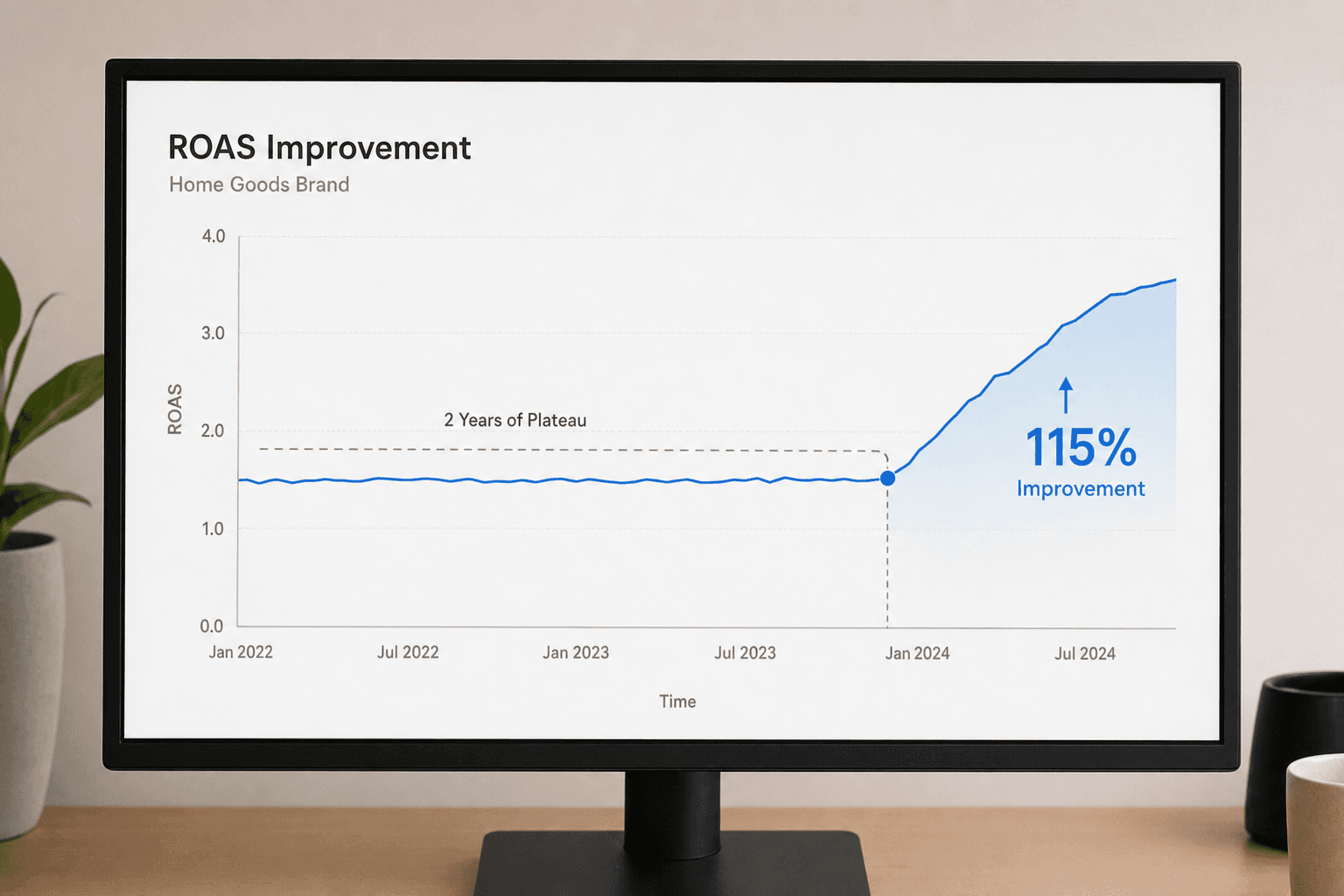
Broke a 2-year ROAS plateau with +115% ROAS at the same spend
House of Jade
Challenge
House of Jade, a home goods ecommerce brand, had been stuck on a two-year ROAS plateau.
What we did
We restructured their strategy without increasing spend, the same approach we would bring to a home improvement brand's seasonal, high-AOV buying cycle.
Result
House of Jade broke its two-year ROAS plateau with a 115% ROAS improvement at the same spend level and had its biggest, most profitable Q4. Read the full case study at sagum.com/case-studies/.
Build Your Plan Before Spring, Home Improvement's Biggest Acquisition Window
No obligation. You get one focused session on your actual blended ROAS, nCAC, and where the real growth is. We take a limited number of clients so every engagement gets senior attention.
Sagum · January 2017 · St. George, Utah · 8+ years