
8+ years growing brands on KPIs, now with AI
Injury Attorney Marketing Judged by Signed Cases
We build injury attorney campaigns around cost per signed case, not cost per click, so your intake pipeline stays full.
8+ years growing service businesses on Google Ads, Meta, and TikTok



Get your free marketing audit
Senior strategist review · response within one business day
Prefer to reach out directly?
The Challenge
Personal Injury Marketing Is Not Like Other Legal Advertising
Your best cases do not come from people browsing options. They come from someone who just walked out of an ER, got off the phone with an adjuster who lowballed them, or watched a tow truck haul away their car. That person opens Google within hours, searches 'car accident lawyer near me,' and hires one of the first firms that answers the phone and sounds like they know what they are doing.
That window is not measured in days. Research puts the optimal response time at under five minutes. After fifteen minutes, the lead starts going cold. After an hour, conversion rates have collapsed to a fraction of their peak. Your competitors know this too, which is why the race to answer is relentless.
Meanwhile, the economics of your market are brutal. CPCs for personal injury keywords in a competitive metro routinely run $150 to $250 per click, and a Quality Score gap of five points can mean you are paying $334 for the same click your competitor buys for $124. A single percentage point of intake conversion is worth tens of thousands of dollars in contingency fees over a year.
On top of that, you are fighting on multiple fronts at once: TV incumbents with eight-figure ad budgets, shared lead vendors selling the same inquiry to several other firms, legal directories with unpredictable volume, and now Google AI Overviews competing with paid ads for attention on the exact queries that used to convert best. The firms that win are the ones who treat every dollar as accountable to one number: cost per signed case.

The Opportunity
The Demand Is There. Most Firms Are Just Capturing It Badly.
The average personal injury firm converts only a small share of its inquiries into signed retainers. Top-performing firms convert several times that share from the same volume of leads. That gap is not a case-quality problem. It is a marketing and intake infrastructure problem, and it is entirely fixable.
Consider the math. At a standard 33 percent contingency, the average PI settlement of roughly $55,000 generates around $18,000 in attorney fees. A trucking case, where commercial policies routinely run $1 million to $5 million, can generate $33,000 to $330,000 in fees from a single retainer. The acquisition cost that is painful for a minor fender-bender claim is completely rational for a catastrophic injury case, as long as your campaigns are separating those case types and bidding accordingly.
The firms capturing the most cases right now are not necessarily the biggest spenders. They are the ones with the tightest keyword-to-landing-page match, the fastest intake response, and the clearest attribution from first click to signed retainer. That combination is not common. Which means the opportunity for a disciplined operator is real and immediate.
What Most Get Wrong
What Most PI Firms and Their Agencies Get Wrong
Optimizing for calls instead of signed cases
Your agency celebrates a record month of phone calls while your managing partner is looking at a thin docket. Calls from property-damage-only inquiries, uninsured pedestrians with no liable party, and people outside your service counties all count as 'leads' in a dashboard built around volume. The real scoreboard is cost per signed retainer, and most agencies never build reporting that reaches it.
Running one campaign across all case types and geographies
A 'car accident lawyer Chicago' campaign and a 'car accident lawyer Peoria' campaign compete in completely different auctions with different CPCs, different case values, and different Quality Score dynamics. Blending them into a single campaign destroys bidding efficiency and burns budget on the wrong mix. The same logic applies to case types: a slip and fall landing page and a trucking accident landing page should never share a campaign, because the buyer intent, the damages range, and the competitive set are entirely different.
Ignoring Quality Score and paying a 50 to 70 percent CPC premium as a result
At $200 market CPCs, a Quality Score of 3 pushes your effective cost to $334 per click. A competitor with a Quality Score of 8 pays $124 for the same position. Over a month of meaningful volume, that gap is the difference between a profitable channel and one that looks broken. Most agencies set up campaigns and never fix the structural issues, including poor keyword-to-ad relevance and landing pages that do not match search intent, that drag Quality Score down.
No 24/7 intake or slow response to new inquiries
An accident victim who submits a form at 11 p.m. and gets a callback the next morning at 9 a.m. has already spoken with two other firms. Speed of response is the single largest intake conversion lever in personal injury, and most firms treat it as an operational afterthought rather than a marketing priority. A missed call at 2 a.m. from a serious trucking case is not a minor inconvenience. It can be one of the largest fees of your year walking to a competitor.
Buying shared leads from vendors as a primary acquisition channel
Lead vendors often sell the same inquiry to several firms at once. The conversion rate on a shared lead is a fraction of an exclusive inbound call from a well-targeted Search campaign, and the economics rarely pencil out once you account for intake time spent on leads that were already signed elsewhere. Shared leads can supplement volume, but firms that build their pipeline on vendor leads are renting their docket from someone else.
Why Now
Why the Window Is Open Right Now
Google AI Overviews are reshaping the personal injury search landscape faster than most firms have noticed. When a user asks a complex legal question, Google now generates an AI summary at the top of the results page. According to Seer Interactive's September 2025 update, paid-ad click-through rates on queries showing an AI Overview fell from roughly 20 percent to 6 percent between mid-2024 and September 2025. That is not a rounding error. It means the firms with the highest-converting landing pages, the strongest Local Services Ads positioning, and the most disciplined case-type targeting will capture a disproportionate share of the clicks that remain.
At the same time, most PI firms are still running the same set-and-forget campaigns they built three years ago. Static ad copy, no creative testing, no intake attribution that reaches the case management system. An operator who builds AI into the workflow right now, to test ad angles faster, to catch attribution gaps, to identify which case types and geographies are generating the best CPSC, can establish a structural advantage before the next peak season.
Memorial Day through Labor Day is a high-volume stretch for auto accident cases in most markets. CPCs spike during that window because every competitor increases spend simultaneously. Firms that build and optimize their campaigns before the summer surge earn better Quality Scores, better landing page conversion rates, and lower average CPCs before the auction gets expensive. The time to build the infrastructure is now, not during the peak when every change is more expensive and riskier.
The Mechanism
How AI Creates a Real Edge in Personal Injury Marketing
Real productivity, not AI theater. Here's where it actually moves a number for injury attorneys.
Digital Ads
What AI does: AI-assisted bid management and Quality Score optimization across case-type campaigns, with real-time budget shifting toward the geographies and case types generating the lowest CPSC each week.
The result: Budget follows actual signed-case performance rather than a static monthly allocation, so spend concentrates on the campaigns that are actually producing retainers, not just calls.
Why it matters here: In a market where CPCs run $150 to $250 and a five-point Quality Score gap doubles your effective cost, every dollar of bid efficiency compounds. A PI firm cannot afford to let a campaign run on autopilot for a month while it bleeds budget on broad-match traffic that never converts to a signed case.
Analytics and Attribution
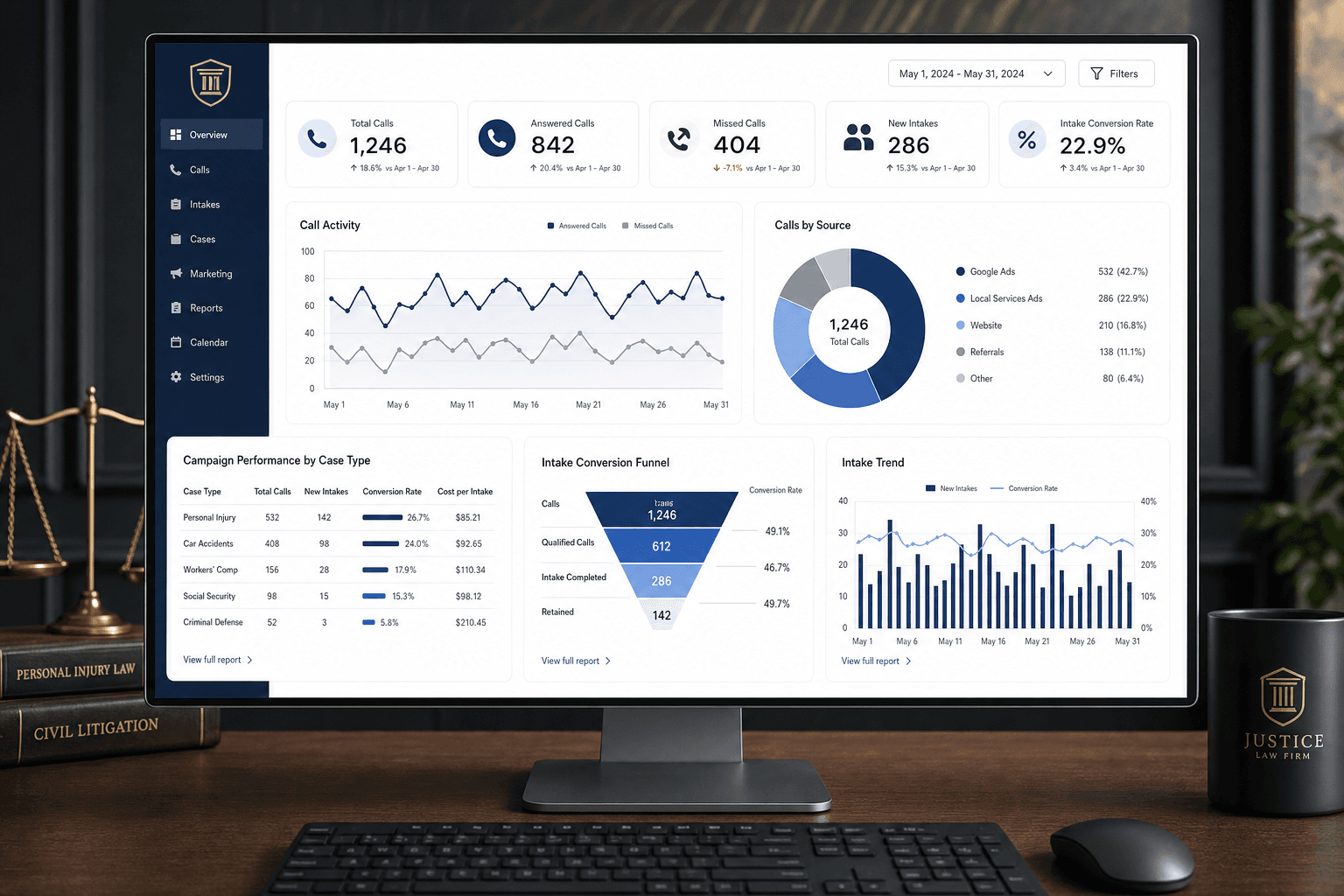
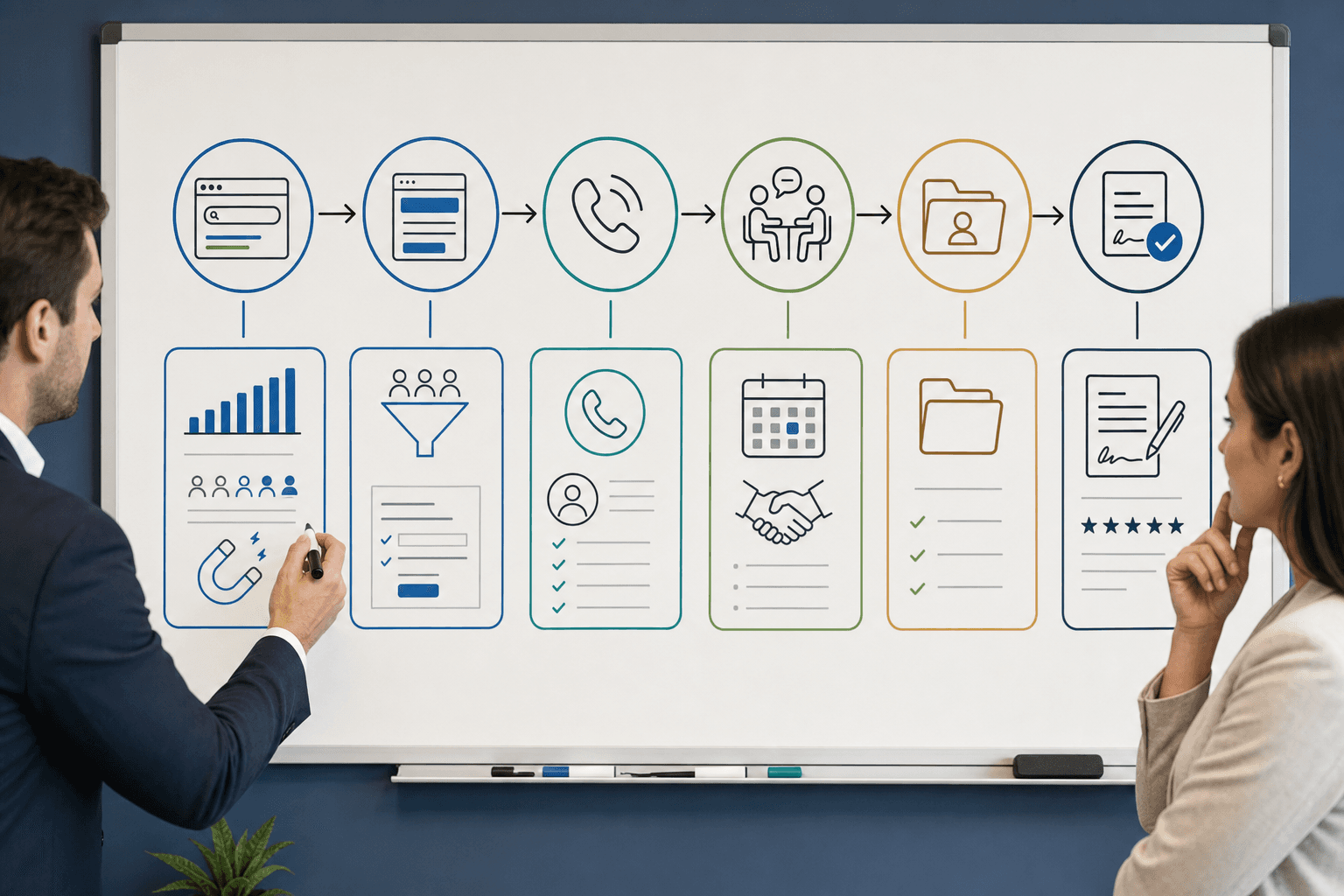
What AI does: AI-assisted attribution that connects the first click through the intake call, the consultation, and the signed retainer in the case management system, so every campaign is measured against CPSC rather than CPL.
The result: You can see, at the campaign and keyword level, which case types and geographies are generating profitable signed cases, and which are generating expensive calls that never convert.
Why it matters here: The average PI firm has no line of sight from a Google click to a signed retainer. Without that connection, every budget decision is a guess. Firms that build this attribution infrastructure make every subsequent marketing dollar more efficient, because they are optimizing against the number that actually pays the bills.
Conversion Optimization
What AI does: AI-built, case-type-specific landing pages optimized for phone calls and form submissions, with continuous testing of headlines, trust signals, and call-to-action placement against actual intake conversion data.
The result: Higher landing-page conversion rates mean more calls from the same ad spend, which directly lowers CPSC without requiring a larger budget.
Why it matters here: As AI Overviews reduce the total click volume available on high-intent PI queries, the firms with the highest-converting landing pages capture a larger share of the clicks that do happen. A landing page built for a trucking accident case should look nothing like one built for a slip and fall, because the buyer, the damages range, and the trust signals that close the call are completely different.
Creative
What AI does: Rapid generation and testing of ad copy variations across case types, testing different urgency angles (statute of limitations, free consultation, no fee unless you win), social proof formats, and case-outcome framings within bar advertising rules.
The result: Testing five to ten ad copy variations per case type per month instead of one or two means finding the message that drives calls faster, and retiring underperformers before they drain budget.
Why it matters here: PI ad copy is constrained by state bar advertising rules on testimonials, past results, and solicitation language. An AI-assisted creative process that generates compliant variations at volume and tests them systematically produces better-performing ads with less risk of a bar complaint from a rushed, one-off creative decision.
Ready to see what this looks like for your injury attorneys business?
No obligation. A senior strategist will show you exactly where the wins are.
The Strategy
What a Properly Built PI Marketing Strategy Actually Looks Like
The foundation is Google Search Ads and Local Services Ads, structured by case type and geography. Every case type, auto, truck, motorcycle, slip and fall, wrongful death, gets its own campaign, its own ad group, its own landing page, and its own bid strategy. Every geography, down to the county level in competitive markets, gets its own campaign so that Chicago and Peoria are never competing against each other in the same auction.
Local Services Ads come first where the firm qualifies. The Google Verified badge and pay-per-lead pricing make LSAs the most efficient top-of-funnel channel for most PI firms in most markets. They appear above standard Search Ads and carry a trust signal that no amount of ad copy can replicate. Passing and maintaining LSA verification, including background checks and bar license verification, is a prerequisite, not an afterthought, and so is building the review volume that feeds ranking.
Intake infrastructure is treated as part of the marketing strategy, not a separate operational concern. Call tracking is installed on every campaign and every landing page. Calls are recorded and reviewed for intake quality. Response time targets are set and monitored. A new inquiry that goes unanswered for more than fifteen minutes is a case that is probably already lost. The 24/7 answering protocol is built before the campaigns go live.
Where platform policy allows it, retargeting runs continuously for people who visited a case-type landing page but did not call. These visitors are still within the statute of limitations window, still deciding, and already familiar with the firm. Retargeting display and video ads reinforcing reviews, the free consultation, and bar-compliant contingency-fee messaging close a meaningful percentage of cases that would otherwise go to a competitor.
Every dollar is measured against cost per signed case. CPL is a leading indicator. CPSC is the scoreboard. Monthly reporting connects campaign spend to intake volume to consultation rate to signed retainers, so every budget decision is grounded in what is actually generating fee revenue.
The one number that governs this
Governing KPI: Cost per Signed Case (CPSC). Every campaign, every landing page, and every intake protocol is optimized against this number, not calls or clicks.
How We Help
How We Build and Run This for Your Firm
We start where the money leaks: attribution and intake. Before we touch a campaign, we make sure you can see the line from a Google click to a signed retainer. Then we build the campaign infrastructure that the strategy requires, and we run it against your CPSC target, not a generic benchmark.
Paid Search and Local Services Ads
We build case-type and geography-separated campaigns on Google Search and LSAs, manage Quality Score discipline to keep your effective CPC competitive, and shift budget toward the case types and markets generating the lowest CPSC each week.
Analytics and Intake Attribution
We install call tracking on every campaign and landing page, connect intake data to your case management system where possible, and build reporting that shows CPSC and intake conversion rate at the campaign level, so every budget decision is grounded in signed-case economics.
Case-Type Landing Pages and Conversion Optimization
We build dedicated landing pages for each case type, auto, truck, motorcycle, slip and fall, wrongful death, optimized for phone calls and bar-compliant trust signals, and test them continuously against intake conversion data.
Ad Creative and Copy Testing
We generate and test multiple ad copy variations per case type each month, working within state bar advertising rules, to find the messages that drive calls at the lowest cost and retire underperformers before they drain budget.
Retargeting
Where platform policy allows, we run retargeting display and video campaigns for visitors who did not convert on the first visit, reinforcing reviews, free consultation, and bar-compliant contingency-fee messaging to close cases that are still in the decision window.
AI Systems and Reporting
We build AI-assisted reporting that surfaces CPSC trends by case type and geography, flags campaigns where Quality Score is degrading before it becomes expensive, and identifies intake conversion gaps so you can act on real data rather than a monthly summary.
Who's Behind This
Who we are, and what makes us different
Sagum is a performance marketing agency founded in January 2017 in St. George, Utah. We've spent 8+ years growing real brands and being judged on KPIs, not vanity metrics.
We deliberately limit how many clients we take so each one gets senior attention. We treat your numbers like our own, we never run generic playbooks, and your strategy is built for your business, because shouldn't your brand's marketing be custom to your brand?
Sagum.ai is our AI arm: the same proven operators now build AI into the work wherever it creates real edge, not as theater, but as leverage applied with discipline.
- 8+ years growing brands on performance KPIs, not vanity metrics
- Limited client roster, with senior attention on every account
- An extension of your team; your success is tied to ours
- Custom strategy per brand, never a generic playbook
- AI built in where it moves a number; judgment over hype
“Sagum is a performance marketing agency that's spent 8+ years growing brands by treating their numbers like our own. We take on few clients, never run generic playbooks, and now build AI into the work wherever it creates real edge, not hype. Your strategy is built for your business, and our success is tied to yours.”

“After six years, Sagum is our most important partner: trusted, communicative, and caring about our business as if it's their own.”
Proof
From a $20 CPL goal to $13 CPL and 300+ leads/mo
Rizzoli's Automotive
Challenge
Rizzoli's Automotive needed a predictable flow of qualified service customers at a cost per lead that justified the channel. Their goal was 100 qualified leads per month at roughly $20 per lead.
What we did
We rebuilt their campaign structure around high-intent service queries and built a custom, call-driving landing page purpose-built for conversion rather than information.
Result
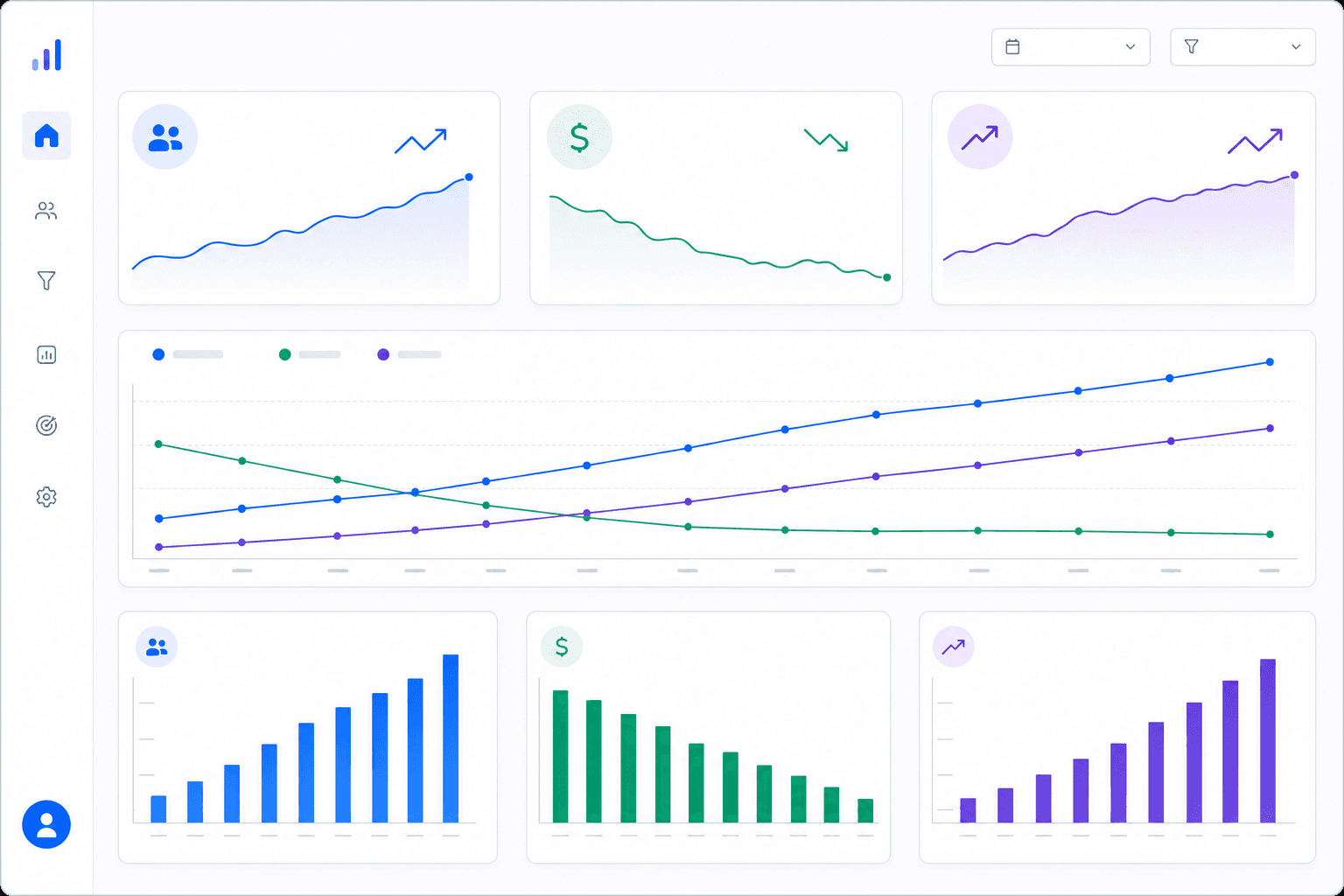
Cost per lead dropped from a $20 target to $13 in practice. Monthly lead volume climbed above 300, and landing-page conversion exceeded 60 percent. The client used the predictable pipeline to open multiple new locations. The same intent-matched search structure and call-driving landing page approach we built for Rizzoli's is how we would approach signed-case economics for your firm.
- Cost per lead
- $13
- Leads / month
- 300+
- Landing-page conversion
- 60%+
Find Out What Your Signed Cases Are Actually Costing You
No obligation. We will review your current campaigns, intake attribution, and cost per signed case benchmark, and show you specifically where the gaps are. Built around your firm, your case types, and your markets.
Sagum · January 2017 · St. George, Utah · 8+ years