

8+ years growing brands on KPIs, now with AI
More Booked Assessments for Insulation Contractors
We build search-first, geo-targeted campaigns that turn comfort complaints and high utility bills into signed insulation projects.
Google Ads · Meta · TikTok Partner | 8+ Years Growing Local Service Businesses



Get your free marketing audit
Senior strategist review · response within one business day
Prefer to reach out directly?
The Challenge
Insulation Buyers Arrive Skeptical, Mid-Research, and on the Weather's Schedule
Your customer doesn't start by searching for insulation. They wake up sweating at 2 a.m. in July because the upstairs won't cool, or open a utility bill $180 higher than last year and Google 'why is my house so hot.' They reach insulation after working through a dozen other possibilities.
That education gap is your biggest marketing problem. Homeowners arrive mid-research, skeptical, and price-anchored to a $40 blown-in bag at Home Depot, so you have to convince them a professional assessment is worth their time before you can sell them on a contractor.
Demand is weather-driven, so flat budgets waste money. The phone rings hard in the first brutal heat wave and the first hard freeze, then goes quiet in the shoulder months (March, April, September), when your crew has capacity and paid search CPL is lowest.
And the jobs aren't equal. A $1,400 blown-in attic top-up and a $14,000 closed-cell spray foam retrofit need different sales conversations, trust signals, and campaign structures.

The Opportunity
The Demand Is There; Most Contractors Can't Capture It Profitably
Homeowners within 30 miles of your shop search 'why is my upstairs so hot,' 'high electric bill summer,' and 'attic insulation cost' every day.
A homeowner who learns a utility or state rebate covers part of the cost sees a $6,000 spray foam estimate differently. Contractors with rebate messaging in ads and landing pages convert materially better than price-led ones.
Most contractors ignore this vertical's highest-converting lead source: HVAC technicians who find inadequate attic insulation during tune-ups and send you pre-diagnosed, pre-sold homeowners. A structured referral program with HVAC companies, roofers, and energy auditors can cut acquisition cost 30–50% below paid search alone, with far higher close rates than shared-lead platforms.
In shoulder months, CPL drops and your crew has openings. Few competitors pitch a fall installation that pays off once heating season starts.
What Most Get Wrong
What Most Insulation Contractors (and Their Agencies) Get Wrong
Running one catch-all 'insulation contractor' campaign
Blown-in, spray foam, and crawlspace buyers differ in intent, ticket size, and objections. In one campaign, high-volume, low-value clicks eat budget and $10,000+ spray foam jobs never get tailored messaging.
Spending the same in February as in July
Heat waves and freezes spike CPL as everyone advertises; shoulder months bring it down. Weight spend toward shoulder months and stay disciplined at peaks for more qualified assessments per dollar.
No call tracking by campaign and keyword
An $800/month campaign could be drawing calls from renters, out-of-area homeowners, and DIYers without you knowing. Every ad dollar should trace to a booked qualified assessment.
Sending local searchers to your homepage
Homeowners 25 miles from your shop searching 'spray foam insulation [their city]' bounce. City pages with local reviews and permit references convert at 2–3x a homepage's rate and rank organically.
Leading with price before closing the education gap
Someone still unsure they need insulation ignores a 'Get a Free Quote' ad. Diagnostic content (thermal imaging explainers, R-value calculators, utility bill analysis) earns the click and pre-qualifies the lead.
Why Now
Rebuild Your Campaigns Before Insulation's Next Peak Season
Most insulation contractors run Google Search campaigns built two or three years ago (same keywords, copy, and landing page) and check them monthly. With AI, that no longer makes sense: contractors using it to test creative weekly, shift budget to campaigns booking jobs, and catch attribution errors pull further ahead every month.
Join them before the next peak season and the advantage compounds: better data, lower CPL, and a feedback loop monthly check-ins can't match. If peak cooling season is near in your market, build campaigns, fix tracking, and launch service-area pages before the first heat wave spikes CPL.
Year-end utility rebate deadlines drive a Q4 spike in inquiries; contractors already messaging local utility and state rebates will capture those inquiries.
The Mechanism
Where AI Gives Insulation Contractors an Edge
Real productivity, not AI theater. Here's where it actually moves a number for insulation contractors.
Digital Ads
What AI does: AI continuously monitors your segmented campaigns (attic blown-in, crawlspace spray foam, whole-house retrofit) and shifts budget to the ad groups and keywords producing qualified assessments, not just clicks.
The result: Budget follows real demand: CPL drops in shoulder months, and spend stays disciplined at peaks when every competitor bids hard.
Why it matters here: Insulation demand moves with the weather. AI can raise bids on 'attic insulation cost' the day temperatures spike, capturing demand monthly-managed campaigns miss.
Creative
What AI does: Where you'd run one or two ads for months, AI helps generate and test angles weekly: comfort hooks ('Why is your upstairs 10 degrees hotter?'), bill savings, rebate deadlines, before/after attic photos.
The result: You find the creative that converts your market in weeks rather than quarters and stop paying for curiosity clicks.
Why it matters here: Insulation buyers respond to comfort, utility bills, or rebate deadlines; you learn which wins in your market only by systematic testing, which AI makes feasible.
Conversion Optimization
What AI does: AI helps build job-type landing pages ('Attic Spray Foam in [City],' 'Crawlspace Insulation Assessment in [City]') with diagnostic content, local reviews, and one CTA for calls and forms.
The result: Conversion rises on the same ad spend, and established service-area pages rank organically for '[city] spray foam insulation'.
Why it matters here: Pages that first validate the problem and address spray foam safety convert 'why is my crawlspace cold' searchers materially better than 'Get a Quote' pages.
Analytics
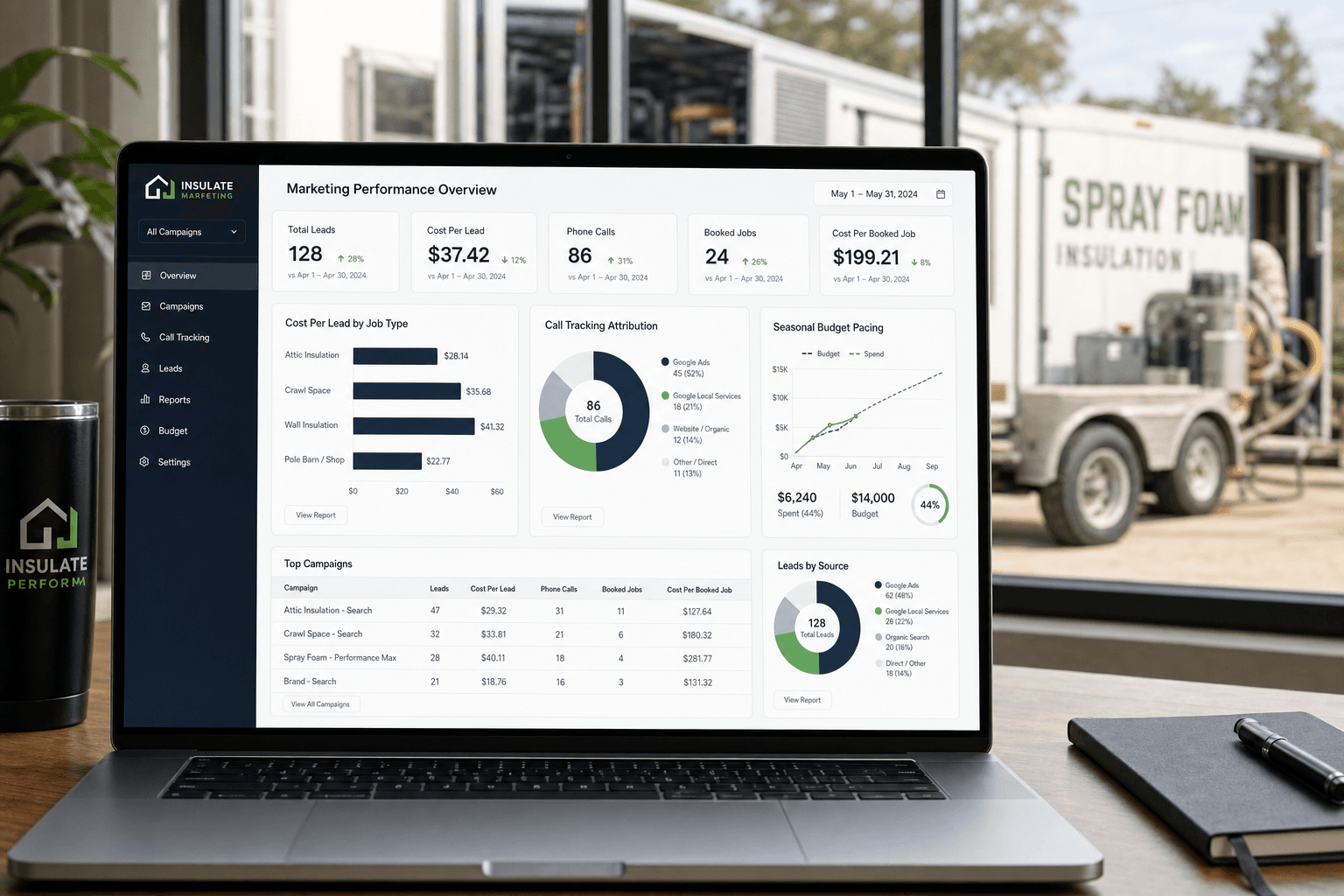
What AI does: AI-powered attribution ties every qualified assessment booking, phone calls included, to the campaign, keyword, and ad that drove it.
The result: You stop funding campaigns that draw $400 rim-joist jobs and unqualified calls, and back the keywords and channels producing $5,000+ spray foam assessments.
Why it matters here: Attribution gaps are routine: a homeowner clicks, calls three days later, and the call goes unattributed. Closing that gap shows true cost per qualified assessment.
Ready to see what this looks like for your insulation contractors business?
No obligation. A senior strategist will show you exactly where the wins are.
The Strategy
How Insulation Contractor Marketing Should Be Built
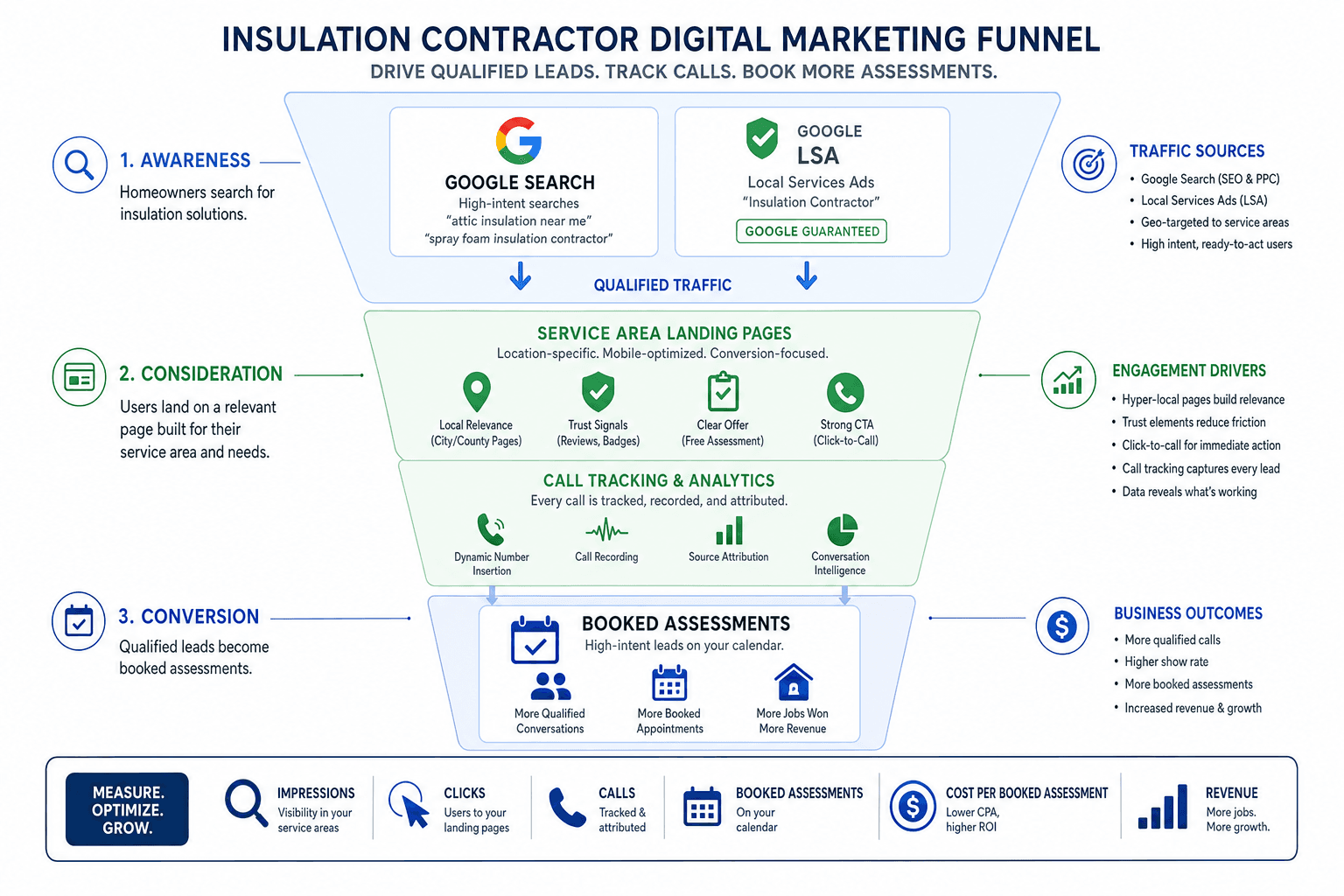
Build on Google Search with separate 'attic insulation,' 'spray foam,' 'crawl space insulation,' and 'blown-in' campaigns: spray foam buyers need more education and a longer nurture, while blown-in attic buyers are often ready to book within days.
Layer Google Local Services Ads (LSAs) on top for the lowest-funnel searches; their Google Verified badge reassures skeptical homeowners. LSAs are pay-per-lead but need a strong Google Business Profile (GBP) with 50+ reviews and active management.
Every campaign needs call tracking by keyword, ad, and campaign, so you can see which produced a booked assessment, not just a ringing phone.
Spend more in shoulder months, when fall-installation messaging ('get comfortable before heating season') converts well. At peaks, when CPL spikes and your crew is booked out, pull back on broad match and tighten bids.
Service-area pages, one per city or county and service line, are your compounding organic asset. One that ranks for 'spray foam insulation [City, ST]' brings leads at near-zero marginal CPL and reassures homeowners cross-checking your paid ads.
Put utility and state rebate messaging, such as a headline naming the rebate your local utility offers, in your ad copy and on every landing page.
The one number that governs this
Measure cost per qualified assessment (a booked estimate at an owner-occupied home in your service area, for work you do), not per click or call.
How We Help
What We'd Do for Your Insulation Business
Tracking comes first, then campaigns, then service-area pages that rank organically. We limit our client count so each gets senior attention and treat your cost per qualified assessment as ours.
Attribution & Call Tracking Setup
We start with keyword-level call tracking, form tracking, and a dashboard tying booked assessments to their ads, so you can optimize cost per sold project.
Segmented Google Search Campaigns
Each job type, air sealing included, gets separate campaigns, keywords, match types, and bids, with longer nurture for spray foam and fast booking for blown-in.
Google Local Services Ads Management
We manage your LSA profile and Google Verified screening, dispute unqualified leads, and optimize your GBP to strengthen your placement.
Service-Area Landing Pages
We build geo-targeted city and service-line pages with local reviews, diagnostic content, and one CTA, serving paid traffic now and ranking organically later.
Seasonal Budget Pacing
We weight budget toward shoulder months, stay disciplined at peaks when competitors overbid, and run fall-installation campaigns that pull demand forward before heating season.
Ad Creative Testing
We use AI to write and rotate new ad angles every week, then keep the ones that book assessments in your market.
Utility & State Rebate Messaging
We build local utility and state rebate messaging into your ads and landing pages, a differentiator most competitors don't use consistently.
Who's Behind This
Who we are, and what makes us different
Sagum is a performance marketing agency founded in January 2017 in St. George, Utah. We've spent 8+ years growing real brands and being judged on KPIs, not vanity metrics.
We deliberately limit how many clients we take so each one gets senior attention. We treat your numbers like our own, we never run generic playbooks, and your strategy is built for your business, because shouldn't your brand's marketing be custom to your brand?
Sagum.ai is our AI arm: the same proven operators now build AI into the work wherever it creates real edge, not as theater, but as leverage applied with discipline.
- 8+ years growing brands on performance KPIs, not vanity metrics
- Limited client roster, with senior attention on every account
- An extension of your team; your success is tied to ours
- Custom strategy per brand, never a generic playbook
- AI built in where it moves a number; judgment over hype
“Sagum is a performance marketing agency that's spent 8+ years growing brands by treating their numbers like our own. We take on few clients, never run generic playbooks, and now build AI into the work wherever it creates real edge, not hype. Your strategy is built for your business, and our success is tied to yours.”

“After six years, Sagum is our most important partner: trusted, communicative, and caring about our business as if it's their own.”
Long-term partner
6-year client
Proof
From a $20 CPL goal to $13 CPL and 300+ leads/mo
Rizzoli's Automotive
Challenge
Rizzoli's Automotive set a goal of 100 qualified leads per month at roughly a $20 cost per lead.
What we did
We built a custom, call-driving landing page and rebuilt paid search around high-intent service queries, the same discipline we bring to insulation campaigns.
Result
Cost per lead came in at $13 against the $20 goal, volume reached 300+ leads per month, and the landing page converted at over 60%. The client opened multiple new locations.
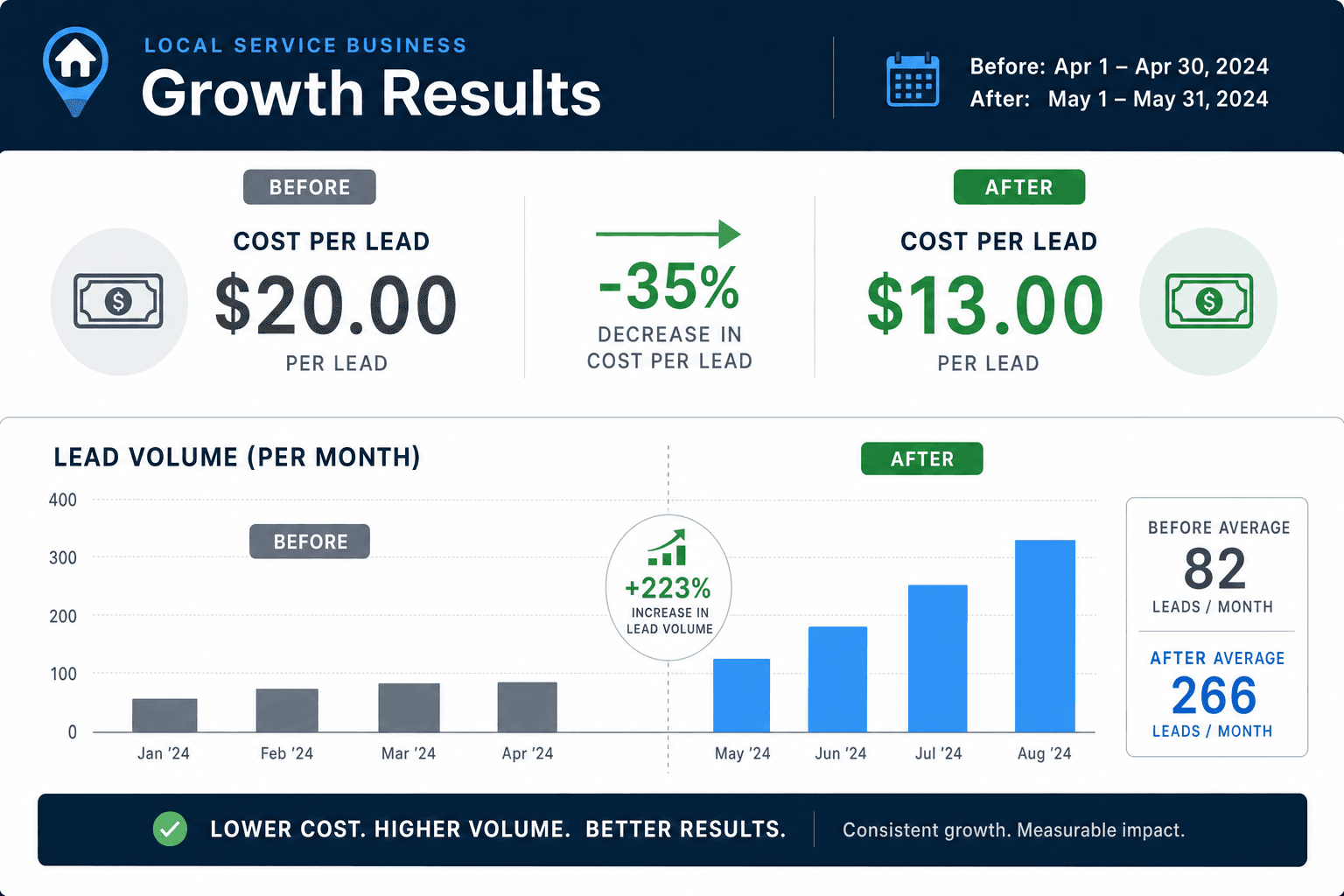
- Cost per lead
- $13
- Leads / month
- 300+
- Landing-page conversion
- 60%+
Find Out Where Your Insulation Marketing Is Leaking Money
No obligation. We'll review your campaigns, tracking, and cost per qualified assessment, then show where the gaps are and what we'd change, built around your service area, job types, and growth goals.
Sagum · January 2017 · St. George, Utah · 8+ years