
8+ years growing brands on KPIs, now with AI
Insurance Agency Leads That Actually Bind
Performance marketing built for independent agencies that need quoted leads to actually bind.
8+ years growing local service businesses | Google Ads | Meta | TikTok



Get your free marketing audit
Senior strategist review · response within one business day
Prefer to reach out directly?
The Challenge
Running an Independent Agency Has Never Been a Fair Fight
Progressive spent roughly $1.3 billion on advertising in a single quarter of 2025. GEICO was projected to approach $1.9 billion for the full year. You are not going to out-spend them on brand awareness, and you were never supposed to. Your edge is something they structurally cannot offer: you can shop fifteen carriers, advocate for a client at claim time, and actually pick up the phone when a renewal comes in 22% higher than last year.
The problem is that most shoppers do not know that yet when they type 'car insurance near me' into Google. They hit a comparison aggregator, fill out a form that gets sold to several agents at once, and the first one to call wins. If your agency is not the first call, or if you are buying those same shared leads and watching them churn at renewal, you are running on a treadmill.
Personal lines shoppers are not browsing casually. They are reacting to a renewal notice that landed in their mailbox and made them angry. Auto premiums spiked in 2023 and 2024, and homeowners in storm-prone or wildfire-adjacent states have seen some of the steepest increases. The shopping window is a matter of days. If your agency is not visible the moment that frustration peaks, and if you cannot get a quote back fast, a competitor binds that policy before you finish the application.
Commercial lines buyers are calmer but harder to reach. They want to know you understand their industry, that your carrier paper is solid, and that you will answer the phone when a certificate of insurance is due in two hours. Generic 'we save you money' messaging does not move them.
And if you offer Medicare Advantage or Part D, you are operating inside CMS marketing rules that govern nearly every touchpoint all year and bite hardest during the October 15 through December 7 Annual Enrollment Period, when seniors are actively shopping. One compliance slip can cost far more than the campaign earns.

The Opportunity
The Shoppers Are Out There. Most Agencies Are Just Missing Them.
Auto insurance shopping was still growing in Q1 2026, up 3.2% year over year per LexisNexis, even as many carriers cut rates. Every renewal notice your competitor's customer opens is a live lead for your agency, if you are visible when they search.
Where Google offers Local Services Ads to insurance agencies, currently only California and Florida, they are the most underused channel in independent agency marketing. The prospect is calling you directly, not filling out a form that gets resold. Intent is as high as it gets in insurance. Agents who answer LSA calls fast close far more of them, and that speed is what keeps the cost per bound policy inside your commission economics.
Organic search can deliver insurance leads at a fraction of paid search cost, but most agency websites are thin, slow, and built around the agency rather than around the searcher's question. A well-optimized Google Business Profile with a deep bench of recent reviews outperforms a generic website for local intent queries. Many of your local competitors have thin review counts and a GBP that has not been touched in years.
The real money, though, is in the household. J.D. Power found renters who bundle with auto retain at 91% versus 67% for those who do not, and every added line raises a household's lifetime value. That math makes cross-sell and lifecycle marketing the highest-return activity in your agency, and most principals are running it manually, if at all.
A single active referral relationship with a Realtor or mortgage broker can produce a steady stream of bound policies at near-zero cost per lead. The infrastructure to build and automate that pipeline exists. Most agencies have never built it.
What Most Get Wrong
What Most Insurance Agencies Get Wrong About Marketing
Buying shared aggregator leads and calling it a strategy
Shared aggregator leads look cheap per lead, but they are often sold to multiple agents simultaneously, tend to retain worse than agency-sourced clients, and require a speed-to-contact infrastructure most agencies do not have. Over a few renewal cycles, the cost advantage can disappear and you have built a book of low-loyalty clients.
No call tracking, so you cannot tell which ads actually bind policies
Most agency owners know their monthly ad spend. Almost none can tell you the cost per bound policy by channel, by line, or by campaign. Without call tracking tied to your agency management system, you are optimizing for clicks or form fills, not for the metric that actually pays commissions. You end up spending more on what looks good and starving what actually works.
Running one generic landing page for every line of business
A homeowner shopping after a hail claim and a small business owner needing a BOP have nothing in common. Sending both to a homepage that says 'we offer auto, home, life, and commercial insurance' converts neither. Line-specific landing pages with a fast quote-start form and a prominent callback option consistently outperform general pages, and they improve Google Ads Quality Score, which lowers your cost per click.
Ignoring the Google Business Profile until it becomes a crisis
LSA ranking and local pack visibility are directly tied to your GBP review count and rating. Agencies with a large base of recent reviews and a strong rating consistently outrank competitors for 'insurance agent near me' queries. Many independent agencies have thin review counts and no systematic process for requesting them. That gap is a ranking deficit that compounds every month you ignore it.
No lifecycle automation for cross-sell and renewal saves
The most profitable marketing an agency can do is to the clients it already has. Renewal save emails sent 60 to 90 days before expiration, personalized with the client's current policy details, get opened and acted on at rates generic newsletters never see. Cross-sell triggers tied to life events, a new home purchase, a teen driver added to the household, convert at rates no cold campaign can match. Most agencies handle this with a sticky note or a manual call list.
Why Now
The Agencies That Move Now Will Own Local Search Before the Next Renewal Wave
Q1 is one of the busiest personal lines shopping stretches of the year, and it arrives fast. New-year budgeting and post-holiday renewal notices push a wave of shoppers into January through March. The agencies that have their LSA profile optimized, their GBP review count climbing, and their line-specific landing pages live before that wave hits will capture the bulk of local inbound demand. The ones still running a single generic campaign will pay more per click and convert fewer of the leads they do get.
Most of your local competitors are still running static, set-and-forget Google campaigns with flat monthly budgets, no call tracking, and no connection between ad spend and bound policies. They are optimizing for impressions or form fills while you could be optimizing for cost per bound policy across every channel.
AI changes what a disciplined operator can do. An agency working with a team that uses AI for creative testing, bid optimization, and attribution analysis can run marketing that a solo principal or a generic agency simply cannot match, without adding headcount. The window where that advantage is available before your local competitors catch up is open right now, not in six months.
There is also a consolidation dynamic worth naming. Buyers announced 319 agency deals in the first half of 2025 alone, about three-quarters of them PE-backed, and OPTIS Partners expects 750 to 800 deals a year going forward. Agencies with strong, documented organic growth and a diversified lead mix command better multiples. Building that infrastructure now is not just a marketing decision; it is an equity decision.
The Mechanism
Where AI Creates a Real Edge for Insurance Agency Marketing
Real productivity, not AI theater. Here's where it actually moves a number for insurance agencies.
Digital Ads
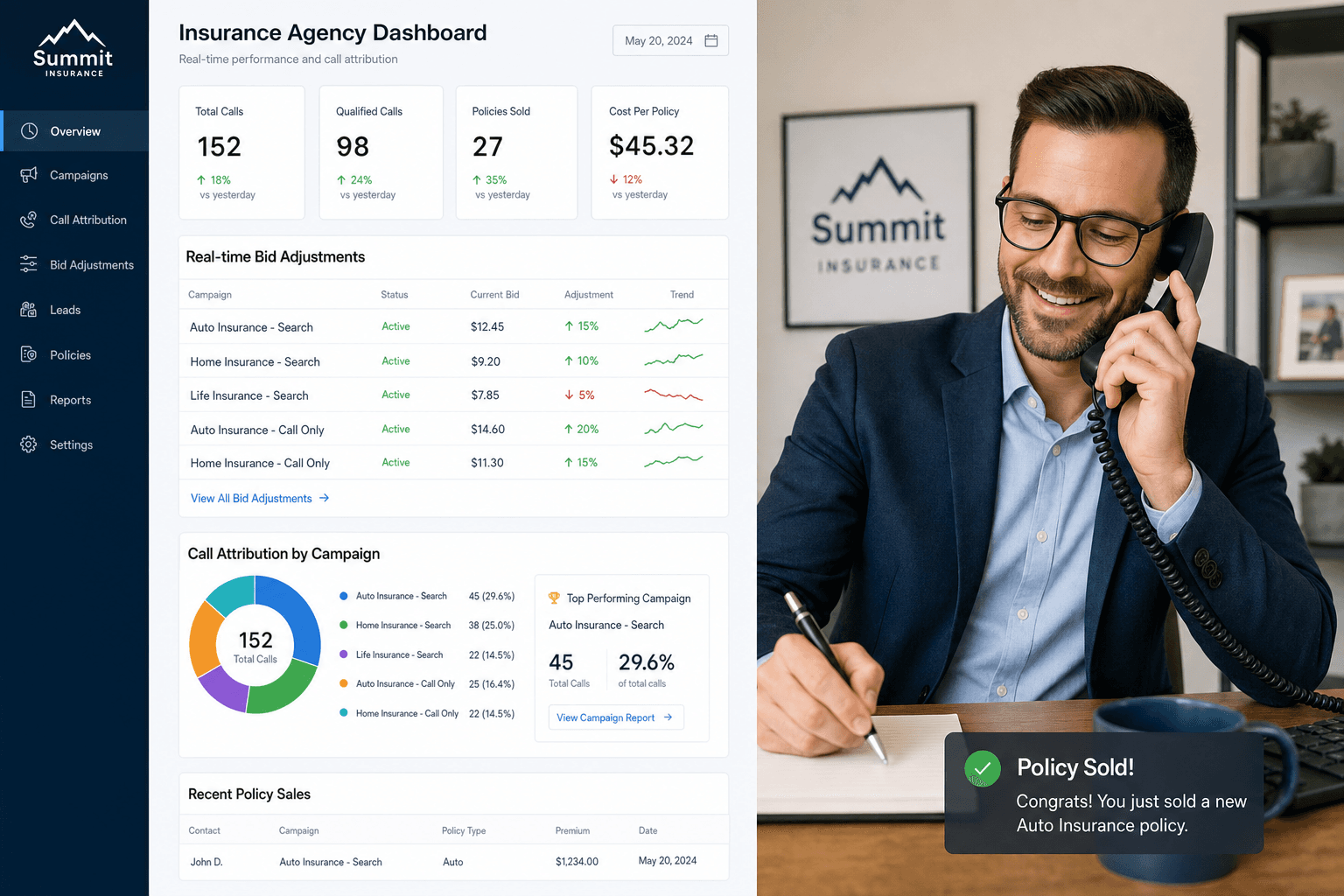
What AI does: AI-driven bid management adjusts Google LSA and Search bids in real time based on time of day, day of week, and seasonal demand signals, so your budget concentrates during the hours when shoppers are actively comparing quotes rather than spreading evenly across the week.
The result: Lower cost per qualified call and a higher share of the LSA inventory during peak shopping windows, particularly the first few days after a renewal notice lands.
Why it matters here: Insurance search demand is not uniform. A flat daily budget treats a Tuesday afternoon the same as a Saturday morning when homeowners are opening mail. AI bid logic captures that difference automatically.
Creative
What AI does: AI generates and tests multiple ad copy angles per week, including carrier-choice messaging, claims-advocacy angles, and rate-comparison hooks, so you identify the message that drives quote starts faster than running one ad for a month.
The result: Higher click-through rates on the search terms that actually bind policies, rather than the terms that generate cheap clicks from shoppers who will never buy.
Why it matters here: Independent agency copy needs to answer a very specific question: why call you instead of going straight to Progressive.com? The answer varies by line and by the shopper's trigger. Testing multiple angles quickly finds the version that converts for your market.
Analytics
What AI does: AI-assisted attribution connects inbound calls, form submissions, and quote-start events back to the specific campaign, keyword, and ad that generated them, then flags mismatches where spend is flowing toward leads that never bind.
The result: A clear view of cost per bound policy by channel and by line, so budget moves toward what actually pays commissions and away from what just looks active.
Why it matters here: Without this connection, most agencies are optimizing for form fills while their actual binding rate by source is invisible. A channel that generates 40 leads and binds 3 is not the same as one that generates 15 and binds 8, but a standard analytics setup will not tell you that.
Conversion Optimization
What AI does: AI reviews line-specific landing pages for conversion leaks, tests quote-start form layouts and callback prompts, and identifies the friction points that cause shoppers to abandon before submitting in the short window when they are actively comparing.
The result: Higher quote-to-bind rates from the same ad spend, because the page is tuned to move a frustrated renewal shopper to a form submission or a phone call rather than back to Google.
Why it matters here: A 1-point improvement in landing-page conversion rate on an insurance campaign running $5,000 per month produces more bound policies than a 10% reduction in cost per click. The page is the bottleneck most agencies never fix.
What AI does: AI-personalized lifecycle sequences trigger renewal save emails 60 to 90 days before expiration, cross-sell prompts when a client adds a teen driver or purchases a home, and annual coverage review invitations, each populated with the client's actual policy details rather than generic text.
The result: Higher retention rates and more multi-policy households, driven by automated outreach that a CSR cannot consistently execute manually across a book of 500 or 1,000 clients.
Why it matters here: Turning a single-policy client into a multi-policy household, the clients who stay longest, depends heavily on whether the agency stays in contact at the right moments. Automation makes that contact consistent at scale.
Ready to see what this looks like for your insurance agencies business?
No obligation. A senior strategist will show you exactly where the wins are.
The Strategy
What a Marketing Strategy Built for an Independent Agency Actually Looks Like
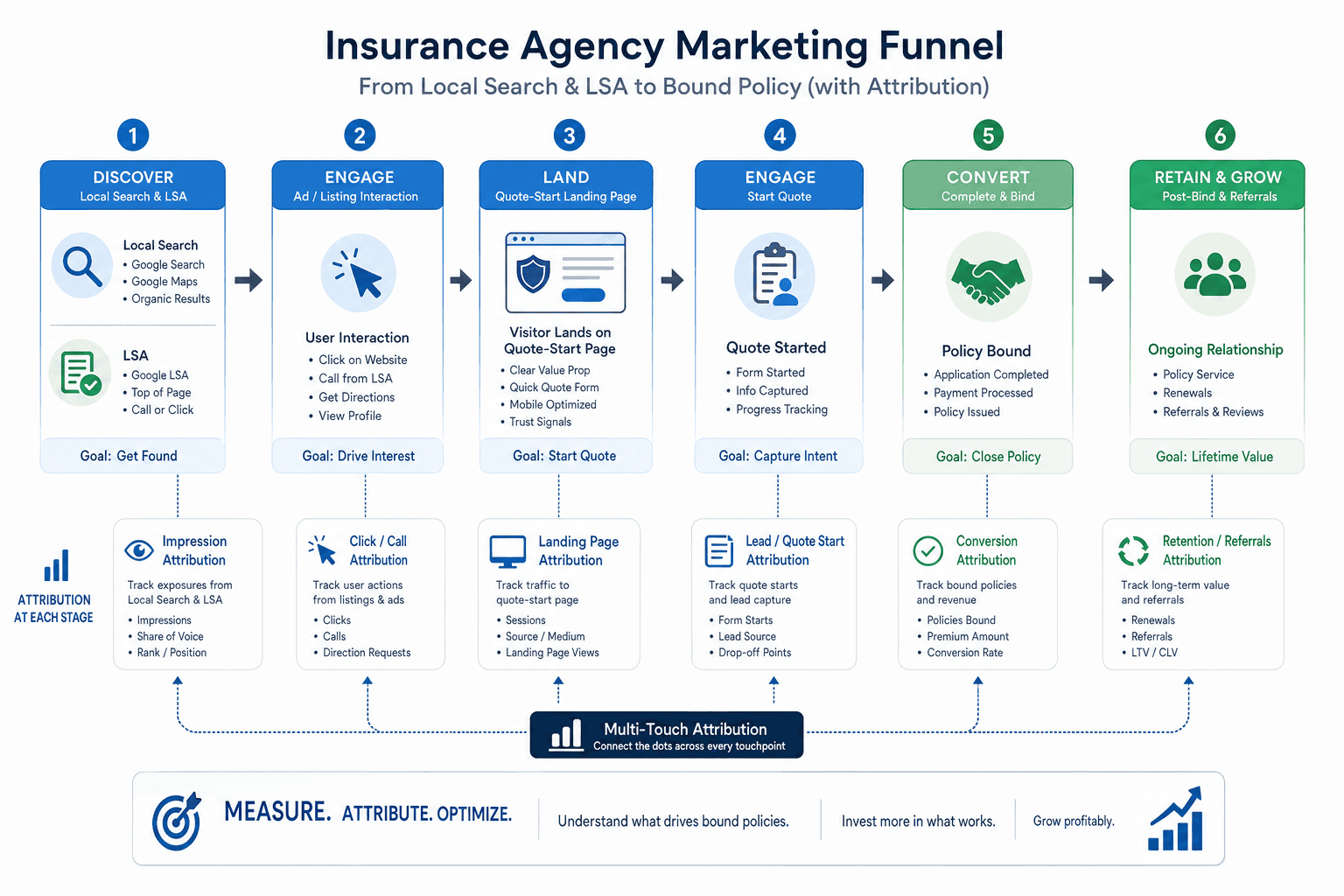
The strategy starts with attribution. You cannot optimize what you cannot measure, and most agency ad accounts are measuring the wrong thing. Before a dollar of ad spend changes, every inbound call gets a tracking number tied to its source campaign, every quote-start form submission fires a conversion event, and your agency management system becomes the ground truth for which leads actually bound. That infrastructure is the foundation everything else sits on.
In California and Florida, the only states where Google currently offers Local Services Ads to insurance agencies, LSAs are the first growth lever for personal lines. The prospect is calling you directly, intent is high, and the cost per bound policy stays low when the agency answers fast. Your LSA profile needs a steady flow of verified reviews and a strong rating to compete for top placement. We build the review generation process alongside the ad setup, not as an afterthought.
Google Search campaigns run in parallel, structured around line-specific intent. 'Car insurance [city]' and 'homeowners insurance quote [city]' go to separate landing pages built to start a quote or trigger a callback, not to a homepage. Commercial lines queries go to a separate page that leads with coverage expertise and carrier paper quality, not price. Each campaign is measured against cost per quote start and, once your AMS data is connected, cost per bound policy.
Referral partnership infrastructure runs alongside paid. A single active Realtor relationship can produce a steady stream of bound policies at near-zero CPL. We build the outreach sequence, the referral tracking, and the follow-up automation so those relationships produce consistently rather than sporadically.
Lifecycle email and SMS handle cross-sell and retention. Renewal save sequences go out 60 to 90 days before expiration. Cross-sell triggers fire when a life event is detected. Annual review invitations go to every household on their policy anniversary. This is where the multi-policy household math compounds, and it runs automatically once it is built.
Budget pacing follows the insurance calendar, not a flat monthly number. Q1 shopping season and the spring home-buying window get heavier investment. Slower stretches, like late August, are used to build GBP authority and organic content at lower CPCs. If your agency sells Medicare, the AEP window from October 15 through December 7 gets its own compliant campaign structure, separate from P&C, with CMS-required disclosures built in.
The one number that governs this
Every decision on this account is measured against cost per bound policy and quote-to-bind rate by line. Clicks, impressions, and form fills are inputs. Bound policies are the output that pays commissions.
How We Help
What We Would Actually Do for Your Agency
Here is how we map Sagum's capabilities onto the strategy above for an independent agency. We take on a limited number of clients so every account gets senior attention, and we treat your cost per bound policy the way we would treat our own.
Paid Search and Local Services Ads
We build and manage your Google LSA profile where your state is eligible, Search campaigns, and line-specific ad groups, structured around the intent signals that actually produce quote starts and inbound calls, not generic insurance traffic.
Call Tracking and Attribution Setup
We install tracking numbers at the campaign and keyword level, connect form submission events to your analytics, and build the reporting layer that shows cost per bound policy by source so you know exactly where to invest more and where to cut.
Line-Specific Landing Pages
We design and build separate quote-start pages for personal auto, homeowners, and commercial lines, each tuned to the specific trigger and objection of that shopper, with fast callback prompts and the carrier logos that build trust on first visit.
Google Business Profile Optimization and Review Generation
We optimize your GBP for local pack and LSA ranking, build a systematic review request process into your post-bind workflow, and monitor your rating to protect the ranking you build.
Lifecycle Email and SMS Automation
We build renewal save sequences, cross-sell trigger campaigns, and annual review invitations personalized with policy details, so your existing book produces more multi-line households without adding CSR hours.
Referral Partnership Infrastructure
We build the outreach sequences and tracking systems that turn Realtor, mortgage broker, and auto dealer relationships into a consistent, measurable lead source rather than an occasional referral.
AI-Assisted Creative Testing
We generate and test multiple ad copy angles per week across your campaigns, finding the carrier-choice, claims-advocacy, or rate-comparison message that drives quote starts in your specific market faster than a single monthly ad rotation ever could.
Who's Behind This
Who we are, and what makes us different
Sagum is a performance marketing agency founded in January 2017 in St. George, Utah. We've spent 8+ years growing real brands and being judged on KPIs, not vanity metrics.
We deliberately limit how many clients we take so each one gets senior attention. We treat your numbers like our own, we never run generic playbooks, and your strategy is built for your business, because shouldn't your brand's marketing be custom to your brand?
Sagum.ai is our AI arm: the same proven operators now build AI into the work wherever it creates real edge, not as theater, but as leverage applied with discipline.
- 8+ years growing brands on performance KPIs, not vanity metrics
- Limited client roster, with senior attention on every account
- An extension of your team; your success is tied to ours
- Custom strategy per brand, never a generic playbook
- AI built in where it moves a number; judgment over hype
“Sagum is a performance marketing agency that's spent 8+ years growing brands by treating their numbers like our own. We take on few clients, never run generic playbooks, and now build AI into the work wherever it creates real edge, not hype. Your strategy is built for your business, and our success is tied to yours.”

“After six years, Sagum is our most important partner: trusted, communicative, and caring about our business as if it's their own.”
Proof
From a $20 CPL goal to $13 CPL and 300+ leads/mo
Rizzoli's Automotive
Challenge
Rizzoli's Automotive set a goal of 100 qualified leads per month at roughly $20 cost per lead.
What we did
We built a custom call-driving landing page and restructured their paid search campaigns around high-intent service queries.
Result
Cost per lead dropped from a $20 target to $13, monthly lead volume grew to more than 300, and landing-page conversion exceeded 60%. The client opened multiple new locations on the back of that lead volume. The same landing-page and search discipline applies directly to an insurance agency optimizing for cost per bound policy.

- Cost per lead
- $13
- Leads / month
- 300+
- Landing-page conversion
- 60%+
Find Out Exactly Where Your Agency Is Leaving Bound Policies on the Table
No obligation. We will review your current channels, your cost per bound policy by source if you have it, and your GBP and LSA setup, then tell you specifically where the gaps are. The analysis is built around your agency and your lines, not a generic insurance template.
Sagum · January 2017 · St. George, Utah · 8+ years