

8+ years growing brands on KPIs, now with AI
Kitchenware sells to careful researchers
Built around how kitchenware buyers research and buy, not a generic DTC playbook.
8+ years growing DTC brands · Google, Meta & TikTok partner · Judged on ROAS, not vanity metrics



Get your free Growth Gap Analysis
Senior strategist review · response within one business day
Prefer to reach out directly?
The Challenge
Kitchenware Is a Beautiful Category With a Brutal Margin Problem
Your hero SKU (the single pan, the starter set) converts, but real revenue is the full set, the bundle, and second and third purchases, which are hard to earn when most consumers buy once or twice a year at most.
Shoppers spend one to four weeks reading reviews, watching in-use video, and checking PFAS-free certifications and induction compatibility before adding a $200–$300 ceramic nonstick set to cart. Your ads must hit the right moment, your landing page must make the price feel inevitable, not expensive, and post-purchase email must sell one-pan buyers the full set.
CAC keeps climbing: paid social costs rose another 8–9% in 2025. Legacy brands (Le Creuset, All-Clad) own shelf space and brand equity. DTC challengers (Caraway, Our Place, HexClad) spend hard on Google Shopping and TikTok, and Amazon private label undercuts your price in your branded search results.
Founders holding a profitable blended ROAS across Google Shopping, Meta, and email while growing LTV build durable brands; the rest ride one gifting season until CAC eats margin.

The Opportunity
Kitchenware Demand Is There, and Most Brands Capture It Sloppily
Kitchenware demand is large: the U.S. market hit $8.96 billion in 2024, grows 5%+ annually, and rides structurally elevated interest in home cooking and hosting, not a pandemic blip. Wedding season (April–June) and holiday (October–December) add two predictable, high-AOV gifting windows.
Wedding registries are an underexploited acquisition channel. Caraway built Google Shopping campaigns for registry shoppers; most brands treat that buyer as an afterthought, leaving room for registry creative and landing pages.
Most kitchenware brands ignore or botch Pinterest and TikTok. Pinterest Shopping reaches high-intent home upgraders, and a TikTok creator's 'what I cook with' video showing your pan after 6 months of daily use answers the durability objection better than any static ad.
Full-funnel discipline (a tight Shopping feed, in-use discovery video, and a landing page that justifies a $250 set) separates a 3:1 blended ROAS from a 5:1.
What Most Get Wrong
What Most Kitchenware Brands (and Their Agencies) Get Wrong
Running the same creative all year, ignoring the gifting calendar
Without gifting creative, registry landing pages, and seasonal pacing, you leave your two highest-AOV windows to chance and pay the same CPMs for traffic that converts at half the rate.
Optimizing for single-item sales, not set attach rate
Measure only the first transaction and you'll underspend on post-purchase flows, even though the cookware set upsell and accessory add-on are where the LTV:CAC math works.
Burying the PFAS-free claim in a product description tab
Material safety is the #1 cookware objection, and shoppers search 'non-toxic cookware' and 'PFAS-free pans.' Rivals who lead with the claim in Shopping titles and above-the-fold copy win those buyers.
Leaving branded search to Amazon private-label sellers and resellers
Without branded search and a reason to buy direct (better warranty, colorway exclusivity, bundle pricing), a meaningful share of purchase-ready traffic lands on Amazon at a margin you'll never recover.
Hiring agencies that treat kitchenware like any other DTC product
They run stock Meta prospecting-retargeting, skip Pinterest Shopping, miss that in-use video beats flat-lays for durability skeptics, and don't time email to multi-week deliberation, so blended ROAS hides lost revenue.
Why Now
Why DTC Kitchenware Brands Should Build Their Full-Funnel System Now
DTC kitchenware is consolidating. Brands built on cheap 2020–2022 Meta CPMs face CAC pressure; before your next gifting season, build the system survivors run: faster creative testing, tighter attribution, and retention infrastructure.
A brand running AI-assisted creative testing can evaluate five times more ad angles per week than one with only a human creative team. Because the winning message (non-toxic, design-led, durability-focused) varies by segment, that speed compounds.
On TikTok Shop, creator gifting and Shop feeds still separate cookware brands; build them before competitors do and you own the top discovery channel for new-to-category buyers. Plan gifting windows two quarters out: brands entering wedding season or holidays with a tested creative library, dialed Shopping feed, and wedding-season retargeting audience outperform last-minute starters; waiting costs a gifting season you can't recover.
The Mechanism
Where AI Moves the Numbers for a Kitchenware Brand
Real productivity, not AI theater. Here's where it actually moves a number for kitchenware brands.
Creative
What AI does: AI generates and tests angles (PFAS-free safety, colorway lifestyle, in-use durability video scripts, gifting-season hooks) across Meta, TikTok, and Pinterest without a full creative team per variant.
The result: You find the winning message faster for registry shoppers, kitchen-renovation buyers, and impulse buyers who discover you on TikTok.
Why it matters here: 'Non-toxic ceramic nonstick' and 'the last pan you'll ever buy' win different buyers. Finding winners in weeks, not months, lifts your Meta channel ROAS.
Digital Ads
What AI does: AI bid management and Performance Max feed optimization surface Shopping listings for queries like 'PFAS-free cookware set' and 'induction-compatible nonstick' with the right titles, ratings, and prices, shifting budget to converting SKUs.
The result: Impression share on purchase-ready queries and Google Shopping ROAS rise, and a branded search campaign keeps Amazon off your name-aware traffic.
Why it matters here: Caraway runs $60K/month on Google Ads at 3.3x ROAS. That ROAS is reachable only with a tight Shopping feed, margin-based bidding, and a branded campaign.
Email & Automation
What AI does: AI tunes Klaviyo cart-abandonment flows to the 1–4 week deliberation window, times upsells to when a single-pan buyer is ready for a sauté pan or Dutch oven, and schedules gifting-season re-engagement.
The result: You earn more from customers you've paid to acquire, with automated sequences recovering buyers who would otherwise go cold.
Why it matters here: Email is your main link to buyers between infrequent purchases. Without a post-purchase upsell flow, you forfeit the set sale after every single-item order.
Analytics
What AI does: AI-assisted attribution accounts for the multi-touch, multi-week purchase journey, so you stop over-crediting last-click Meta and underfunding the Pinterest and TikTok touchpoints that started consideration.
The result: You get a blended ROAS picture you can trust for channel investment decisions.
Why it matters here: In high-consideration cookware, a misfiring pixel or last-click model makes your heaviest awareness channels look wasteful, so you cut them. Fix measurement first.
Conversion Optimization
What AI does: AI tests landing pages with above-the-fold PFAS-free certification, weight and material specs for the 'can't feel it online' objection, prominent BNPL/Afterpay, and long-form reviews from owners 6 months in.
The result: More of the paid traffic you already buy converts, improving ROAS without more ad spend.
Why it matters here: A landing page that skips material safety, real kitchen use, or price justification loses premium shoppers who were already close to buying.
Ready to see what this looks like for your kitchenware brands business?
No obligation. A senior strategist will show you exactly where the wins are.
The Strategy
How to Run Marketing for a DTC Kitchenware Brand
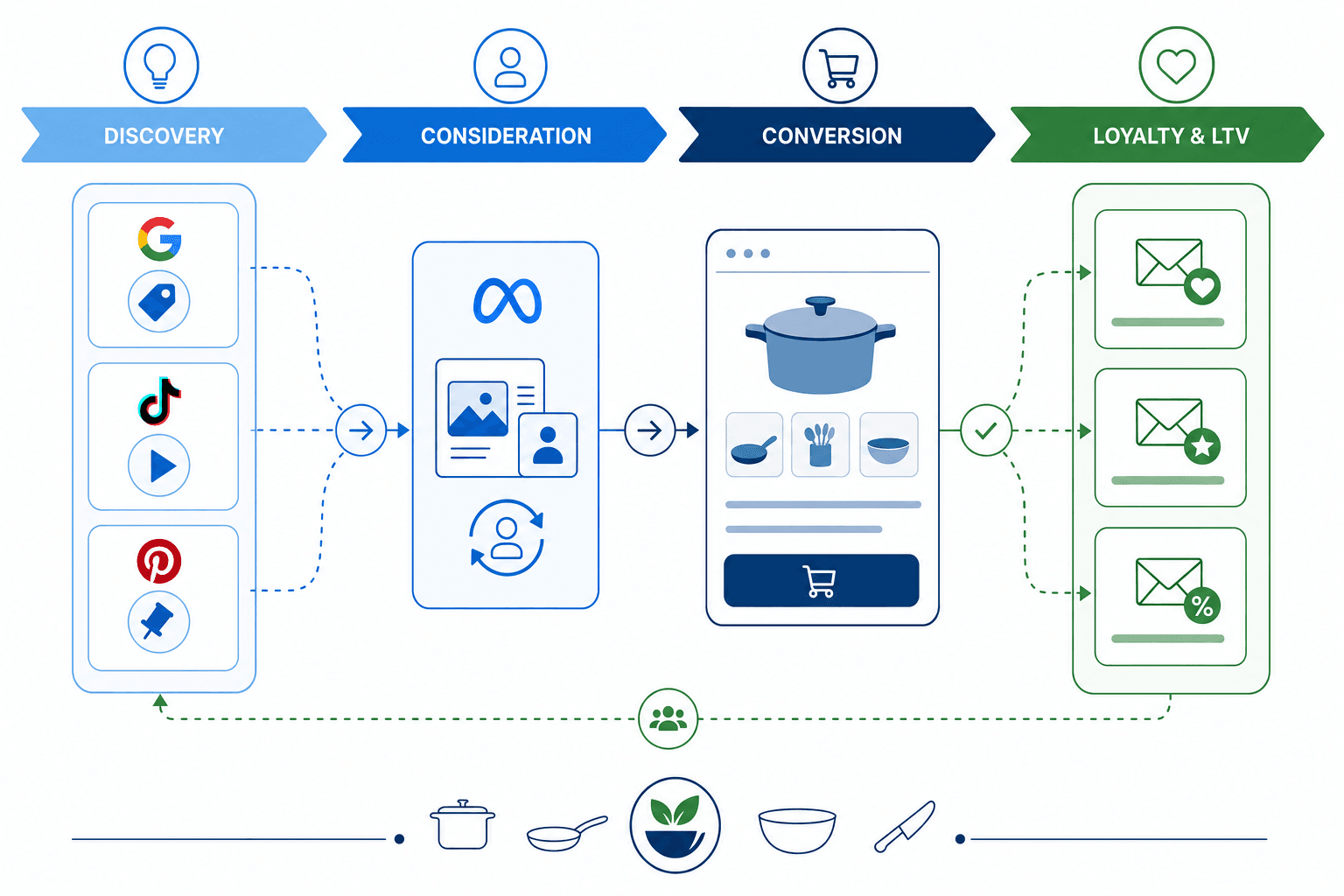
A $250 set is a considered buy: kitchenware buyers discover, deliberate, then convert. Run a full-funnel system present at all three stages and calibrated to the two gifting windows.
Google Shopping is the floor: put PFAS-free and material claims in titles, surface star ratings in the ad unit, and calibrate smart bidding to contribution margin, not revenue. Once you have awareness, run branded search campaigns so Amazon and resellers can't take traffic you paid to build.
Meta runs two jobs: prospecting with in-use video and retargeting deliberating buyers with the product they viewed plus social proof. Test non-toxic safety, colorway, durability, and gifting angles by segment.
Build TikTok and Pinterest as discovery channels: Pinterest Shopping for home upgraders, TikTok recipe content for organic-feeling demand, and creator programs that compound as TikTok matures.
Email and SMS carry retention. Upsells timed to when a single-pan buyer is statistically ready to expand the set are where LTV:CAC gets healthy, and Mother's Day, wedding-season, and holiday flows re-engage buyers dormant between annual purchases.
Attribution runs underneath: in a multi-week journey, last-click misleads budget decisions, so track blended ROAS at the brand level.
The one number that governs this
Blended ROAS (total revenue ÷ total ad spend across all channels) governs, with LTV:CAC as the north star; LTV at 3x CAC is investor-grade.
How We Help
How We'd Run Marketing for Your Kitchenware Brand
We'd start with attribution, since everything downstream depends on it, then build the Shopping, Meta, TikTok, Pinterest, and Klaviyo system and tie each service to a ROAS or LTV:CAC outcome.
Analytics & Attribution
Fix pixel integrity and build a blended ROAS dashboard you trust before any channel investment decision.
Google Ads (Shopping + Search + Branded Defense)
Put PFAS-free and material claims in Shopping titles, calibrate smart bidding to contribution margin, and defend branded search against Amazon.
Meta Ads (Prospecting + Retargeting)
Run weekly tests across message angles and retarget deliberating buyers with product-specific social proof.
TikTok & Pinterest Ads
Launch TikTok Shop feeds and creator gifting, plus Pinterest Shopping campaigns for home-upgrade and registry-intent audiences.
Email & SMS Automation (Klaviyo)
Time upsells to the set-expansion window, tune cart abandonment to the deliberation cycle, and run wedding-season and holiday re-engagement.
Creative Production & AI-Assisted Testing
Produce in-use video, lifestyle, and social-proof creative and test it faster than a traditional creative team can, so ROAS gains compound.
Conversion Rate Optimization
Test PFAS-free proof above the fold, material specs, and prominent BNPL to ease sticker shock on $200+ sets.
Who's Behind This
Who we are, and what makes us different
Sagum is a performance marketing agency founded in January 2017 in St. George, Utah. We've spent 8+ years growing real brands and being judged on KPIs, not vanity metrics.
We deliberately limit how many clients we take so each one gets senior attention. We treat your numbers like our own, we never run generic playbooks, and your strategy is built for your business, because shouldn't your brand's marketing be custom to your brand?
Sagum.ai is our AI arm: the same proven operators now build AI into the work wherever it creates real edge, not as theater, but as leverage applied with discipline.
- 8+ years growing brands on performance KPIs, not vanity metrics
- Limited client roster, with senior attention on every account
- An extension of your team; your success is tied to ours
- Custom strategy per brand, never a generic playbook
- AI built in where it moves a number; judgment over hype
“Sagum is a performance marketing agency that's spent 8+ years growing brands by treating their numbers like our own. We take on few clients, never run generic playbooks, and now build AI into the work wherever it creates real edge, not hype. Your strategy is built for your business, and our success is tied to yours.”

“Sagum roughly doubled our bottom line. They treat the work like it's their own business.”
Rachel Nilsson
CEO, RAGS
Proof
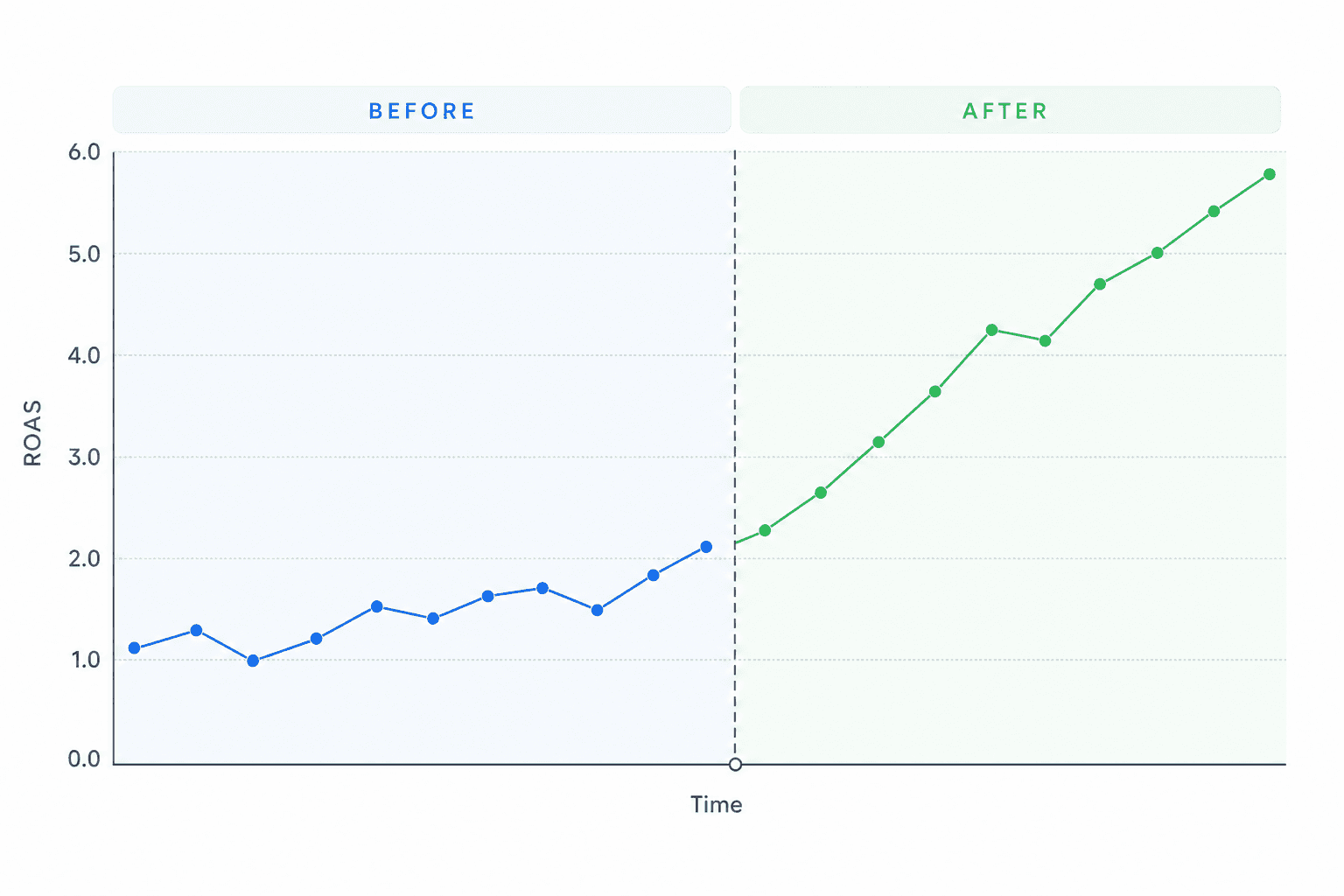
Broke a 2-year ROAS plateau with +115% ROAS at the same spend
House of Jade
Challenge
House of Jade, a home goods ecommerce brand, was stuck on a two-year ROAS plateau.
What we did
We restructured their strategy without increasing spend. The same discipline applies to a kitchenware brand's Shopping, Meta, and email mix.
Result
House of Jade broke the plateau with a 115% ROAS improvement at the same spend and had its biggest, most profitable Q4.
Let's Build a Marketing System Your Kitchenware Brand Can Grow On
No obligation. We'll come to the session having studied your channel mix, creative, and seasonality, with a specific point of view on where your ROAS opportunity is.
Sagum · January 2017 · St. George, Utah · 8+ years