

8+ years growing brands on KPIs, now with AI
The slow, high-AOV linens sale, made profitable
We build paid media, creative, and email around long consideration windows and a make-or-break Q4.
8+ years growing ecommerce brands · Google, Meta & TikTok partners · Judged on ROAS, not vanity metrics



Get your free Growth Gap Analysis
Senior strategist review · response within one business day
Prefer to reach out directly?
The Challenge
Selling Linens Online Is Harder Than the Lifestyle Shots Make It Look
Customers can't touch the fabric before buying, which shapes your consideration window, return rate, trust signals, and creative. A shopper comparing your percale set to Brooklinen's is judging more than thread count; they're deciding whether to trust a brand they've never felt.
Home & Garden AOV benchmarks around $110, which looks healthy until you add the cost of acquiring a buyer with a 3–10 day deliberation window. Meta introduces the brand, Google Shopping captures intent, and email closes and retains buyers through a years-long repurchase cycle.
A decade ago, Brooklinen staked its positioning on price-to-feel ratio and Boll & Branch on GOTS and Fair Trade certification. Parachute, Buffy, and a dozen well-funded challengers followed, while Target's Threshold line and Amazon Basics undercut on price. If your pitch is still 'better quality, cut out the middleman,' you're describing half the market.
Winning brands pair a sharper angle (a specific fabric story, a certification that survives scrutiny, a sleep wellness community) with infrastructure that sells it profitably across channels. Few have both.
The Opportunity
Linens Demand Is There. The Infrastructure to Capture It Usually Isn't.
The DTC shift is early. Offline channels still took about 67% of global bedroom linen sales in 2024, and Grand View Research projects a 7.9% CAGR for online sales globally through 2030.
Q4 is your biggest revenue season: from Black Friday through December, brands with targeted 'warm sheets for winter' campaigns documented 35% YoY sales increases. Spring cleaning and home refresh drive a 15–20% surge, and back-to-school dorm bundles add a 28% lift in July and August for brands positioned for it.
Retention is the hidden upside. Long repurchase cycles make most brands stop at the first sale, but a $55 CAC customer who buys again is worth far more.
Winning the next five years takes differentiated positioning, sub-$65 CAC paid media, and email and SMS earning second and third purchases. Most brands have one.
What Most Get Wrong
What DTC Linens Brands (and Their Agencies) Get Wrong
Optimizing for first-purchase ROAS and calling it profitable growth
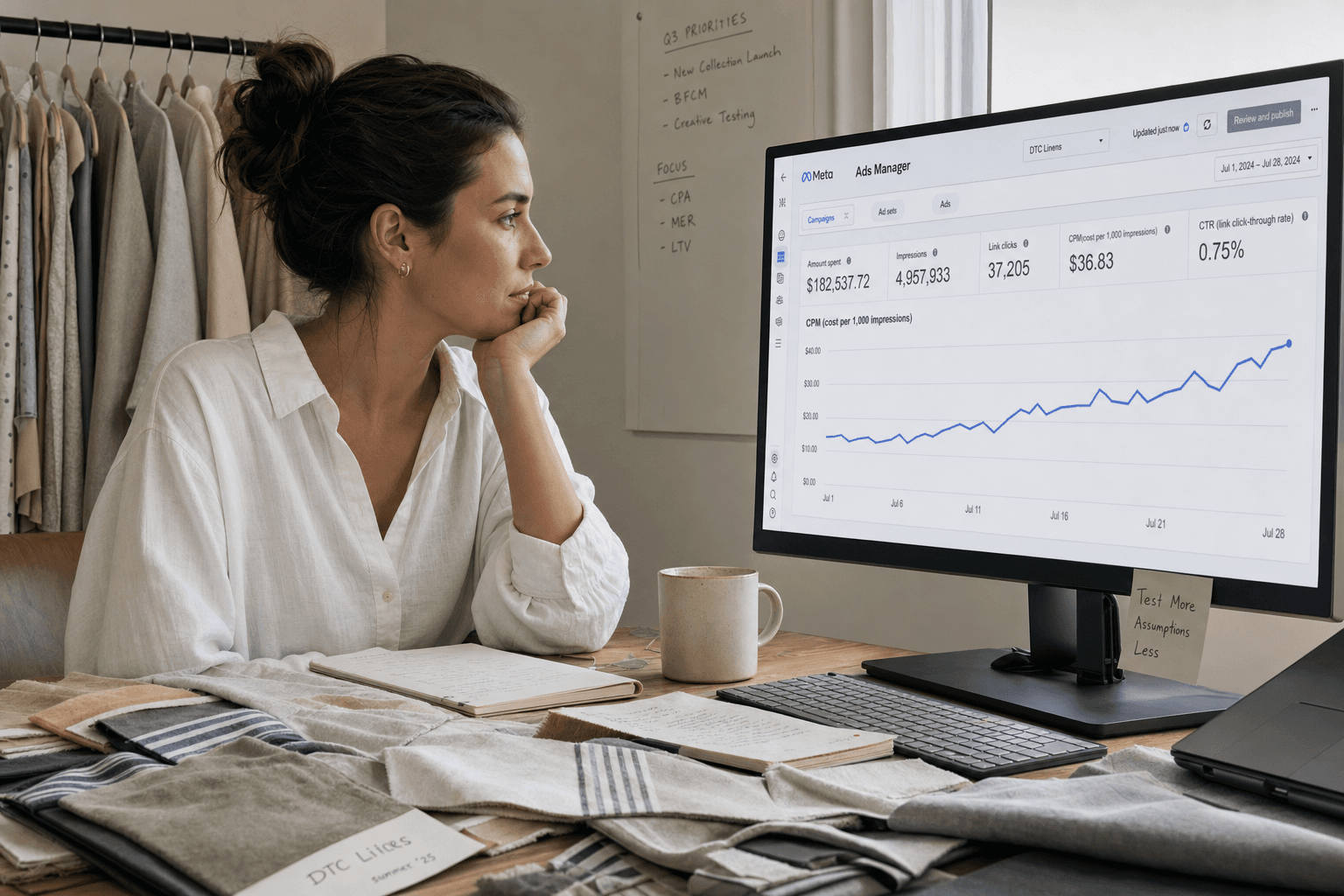
Meta-reported first-purchase ROAS can read 4x while your CFO shows a loss: Meta over-credits sales and ignores returns and margin. Without second orders, you're funding a leaky bucket.
Running product-only creative where tactile trust is everything
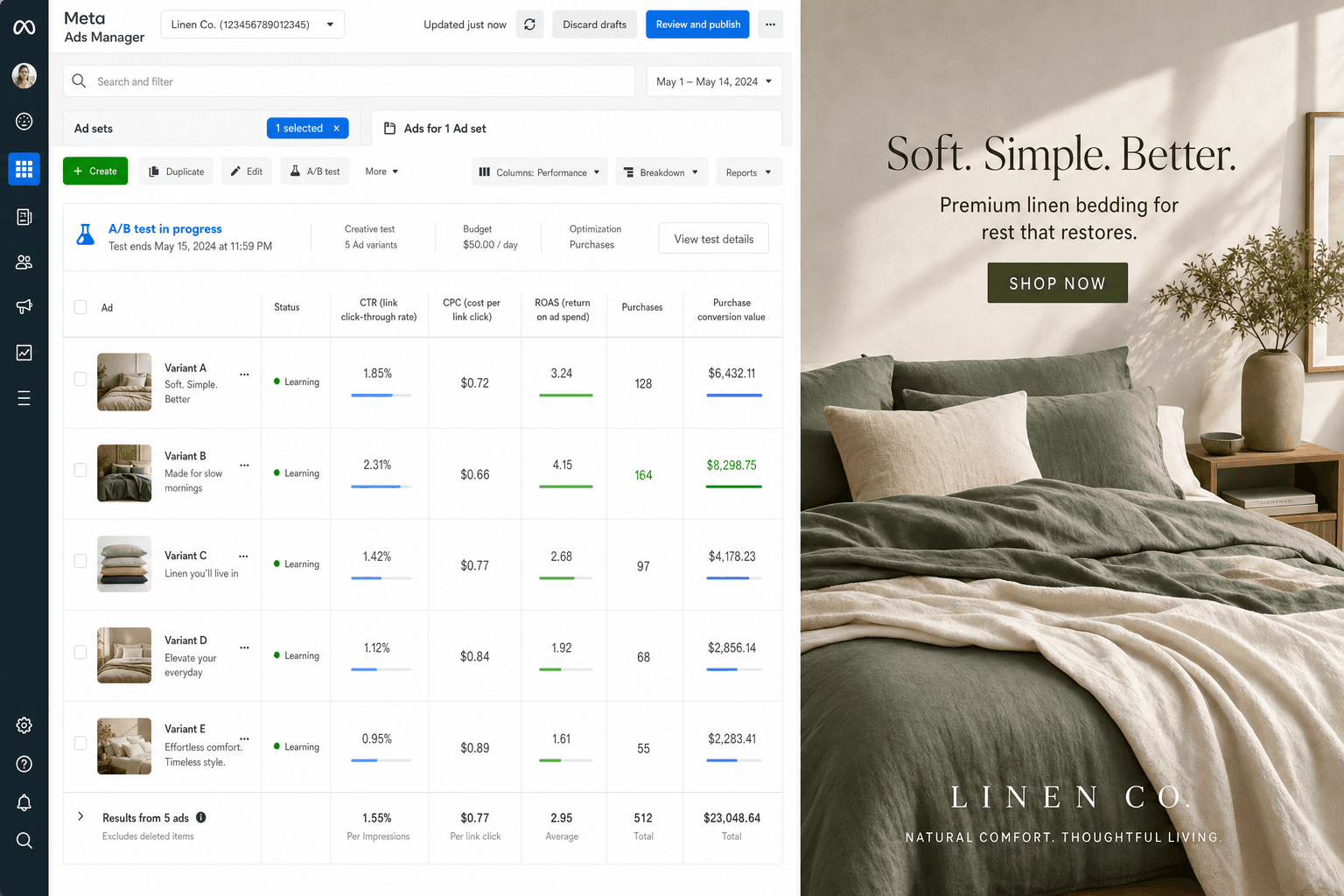
A folded sheet set on white shows nothing Amazon Basics doesn't. Styled bedrooms, morning-routine UGC, and texture close-ups do the persuading; static product ads burn CPMs without converting.
Treating Q4 as one event, not a three-month build
Winners start in September and run October gifting, BFCM on pre-built segments, and 'gift for the home' messaging through December. Black Friday starters pay peak CPMs in a warmed market.
Going 18 months silent because 'the cycle is too long'
The long cycle is why email and SMS matter more for linens than for consumables. Brands with post-purchase, fabric education, and seasonal re-engagement flows outperform on cohort LTV.
Trusting platform attribution without knowing what it hides
A misfiring pixel or over-attributed view-through window can make a struggling campaign look like a winner for months. Scale on that data and you scale losses.
Why Now
Why DTC Linens Brands Can Pull Ahead Now
The DTC linens market is consolidating around well-capitalized incumbents and a long tail of undifferentiated brands fighting on price. Brands in the middle, with real product differentiation but lagging marketing, are the ones at risk and must catch up before their next peak.
Most DTC linens brands still run 2020-era campaigns: a few static ad sets, a broad audience, a Klaviyo welcome and abandoned cart flow, and a hope Meta's algorithm figures it out. Brands using AI to test creative systematically, catch attribution errors early, and build email that responds to purchase behavior pull further ahead every month.
AI lets you test five creative angles per week instead of one. Get that testing, tracking, and email flows in place before your next peak window: Q4, spring refresh, or dorm-bundle season.
The Mechanism
Where AI Gives Linens Brands a Real Edge
Real productivity, not AI theater. Here's where it actually moves a number for linens brands.
Creative
What AI does: AI helps generate and rotate lifestyle concepts, including the certification story, and test them systematically to find the strongest cold-audience message faster than manual iteration.
The result: You find the angle that closes a considered linens buyer in two weeks instead of two months, at a lower effective CPM.
Why it matters here: Creative does a store's job when buyers can't feel the fabric. Brands that test more angles find the trust-building message sooner, which feeds ROAS directly.
Analytics
What AI does: AI continuously audits pixel health, view-through window settings, and cross-channel attribution logic to catch the mismatches that make a losing campaign look profitable.
The result: You can trust that dashboard ROAS reflects actual revenue, so budget decisions run on real data.
Why it matters here: Attribution drift can hide a CAC problem for months, especially at $2M–$20M linens brands. Catching it early separates a profitable Q4 from an expensive one.
What AI does: AI-assisted segmentation and send-time optimization in Klaviyo tailor post-purchase flows to fabric type, order value, and bundle-discount use, and time re-engagement to the home goods repurchase window.
The result: You get higher 90-day repurchase rates and 12-month cohort LTV at the same CAC, improving the unit economics of acquisition.
Why it matters here: Email is the main LTV lever: an ignored percale buyer is worth less than one sent duvet education three months later and October flannel re-engagement.
Digital Ads
What AI does: AI-informed pacing across Meta and Google Shopping shifts spend in real time toward campaigns hitting ROAS targets and away from underperformers before they drain the budget.
The result: More of your monthly ad budget funds revenue-generating campaigns, and less sustains ones that look active but don't convert.
Why it matters here: Linens demand peaks predictably in Q4, spring refresh, and dorm season; accelerating when signals are strong and easing off in January beats a flat budget.
Conversion Optimization
What AI does: AI-reviewed product and landing page audits find friction for a high-consideration buyer who needs fabric education, certification proof, and return policy reassurance before adding to cart.
The result: Paid traffic converts better without more ad spend, so the same acquisition budget produces more revenue.
Why it matters here: Pages matter as much as ads: bury the certification your 'GOTS-certified organic cotton' ad promised, and you've paid to educate a shopper for a competitor.
Ready to see what this looks like for your linens brands business?
No obligation. A senior strategist will show you exactly where the wins are.
The Strategy
How a DTC Linens Brand's Marketing Should Be Built
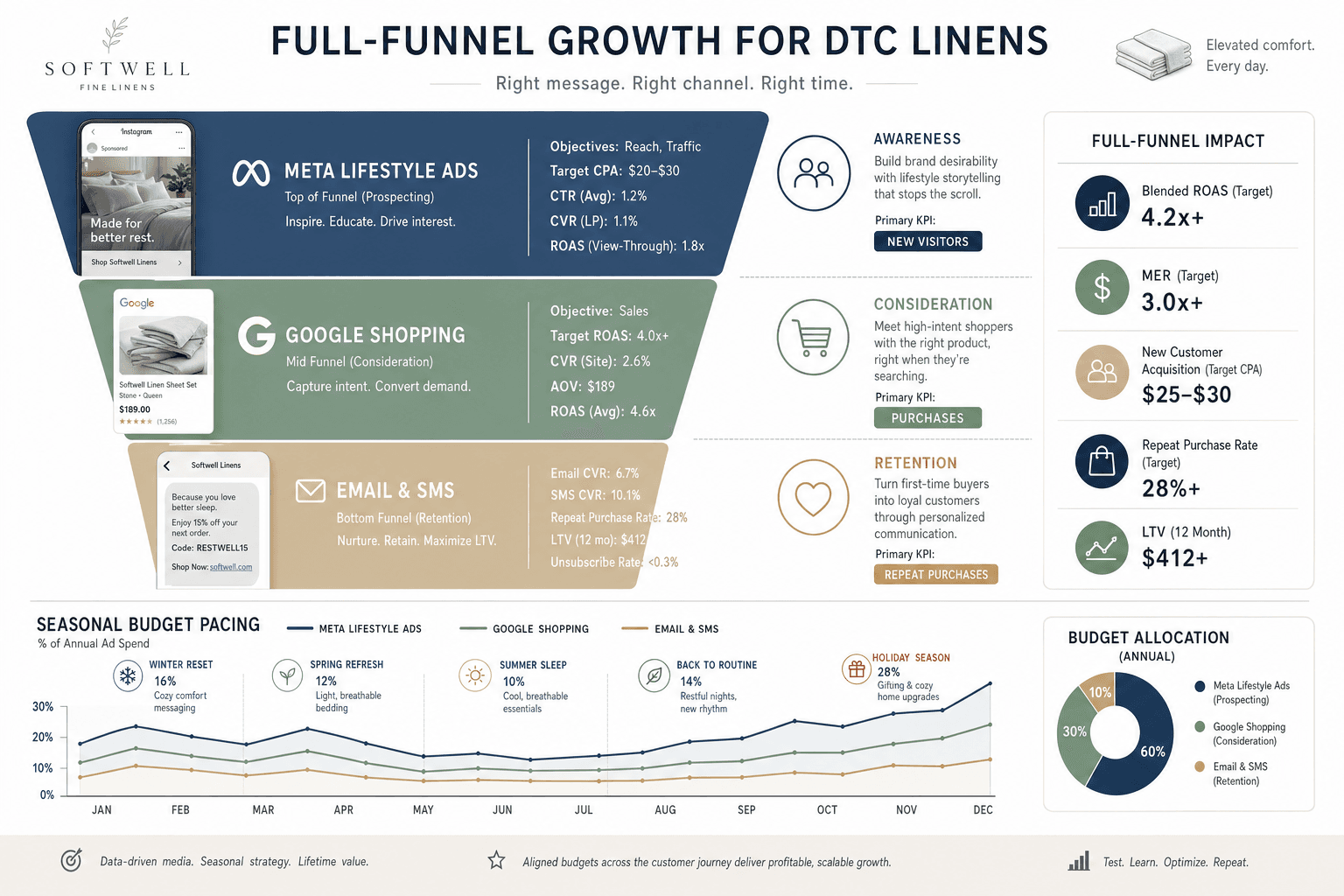
Build the funnel around the deliberation window between first impression and purchase. Meta owns the top, where lifestyle creative and a visual certification story introduce the brand to cold audiences targeted by home-ownership signals, sleep wellness interest, and lookalikes of your best LTV cohorts.
Mid-funnel is where most brands leak. Retarget Meta engagers who didn't buy with objection-specific messages: free returns for 'I can't feel it,' certification detail for the skeptic, a bundle offer for the price-sensitive. Recycling creative they already saw wastes spend.
Capture high-intent search on Google Shopping and Performance Max ('best percale sheets,' 'organic cotton duvet cover,' 'GOTS certified bedding') with margin-weighted product feeds.
Run email and SMS alongside paid. The abandoned cart flow wins back some lost sales (Klaviyo's 2023 benchmark: 3.33% average placed-order rate per recipient), and the post-purchase sequence teaches fabric care, cross-sells pillowcases or a duvet cover six months later, and sets up the seasonal re-engagement behind the second purchase.
Pace budget to the calendar: build audience in September, accelerate through Q4, pull back in the January trough, and rebuild for the spring home-refresh surge in March.
The one number that governs this
Your governing KPI is blended ROAS (target 3–5x), tracked with 90-day cohort LTV and CAC, not last-click attribution, impressions, or follower counts.
How We Help
What We'd Do for a Linens Brand Like Yours
We audit tracking and attribution before touching a single campaign, then build what the strategy calls for, in the order that moves your numbers fastest.
Attribution & Analytics Audit
We verify pixel health, view-through windows, and cross-channel attribution before any budget moves.
Meta Paid Social (Prospecting + Retargeting)
We run top-of-funnel prospecting with systematically tested lifestyle and UGC creative, and mid-funnel retargeting with objection-specific messages instead of recycled creative.
Google Shopping & Performance Max
We build margin-weighted Shopping campaigns on high-intent queries and run Performance Max with the feed hygiene and negative keyword discipline most agencies skip.
Creative Strategy & Production
We develop and test multiple creative angles per week, using AI to shorten the path to a winning message.
Email & SMS (Klaviyo)
We build core flows (welcome, abandoned cart, post-purchase education, seasonal re-engagement) with segmentation that responds to purchase behavior.
Conversion Rate Optimization
We audit product and paid landing pages for buried certification details, weak return policy placement, and missing fabric education, fixing them before you scale traffic.
Seasonal Budget Pacing
We build your Q4 campaign architecture from September and plan the spring home-refresh and back-to-school dorm windows so budget accelerates into peaks.
Who's Behind This
Who we are, and what makes us different
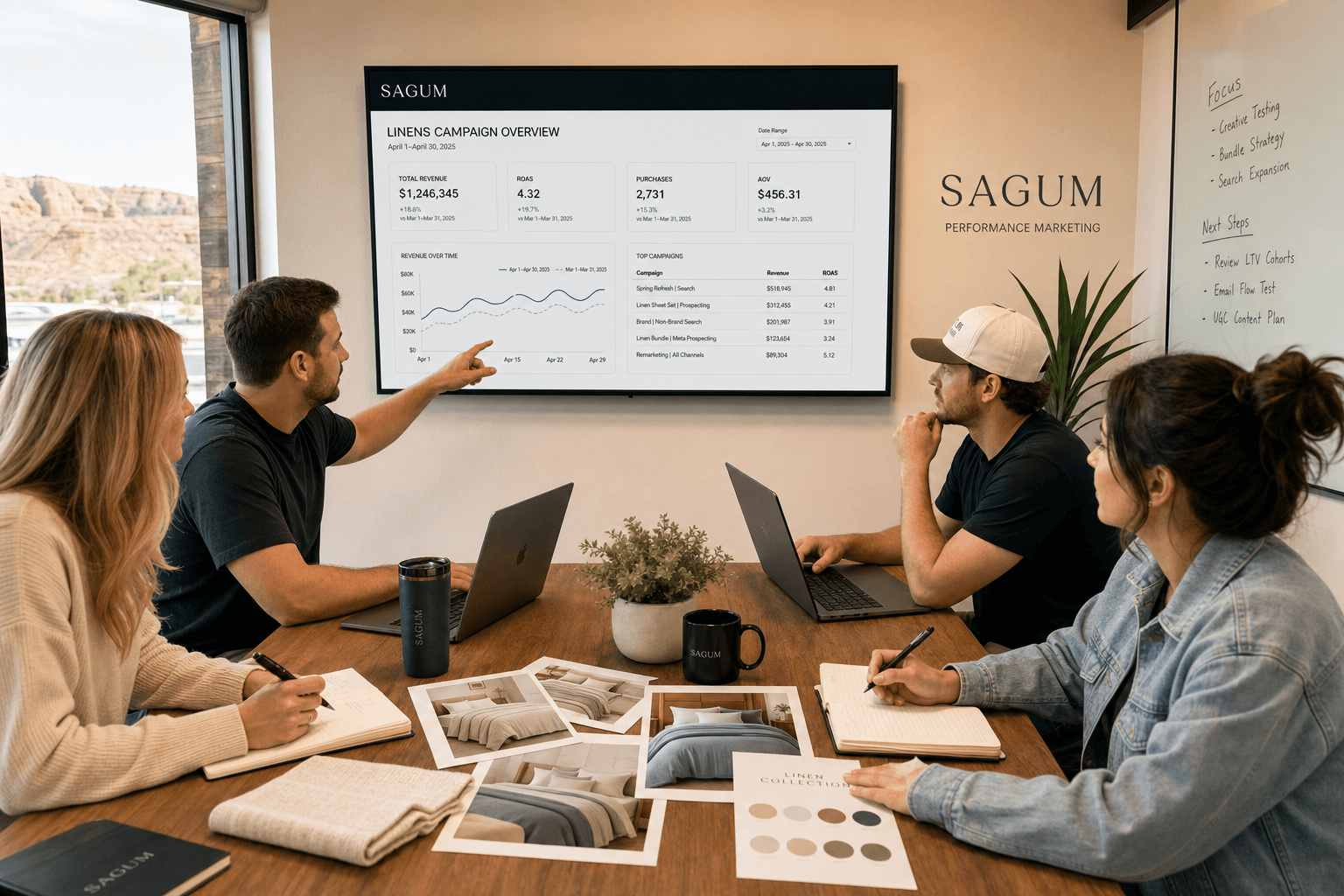
Sagum is a performance marketing agency founded in January 2017 in St. George, Utah. We've spent 8+ years growing real brands and being judged on KPIs, not vanity metrics.
We deliberately limit how many clients we take so each one gets senior attention. We treat your numbers like our own, we never run generic playbooks, and your strategy is built for your business, because shouldn't your brand's marketing be custom to your brand?
Sagum.ai is our AI arm: the same proven operators now build AI into the work wherever it creates real edge, not as theater, but as leverage applied with discipline.
- 8+ years growing brands on performance KPIs, not vanity metrics
- Limited client roster, with senior attention on every account
- An extension of your team; your success is tied to ours
- Custom strategy per brand, never a generic playbook
- AI built in where it moves a number; judgment over hype
“Sagum is a performance marketing agency that's spent 8+ years growing brands by treating their numbers like our own. We take on few clients, never run generic playbooks, and now build AI into the work wherever it creates real edge, not hype. Your strategy is built for your business, and our success is tied to yours.”
“Sagum roughly doubled our bottom line. They treat the work like it's their own business.”
Rachel Nilsson
CEO, RAGS
Proof
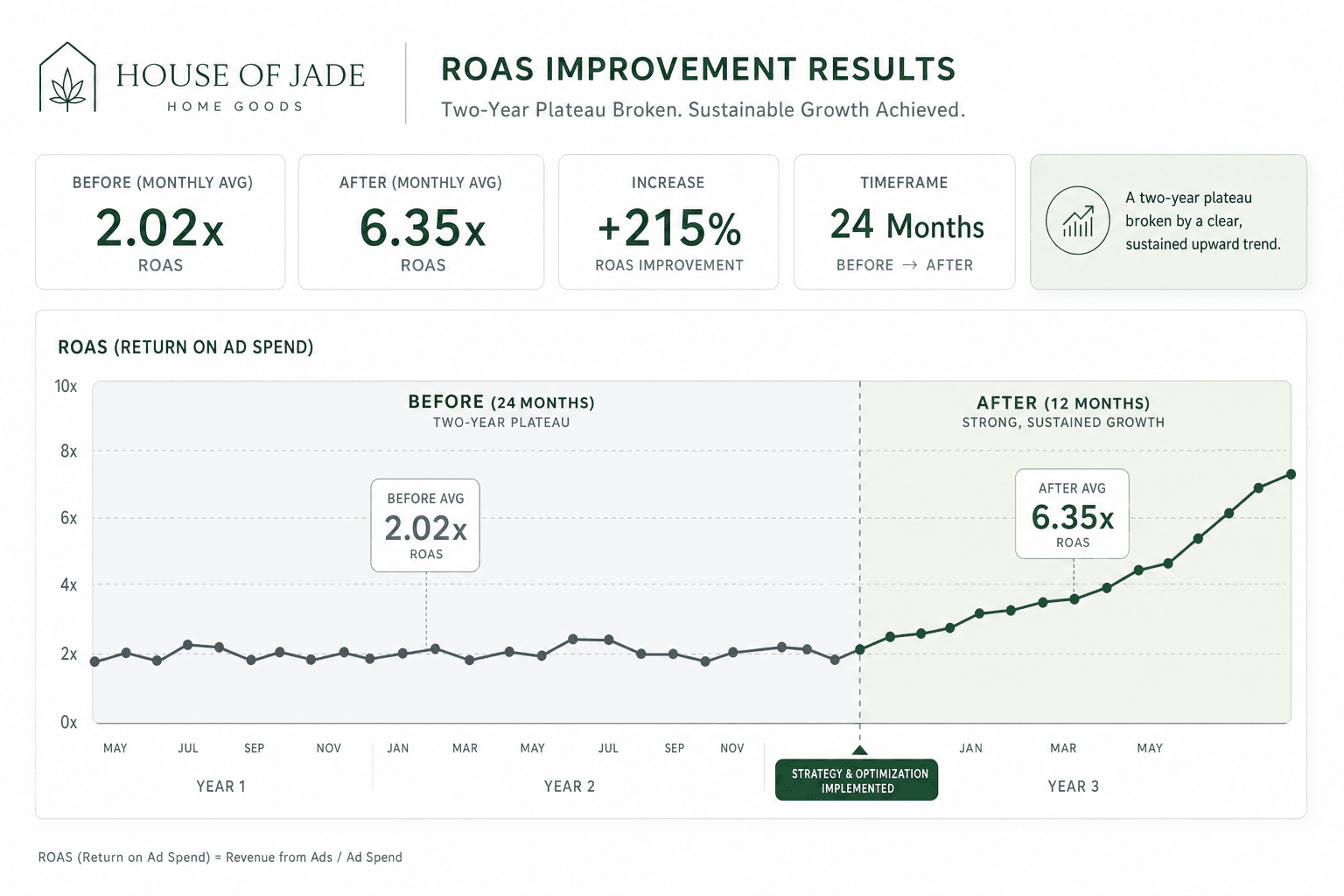
Broke a 2-year ROAS plateau with +115% ROAS at the same spend
House of Jade
Challenge
House of Jade, a home goods ecommerce brand, had hit a two-year ROAS plateau.
What we did
We restructured their strategy without increasing spend. That discipline carries over to linens brands selling to a considered buyer.
Result
ROAS rose 115% at the same spend, and they had their biggest, most profitable Q4.
If Your ROAS Looks Fine but the P&L Doesn't, Let's Talk
No obligation. We'll review your setup, name the gap we see, and show you a strategy built on your brand's economics. If we're not the right fit, you'll still leave with something useful.
Sagum · January 2017 · St. George, Utah · 8+ years