

8+ years growing brands on KPIs, now with AI
Men's grooming revenue outlasts a dead ad
We build the creative pipeline and attribution clarity that keep revenue growing after a top ad fatigues.
Google Ads · Meta · TikTok · 8+ years growing DTC brands · Performance-judged, not vanity-metric-judged



Get your free Growth Gap Analysis
Senior strategist review · response within one business day
Prefer to reach out directly?
The Challenge
Marketing a Men's Grooming Brand Is a Problem Most Agencies Misread
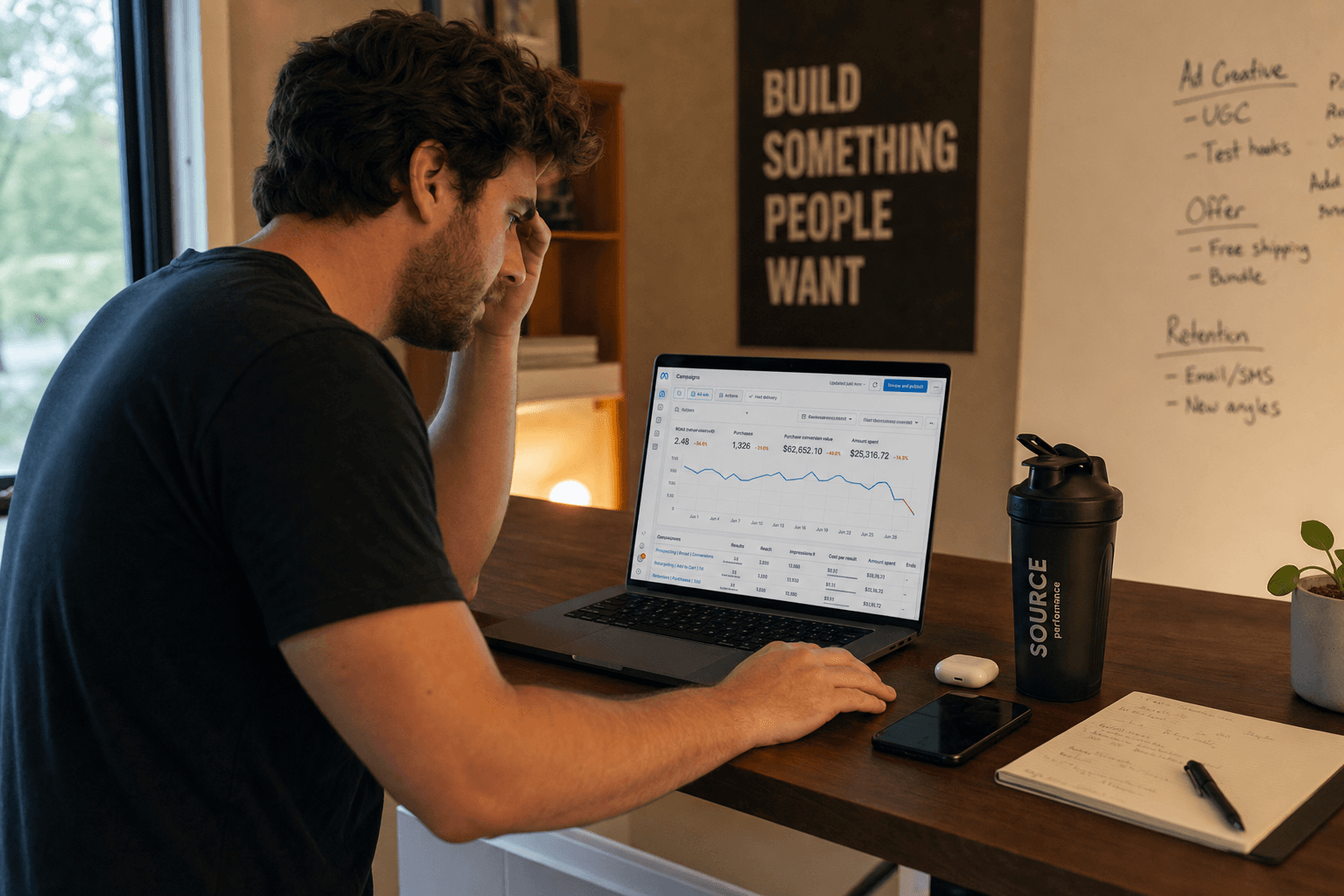
In DTC grooming, your best ad set's ROAS can drop 25% without warning (creative fatigue, a CPM spike, a competitor's viral TikTok), and you're hunting a new hook before the month closes in the red.
You pay Health and Beauty CPMs (around $16, among Meta's most expensive) to reach men who only recently became a skincare audience. Gen Z men are entering the category fast (68% used facial skincare in 2024, up from 42% two years prior) but discover brands on TikTok.
At a $60–$80 AOV, you need 2–3 repurchases a year from each transactional buyer for LTV to justify CAC, and research puts DTC grooming's average repeat-purchase rate at 40–54%. One-time buyers leave you funding a sampling program.
Post-iOS 14, Meta ROAS and Shopify revenue disagree, yet most brands budget $50K+ monthly on numbers they don't fully trust. Grooming has its own seasonality (Father's Day kits, BFCM gift sets, January's self-care bump), creative language (UGC over polish, ingredient transparency over claims), and retention math (subscription attach rate, 90-day LTV).
The Opportunity
Men's Grooming Brands Win on Execution, Not Budget
P&G holds 16% market share and outspends you, but you can own a sub-niche (beard care, scalp health, clean formulations, barbershop-grade performance) with the right creative, channel, and timing before the category consolidates.
TikTok Shop creator affiliates are the category's most underexploited channel. One operator drove over $5M GMV for a national men's grooming brand through 500+ creator affiliates. In one quarter, 12,600+ creator videos drew 52 million views.
DTC brands with mature email programs get roughly $38 back per $1, and email and SMS flows (abandon-cart, post-purchase bundle upsell, winback) compound over time.
Subscription attach rate is your biggest lever: replenishment subscriptions (beard wash, face wash, shaving cream) churn less than lifestyle ones because customers run out on schedule. Top-quartile grooming brands hold monthly churn under 3%; every point you cut is LTV you don't buy back with ads.
What Most Get Wrong
What Most Men's Grooming Brands (and Their Agencies) Get Wrong
Running polished brand creative when UGC converts
Grooming buyers trust a guy's 30-second iPhone clip of his beard routine over cinematic spots. Without UGC, you pay premium CPMs for weaker creative and test too little to notice.
Optimizing first-purchase ROAS instead of 90-day LTV
A 3.5x ROAS on first orders can lose money if buyers never return. Without post-purchase flows driving a second purchase within 60 days, you pay CAC for one-and-done customers.
Ignoring Father's Day as its own campaign moment
Father's Day is grooming's top gifting window outside BFCM. Brands without kit SKUs and campaigns live by May 1 miss it; generic agencies on evergreen June campaigns forfeit it yearly.
Trusting broken attribution and budgeting on bad data
Meta's reported ROAS is often overstated. Without a source of truth (a triple-attribution model, Northbeam, or properly configured GA4 checked against Shopify), you quietly scale losers and pause winners.
No creative replenishment system, so fatigue becomes a crisis
Winning ad sets in competitive DTC categories burn out in weeks. Without steady hook and spokesperson tests, one fatigue event can cut their ROAS 25%. Most agencies refresh monthly.
Why Now
Men's Grooming Brands That Build Their Growth Systems First Pull Ahead
Gen Z men's skincare adoption is climbing and the market is projected to keep expanding, but Meta CPMs rose about 13% in the year to July 2026 (Triple Whale). Grooming brands that build acquisition and retention infrastructure now get a compounding cost advantage; brands that wait build it at even higher CPMs.
Most incumbent grooming brands haven't built a TikTok Shop affiliate program yet. Micro-creators deliver distribution that looks like earned media and performs like paid. The window closes as the channel matures and competition for top creators rises.
AI-assisted creative lets smaller DTC brands test 5–8 new ad creatives per week instead of 1–2 a month. For a brand doing $3M–$10M, staying ahead of fatigue can be worth 30–40% in annual revenue.
The Mechanism
Where AI Creates an Edge for Men's Grooming Brands
Real productivity, not AI theater. Here's where it actually moves a number for men's grooming brands.
Creative
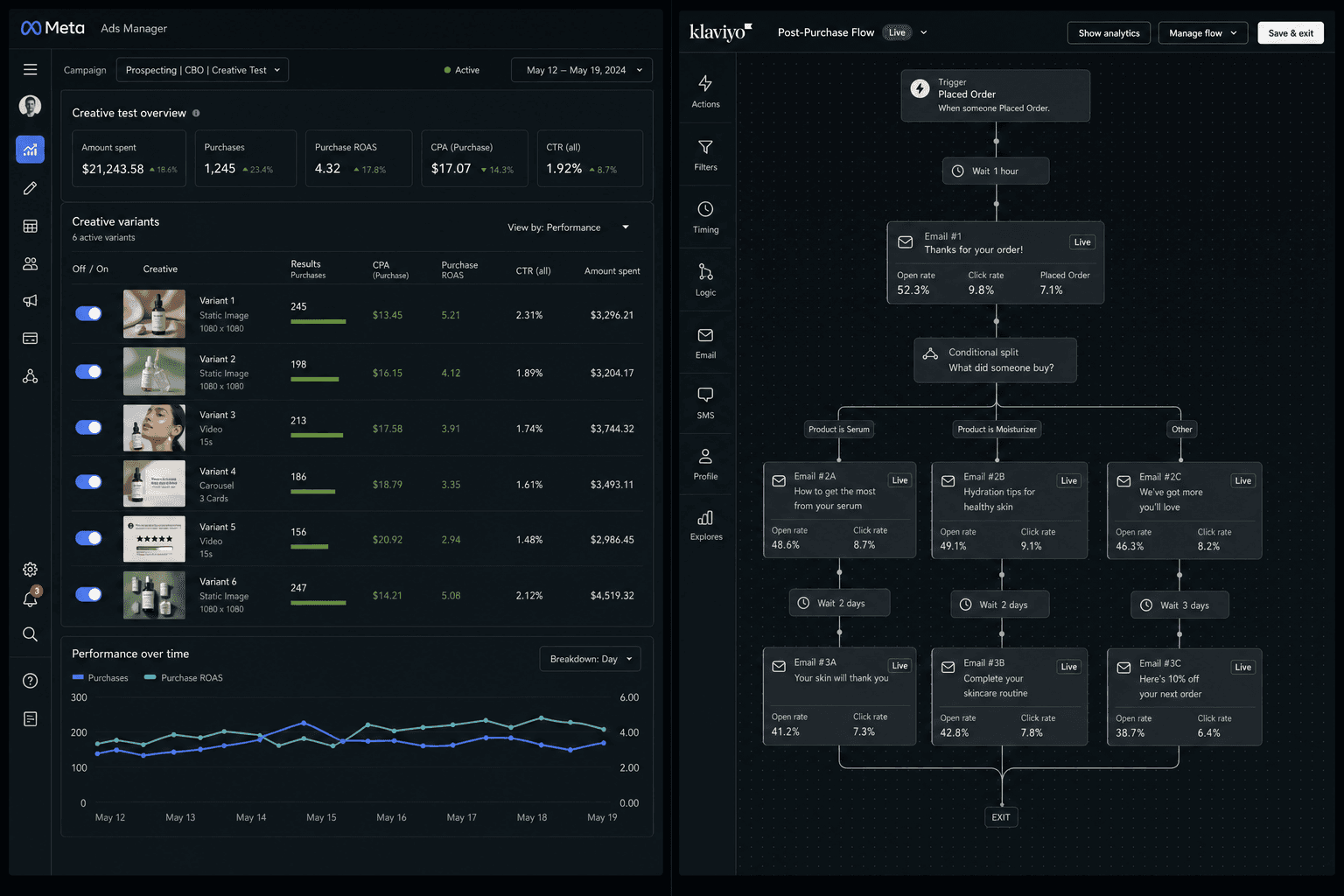
What AI does: AI-assisted briefing and production let you generate and test new hooks, formats, and angles every week: UGC scripts, static ad copy variations, and short-form video concepts.
The result: A brand testing 1–2 new creatives per month can test 5–8 per week, finding the next winner before the current one dies.
Why it matters here: Fatigue is grooming's top revenue risk; winning UGC (a real man's beard or skin before-and-after) has a short half-life. Velocity is the only defense.
Analytics
What AI does: AI-assisted attribution reconciles Meta's reported ROAS with Shopify revenue, flags misattribution and pixel errors, and shows true cost-per-new-customer by channel.
The result: You budget on reconciled data instead of Meta's self-reported numbers.
Why it matters here: For brands spending $50K+ a month on paid media, fixing broken attribution separates scaling a profitable channel from scaling a losing one.
What AI does: AI-optimized Klaviyo flows time emails to each SKU's repurchase cycle (beard oil typically runs out in 4–6 weeks, face wash in 6–8), trigger winbacks on churn-risk signals, and personalize bundle upsells.
The result: Email moves toward mature programs' 20–30% revenue share at a return no paid channel matches, and subscription churn falls toward top-quartile levels under 3% monthly.
Why it matters here: The second purchase is the whole LTV equation; buyers who repurchase once are 3x likelier to subscribe. Product-cycle timing beats a generic 7-day cadence.
Digital Ads
What AI does: AI shifts budget among Meta, Google Shopping, and TikTok in real time toward whichever campaigns deliver the lowest cost-per-new-customer, with Google guarding branded search while Meta and TikTok drive discovery.
The result: Blended ROAS holds in the 3.0–4.5x target range as CPMs swing, because budget leaves fatiguing placements before they drag down the account.
Why it matters here: At Health and Beauty CPMs, dollars left on fatiguing campaigns starve the creative that converts. Real-time reallocation stops blended ROAS from sliding.
Conversion Optimization
What AI does: AI-assisted testing targets the bundle/kit page, where AOV is made, and the subscription opt-in, where LTV is made, trying ingredient-transparency copy, social proof formats, and bundle pricing.
The result: Bundle tests push AOV toward the $85–$110 range, checkout-flow tests lift subscription attach rate, and conversion rises without more ad spend.
Why it matters here: 42% of male consumers now check ingredient labels before purchase. Transparency-led pages with real reviews outconvert generic benefits pages; the lift compounds across paid traffic.
Ready to see what this looks like for your men's grooming brands business?
No obligation. A senior strategist will show you exactly where the wins are.
The Strategy
The Strategy That Works for a DTC Men's Grooming Brand
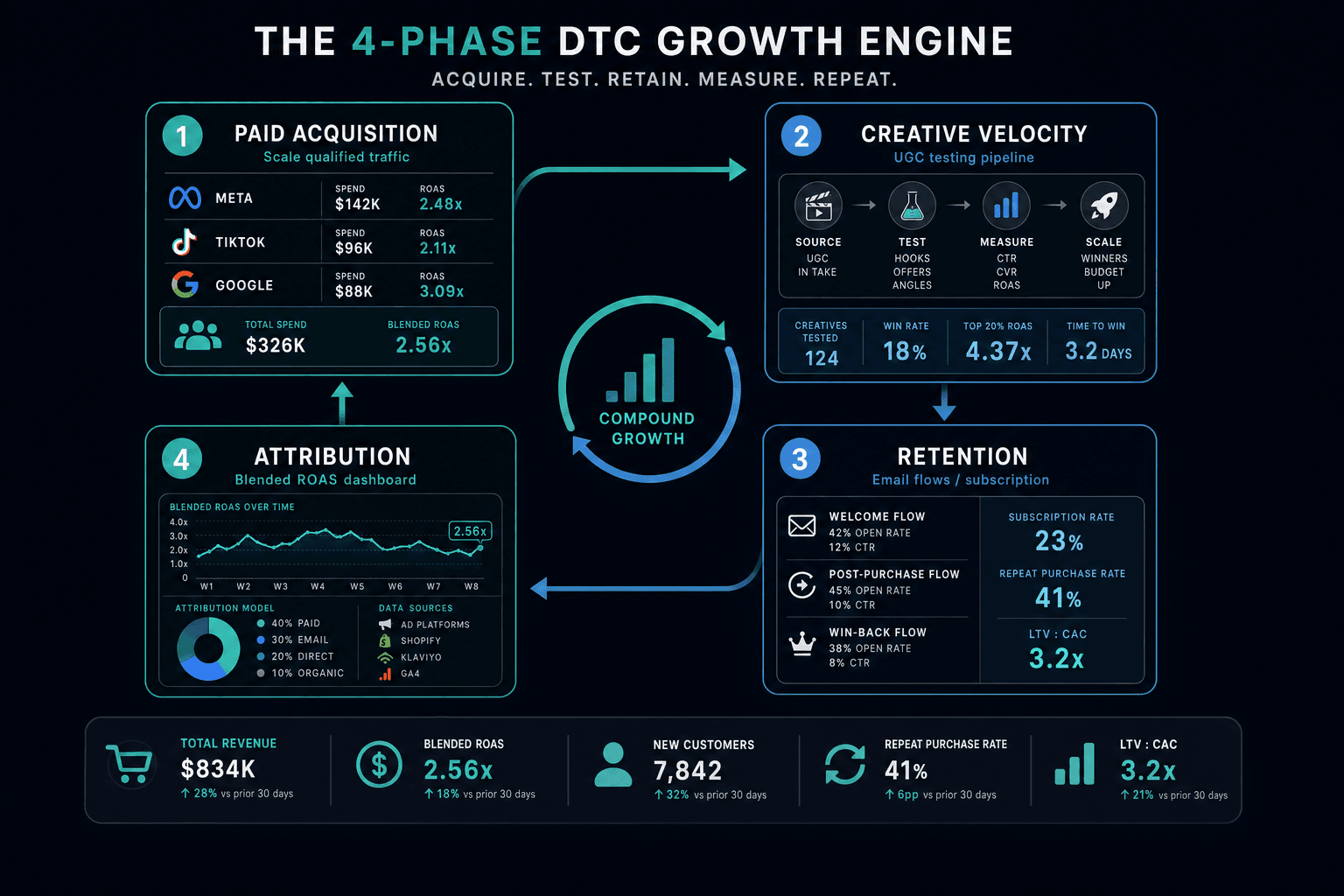
Run your marketing as a four-part system, each part feeding the next: paid acquisition at a target CAC, creative velocity to keep it efficient, retention for repeat buyers and subscribers, and attribution to show what to scale.
Meta handles discovery with UGC-style creative in fitness, barbering, and men's lifestyle interest clusters, and lookalikes of your highest-LTV cohort, not just your purchaser list. Alongside Meta, recruit 20–50 TikTok micro-creator affiliates (10K–100K followers) paid on performance.
Google Shopping and branded search capture in-market buyers and protect your brand terms from Amazon and competitor conquesting.
Treat creative as a production system: test weekly, break down what drove each winner (hook, social proof format, before-and-after structure), and feed it into the next round. Never get caught with a dead ad set and nothing ready.
Time email and SMS to when each product runs out: beard oil buyers get a replenishment prompt at week 5, not week 4 or 8. Post-purchase flows target a second purchase within 60 days, when repeat conversion peaks; churn-risk signals trigger subscription winbacks.
Run Father's Day and BFCM as separate campaigns with dedicated SKUs, budget, and creative: Father's Day kits go live by May 1, and BFCM creative and inventory lock by October 1. Plan ahead for January's self-care bump.
The one number that governs this
Blended ROAS (3.0–4.5x target) and new-customer CAC payback under 6 months govern every decision, not impressions, follower counts, or unreconciled Meta ROAS.
How We Help
What We'd Build for Your Men's Grooming Brand
We skip generic plans and start from your numbers: what your attribution shows, where your creative pipeline runs thin, and how fast subscribers churn. We typically build in this order.
Attribution Audit & Fix
Before touching budget, we reconcile Meta-reported ROAS against Shopify, find pixel errors and misattribution inflating your numbers, and build the source-of-truth dashboard everything rests on.
Paid Media Management (Meta, Google, TikTok)
We rebuild Meta campaigns around your highest-LTV cohort, add Google Shopping and branded search, scale TikTok creator-affiliate content, and shift budget wherever cost-per-new-customer is lowest.
Creative Strategy & Production System
We run weekly creative tests so a replacement is always ready, and feed each winner's lessons into production.
Email & SMS Automation (Klaviyo)
We build flows around each SKU's repurchase cycle: replenishment prompts, second-purchase sequences, subscription winbacks, and personalized bundle upsells.
Conversion Optimization (Bundle Pages & Subscription Prompts)
We continuously test your kit/bundle page and subscription opt-in to lift both conversion rate and AOV.
Seasonal Campaign Planning (Father's Day & BFCM)
We plan Father's Day and BFCM 8–12 weeks ahead with dedicated kit SKUs, creative, and budgets, so you're not scrambling in May or October.
Who's Behind This
Who we are, and what makes us different
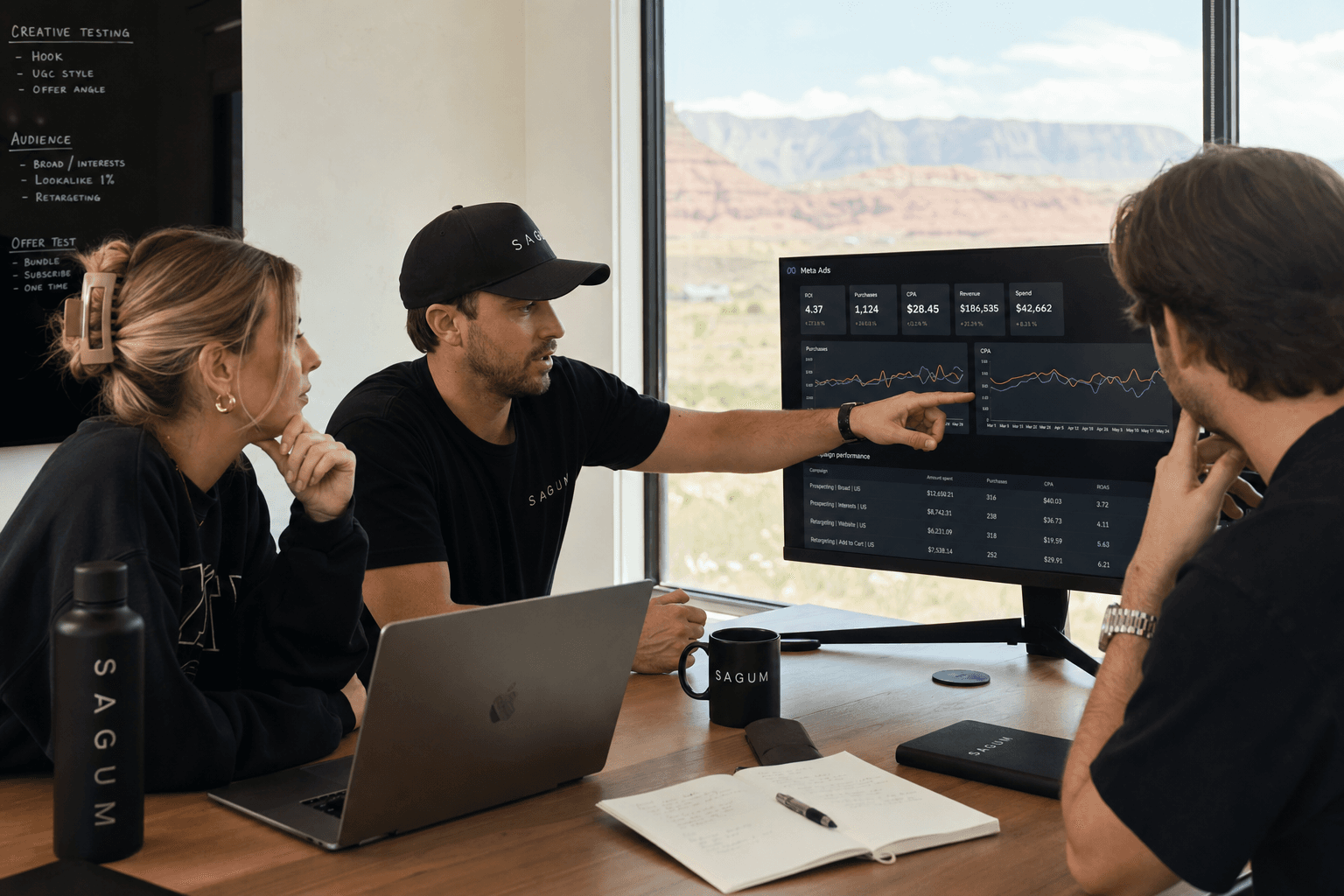
Sagum is a performance marketing agency founded in January 2017 in St. George, Utah. We've spent 8+ years growing real brands and being judged on KPIs, not vanity metrics.
We deliberately limit how many clients we take so each one gets senior attention. We treat your numbers like our own, we never run generic playbooks, and your strategy is built for your business, because shouldn't your brand's marketing be custom to your brand?
Sagum.ai is our AI arm: the same proven operators now build AI into the work wherever it creates real edge, not as theater, but as leverage applied with discipline.
- 8+ years growing brands on performance KPIs, not vanity metrics
- Limited client roster, with senior attention on every account
- An extension of your team; your success is tied to ours
- Custom strategy per brand, never a generic playbook
- AI built in where it moves a number; judgment over hype
“Sagum is a performance marketing agency that's spent 8+ years growing brands by treating their numbers like our own. We take on few clients, never run generic playbooks, and now build AI into the work wherever it creates real edge, not hype. Your strategy is built for your business, and our success is tied to yours.”
“Sagum roughly doubled our bottom line. They treat the work like it's their own business.”
Rachel Nilsson
CEO, RAGS
Proof
$0 → $500k/mo in months at a 4:1 ROAS target
Viori
Challenge
Viori, a new DTC brand, needed to scale from zero.
What we did
We built and scaled Viori's paid acquisition to a 4:1 ROAS target.
Result
Viori went from $0 to $500K per month within months at a 4:1 ROAS target. A grooming brand can scale against the same kind of target. See sagum.com/case-studies/.
Every Winning Ad Set Fades. Let's Build the System That Replaces It.
No obligation. We'll bring a read on your channel mix, creative approach, and attribution setup and show where we'd focus first, so you leave with a clearer picture of your gaps.
Sagum · January 2017 · St. George, Utah · 8+ years