
8+ years growing brands on KPIs, now with AI
Turn Rate Shoppers Into Funded Mortgage Loans
We build mortgage marketing systems that fill your pipeline with qualified borrowers, not rate-shoppers burning your team's time.
8+ years of performance marketing results | Google Ads, Meta, TikTok | Judged on KPIs, not vanity metrics



Get your free marketing audit
Senior strategist review · response within one business day
Prefer to reach out directly?
The Challenge
Mortgage Marketing Is Not Like Any Other Lead-Gen Business
Your pipeline lives or dies on forces you cannot fully control. A 25-basis-point rate move can flood your inbox with refi inquiries on Tuesday and leave it silent by Friday. The spring purchase season runs March through June, then Q4 goes quiet as buyers wait out the holidays. You are managing two completely different demand engines, each with its own buyer psychology, conversion timeline, and channel mix.
Purchase borrowers are not browsing casually. They are already working with a real estate agent, under contract pressure, and comparing you against two or three other LOs simultaneously. The one who issues the pre-approval letter first wins the relationship. That 60-to-120-day shopping window is your entire window, and speed-to-lead is the deciding factor, not your rate sheet.
Refi and HELOC borrowers move on a different clock entirely. When rates drop 50 basis points, a borrower who funded with you three years ago will refinance with whoever calls first. If you do not have a rate-alert system and a documented TCPA-compliant past-borrower list, that call goes to Rocket or LendingTree.
Layer on top of this: Google restricts personalized ad targeting for credit products, Meta requires Special Ad Category compliance that eliminates ZIP code, age, and gender targeting, Regulation Z governs what you can say about rates in an ad, every landing page needs an NMLS ID, any required state license number, and Equal Housing Opportunity disclosure, and trigger leads are now restricted under the Homebuyers Privacy Protection Act that took effect March 2026. The compliance surface area alone disqualifies most generalist marketing agencies from doing this work competently.

The Opportunity
The Lenders Who Build the Right Systems Now Will Own the Next Rate Cycle
Here is what the margin pressure data actually tells you: in Q1 2025, independent mortgage banks lost $28 on each loan they originated before production swung back to a profit later in the year. That is not a marketing problem, it is a cost-per-funded-loan problem. The lenders who survive rate cycles are the ones who generate exclusive, high-intent applications at a fraction of what aggregators charge and convert them faster than the competition.
First-party exclusive leads generated on paid search convert at meaningfully higher rates than shared leads, and organic leads convert higher still. Compare that to marketplace leads sold to several lenders at once, which convert at a fraction of those rates. The math is not close. The lenders winning right now are not buying more leads, they are building better systems to generate and convert their own.
The purchase market is not going away. The spring selling season reliably produces peak demand every March through June. HELOC is a growing product category in 2026 as homeowners tap equity accumulated during the 2020 to 2024 price run. And when rates drop, the lenders with a clean, TCPA-documented past-borrower database and an automated rate-alert sequence will be taking applications within days of a rate move while competitors scramble.
A funded loan on a $300,000 purchase at 100 basis points is $3,000 in gross commission. A borrower who returns for a refi, HELOC, and investment property over a seven-year relationship is worth $10,000 to $20,000 or more. The economics reward lenders who invest in the full relationship, not just the first application.
What Most Get Wrong
What Most Mortgage Lenders and Their Agencies Get Wrong
Buying aggregator leads as a primary strategy
Aggregator marketplaces sell the same borrower to several lenders at once. Your LOs are competing on a speed-to-lead race against several other teams before they say a single word about your rates or service. At the low conversion rates shared leads produce, the unit economics only work at high volume with a dialed-in speed-to-lead system under five minutes. Most branch-level operations cannot sustain that, and they bleed margin on every lead they fail to convert.
Running one generic campaign for all loan types
A VA borrower in Texas, an FHA first-time buyer in Ohio, and a jumbo refinance prospect in California have nothing in common except that they need a mortgage. Sending all three to the same landing page with the same headline destroys conversion. Each loan program has its own eligibility triggers, rate sensitivity, and education requirements. Campaigns that do not segment by loan type and state waste budget on mismatched intent and produce applications your LOs cannot close.
No rate-alert infrastructure for the refi and HELOC pipeline
When the 30-year fixed drops 50 basis points, refinance applications can jump sharply week over week and year over year. Lenders without an automated rate-alert email and SMS sequence to past borrowers miss this window entirely. The borrower who funded with you three years ago calls Rocket because Rocket emailed them first.
Ignoring compliance requirements in ad copy and landing pages
Running a rate-specific headline without the required APR disclosure triggers Regulation Z exposure. Running Meta ads outside Special Ad Category compliance, targeting by ZIP code, age, or gender, creates fair lending liability. Missing NMLS IDs on landing pages erodes trust and may violate state licensing rules. Generalist agencies that do not know these rules either water down the ad to avoid risk or create compliance exposure the branch manager discovers too late.
No call tracking or attribution by loan type and source
Most branch managers cannot tell you whether their funded loans this quarter came from Google Search, a realtor referral, a past-borrower email, or a Facebook lead form. Without source-level attribution tied to funded loan outcomes, budget decisions are guesses. The result is spending money on channels that generate applications that never close and starving the channels that actually fund loans.
Why Now
Why the Next 90 Days Are the Right Time to Rebuild Your Marketing System
The trigger-lead market was sharply restricted in March 2026. The Homebuyers Privacy Protection Act now prohibits credit bureaus from selling a borrower's mortgage inquiry to competing lenders unless the borrower explicitly opted in or the lender already holds the relationship. The cheapest interception tactic in mortgage marketing is largely gone. Lenders who relied on trigger leads are scrambling for replacement volume. That creates a real window for lenders who have already built first-party lead generation systems to capture share before the competition adapts.
The spring purchase season is the highest-demand window of the year. Purchase applications peak March through June. A lender who enters that window with optimized Search campaigns segmented by loan type and state, dedicated pre-approval landing pages for VA and FHA, and a realtor co-marketing program already running will out-convert a competitor who is still setting up their campaigns in April.
AI is now practical enough to change the economics of mortgage marketing in specific, measurable ways. Not as a buzzword, but as a tool that lets a lean LO team test more ad creative angles per week, catch attribution errors that inflate cost-per-application numbers, and run automated rate-alert sequences to past borrowers the moment a rate threshold is hit. The lenders who build these systems before the next rate-drop cycle will fund loans while competitors are still manually pulling their database.
The Mechanism
Where AI Creates a Real Edge in Mortgage Marketing
Real productivity, not AI theater. Here's where it actually moves a number for mortgage lenders.
Digital Ads
What AI does: AI-assisted bid management and campaign segmentation by loan type, state, and intent signal, with budget shifting toward the queries and geographies that are producing submitted applications, not just clicks.
The result: Lower cost per application and cost per funded loan by eliminating spend on high-volume, low-intent queries like 'mortgage rates today' in favor of high-intent, loan-program-specific searches like 'VA loan pre-approval Virginia' or 'FHA loan first-time buyer Ohio'.
Why it matters here: Google restricts personalized ad targeting for credit products, so keyword and geo targeting carry the entire load. Precise segmentation and continuous bid optimization are not optional, they are the mechanism. An AI-assisted system can monitor performance across dozens of loan-type and state combinations simultaneously, something a human campaign manager checking in weekly cannot match.
Conversion Optimization
What AI does: Dedicated landing pages built per loan type (VA, FHA, conventional, jumbo, HELOC) with a single conversion action, pre-qual form or call, plus continuous AI review of page elements for conversion leaks, form friction, and compliance gaps.
The result: Dedicated loan-type landing pages typically outperform generic homepage traffic on conversion. A page built for a VA borrower in Texas surfaces the LO's NMLS ID, a Texas median home price context, and a headline specific to VA eligibility, not a generic rate table.
Why it matters here: Purchase borrowers comparing three LOs simultaneously will submit a pre-qual form on the page that feels most relevant to their situation and most trustworthy. Rate bait-and-switch fear is real. A landing page with transparent APR disclosure, an NMLS ID visible above the fold, and an Equal Housing Opportunity logo converts borrowers who would otherwise bounce to an aggregator.
Analytics and Attribution
What AI does: Source-level attribution that tracks each application and funded loan back to its originating channel, campaign, loan type, and LO, with AI-assisted anomaly detection that flags when a pixel misfire or tracking gap is inflating or deflating reported cost-per-application numbers.
The result: Branch managers can see exactly which channels are producing funded loans versus applications that never close, and shift budget accordingly. Attribution errors that inflate reported ROAS or deflate reported CPL are caught before they corrupt months of budget decisions.
Why it matters here: In mortgage, the gap between a submitted application and a funded loan is where most marketing budgets go wrong. A campaign generating 50 applications a month at $40 each looks great until you discover that 80 percent of those borrowers are not creditworthy or are simultaneously shopping four other lenders. Source-level attribution tied to funded loan outcomes is the only way to know which channels are actually profitable.
Email and Automation
What AI does: Automated rate-alert sequences triggered by rate-threshold events, sent to segmented past-borrower lists with loan-type-specific messaging (refi, HELOC, cash-out), plus long-cycle purchase nurture sequences for pre-approval prospects who are 60 to 120 days from a target close date.
The result: When rates drop 50 basis points, an automated sequence reaches a TCPA-documented past-borrower list within hours, not days. Purchase prospects who submitted a pre-qual form but are not yet under contract receive educational content calibrated to their loan program and timeline, keeping the LO top of mind until the borrower is ready to lock.
Why it matters here: Database marketing to past borrowers is the highest-ROI channel in mortgage when rates drop, because the acquisition cost is near zero and the trust relationship already exists. A borrower who funded with you three years ago and receives a personalized rate-alert with their original loan balance and a new estimated payment, plus the Reg Z disclosures a payment figure triggers, converts at a fundamentally different rate than a cold aggregator lead.
Ready to see what this looks like for your mortgage lenders business?
No obligation. A senior strategist will show you exactly where the wins are.
The Strategy
How Mortgage Marketing Actually Should Be Run
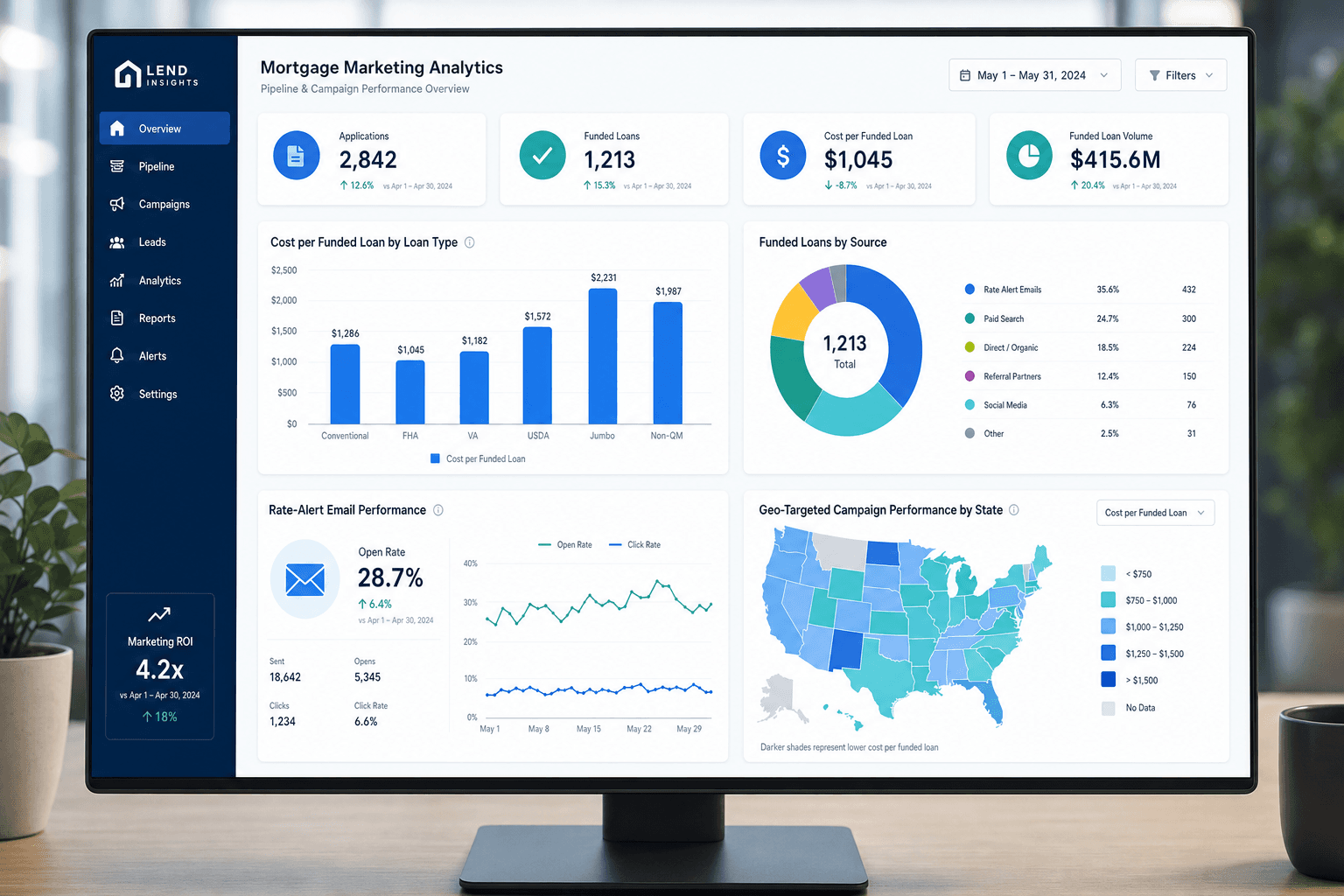
The governing KPI is cost per funded loan. Every channel, campaign, and creative decision is measured against that number. Cost per application matters only as a leading indicator. An LO team generating applications at $40 each that fund at 15 percent has a $267 cost per funded loan. A team generating applications at $80 each that fund at 45 percent has a $178 cost per funded loan. The second team wins, and most branch managers are optimizing the wrong number.
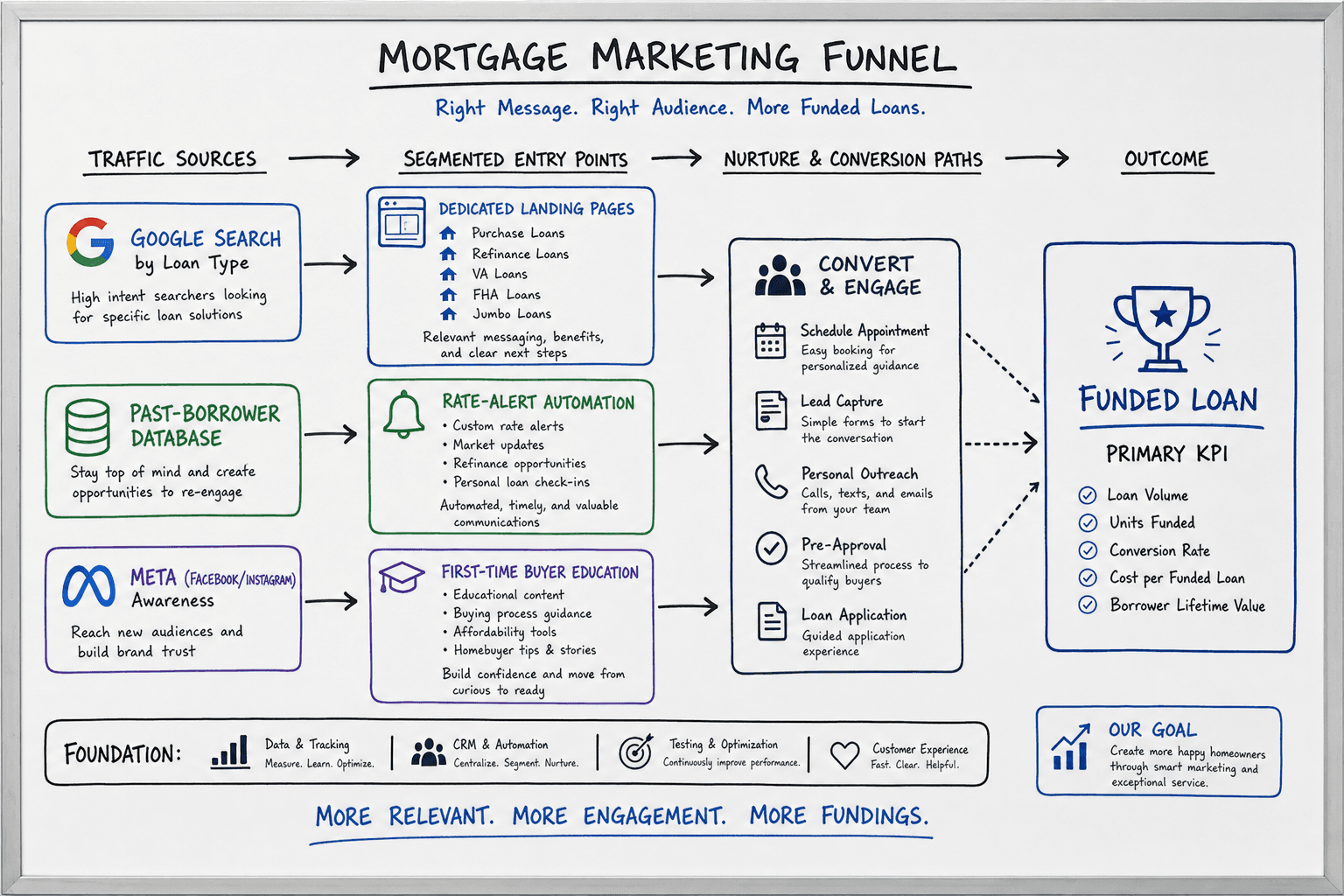
The channel stack is not the same for every loan type or every rate environment. Purchase market: Google Search campaigns segmented by loan program (VA, FHA, conventional, jumbo) and geo-fenced to licensed states, with dedicated landing pages per loan type and a pre-approval CTA. An optimized Google Business Profile for LO personal brand queries. Meta under Special Ad Category compliance for first-time buyer education funnels and LO video content, not bottom-of-funnel rate shoppers. Realtor co-marketing programs built within RESPA Section 8 limits for the highest-quality purchase referral pipeline.
Refi and HELOC market: rate-alert email and SMS automation to past-borrower databases segmented by original loan type, balance, and rate. HELOC campaigns running year-round as a floor product, targeting homeowners by geography and home equity signals within compliant targeting parameters. Budget pacing that can respond to a rate move within 48 hours, not a monthly planning cycle.
Compliance is built into the system, not added at the end. Every ad references APR where a rate is mentioned. Every landing page displays the applicable NMLS ID and Equal Housing Opportunity language. Meta campaigns are set up under the correct Special Ad Category from day one. TCPA consent is documented at the pre-qual form level. These are not optional additions, they are the foundation the rest of the system sits on.
The one number that governs this
Governing KPI: Cost per funded loan. Every budget decision, channel allocation, and creative test is measured against this number, not cost per click or cost per lead.
How We Help
What We Would Actually Do for Your LO Team
We start where most agencies will not: fixing your tracking so you know which channels are producing funded loans, not just applications. Then we build the system around your loan mix, your licensed states, and your rate environment. Here is the specific sequence.
Attribution and Tracking Audit
Before any budget is moved, we audit your current tracking setup to verify that applications and funded loans are being attributed correctly by source, channel, and loan type. Attribution errors that inflate or deflate reported cost-per-application are caught here, not six months later.
Google Search Campaign Build by Loan Type and State
We build segmented campaigns for each loan program you originate (VA, FHA, conventional, jumbo, HELOC) geo-fenced to your licensed states, with match types and negative keyword lists tuned to filter out rate-shopping queries that will never convert to applications.
Dedicated Pre-Approval and Rate-Alert Landing Pages
Each loan type gets its own landing page with a single CTA, the applicable NMLS ID, Equal Housing Opportunity disclosure, and transparent fee language that addresses rate bait-and-switch concerns directly. Pages are built to drive pre-qual form submissions and inbound calls, not to rank for every keyword.
Meta Advertising Under Special Ad Category Compliance
We run Meta campaigns under the required Special Ad Category, using only the targeting options it allows, focused on first-time buyer education funnels and LO personal brand video content. We do not run bottom-of-funnel rate ads on Meta because the targeting restrictions make it the wrong channel for that job.
Past-Borrower Database and Rate-Alert Automation
We build or audit your past-borrower list for TCPA consent documentation, then set up automated rate-alert email and SMS sequences that trigger when rate thresholds are hit, segmented by original loan type and balance so the message is specific, not generic.
Creative Testing and LO Personal Brand Content
We test multiple ad creative angles per week across loan programs, including LO-forward video content for Meta and YouTube pre-roll, so you are finding the message that converts borrowers faster than a competitor running one static ad for months.
Ongoing Performance Reporting Tied to Funded Loans
Monthly reporting is built around cost per application and cost per funded loan by channel and loan type, not impressions or click-through rates. You see exactly where the budget is working and where it is not, and we adjust accordingly.
Who's Behind This
Who we are, and what makes us different
Sagum is a performance marketing agency founded in January 2017 in St. George, Utah. We've spent 8+ years growing real brands and being judged on KPIs, not vanity metrics.
We deliberately limit how many clients we take so each one gets senior attention. We treat your numbers like our own, we never run generic playbooks, and your strategy is built for your business, because shouldn't your brand's marketing be custom to your brand?
Sagum.ai is our AI arm: the same proven operators now build AI into the work wherever it creates real edge, not as theater, but as leverage applied with discipline.
- 8+ years growing brands on performance KPIs, not vanity metrics
- Limited client roster, with senior attention on every account
- An extension of your team; your success is tied to ours
- Custom strategy per brand, never a generic playbook
- AI built in where it moves a number; judgment over hype
“Sagum is a performance marketing agency that's spent 8+ years growing brands by treating their numbers like our own. We take on few clients, never run generic playbooks, and now build AI into the work wherever it creates real edge, not hype. Your strategy is built for your business, and our success is tied to yours.”

“After six years, Sagum is our most important partner: trusted, communicative, and caring about our business as if it's their own.”
Proof
From a $20 CPL goal to $13 CPL and 300+ leads/mo
Rizzoli's Automotive
Challenge
Rizzoli's Automotive needed a consistent flow of qualified local service leads at a cost-per-lead that kept their locations profitable. They had a target of 100 qualified leads per month at roughly $20 each.
What we did
We built a custom call-driving landing page designed around the specific action they needed, a phone call, and restructured their paid campaigns around high-intent local queries rather than broad traffic.
Result
Cost per lead dropped from the $20 target to $13. Monthly lead volume grew to over 300. Landing-page conversion exceeded 60 percent. The client opened multiple new locations on the strength of a predictable, profitable lead system. The same principles apply directly to mortgage: rebuild search around high-intent queries, build landing pages around the specific conversion action you need, and measure everything against the cost of a funded outcome.

- Cost per lead
- $13
- Leads / month
- 300+
- Landing-page conversion
- 60%+
Find Out Exactly Where Your Mortgage Marketing Is Leaking Cost Per Funded Loan
No obligation. We will review your current channel mix, attribution setup, and loan-type segmentation and show you specifically where the gaps are. The analysis is built around your loan programs, your licensed states, and your rate environment.
Sagum · January 2017 · St. George, Utah · 8+ years