
8+ years growing brands on KPIs, now with AI
Keep Your Optometry Exam Chairs Full All Year
Performance marketing for optometry practices built around your insurance mix, your season, and your cost per booked exam.
Google Ads, Meta, and TikTok partner agency with 8+ years growing local service businesses on measurable KPIs.



Get your free marketing audit
Senior strategist review · response within one business day
Prefer to reach out directly?
The Challenge
Running an Optometry Practice Is a Marketing Problem Nobody Prepared You For
You spent years mastering ocular health, not Google Ads. But the business reality of private practice is that clinical excellence alone does not fill a schedule. Vision-plan reimbursements for routine exams stay thin while your overhead climbs. Patient acquisition costs keep rising. And yet, on average, only 43% of active patients in a typical practice had an exam in the previous 12 months, compared to 77% at top-performing practices. That gap is not a clinical problem. It is a marketing and recall problem.
Your demand is not steady. It spikes hard during back-to-school in July and August when parents suddenly realize their child has been squinting at the board all year, then surges again in October through December as patients scramble to use vision benefits before January 1st resets the clock. In between, your phone goes quiet. January and February bring a real lull as deductibles reset and patients delay. If your marketing budget runs flat all year, you are overspending in slow months and underspending exactly when the schedule should be full.
The competitive picture has also changed. LensCrafters, Costco Optical, and Walmart Vision Center compete on walk-in convenience and same-day eyewear. Online retailers like Zenni and GlassesUSA compete for the optical sale the moment your patient walks out the door with a paper prescription. Corporate chains like MyEyeDr run marketing budgets that dwarf most private practice spend. And a common reason a patient chooses a competitor over you is not frame selection or price. It is that they could not immediately confirm you accept their insurance and could not book online in under two minutes.
Specialty services, the highest-margin work you do, are almost invisible in most practices' marketing. Dry eye consultations, myopia management programs, ortho-k fittings, and medical eye care all carry better reimbursement than a routine exam, and they create recurring patient relationships. But if your website has no dedicated landing page for dry eye and no educational content explaining ortho-k versus atropine for a parent researching options, those patients find a competitor who does.
The Opportunity
The Demand Is Already There. The Question Is Whether It Finds You.
Many new patients start their search on Google Business Profile. They type 'optometrist near me,' 'eye doctor that takes VSP near me,' or 'dry eye specialist in [city].' They look at your star rating, read two or three reviews that mention the doctor by name, check whether you accept their plan, and click the first practice that answers all three questions clearly. If your GBP profile is stale, your insurance pages are buried, or your booking flow requires a phone call, they move to the next result. That next result is often a chain with a marketing team.
The math on winning this demand is compelling. A retained patient seen annually for ten years, purchasing eyewear and contacts in-house, is worth many times the cost of acquiring them. Every point of optical capture rate you win back shows up directly in annual revenue. Well-managed paid search can book eye exams at a cost that is small next to that value. At that ratio, the return on a disciplined marketing program is not marginal. It is one of the better investments in your practice.
Specialty funnels compound the opportunity further. A dry eye patient who enters a recurring treatment protocol is not a one-visit transaction. A child enrolled in a myopia management program with annual supply of MiSight lenses or nightly ortho-k wear is a multi-year relationship for both the child and the parent. These are not difficult patients to reach. They are actively searching for answers to symptoms their primary care doctor dismissed. They just need to find a practice that speaks their language before they find yours.
The practices winning right now are not necessarily the ones with the best doctors. They are the ones that show up first in the map pack, answer the insurance question before it is asked, make booking frictionless, and run recall sequences that bring patients back every 12 months without anyone at the front desk having to remember to call. That is a solvable operational and marketing problem, and the window to own your local market before a well-funded competitor does is open right now.
What Most Get Wrong
What Most Optometry Practices Get Wrong With Marketing
Running one generic campaign for all patient types
A parent searching for myopia management for her third-grader and a 55-year-old searching for dry eye relief have nothing in common. Sending both to the same homepage with a generic 'book an exam' button loses both. Routine exam, contact lens, dry eye, and myopia management funnels need separate campaigns, separate landing pages, and separate messaging. Blending them inflates cost per booked exam and produces data you cannot act on.
Ignoring the insurance question until the patient is already gone
One of the most common reasons a prospective patient bounces from an optometry website is not finding a clear answer to 'do you take my insurance?' within ten seconds. If your accepted plans are buried in a footer or require a phone call to confirm, you are sending high-intent patients to a competitor who answered faster. Dedicated landing pages for VSP, EyeMed, Medicaid, and Medicare Advantage are not nice-to-haves. They are your highest-converting pages.
Spending the same budget in February as in October
Optometry demand is calendar-driven. Year-end benefit rush, back-to-school, and spring plan activations are predictable peaks. Running a flat monthly ad budget means you are underspending when the schedule should fill and burning money in January when patients are waiting for deductibles to reset. Budget should follow demand, not a billing cycle.
Treating recall as a manual front-desk task
Top-performing practices recall 77% of active patients annually. Average practices recall 43%. The difference is almost never the quality of care. It is whether the practice has an automated recall sequence tied to the EHR that sends the right message at the right interval without anyone having to pull a list. Practices relying on front-desk staff to manually call patients for annual reminders leave tens of thousands of dollars in the schedule every year.
Using conversion tracking that is either broken or HIPAA non-compliant
Standard Google Ads conversion tags placed on a booking confirmation page can constitute a protected health information transmission under HIPAA, creating real legal exposure. At the same time, many practices have no conversion tracking at all, so they cannot tell which campaigns are booking exams and which are burning budget. You cannot optimize what you cannot measure, and the way many agencies set it up creates legal risk. HIPAA-safe call tracking and server-side conversion APIs are not optional compliance theater. They are the foundation of a trustworthy data set.
Why Now
Why the Next 90 Days Matter More Than the Next 90 Months
Two things are converging right now that create a specific window for optometry practices willing to move.
The first is competitive. Most private practices in your market are still running the same set-and-forget Google Ads campaign they launched three years ago, maybe with a monthly budget adjustment, no segmentation by service line, and no call tracking tied to actual booked appointments. Corporate chains have marketing budgets but generic messaging. The practice that builds a disciplined, segmented, locally-tuned marketing program in the next two quarters will own the map pack and the paid results before a well-funded competitor decides to get serious.
The second is seasonal. Back-to-school season, the single highest-volume window for kids' exams and myopia management consultations, builds from June and fills by late July. Year-end benefit rush, the other major peak, starts in October. Both windows reward the practice that has its campaigns, landing pages, and recall sequences in place before demand spikes. Practices that wait until August to think about back-to-school campaigns are competing for a schedule that is already filling.
AI is also changing what a small practice team can execute. Testing five ad creative angles per week instead of one, automatically shifting budget toward the campaigns producing booked exams, catching attribution errors before they distort your decisions, and running recall sequences that adapt timing based on patient behavior are all things that required a large in-house marketing team two years ago. They do not anymore. The practices that adopt these capabilities now will be running at a structural advantage their competitors will struggle to close.
The Mechanism
Where AI Creates a Real Edge in Optometry Marketing
Real productivity, not AI theater. Here's where it actually moves a number for optometrists.
Digital Ads
What AI does: AI-driven bid optimization and budget pacing tied to your actual appointment calendar, not a flat monthly spend. Campaigns are segmented by funnel: routine exam, contact lens annual supply, dry eye consultation, myopia management. Budget shifts toward the service lines and time windows producing booked exams.
The result: Lower cost per booked exam, higher schedule utilization during peak windows, and less budget wasted on service lines that are already at capacity.
Why it matters here: In optometry, demand is not steady. A flat-budget, single-campaign approach overspends in slow months and underspends during back-to-school and year-end benefit rush. AI pacing follows your calendar, not a billing cycle.
Analytics and Attribution
What AI does: HIPAA-safe conversion tracking using server-side APIs and compliant call tracking so that every booked exam is tied back to the campaign, keyword, and ad that produced it, without transmitting protected health information through standard browser-based pixels.
The result: A clean, privacy-first data set that tells you exactly which campaigns are filling your schedule and which are burning budget, with no guesswork and far less compliance exposure.
Why it matters here: Most optometry practices either have no conversion tracking or are running tracking configurations that create HIPAA exposure. You cannot optimize cost per booked exam without trustworthy data, and you cannot trust data built on a broken or non-compliant foundation.
Creative
What AI does: Rapid testing of ad creative angles across Google and Meta, including insurance-specific messaging (VSP, EyeMed, Medicaid), seasonal triggers (back-to-school, year-end use-it-or-lose-it, FSA deadline), service-line education (what is ortho-k, what causes dry eye), and social proof formats built around doctor-specific reviews.
The result: Finding the message that books exams faster, with data from multiple angles per week rather than one ad running for a quarter with no variation.
Why it matters here: A parent researching myopia management responds to different creative than a 50-year-old searching for dry eye relief or a patient trying to use benefits before December 31st. Generic creative costs you all three. Testing at speed finds the specific angle that converts each segment.
Conversion Optimization
What AI does: Landing pages built specifically for each service funnel, with visible insurance acceptance, real-time booking integration, and AI-assisted review of each page for friction points that cause patients to abandon before booking. Specialty service pages (dry eye, myopia management) are built as education-first pages that answer the questions parents and patients research before they call.
The result: Higher landing page conversion rates, fewer patients who click and leave without booking, and specialty consultation requests from patients who arrive already educated on the service.
Why it matters here: The exam is your moat. Online retailers cannot compete for it. But if your booking flow requires a phone call during office hours, or if your dry eye page is a single paragraph with no clinical context, you are handing high-intent patients to a competitor who made the path to booking shorter.
Email and Recall Automation
What AI does: Automated recall sequences integrated with your EHR (RevolutionEHR, Compulink, Crystal PM) that send the right message at the right interval based on patient history, benefit eligibility timing, and service type. Year-end benefit expiration sequences, contact lens reorder reminders, and post-visit review requests run without front-desk intervention.
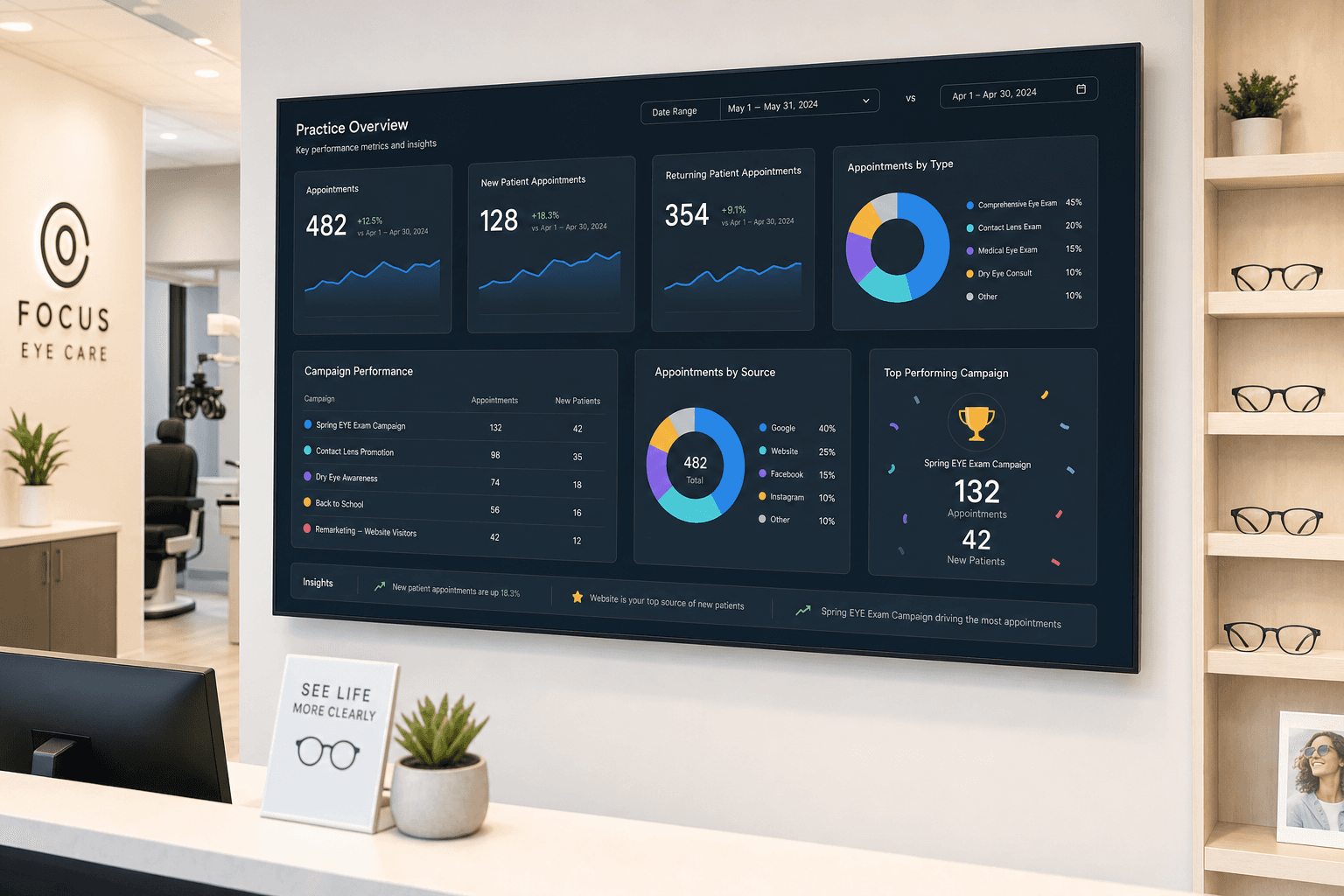
The result: Recall rates that approach top-performer benchmarks (77% of active patients seen annually versus the 43% average), contact lens reorder capture, and a steady stream of post-visit Google reviews that improve map pack ranking.
Why it matters here: Recall is the highest-ROI channel for an established practice because the acquisition cost is near zero. The gap between a 43% recall rate and a 77% recall rate is not a clinical gap. It is a marketing automation gap, and it represents tens of thousands of dollars in recoverable annual revenue.
Ready to see what this looks like for your optometrists business?
No obligation. A senior strategist will show you exactly where the wins are.
The Strategy
What a Purpose-Built Optometry Marketing Strategy Actually Looks Like
The foundation is local search dominance. Many new patients start on Google Business Profile. That means your GBP profile needs weekly posts, a managed Q&A section, photo updates, and a review generation system that is automated post-visit. Ranking in the map pack for 'optometrist near me,' 'eye doctor that takes VSP,' and 'dry eye specialist in [city]' solves a significant portion of the new patient acquisition problem before you spend a dollar on paid search.
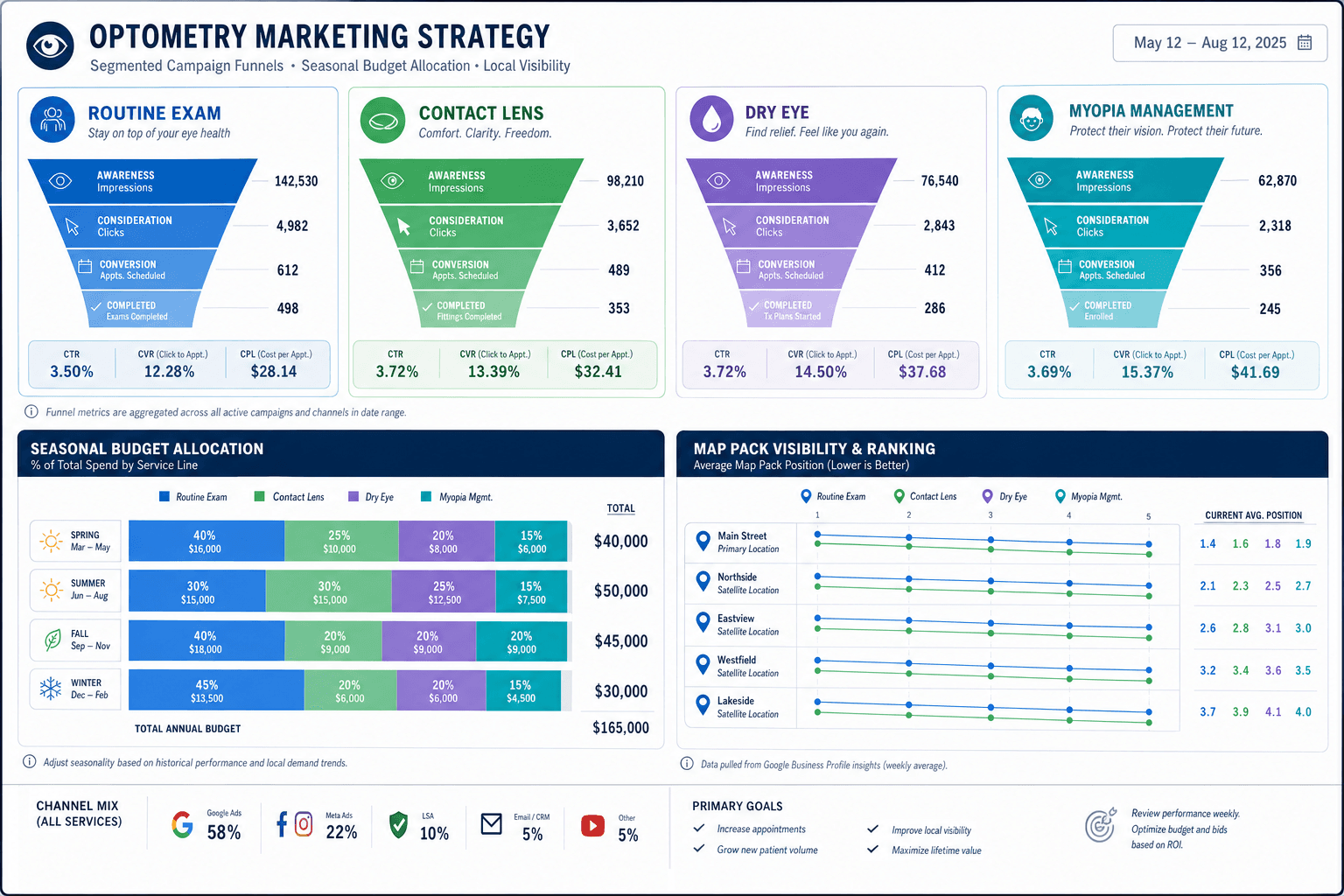
On top of that foundation, Google Search campaigns are segmented by service line, not lumped into one campaign with a generic landing page. Routine exam campaigns target high-intent queries and route to a landing page that shows accepted insurance plans, the next available appointment, and a one-click booking option. Contact lens campaigns separate daily disposable queries from annual supply and specialty lens searches. Dry eye and myopia management campaigns route to education-first landing pages that explain the diagnosis, the technology you use (meibography, corneal topography, ortho-k), and what a consultation looks like, before asking for the booking.
Local Services Ads run above paid search and carry the Google Verified badge, which resolves the 'is this doctor legitimate' question before the patient even reaches your website. For practices with strong review profiles, LSAs often produce the lowest cost per booked exam of any paid channel.
Paid social on Meta and Instagram is not the primary booking channel for routine exams, but it is the right channel for eyewear promotions, back-to-school family campaigns, specialty service awareness, and retargeting recent site visitors. These audiences are warm and already past the awareness stage.
Recall and reorder automation runs in the background on every established practice, recovering patients who would otherwise lapse and capturing contact lens reorders before a patient goes to 1-800 Contacts. The sequences are triggered by EHR data, not manual list pulls.
Every campaign is tracked against cost per booked exam and optical capture rate, the two numbers that determine whether the marketing is actually working. Budget pacing follows your seasonal calendar: heavier in June through August for back-to-school, heavier in October through December for year-end benefit rush, and redirected toward dry eye and specialty services in January and February when routine exam volume dips.
The one number that governs this
The governing KPIs are cost per booked exam and optical capture rate. Every campaign decision, budget allocation, and creative test is measured against those two numbers. Not impressions. Not clicks. Booked exams and in-house optical revenue.
How We Help
Here Is What We Would Actually Do for Your Practice
We take on a limited number of clients so every practice gets senior attention, not a junior account manager following a template. For an optometry practice, here is how we would build and run your marketing program, mapped directly to the strategy above.
HIPAA-Safe Conversion Tracking and Attribution Setup
Before any campaign goes live, we fix your tracking. Server-side conversion APIs and HIPAA-compliant call tracking so every booked exam traces back to the campaign and keyword that produced it, built to keep PHI out of ad platforms and limit legal exposure. You cannot optimize cost per booked exam without a clean, trustworthy data set.
Google Search Campaigns Segmented by Service Line
We build separate campaigns for routine exams, contact lens fittings, dry eye consultations, and myopia management, each with its own keyword set, negative keyword sculpt, and landing page. No more blending all patient types into one campaign with one generic destination.
Local Services Ads and Google Business Profile Management
We set up and manage LSAs to capture the above-the-fold placement with the Google Verified badge, and we run your GBP with weekly posts, Q&A management, and photo updates to maintain and improve map pack ranking for the queries your new patients are actually typing.
Service-Line Landing Pages with Online Booking Integration
We build dedicated landing pages for each funnel: insurance-accepted pages for VSP, EyeMed, Medicaid, and Medicare Advantage; an education-first dry eye page that explains meibography and IPL treatment before asking for the booking; a myopia management page that answers the ortho-k versus atropine question parents are already researching. Each page is built to convert, not just inform.
Paid Social on Meta and Instagram
We run paid social for eyewear promotions, back-to-school family campaigns, specialty service awareness, and retargeting recent site visitors. We do not use social as a primary booking channel for routine exams, because routine-exam demand starts in search, not the feed. We use it where it actually works.
Recall and Reorder Automation
We build automated recall sequences integrated with your EHR, year-end benefit expiration campaigns, contact lens reorder reminders, and post-visit review request sequences. The goal is a recall rate that approaches top-performer benchmarks without adding work to your front desk.
Seasonal Budget Pacing and Creative Testing
We pace your budget to your calendar, heavier in June through August and October through December, and we test multiple ad creative angles per week so we find the message that books exams faster. Every budget decision and creative test is evaluated against cost per booked exam and optical capture rate.
Who's Behind This
Who we are, and what makes us different
Sagum is a performance marketing agency founded in January 2017 in St. George, Utah. We've spent 8+ years growing real brands and being judged on KPIs, not vanity metrics.
We deliberately limit how many clients we take so each one gets senior attention. We treat your numbers like our own, we never run generic playbooks, and your strategy is built for your business, because shouldn't your brand's marketing be custom to your brand?
Sagum.ai is our AI arm: the same proven operators now build AI into the work wherever it creates real edge, not as theater, but as leverage applied with discipline.
- 8+ years growing brands on performance KPIs, not vanity metrics
- Limited client roster, with senior attention on every account
- An extension of your team; your success is tied to ours
- Custom strategy per brand, never a generic playbook
- AI built in where it moves a number; judgment over hype
“Sagum is a performance marketing agency that's spent 8+ years growing brands by treating their numbers like our own. We take on few clients, never run generic playbooks, and now build AI into the work wherever it creates real edge, not hype. Your strategy is built for your business, and our success is tied to yours.”

“After six years, Sagum is our most important partner: trusted, communicative, and caring about our business as if it's their own.”
Proof
From a $20 CPL goal to $13 CPL and 300+ leads/mo
Rizzoli's Automotive
Challenge
Rizzoli's Automotive needed a steady, predictable flow of qualified local service leads at a cost per lead that made the marketing worth running. They had a target of 100 qualified leads per month at roughly a $20 cost per lead.
What we did
We built a purpose-built, call-driving landing page specific to their service area and buyer, and rebuilt the campaign structure around high-intent local queries.
Result
Cost per lead dropped to $13, lead volume grew to over 300 per month, and the landing page converted at over 60%. The client subsequently opened multiple new locations. For an optometry practice, the parallel is direct: a segmented, locally-tuned campaign structure with a purpose-built booking page and clean conversion tracking is built to produce booked exams at a cost that makes the math work.

- Cost per lead
- $13
- Leads / month
- 300+
- Landing-page conversion
- 60%+
Find Out What Your Practice Is Leaving on the Schedule
No obligation. No generic pitch. We will look at your current campaigns, your GBP profile, your recall rate, and your tracking setup and tell you exactly where the cost per booked exam is higher than it should be and what we would do about it. Built around your practice, your insurance mix, and your market.
Sagum · January 2017 · St. George, Utah · 8+ years