
8+ years growing brands on KPIs, now with AI
Real Estate Agents: Win Listings, Not Just Leads
We build seller and buyer funnels for real estate agents that convert at a profitable cost per closed transaction.
8+ years of performance marketing results across Google Ads, Meta, and TikTok



Get your free marketing audit
Senior strategist review · response within one business day
Prefer to reach out directly?
The Challenge
Real Estate Marketing Is a Different Problem Than Most Agents Realize
Sellers do not pick an agent on a whim. By the time a homeowner calls you, they have already Googled your name, read your reviews, and counted your recent sold listings in their ZIP code. The decision to invite you to a listing presentation is made before you ever say a word. That means your marketing is not just advertising, it is your first impression, your proof of expertise, and your competitive differentiator, all before the appointment.
The seller you want most is not browsing casually. They have a life event driving them, a relocation offer, a divorce, a retirement, an estate to settle, and they are interviewing two or three agents simultaneously. They want certainty about pricing and a documented marketing plan, not enthusiasm. They are skeptical of commission and worried about disruption. Generic ads that shout 'I sell homes fast!' do nothing for them.
Buyers are a different problem entirely. They start online six to eighteen months before they are ready to transact, treating portal browsing as entertainment until a lease expiration, a rate drop, or a new baby makes it real. And since August 2024, the NAR settlement requires a signed written buyer-broker agreement before the first home tour, which means the first consultation now carries formal commitment stakes that did not exist before. Your buyer funnel has to earn trust faster than it used to.
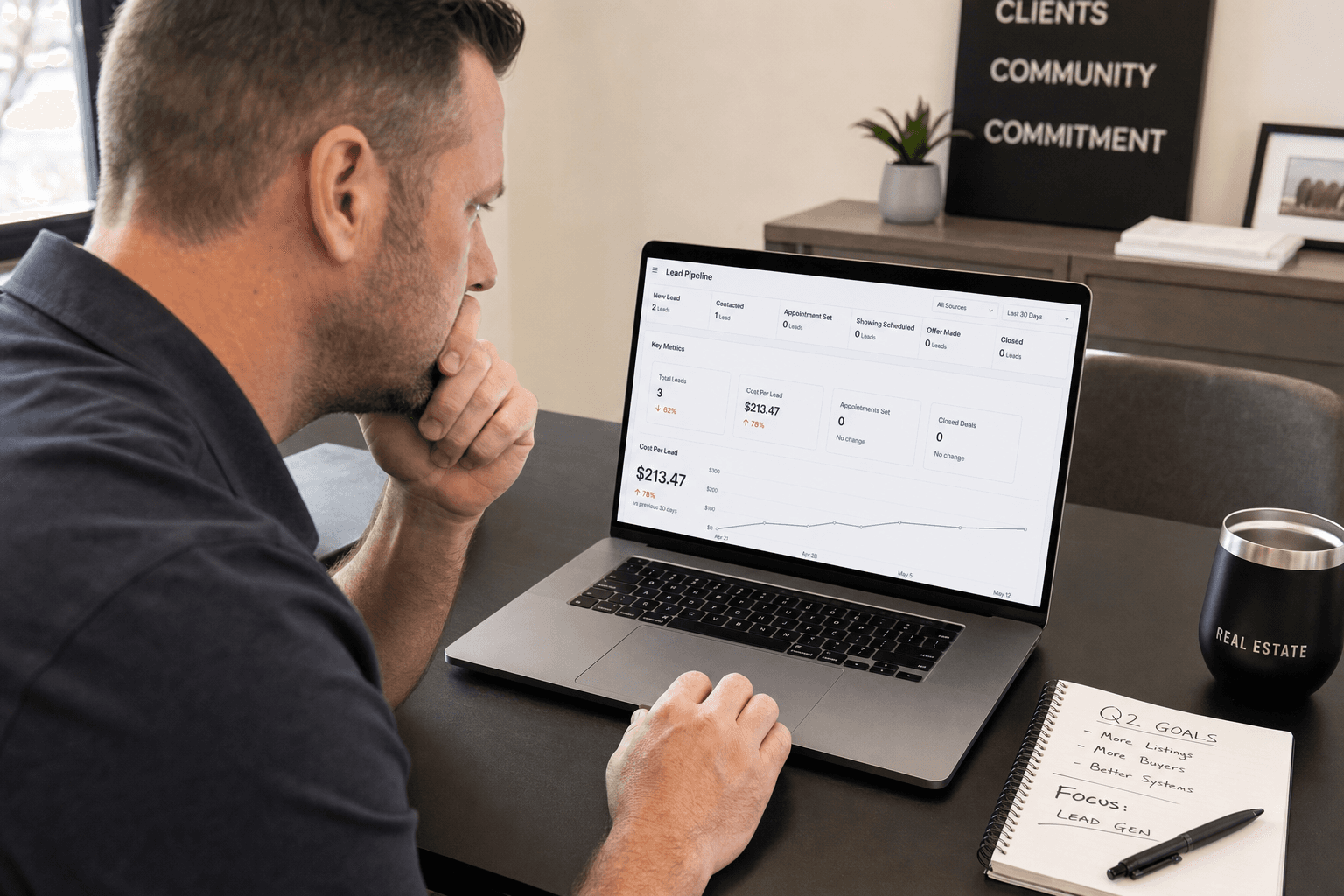
Meanwhile, the channels most agents rely on are working against them. Portal advertising costs have climbed sharply over the past decade. Divide a year of Premier Agent spend by the deals it actually closes, and the effective cost per closed transaction is often far higher than the monthly invoice suggests. The leads are shared, the intent is low, and the portal is simultaneously your marketing platform and your direct competitor for the consumer's attention.
Running a real estate business on portal leads and hope is not a growth strategy. It is a treadmill.
The Opportunity
The Agents Who Win Listings Are Not the Loudest. They Are the Most Visible at the Right Moment.
There is real, capturable demand in your market right now. Total housing inventory is up nearly 6 percent year over year nationally, which means more homeowners are considering a move and more listing presentations are happening. The agents who have a documented, channel-specific marketing system will win a disproportionate share of those appointments.
Seller-intent search is underexploited in most local markets. Queries like 'what is my home worth in [city]' and 'sell my house [neighborhood]' represent homeowners who have already made a mental decision to explore selling. Google Ads targeting those keywords, paired with a home valuation landing page that captures the lead and triggers an immediate follow-up, converts at a cost per listing appointment that most agents have never achieved through portals.
Google Business Profile is the single most overlooked free asset in real estate. Ranking in the local pack for '[city] real estate agent' or '[neighborhood] homes for sale' drives inbound calls at a cost per lead that compounds over time, unlike portal spend that resets to zero the moment you stop paying.
And the past-client database that most agents treat as a Christmas card list is actually the highest-ROI marketing asset you own. A closed client who refers two transactions over five years generates more than $20,000 in gross commission income from a single relationship. A structured 33-touch annual plan and a referral ask system costs almost nothing to run and produces the lowest cost per closing of any channel.
The opportunity is not to spend more on marketing. It is to spend on the right channels, with the right message, timed to the seller's decision window, and to stop paying portals to rent access to your own market.
What Most Get Wrong
What Most Real Estate Agents and Their Marketing Vendors Get Wrong
Running one generic funnel for both sellers and buyers
Sellers and buyers have completely different timelines, triggers, and value propositions. A homeowner evaluating whether to list needs a home valuation offer, local market data, and proof of your sold history in their neighborhood. A buyer six months from readiness needs a saved-search tool and a long nurture sequence. When you run one campaign trying to speak to both, you speak clearly to neither, and your cost per appointment climbs.
Pouring budget into portal advertising while ignoring owned channels
Portal leads are shared with competing agents, arrive with low intent, and cost more every year. Meanwhile, Google Business Profile optimization, local SEO, and a home valuation landing page on your own domain build equity that compounds. Agents who invest in portals are renting visibility. Agents who invest in owned channels are building an asset.
No speed-to-lead system, so paid leads die in the inbox
Harvard Business Review research found firms that contacted leads within an hour were nearly seven times as likely to qualify them as firms that waited even an hour longer. Most agents respond to online leads in hours, not minutes. A paid lead from Google or Meta that sits for two hours before a callback is a lead your competitor already called. Without an automated immediate-response sequence connected to your CRM, you are paying for leads you are not converting.
Ignoring the 12-to-24-month nurture cycle for cold leads
A home valuation lead captured in January may not list until the following spring. Most agents and most marketing agencies stop nurturing after 30 to 60 days and call the lead dead. The agents who win that listing appointment a year later are the ones running a CRM sequence with market update emails, neighborhood report drips, and periodic personal check-ins that keep them top of mind through the entire decision window.
No tracking from ad click to closed transaction
Most real estate marketing vendors report on leads and cost per lead. That tells you almost nothing useful. A channel producing $15 leads that never close is worse than a channel producing $200 leads that close at 6 percent. Without attribution from ad click through booked appointment through signed listing agreement through closed transaction, you cannot make a single good budget decision.
Why Now
Why the Next Six Months Are the Right Window to Build This System
Late winter and early spring are when sellers make their decision. Homes listed in the mid-April window carry list prices roughly $26,000 higher than homes listed at the start of the year, and approximately 40 percent of annual existing-home sales close between May and August. The agents who fill their listing pipeline in January and February are the ones with closings in the spring. The agents who start building their marketing system in April are already behind.
Most of your local competitors are still running the same static campaigns they ran three years ago: a boosted Facebook post, a Zillow Premier Agent subscription, and a prayer. They are not testing creative weekly. They are not adjusting ad spend when a weather event or a rate announcement shifts buyer sentiment overnight. They are not running a home valuation funnel that captures seller intent before the seller calls anyone.
AI has changed what a disciplined operator can do in this window. It is now possible to test five times more ad angles per week than a manual process allows, to catch attribution errors that are inflating your reported lead counts, and to build landing pages that are continuously reviewed for conversion leaks without waiting for a monthly agency report. An agent or team that builds this system now, before peak season, owns the market position that is hardest to take away.
The 2024 NAR settlement also reshuffled the board. Buyer-agent compensation is now negotiated explicitly and disclosed in writing before the first tour. Agents who have a documented value proposition and a professional buyer consultation process will win signed buyer-broker agreements. Agents who rely on personality and hope will watch prospects sign with someone who looked more credible online.
The window to build a real marketing system before the spring selling season is open right now. It will not be open for long.
The Mechanism
Where AI Actually Creates an Edge in Real Estate Marketing
Real productivity, not AI theater. Here's where it actually moves a number for real estate agents.
Digital Ads
What AI does: AI monitors campaign performance around the clock and shifts budget toward the ad sets and keywords that are actually booking listing appointments, not just generating clicks. For seller-intent keywords like 'sell my house [city]' and 'home value [zip]', where clicks are expensive, that continuous optimization can be the difference between a cost per listing appointment that pays and one that does not.
The result: Budget follows real appointment-booking performance rather than a set-and-forget allocation that made sense in month one but is wrong by month three.
Why it matters here: In real estate, a single listing appointment that converts is worth $10,000 or more in gross commission income. Every dollar of wasted ad spend is a meaningful fraction of a deal. Precision in budget allocation is not a nice-to-have.
Creative
What AI does: AI generates and systematically tests a larger volume of ad creative angles each week than any manual process can manage. For a real estate agent, that means testing neighborhood-specific proof points ('14 homes sold in Riverside Heights in the last 90 days') against market authority angles ('Your home's value in today's market') against urgency angles tied to rate or inventory shifts, and finding the message that books appointments in your specific market.
The result: You find the ad message that resonates with sellers in your ZIP codes in weeks rather than months, and you stop running creative that is not working long before it has drained your budget.
Why it matters here: Sellers in different neighborhoods respond to different proof points. A seller in a high-turnover starter-home market cares about speed and net proceeds. A seller in a move-up neighborhood cares about your marketing plan and your track record with comparable homes. Generic creative performs generically. Tested, hyperlocal creative books appointments.
Conversion Optimization
What AI does: AI reviews your home valuation landing page and buyer consultation landing page continuously for conversion leaks: form fields that cause drop-off, page load times that kill mobile conversions, headline and CTA combinations that do not match the search intent that brought the visitor. Changes are tested and validated rather than guessed at.
The result: More of the traffic you are already paying for converts into leads rather than bouncing, which directly lowers your cost per listing appointment without increasing ad spend.
Why it matters here: A home valuation page converting at 18 percent versus 9 percent on the same ad spend cuts your cost per seller lead in half. For a channel where seller-keyword clicks are expensive, landing page performance is as important as ad performance.
Analytics
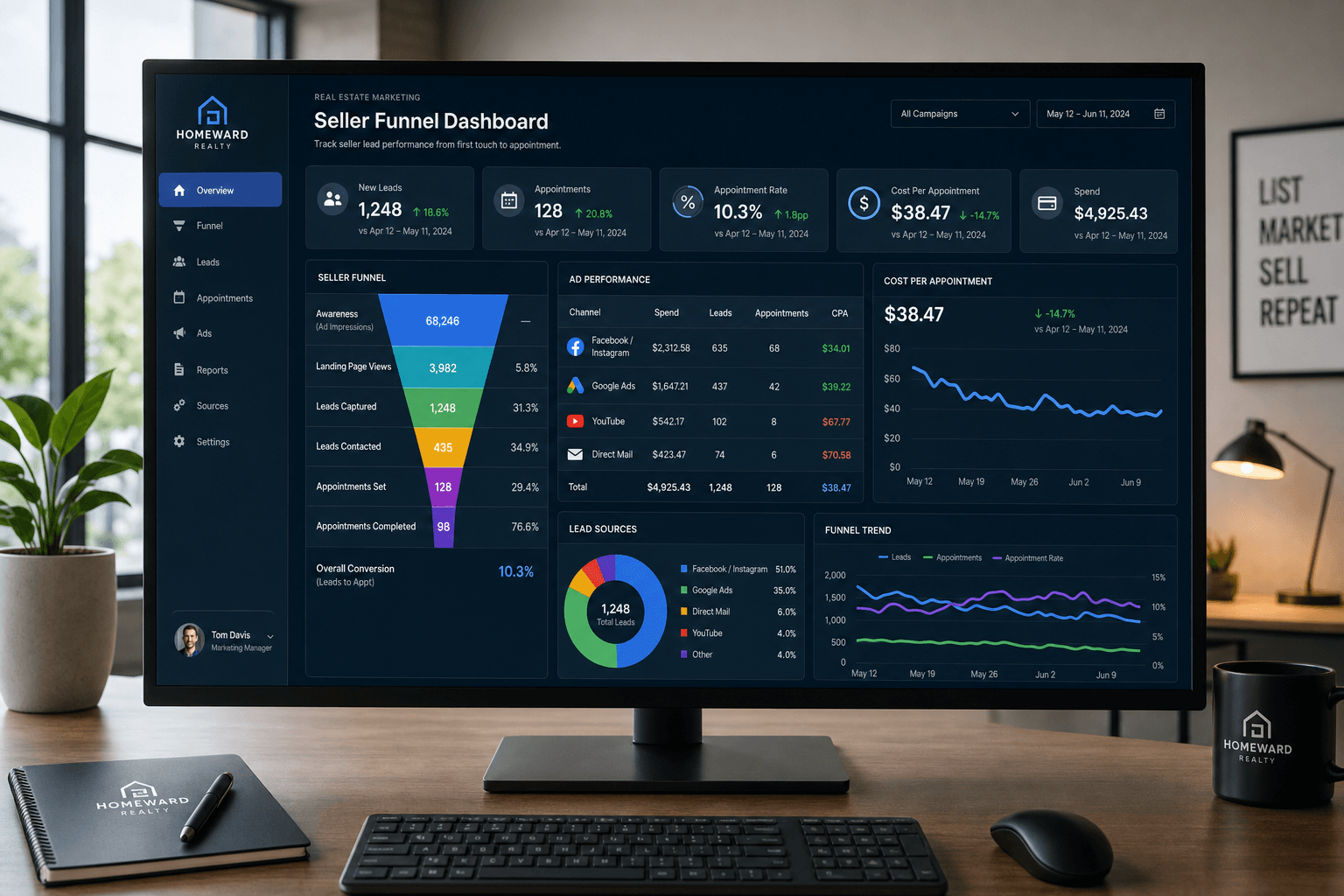
What AI does: AI-assisted attribution tracks the full path from ad click through lead capture through CRM stage through booked appointment through closed transaction. It flags when reported lead counts are inflated by tracking errors, duplicate form submissions, or misattributed conversions, so you are making budget decisions on real data rather than numbers that feel good.
The result: You know which channels are producing closed transactions at what cost, not just which channels are producing leads. That is the only number that tells you where to put next month's budget.
Why it matters here: Real estate has one of the longest lead-to-close cycles of any industry. Without attribution that runs the full 3-to-12-month timeline from first click to closed deal, you will consistently over-invest in channels that look good on a lead report and under-invest in channels that actually close.
Email and CRM Nurture
What AI does: AI builds and optimizes long-cycle nurture sequences for seller and buyer leads separately: neighborhood market report drips for homeowners who are 6 to 18 months from listing, rate-alert and new-listing sequences for buyers in active search mode, and past-client referral ask sequences timed to the anniversary of their closing. Sequences are adjusted based on open and engagement signals, not a static calendar.
The result: Leads that would have gone cold after 60 days stay engaged through a 12-to-24-month decision window, and past clients receive systematic referral prompts rather than a Christmas card once a year.
Why it matters here: The database is the business. A past client who refers two transactions generates more than $20,000 in downstream gross commission income. An automated, personalized nurture system is the only way to capture that value at scale without adding hours to your week.
Ready to see what this looks like for your real estate agents business?
No obligation. A senior strategist will show you exactly where the wins are.
The Strategy
How Real Estate Marketing Should Actually Be Built
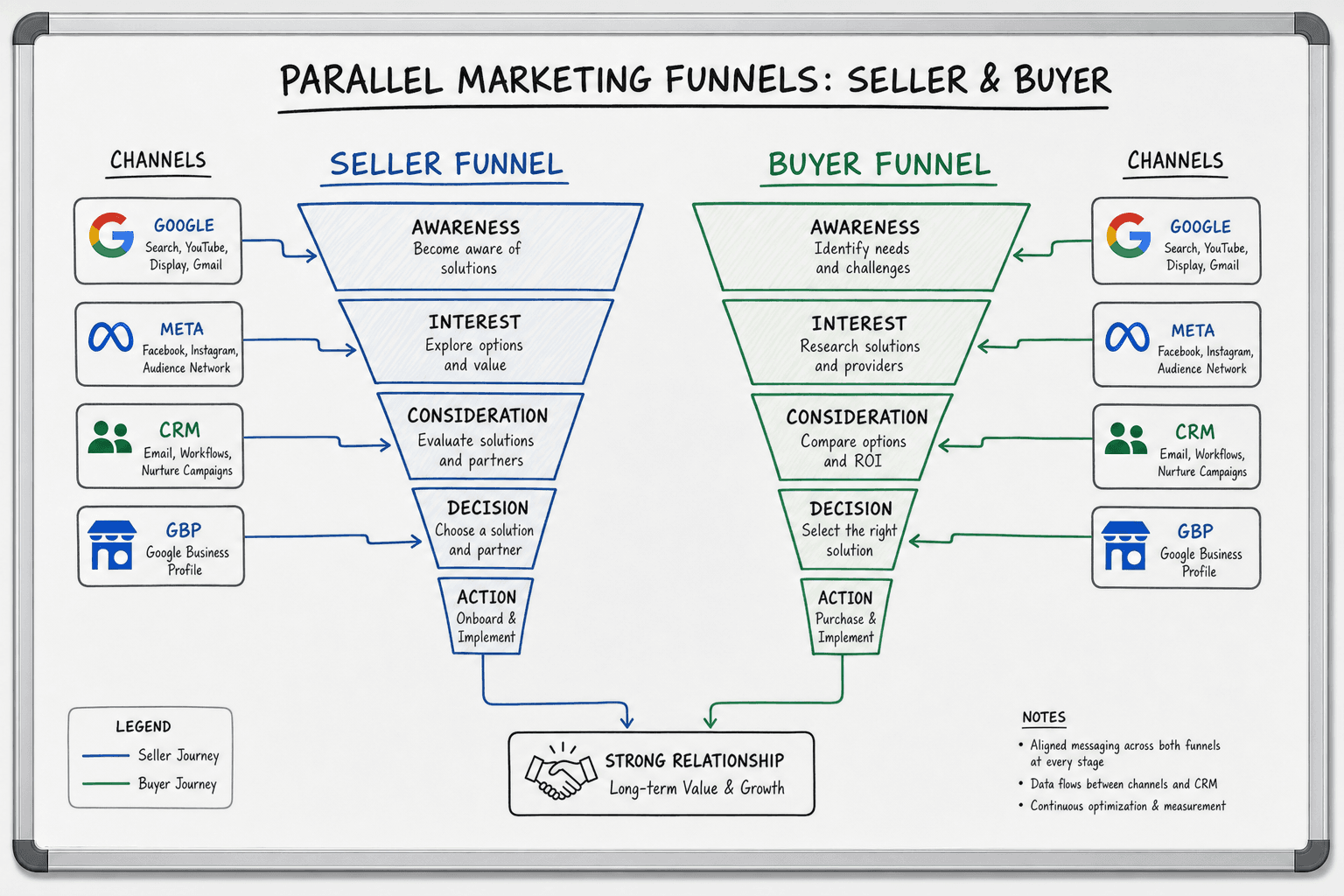
The first decision is to run two separate funnels, because sellers and buyers are different problems. Conflating them produces mediocre results for both.
The seller funnel starts with Google Search. Seller-intent keywords, 'sell my house [city]', 'what is my home worth [neighborhood]', 'list my home [zip]', are the highest-intent traffic you can buy. These clicks are expensive relative to a buyer lead, but a seller who converts is worth $10,000 or more in gross commission income. Every click goes to a purpose-built home valuation landing page with a single conversion goal: capture name, email, phone, and property address. The page is not your brokerage homepage. It is built to convert one type of visitor.
Alongside paid search, Google Business Profile is maintained as an active asset: weekly posts, consistent review generation after every closing, and accurate service-area coverage. Ranking in the local pack for '[city] real estate agent' drives inbound calls at zero marginal cost per click. This is the channel that compounds.
The buyer funnel runs on Meta. Facebook and Instagram lead ads, run under Meta's Housing special ad category (no ZIP-code, age, or gender targeting; 15-mile minimum radius), produce leads far below Google's cost, with the understanding that these leads require a 6-to-18-month nurture cycle. An IDX home search tool on your domain captures buyers in browse mode and triggers CRM sequences based on their saved searches and property views. Retargeting campaigns re-engage website visitors in a 7-to-30-day window.
Every lead from every channel enters a CRM immediately and triggers an automated speed-to-lead response within five minutes. Not an hour. Not a business day. Five minutes. After the initial contact, seller leads receive a neighborhood market report sequence and periodic personal check-ins timed to their stated timeline. Buyer leads receive rate alerts, new-listing notifications matching their saved search criteria, and a buyer consultation offer when engagement signals indicate readiness.
Budget pacing follows the seller calendar. Seller-focused campaigns ramp in January and February to capture homeowners who will list in March through May. Buyer campaigns ramp in March and April as spring inventory arrives. Both pull back to nurture-only in November and December, when active buyers are highly motivated but volume is low.
Past-client referral programs run year-round: a structured annual touch plan, a referral ask script delivered at the one-year closing anniversary, and client appreciation touchpoints that keep your name in front of the people most likely to send you business.
The one number that governs this
Every decision is measured against two numbers: cost per listing appointment and cost per closed transaction. Cost per lead is a leading indicator, not the governing metric. A channel that produces cheap leads that never close is a channel to cut.
How We Help
How Sagum Executes This for Real Estate Agents and Teams
We build and run the full system described above, starting with the pieces that have the fastest impact on your cost per listing appointment and expanding from there. We take on a limited number of clients so every account gets senior attention, and we measure our own success by your closed transaction numbers, not your click volume.
Tracking and Attribution Setup
Before we spend a dollar on ads, we fix your tracking so you know which channels are producing closed transactions, not just leads. We connect ad platforms through your CRM to your pipeline stages so your cost-per-closing number is real.
Google Search Ads for Seller Intent
We build and manage seller-keyword campaigns targeting 'sell my house', 'home value', and 'list my home' queries for your ZIP codes and neighborhoods, using the location targeting Google's housing-ad policy allows (no ZIP-code targeting), with every dollar measured against cost per listing appointment.
Home Valuation Landing Pages
We build purpose-built landing pages for seller lead capture, not your brokerage homepage. Pages are continuously tested and optimized for conversion rate, because a page converting at 18 percent versus 9 percent cuts your cost per seller lead in half.
Google Business Profile Management
We manage your GBP as an active asset: weekly posts, review generation systems after closings, and service-area optimization to rank in the local pack for agent and neighborhood searches in your market.
Meta Lead Ads for Buyer Funnels
We build and run Facebook and Instagram lead ad campaigns under Meta's Housing special ad category across your service area, producing lower-cost leads that feed your long-cycle CRM nurture sequences.
CRM Nurture and Speed-to-Lead Automation
We build separate seller and buyer nurture sequences in your CRM: immediate five-minute response automation, market report drips for seller leads, new-listing and rate-alert sequences for buyers, and past-client referral programs timed to closing anniversaries.
Creative Testing and Hyperlocal Ad Content
We generate and test a higher volume of ad creative angles each week than a manual process allows, including neighborhood-specific proof points and market authority angles, to find the message that books appointments in your specific market faster.
Retargeting
We run 7-to-30-day retargeting campaigns to re-engage website visitors who did not convert on the first visit, keeping your name in front of homeowners who are still in the decision window.
Who's Behind This
Who we are, and what makes us different
Sagum is a performance marketing agency founded in January 2017 in St. George, Utah. We've spent 8+ years growing real brands and being judged on KPIs, not vanity metrics.
We deliberately limit how many clients we take so each one gets senior attention. We treat your numbers like our own, we never run generic playbooks, and your strategy is built for your business, because shouldn't your brand's marketing be custom to your brand?
Sagum.ai is our AI arm: the same proven operators now build AI into the work wherever it creates real edge, not as theater, but as leverage applied with discipline.
- 8+ years growing brands on performance KPIs, not vanity metrics
- Limited client roster, with senior attention on every account
- An extension of your team; your success is tied to ours
- Custom strategy per brand, never a generic playbook
- AI built in where it moves a number; judgment over hype
“Sagum is a performance marketing agency that's spent 8+ years growing brands by treating their numbers like our own. We take on few clients, never run generic playbooks, and now build AI into the work wherever it creates real edge, not hype. Your strategy is built for your business, and our success is tied to yours.”

“After six years, Sagum is our most important partner: trusted, communicative, and caring about our business as if it's their own.”
Proof
From a $20 CPL goal to $13 CPL and 300+ leads/mo
Rizzoli's Automotive
Challenge
Rizzoli's Automotive needed a reliable, predictable flow of qualified leads at a cost that made the math work for their business: 100 qualified leads per month at roughly $20 each.
What we did
Sagum built a custom, call-driving landing page and rebuilt their paid search around high-intent service queries.
Result
Cost per lead dropped to $13, lead volume climbed to more than 300 per month, and the landing page converted at more than 60 percent. The business grew to the point of opening multiple new locations. The same discipline, connecting ad spend to real business outcomes and optimizing against the number that matters, is how we would build your real estate funnels.

- Cost per lead
- $13
- Leads / month
- 300+
- Landing-page conversion
- 60%+
Find Out What Your Listing Pipeline Should Actually Look Like
No obligation. We will look at your current channels, your cost per appointment, and your market, and tell you specifically where the gap is and how to close it. Built around your business, your ZIP codes, and your transaction goals.
Sagum · January 2017 · St. George, Utah · 8+ years