
8+ years growing brands on KPIs, now with AI
More Closing Files for Real Estate Attorneys
Performance marketing built for real estate attorneys who measure success by retained matters, not impressions.
Google Ads, Meta & TikTok Partner | 8+ Years | Performance-Judged



Get your free marketing audit
Senior strategist review · response within one business day
Prefer to reach out directly?
The Challenge
Marketing a Real Estate Law Practice Is Nothing Like Marketing a General Firm
Your closing clients do not shop for you the way they shop for a plumber. In attorney-closing states, the agent or lender hands off the attorney referral within 24 to 48 hours of contract execution, and the closing date is a hard deadline. The buyer often has no idea who chose you or why. If you are not embedded in the agent's referral list before that contract is signed, you never existed.
In title-company states, the problem is the opposite. You are actively displacing a default workflow the agent already trusts. Title companies are faster, cheaper, and already in the agent's contact book. Winning transactional work there requires a deliberate campaign to build relationships with top-producing teams at local brokerages, stay within RESPA Section 8 limits, and give agents a reason to break a habit.
Your dispute clients arrive in a completely different state of mind. Someone who just received an eviction notice, discovered an adverse boundary claim, or watched a closing fall apart is searching 'quiet title attorney [city]' or 'eviction lawyer near me' in a reactive, high-stress moment. They will call the first attorney who answers. Speed of response, not brand awareness, wins that matter.
And then there is the volume problem. Closing file counts swing sharply between the spring peak and the winter trough, tracking NAR's seasonal transaction data. Landlord-tenant work partially offsets that trough, but the two matter types have completely different economics, different buyers, and different keyword clusters. Running one undifferentiated campaign across all of it wastes money on the wrong intent at the wrong time of year.
Add state bar advertising rules, the prohibition on anything that looks like fee-splitting with referral partners, and the near-zero deliberation time a closing client actually has, and you have a practice that punishes generic marketing harder than almost any other professional service.

The Opportunity
High-Intent Demand Exists Right Now, and Most Firms Capture It Sloppily
Every week in your market, buyers are going under contract, landlords are filing evictions, and investors are structuring 1031 exchanges. That demand is real and immediate. The question is whether your firm shows up at the exact moment the need becomes urgent, or whether a competitor with a better-optimized Google Business Profile and a published flat fee takes the call.
The economics reward the firm that wins the referral relationship, not the firm that wins the individual client. One productive agent relationship at an $800 average closing fee generates $8,000 to $24,000 in annual revenue from a single source. A lender who closes 40 loans per year and refers half of them is worth more to your practice than any paid campaign you will ever run. The opportunity is to build that referral pipeline systematically, not by accident.
Commercial closings and investor work represent the highest-LTV segment in the practice. A repeat investor client handling entity closings, assignments, and 1031 exchanges at $2,500 to $10,000 per matter, returning multiple times per year, is a different economic animal than a residential buyer you may not see again for a decade. Firms that build a visible investor practice, with dedicated content and landing pages, tap a segment most local competitors ignore entirely.
The firms winning this market are not necessarily the largest. They are the ones with the most Google reviews, the clearest flat-fee pricing on their website, matter-specific landing pages that match the exact search the prospect ran, and a consistent referral partner outreach program. Those are buildable advantages, and right now most local competitors have none of them fully in place.
What Most Get Wrong
What Most Real Estate Law Firms and Their Marketing Vendors Get Wrong
Running one campaign for every matter type
A residential buyer searching 'real estate closing attorney' and a landlord searching 'eviction attorney' have completely different urgency levels, fee expectations, and decision timelines. One campaign with one landing page serves neither well. The closing prospect sees litigation language that raises their anxiety; the eviction prospect sees flat-fee residential pricing that does not apply to their situation. Both bounce.
Ignoring Google Business Profile while paying for ads
In a hyper-local practice, the GBP listing in the local pack drives more qualified calls than most paid campaigns, at zero marginal cost per click. Firms that neglect review generation, service category selection, and weekly posts are paying for paid traffic to compensate for an organic asset they are leaving dormant. Closing clients at peak satisfaction, the day they get their keys, convert to Google reviews at high rates when asked immediately. Most firms never ask.
No published flat fee on the website
The number-one friction point for a residential closing prospect is fee uncertainty. Competitors who display a specific flat fee, for example $995 for a standard residential closing, eliminate the objection before the prospect ever calls. Firms that hide their fees behind 'contact us for a quote' lose to the firm that answered the question on the website. The prospect moves on in seconds.
Flat ad spend regardless of transaction volume
Closing file volume swings sharply between the spring peak and the winter trough. A firm spending the same monthly budget in January as in May is either overspending during the slow season or underspending during the surge. The spring surge is won or lost in February, before most competitors ramp. Flat spend means you are always a step behind the market.
No tracking by matter type, so no way to know what is working
Without separate phone numbers or form destinations for residential closings, commercial closings, landlord-tenant, and dispute matters, every lead looks identical in the dashboard. You cannot tell whether your Google Search spend is producing closing files at a profitable cost per retained matter or generating dispute inquiries that take months to convert. You cannot optimize what you cannot measure at the matter-type level.
Why Now
Why the Firms That Move Now Will Own the Referral Network for Years
The spring transaction surge builds from February. Agents are already matching buyers with lenders, and the referral conversations that determine which attorney gets the call are happening now. The firms that have already built agent relationships, earned 50-plus Google reviews, and launched matter-specific landing pages will absorb the majority of that volume. The firms still running a single generic campaign will pay more per lead and convert fewer of them.
AI has changed the speed at which a disciplined firm can test and improve. A competitor testing one ad message per month takes a year to find what actually books closing consultations. A firm using AI to run parallel creative tests across matter types and geographies finds the winning message in weeks, then scales it into the peak season with confidence. That compounding advantage is not theoretical. It is the difference between a cost per retained matter that pays and one that does not.
Google's Local Services Ads program, which has used a unified 'Google Verified' badge since October 2025, is still underutilized by real estate attorneys in most secondary markets. Pay-per-lead pricing means you pay only when a qualified prospect contacts you directly through the listing. In markets where competitors have not yet claimed and optimized their LSA profiles, the cost per verified lead is materially lower than standard Search. That window closes as more firms figure it out.
The referral partner channel has a similar window. Most real estate law firms do RESPA-compliant co-marketing poorly or not at all. A firm that builds a systematic outreach program to top-producing agent teams, with co-branded closing checklists and educational content on what an attorney does that a title company cannot, can lock in those relationships before a competitor realizes the channel exists.
The Mechanism
Where AI Creates a Real Edge for a Real Estate Law Practice
Real productivity, not AI theater. Here's where it actually moves a number for real estate attorneys.
Digital Ads
What AI does: AI monitors campaign performance by matter type in real time, shifting budget toward the keywords and ad groups generating closing file inquiries at the lowest cost per retained matter, and pulling spend from broad terms that generate calls but not signed engagement letters.
The result: Budget follows actual file production rather than a static monthly allocation, so you are not overspending on landlord-tenant clicks during the spring closing surge or underspending on high-intent 'real estate closing attorney' queries during peak season.
Why it matters here: In a practice where closing volume swings sharply by season and matter types have completely different economics, a campaign that cannot distinguish between an $800 closing file and a $150 general inquiry call will always misallocate spend. Real-time AI optimization keeps the budget calibrated to what is actually converting to retained matters.
Analytics
What AI does: AI-assisted attribution maps every inbound call and form submission to the specific campaign, keyword, and landing page that generated it, broken out by matter type, so cost per retained matter is visible at the matter-type level rather than blended across all inquiries.
The result: You know exactly what a residential closing lead costs versus a landlord-tenant inquiry versus a quiet title call, which means you can make budget decisions based on the economics of each matter type rather than guessing.
Why it matters here: Most real estate law firms are flying blind because all leads look identical in their dashboard. Without matter-type attribution, you cannot know whether your Google Search spend is producing profitable closing files or expensive dispute inquiries that take months to convert. Clean attribution is the foundation everything else is built on.
Conversion Optimization
What AI does: AI-informed landing pages built separately for each matter type, with published flat fees, clear calls to action, and response speed optimization, including automated text and email follow-up triggered within minutes of a form submission.
The result: Prospects searching 'eviction attorney [city]' land on a page about evictions with eviction pricing, not a generic firm overview. The first attorney to respond wins a disproportionate share of dispute matters. Automated follow-up within three minutes of a form submission closes that gap even when your front desk is handling a closing.
Why it matters here: Closing clients have near-zero deliberation time. Dispute clients often comparison-shop for days before calling. The firm that responds first and speaks directly to the specific matter type converts at a materially higher rate. A generic contact page with a 24-hour response window loses to a matter-specific page with a three-minute automated reply.
Creative
What AI does: AI-assisted ad creative testing runs multiple message angles simultaneously across matter types, for example flat-fee transparency versus closing volume versus response speed, to identify which message generates the most cost-efficient retained matters rather than just the most clicks.
The result: Instead of running one ad per matter type for months, you identify the winning creative angle in weeks and enter peak season already knowing what books consultations.
Why it matters here: A residential closing prospect responds to fee certainty and agent trust signals. A landlord with a problem tenant responds to speed and familiarity with the eviction process in their specific state. The same ad does not work for both. Testing at speed finds the right message for each segment before competitors figure out what is working.
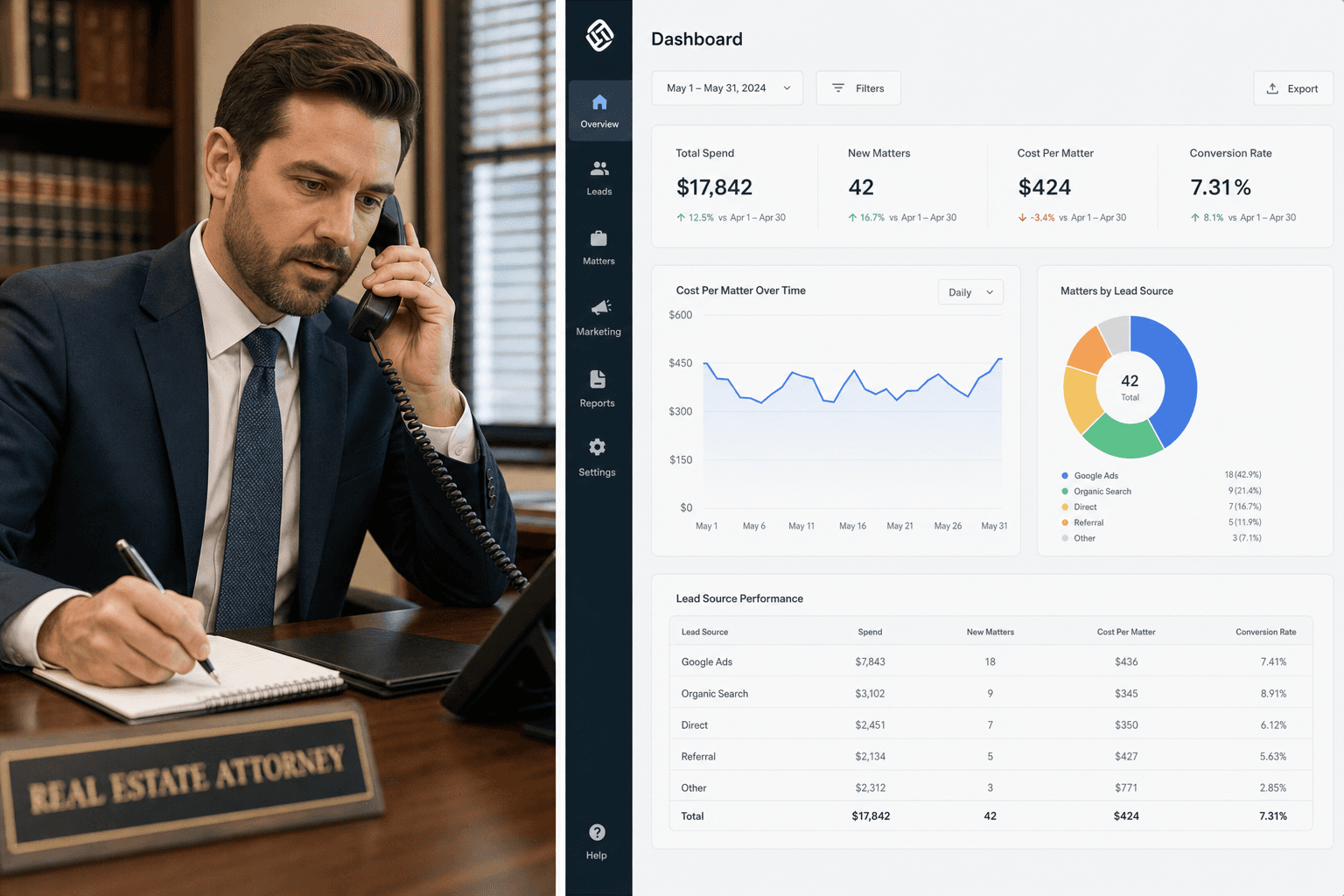
Ready to see what this looks like for your real estate attorneys business?
No obligation. A senior strategist will show you exactly where the wins are.
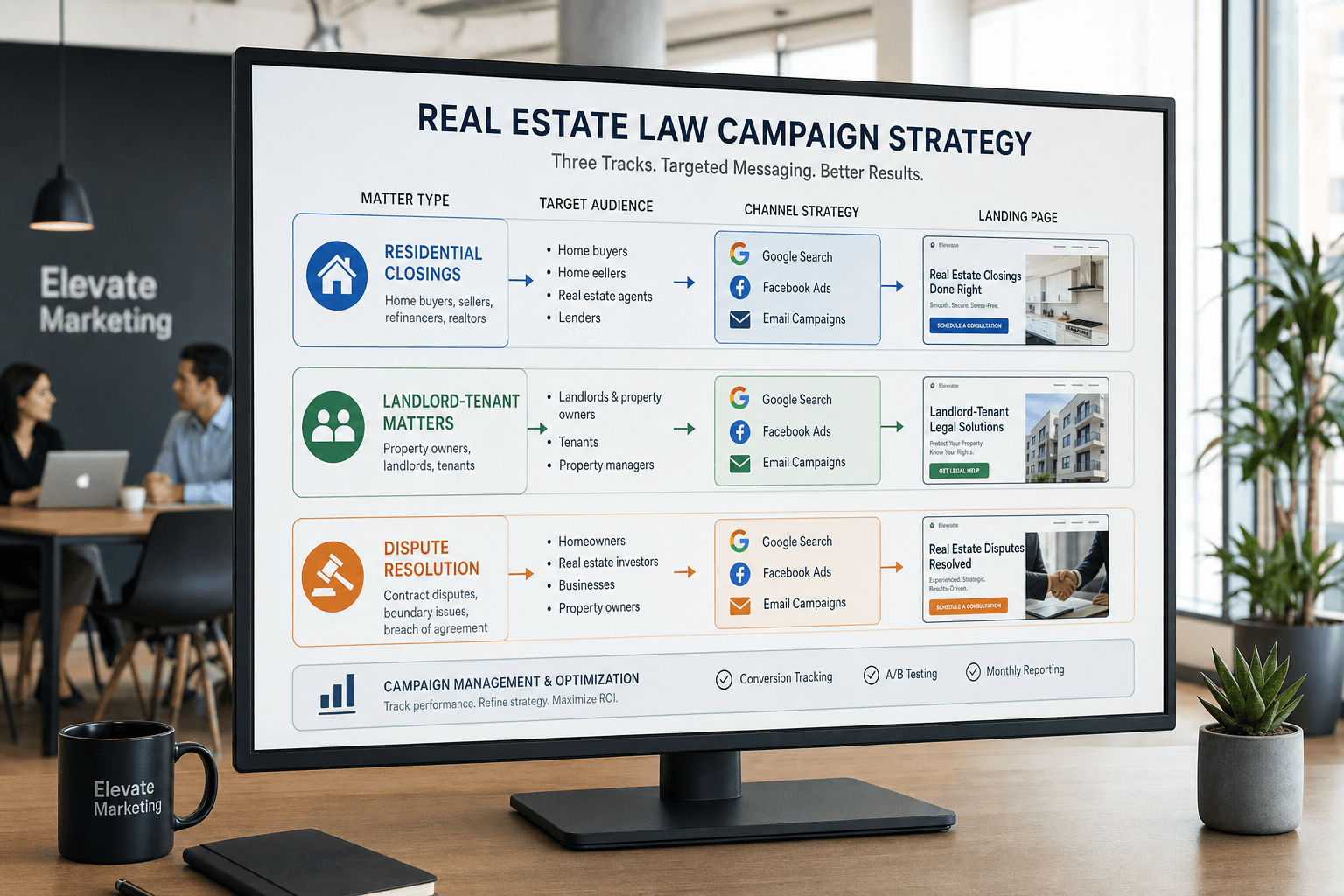
The Strategy
The Advertising Strategy That Actually Works for a Real Estate Law Practice
The foundation is tracking. Before a dollar of paid spend is optimized, every inbound channel needs a distinct tracking path by matter type: separate call tracking numbers for residential closings, commercial closings, landlord-tenant, and disputes. Without that, every optimization decision is a guess.
Google Local Services Ads come first for closing and dispute matters. Pay-per-lead pricing, the Google Verified badge, and top-of-SERP placement make LSAs the highest-intent, lowest-friction paid channel for a hyper-local practice. In markets where competitors have not fully optimized their LSA profiles, the cost per verified lead is significantly lower than standard Search.
Google Search campaigns are built around matter-type keyword clusters, not firm-level brand terms. 'Real estate closing attorney [county],' 'eviction lawyer [city],' 'quiet title attorney [state],' and 'commercial real estate attorney [metro]' are separate campaigns with separate budgets, separate landing pages, and separate conversion goals. Each landing page publishes a specific flat fee for the matter type it covers.
Budget pacing follows the NAR transaction calendar. Spend ramps in February before the spring surge, holds through August at peak allocation, tapers in October, and shifts toward referral partner content and GBP optimization in November through January. Landlord-tenant budget holds or increases in January through March when eviction filings spike post-holiday.
Google Business Profile is treated as a primary channel, not an afterthought. Review generation is automated: a post-closing text or email goes to every closing client within 24 hours of the closing date, when satisfaction is highest and the ask is easiest. Service categories are set precisely. Weekly posts cover matter-specific topics to maintain local pack visibility.
Referral partner outreach runs as a parallel program. Top-producing agent teams and lenders within the service area receive co-branded closing checklists and educational materials about what attorney representation provides that a title company cannot. All activity stays within RESPA Section 8 limits. The goal is to be on the short list every agent gives their buyers before a contract is signed.
The one number that governs this
Every campaign is measured against cost per retained matter by matter type. Closing files, landlord-tenant retainers, and dispute retainers each have their own CPL target based on average fee and conversion rate. A blended CPL across all matter types is not actionable. Matter-type CPL is.
How We Help
Here Is Specifically What We Would Do for Your Practice
We would start by fixing your tracking so you know exactly what each matter type costs to acquire, then build out the channel strategy in the order that produces retained matters fastest. Every service maps directly to a specific strategy point, and we treat your cost per retained matter as our own benchmark.
Attribution and Call Tracking Setup
Separate tracking paths by matter type so cost per retained closing file, landlord-tenant retainer, and dispute retainer are each visible before any optimization decisions are made.
Google Local Services Ads Management
LSA profile build-out, Google Verified badge qualification, and ongoing lead management to capture the highest-intent closing and dispute prospects at the lowest cost per verified lead.
Google Search Campaigns by Matter Type
Separate campaigns for residential closings, commercial closings, landlord-tenant, and dispute matters, each with its own keyword clusters, budget, and conversion goal, paced to the NAR transaction calendar.
Matter-Specific Landing Pages
Dedicated pages for each matter type with published flat fees, clear calls to action, and automated follow-up triggered within minutes of a form submission to win the speed-of-response competition on dispute matters.
Google Business Profile Optimization and Review Generation
Service category configuration, weekly posting, and an automated post-closing review request sequence to compound local pack visibility over time.
AI-Assisted Creative Testing
Parallel ad creative testing across matter types to identify the message angle that produces the most cost-efficient retained matters before peak season, rather than after months of single-ad guessing.
Referral Partner Content and Outreach
Co-branded closing checklists and educational materials for agent and lender outreach, designed to stay within RESPA Section 8 limits while systematically building the referral relationships that generate the highest-LTV files.
Who's Behind This
Who we are, and what makes us different
Sagum is a performance marketing agency founded in January 2017 in St. George, Utah. We've spent 8+ years growing real brands and being judged on KPIs, not vanity metrics.
We deliberately limit how many clients we take so each one gets senior attention. We treat your numbers like our own, we never run generic playbooks, and your strategy is built for your business, because shouldn't your brand's marketing be custom to your brand?
Sagum.ai is our AI arm: the same proven operators now build AI into the work wherever it creates real edge, not as theater, but as leverage applied with discipline.
- 8+ years growing brands on performance KPIs, not vanity metrics
- Limited client roster, with senior attention on every account
- An extension of your team; your success is tied to ours
- Custom strategy per brand, never a generic playbook
- AI built in where it moves a number; judgment over hype
“Sagum is a performance marketing agency that's spent 8+ years growing brands by treating their numbers like our own. We take on few clients, never run generic playbooks, and now build AI into the work wherever it creates real edge, not hype. Your strategy is built for your business, and our success is tied to yours.”

“After six years, Sagum is our most important partner: trusted, communicative, and caring about our business as if it's their own.”
Proof
From a $20 CPL goal to $13 CPL and 300+ leads/mo
Rizzoli's Automotive
Challenge
Rizzoli's Automotive needed a steady, predictable flow of qualified service leads at a cost per lead that made the economics of each location work. Their goal was 100 qualified leads per month at roughly $20 per lead.
What we did
We built a dedicated, call-driving landing page and restructured their paid search around high-intent service keywords.
Result
Cost per lead dropped from a $20 target to $13, monthly lead volume exceeded 300, landing-page conversion crossed 60%, and the client opened multiple new locations on the back of a predictable, profitable acquisition cost. The same discipline, intent-matched campaigns and a call-driving landing page, applies directly to a real estate law practice.

- Cost per lead
- $13
- Leads / month
- 300+
- Landing-page conversion
- 60%+
Find Out What Your Practice Should Be Paying Per Closing File
No obligation. We will review your current channels, identify where cost per retained matter is leaking, and show you exactly what a matter-type campaign structure would look like for your practice area and geography.
Sagum · January 2017 · St. George, Utah · 8+ years