
8+ years growing brands on KPIs, now with AI
Self-Storage Marketing Built Around Move-Ins
We build facility-level search, paid ads, and online rental flows that fill units at a profitable cost per move-in.
8+ years of performance marketing | Google Ads, Meta, TikTok | Judged on KPIs, not vanity metrics



Get your free marketing audit
Senior strategist review · response within one business day
Prefer to reach out directly?
The Challenge
Self-Storage Marketing Is a Local Battle Fought at the Unit Level
Your renter is not browsing. They just signed a lease, got divorce papers, received a PCS order, or realized their garage renovation starts in two weeks. They open Google, type 'storage near me,' and pick a facility fast. Many rent the same day they search. That compressed decision window means if you are not visible in the map pack and paid results at the exact moment they search, you simply do not exist.
The unit-type detail matters more than most operators realize. The person searching 'climate controlled storage 10x10 [city]' has different urgency, a different price ceiling, and a different trust threshold than the person searching 'drive-up storage for my truck.' A single generic facility page cannot convert both of them well. Neither can a single ad campaign.
Then there is the competitive reality. Public Storage, Extra Space, and CubeSmart have dedicated paid search teams, aggregator deals, and the budget to appear several times on page one of a local storage search through their main listing, aggregator profiles, directory sites, and paid ads. An independent operator or regional portfolio typically shows up once. That asymmetry is not fixed by running a bigger budget on the same strategy. It is fixed by being smarter about where and how you show up.
And the aggregator question never goes away. SpareFoot and SelfStorage.com are useful during lease-up, when filling units fast matters more than margin. But at stabilization, they become a tax: they buy ad space above the local pack to capture the lead you would have gotten organically, then sell it back to you at a multiple of your monthly unit rate. Knowing when to use them, when to cut bids, and when to shut them off entirely is one of the highest-impact decisions in self-storage marketing.

The Opportunity
High-Intent Renters Are Searching Right Now. Most Facilities Are Leaving Them on the Table.
Storage demand starts with a search on a phone, and the operators capturing it are the ones with tight local search presence, fast-loading unit-level pages, and a frictionless online rental flow.
The math on a captured move-in is compelling. A standard 10x10 non-climate-controlled unit at about $120 per month, held for the industry average of 18.5 months, produces a baseline LTV of roughly $2,200. Climate-controlled or larger units push that meaningfully higher. A well-run Google Ads campaign that delivers move-ins at a small fraction of that LTV is returning many times its spend before you account for existing customer rate increases.
The window is widest right now for operators who are not yet running facility-level paid search. The big REIT brands may be bidding on your brand terms and your geo terms. Aggregators are bidding above the map pack. But most independent operators and smaller portfolios are still running a single broad campaign with a homepage destination and no call tracking. That is the gap. Own your unit-type search terms, send traffic to pages that show live availability and a rent-now button, and you pull move-ins away from competitors who are spending more but converting worse.
Many renters say they would use the same storage company again when they move. First-touch brand capture is not just about this move-in. It is about the LTV of a customer who comes back in three years when they downsize again.
What Most Get Wrong
What Most Self-Storage Operators Get Wrong With Their Marketing
Sending paid search traffic to the facility homepage
A renter searching 'climate controlled 10x10 storage [city]' lands on your homepage, sees no live availability, no unit-specific pricing, and no rent-now button. They click back and rent from the REIT whose landing page showed them exactly what they needed. You paid for the click and lost the move-in.
Running aggregators at full bid year-round
SpareFoot buys paid placement above your own map pack listing, captures the lead, and charges you a multiple of your monthly unit rate to get it back. At peak season, when organic demand would fill your units anyway, you are paying that premium per move-in for traffic you would have gotten for a fraction of that cost through your own Google Ads campaign.
Managing a 5- or 10-facility portfolio with one Google Business Profile strategy
Each facility has its own micro-market, its own unit-type mix, and its own map pack competition. A portfolio-level GBP approach means every individual facility is under-optimized. Extra Space can appear several times in a single local search. You appear once, with a stale profile and generic photos.
Flat monthly ad budgets regardless of season or occupancy
The moving season runs May through September. Front-loading paid search in April to capture early-season intent is the highest-ROI budget decision most operators never make. Running the same spend in January as in June means you are over-investing in the trough and under-investing at the peak, when a filled unit locks in 14-plus months of LTV.
No same-day follow-up system for phone reservations
Renters expect a callback within minutes, not hours. A renter who calls and reaches voicemail, or who fills out a contact form and hears back the next morning, has already rented somewhere else. The decision window in self-storage is measured in hours, not days. A missed call is a missed move-in.
Why Now
The Operators Who Move Now Will Own Their Local Market Before the Next Peak Season
Street rates have stalled, with 28 of the top 30 metros tracked by Yardi Matrix posting year-over-year declines in non-climate-controlled rates in May 2026. New supply has pressured street rates in Southern and Sun Belt markets. In that environment, operators who compete on price alone are in a race to the bottom. The ones who win are the ones capturing high-intent demand more efficiently than their competitors, protecting street rates by converting renters before they reach the aggregator, and building a review and GBP presence that makes them the obvious local choice.
AI is changing what a disciplined operator can do with a modest marketing budget. Testing five ad creative angles per week instead of one means you find the message that drives online rentals faster. AI-assisted budget pacing that shifts spend toward high-vacancy unit types and pulls back on unit types already full means you stop paying for move-ins you do not need. These are not theoretical capabilities. They are practical today for any operator willing to set them up.
The timing is specific. May through September is the primary lease-up window. Operators who have their paid search structure, unit-level landing pages, and online rental flow dialed in before April will capture the early-season intent that sets occupancy for the rest of the year. Operators who are still running a homepage-destination campaign in June are funding their competitors' best months.
Most independent operators and regional portfolios have not yet built the facility-level search infrastructure that the big REITs take for granted. That is a gap you can close. The question is whether you close it before the next peak or after it.
The Mechanism
Where AI Creates a Real Edge in Self-Storage Marketing
Real productivity, not AI theater. Here's where it actually moves a number for self-storage facilities.
Digital Ads
What AI does: AI-assisted bid management and budget pacing by facility, unit type, and occupancy level, updated continuously rather than reviewed monthly.
The result: Budget shifts automatically toward high-vacancy unit types and pulls back when a unit type hits target occupancy, so you stop paying for climate-controlled move-ins when those units are already full and double down on drive-up when they are not.
Why it matters here: In self-storage, occupancy by unit type within a single facility can vary widely. A flat campaign structure treats a 95%-occupied 10x10 the same as a 60%-occupied 10x20. AI pacing fixes that without requiring manual weekly audits across a 10-facility portfolio.
Conversion Optimization
What AI does: AI-built unit-level landing pages that surface live availability, exact pricing, and a direct online rental link, continuously tested for conversion rate against the specific search query that drove the click.
The result: Renters who searched 'climate controlled storage near me' land on a page showing your climate-controlled units, their current price, and a rent-now button. No homepage detour. No availability dead-end.
Why it matters here: The self-storage decision window is short, and many renters rent the same day they search. A landing page that requires three more clicks to find availability and pricing loses the move-in to a competitor whose page does not. Every percentage point of landing page conversion rate is a direct reduction in cost per move-in.
Analytics
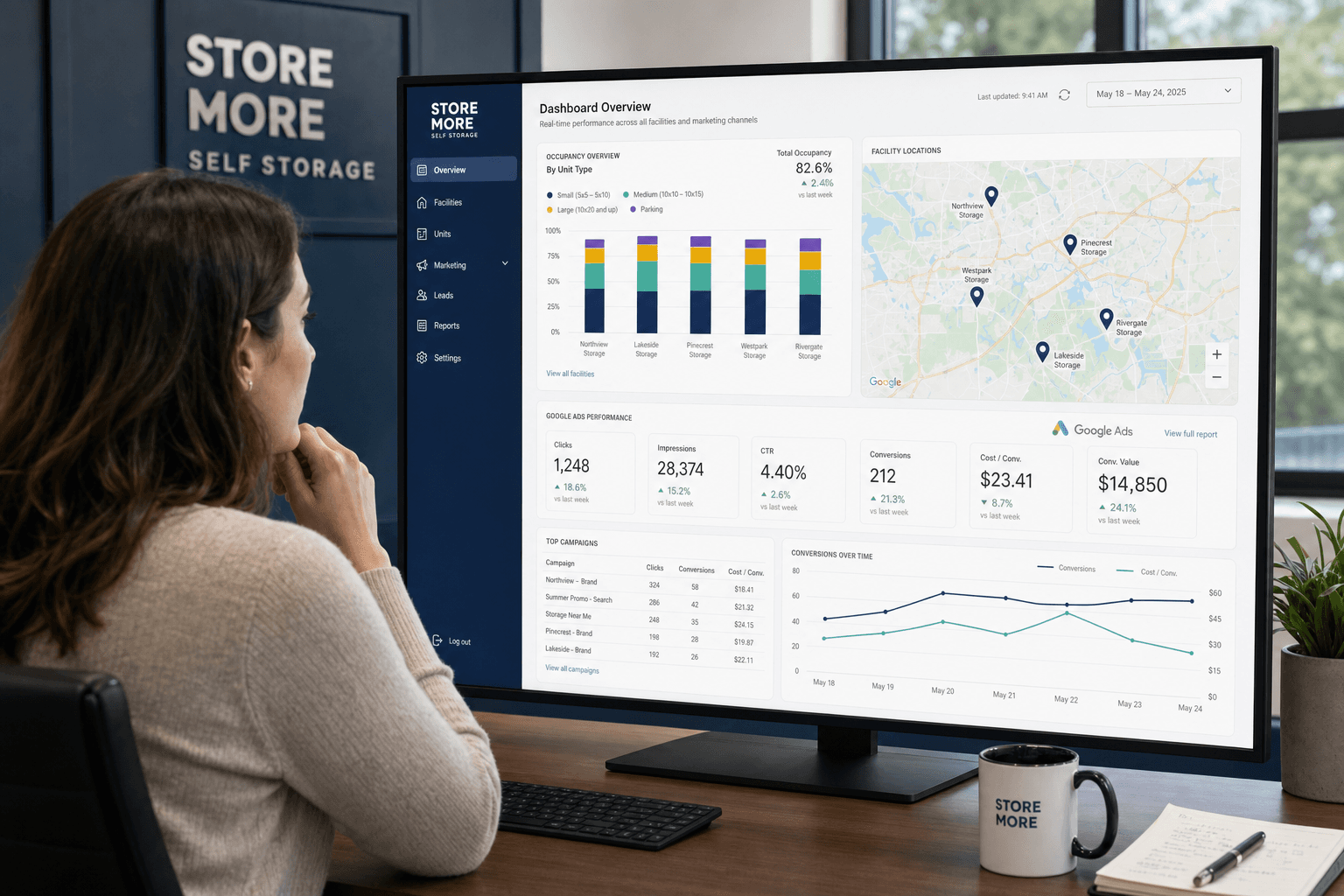
What AI does: Attribution tracking that ties each move-in back to the specific campaign, keyword, and facility, with call tracking per facility so phone reservations are not invisible in your reporting.
The result: You know exactly which campaigns are producing move-ins at what cost, which facilities are over-spending relative to their occupancy gap, and which aggregator placements are generating move-ins versus just generating clicks you are paying for twice.
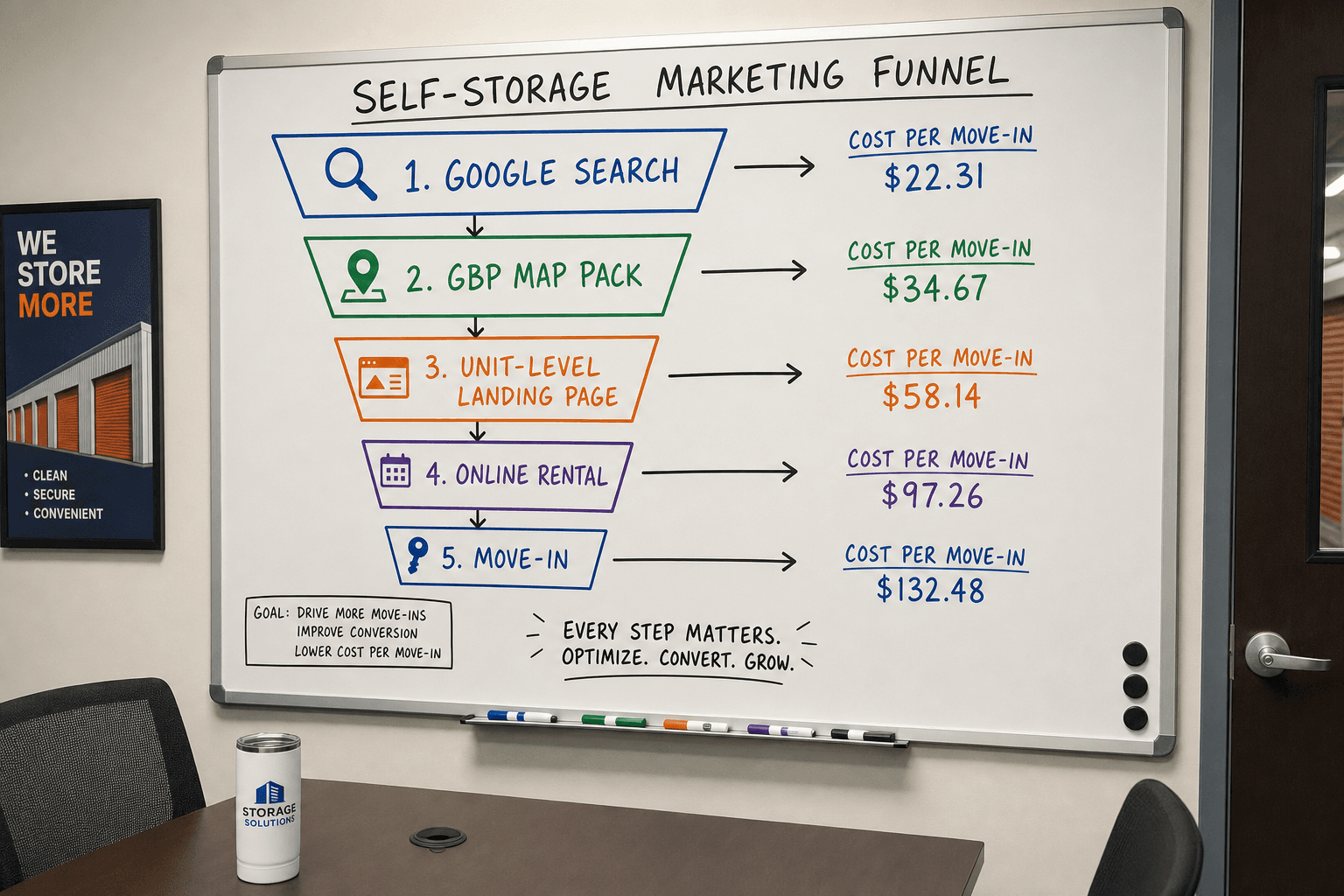
Why it matters here: Most self-storage operators cannot answer the question 'what did it cost us to fill that unit?' with any precision. Without that number, every budget decision is a guess. With it, you can optimize toward cost per move-in instead of cost per click, which is the number that actually determines whether your marketing is profitable.
Creative
What AI does: AI-assisted generation and rapid testing of ad creative variations by trigger segment: moving, downsizing, college move-out, business inventory, RV and vehicle storage, each with copy and imagery matched to the specific renter state of mind.
The result: Instead of running one generic 'affordable storage near you' ad to every search, you are running a 'need storage fast? We have same-day online rental' ad to the high-urgency mover and a 'protect your classic car this winter' ad to the vehicle storage searcher.
Why it matters here: Self-storage renters are in a specific, emotionally charged situation when they search. An ad that acknowledges their trigger converts better than a generic one. Testing multiple creative angles per week means you find the highest-converting message in days rather than months.
Ready to see what this looks like for your self-storage facilities business?
No obligation. A senior strategist will show you exactly where the wins are.
The Strategy
How Self-Storage Marketing Should Actually Be Built
The foundation is facility-level, not brand-level. Every location needs its own Google Business Profile with real facility photos, weekly posts, and review responses within 48 hours. GBP is the single highest-impact local asset in self-storage. Operators who fix their profiles, post weekly, and answer reviews with specific human replies instead of templates can climb the map pack without new backlinks or a citation blitz. Just consistent, facility-level attention.
Paid search runs on unit-type and geo terms, not just brand terms. 'Climate controlled storage [city]' and 'drive-up storage near me' are the searches that produce move-ins. Branded terms protect you from REIT conquesting. Both need separate campaigns with separate budgets, separate landing pages, and separate conversion tracking. Every campaign destination is a unit-level page with live availability, exact pricing, and a direct online rental link.
Aggregator strategy is a dial, not a switch. During lease-up, when occupancy is below 85% and you need move-in volume, aggregators earn their place in the mix. At stabilization, bids get cut on high-occupancy unit types and eliminated during peak season when organic and paid search would have captured those renters anyway. Paying SpareFoot a multiple of your monthly rate per move-in in June, when your phone is already ringing from Google, is a direct margin leak.
Online rental flow is non-negotiable. Renters expect to reserve and rent without a required phone call or office visit. Friction at the rental step loses same-day decisions to competitors whose flow is cleaner. The goal is a renter who searches, lands on a unit-level page, sees availability, and completes an online rental in under five minutes.
Budget pacing follows occupancy and season, not a flat monthly number. April through August gets the heaviest paid search investment. Q4 and Q1 get first-month promotions and retargeting to sustain move-in velocity during the trough. Climate-controlled, vehicle, and business storage campaigns run on their own seasonal logic, separate from residential moving demand.
The one number that governs this
Every dollar is measured against cost per move-in and online rental conversion rate by facility and unit type. Not clicks, not impressions, not leads. Move-ins at a cost that makes the LTV math work.
How We Help
How Sagum Executes This for Your Facility or Portfolio
We start where the money leaks: tracking. If you cannot tie a move-in back to the keyword and campaign that drove it, every budget decision is a guess. We fix attribution first, then build the paid search structure, landing pages, and GBP presence that produce move-ins at a cost that makes the LTV math work. Here is what that looks like in practice for a self-storage operator.
Paid Search (Google Ads)
We build separate campaigns for branded, unit-type, and geo terms at the facility level, with budget pacing tied to occupancy and season. Every campaign destination is a unit-level landing page, not your homepage.
Google Business Profile Management
We manage GBP per facility: real photos, weekly posts, and review responses within 48 hours. This is the map pack presence that produces the first click for 'storage near me' searches.
Conversion Optimization
We build and test unit-level landing pages with live availability, exact pricing, and a direct online rental link. We track and improve online rental conversion rate continuously, because every percentage point is a direct reduction in cost per move-in.
Analytics and Attribution
We install call tracking per facility, connect it to your management platform, and build reporting that shows cost per move-in by campaign, facility, and unit type. You know exactly what is working and what is not.
Creative Production and Testing
We produce and test ad creative by renter trigger segment: moving, downsizing, college, military, business, vehicle storage. We find the message that converts your specific local market faster than a single generic campaign ever would.
Aggregator Strategy
We manage your SpareFoot and SelfStorage.com bids tactically: up during lease-up on high-vacancy unit types, cut during peak season and at stabilization so you stop paying for move-ins your own channels would have captured.
AI Systems and Automation
We build AI-assisted budget pacing, creative testing workflows, and review request automation so the system improves continuously without requiring manual weekly audits across every facility in your portfolio.
Who's Behind This
Who we are, and what makes us different
Sagum is a performance marketing agency founded in January 2017 in St. George, Utah. We've spent 8+ years growing real brands and being judged on KPIs, not vanity metrics.
We deliberately limit how many clients we take so each one gets senior attention. We treat your numbers like our own, we never run generic playbooks, and your strategy is built for your business, because shouldn't your brand's marketing be custom to your brand?
Sagum.ai is our AI arm: the same proven operators now build AI into the work wherever it creates real edge, not as theater, but as leverage applied with discipline.
- 8+ years growing brands on performance KPIs, not vanity metrics
- Limited client roster, with senior attention on every account
- An extension of your team; your success is tied to ours
- Custom strategy per brand, never a generic playbook
- AI built in where it moves a number; judgment over hype
“Sagum is a performance marketing agency that's spent 8+ years growing brands by treating their numbers like our own. We take on few clients, never run generic playbooks, and now build AI into the work wherever it creates real edge, not hype. Your strategy is built for your business, and our success is tied to yours.”

“After six years, Sagum is our most important partner: trusted, communicative, and caring about our business as if it's their own.”
Proof
From a $20 CPL goal to $13 CPL and 300+ leads/mo
Rizzoli's Automotive
Challenge
Rizzoli's Automotive set a goal of 100 qualified leads per month at roughly $20 cost per lead.
What we did
We rebuilt the campaign structure around high-intent search terms and launched a purpose-built call-driving landing page.
Result
Cost per lead dropped from a $20 target to $13. Lead volume grew to 300-plus per month. Landing page conversion hit 60% or higher. The business opened multiple new locations on the back of that lead volume. The same intent-matched, call-driving approach is how we would build self-storage campaigns around cost per move-in.

- Cost per lead
- $13
- Leads / month
- 300+
- Landing-page conversion
- 60%+
Find Out What Your Facilities Are Leaving on the Table
No obligation. We will review your current paid search, GBP presence, and landing page setup and show you exactly where cost per move-in is higher than it should be and why. Built around your facilities, your unit mix, and your occupancy goals.
Sagum · January 2017 · St. George, Utah · 8+ years