
8+ years growing brands on KPIs, now with AI
Sell sporting goods on more than the lowest price
Built around the real seasonality, unit economics, and competitive dynamics of the category, not a template.
Google Ads · Meta · TikTok Partner | 8+ Years in Performance Marketing | DTC Ecommerce Specialists



Get your free Growth Gap Analysis
Senior strategist review · response within one business day
Prefer to reach out directly?
The Challenge
Sporting Goods Ecommerce Is One of the Hardest Verticals to Market Well, and the Last Few Years Have Proved It
Your demand doesn't follow a clean calendar. It follows a viral clip, a championship game, a warm weekend in March, and a back-to-school shopping rush that starts in July and evaporates by Labor Day. When a micro-influencer posts a pickleball reel that hits a million views, you have roughly 72 hours to capitalize before the moment is gone and the algorithm moves on. That's not a marketing problem you can solve with a set-and-forget campaign.
The post-COVID correction made it worse. The category saw multiple consecutive years of negative YoY growth as pandemic-era demand normalized. You've been running harder just to hold ground, watching blended ROAS compress while CPMs climbed and the giants like Nike pushed harder into DTC, taking direct sales from 30% to roughly 40% of their total revenue and competing in your lane with budgets you can't match head-on.
Your unit economics don't give you much margin for error. At a ~$123 AOV and gross margins that range from 28% at the low end to 66% at the top depending on whether you're selling hard goods or apparel and accessories, a few bad weeks of inefficient spend doesn't just hurt: it eats the CAC payback window you need to make the LTV math work. A customer who buys three times over two years at $120 AOV is worth $480–$720. But only if you acquire them at a CAC that gives you room to breathe.
And then there's the competitive structure: Dick's, REI, and Academy own brand recognition and ad budgets. Amazon owns bottom-funnel intent. Other DTC niche brands are fighting for the same community you're building. Generalists lose this war. Specialists win it, but only if their marketing is as sharp as their product focus.

The Opportunity
The Brands That Get This Right Right Now Are Building Moats Their Competitors Can't Cross
Here's the real picture: sporting goods is one of the highest-ROAS categories in ecommerce. The industry benchmarks at a 5.61 ROAS on paid channels, with Google Search and Shopping delivering 4.35x on intent-driven queries. The demand is there. The buyers are ready. The problem isn't the market. It's that most brands in this space are leaving the majority of that demand on the table because their marketing infrastructure wasn't built for how sporting goods buyers actually behave.
Paid search (Google Shopping and Performance Max) drives 58% of sales in this category. That's not a channel you experiment with; it's the engine. But the brands winning right now aren't just running Shopping feeds. They're pairing intent-driven search with social-driven discovery, because 34% of product discovery in this category happens on social platforms, and over 50% of Gen Z and Millennials say social is what drives them to buy. The brands that have both channels working together (capturing intent and manufacturing it) are the ones compounding.
Smaller brands under $10M in revenue actually improved ROAS by 16.5% in 2025, even as mid-market and large brands saw ROAS decline roughly 9% YoY. Agility is the advantage at your tier. You can pivot creative, shift budget toward a trending sport or a seasonal spike, and test a new angle in days, not quarters. That window is real, and it's open right now. The question is whether your marketing infrastructure is built to exploit it.
What Most Get Wrong
What Most Sporting Goods Brands Get Wrong, and What Generic Agencies Make Worse
Running flat budgets across a violently seasonal calendar
Football pads peak in August, ski gear in November, fitness equipment in January, and most hard goods go cold in late April. Brands running the same monthly ad spend regardless of where demand actually is waste budget in the dead zones and underinvest in the windows that drive 60–70% of annual revenue. The back-to-school window alone can make or break a youth sports brand's year, and it requires planning months ahead, not a budget bump two weeks before school starts.
Optimizing for channel ROAS instead of blended ROAS and MER
A 6x ROAS on a branded search campaign looks great in a dashboard and means almost nothing: those buyers were coming anyway. The brands that scale profitably track Marketing Efficiency Ratio: total revenue divided by total spend across every channel. When an agency reports channel-level ROAS without connecting it to blended performance and CAC payback, they're giving you a number that flatters them and obscures whether you're actually growing.
Ignoring the trust gap on high-ticket hard goods
Cart abandonment in this category runs at 70%+, and 19% of abandoners cite trust issues: unclear return policies, no social proof, no risk reversal. For items like bikes, fitness equipment, or high-end outdoor gear where customers can't touch the product before buying, the conversion lever isn't a better ad. It's a risk-reversal offer (free returns, money-back guarantee) and review volume. Products with 50+ reviews convert 37% better. Most brands underinvest in the post-purchase review engine and then wonder why their high-ticket pages convert at 0.8%.
Treating email as an afterthought instead of a repeat-purchase machine
Email converts at 5%+ in this category, three to four times higher than social. For a sporting goods brand selling consumables (balls, chalk, tape, nutrition) alongside hard goods, the post-purchase email sequence is where LTV is built or lost. Brands that don't have automated replenishment flows, sport-specific segmentation, and a seasonal promotional calendar are paying to acquire customers and then watching them drift to Amazon for the refill.
Using macro influencers when micro-influencers drive the actual sales
A sponsored post from a 2M-follower athlete generates impressions. A post from a 20,000-follower pickleball coach generates conversions. Micro-influencers in the 5k–100k range generate up to 60% more engagement than macro influencers because their followers treat them as peers, not celebrities. Brands chasing big names for brand awareness and ignoring the community-level creators who actually move product are spending their influencer budget in the wrong direction.
Why Now
Why the Next 12 Months Are a Specific Window, and Why Early Movers Win It
The post-COVID correction in sporting goods appears to be at or near its end. After multiple years of negative YoY growth, category demand is stabilizing. The brands that spent those correction years building tighter marketing infrastructure (better attribution, faster creative testing, more disciplined budget pacing) are positioned to ride the recovery. The brands that coasted are going to spend the next two years catching up.
At the same time, AI has quietly changed what a lean DTC team can execute. Not in a theoretical way, but in a concrete operational way. A two-person marketing team using AI-assisted creative production can now test as many ad angles in a week as a larger team used to test in a quarter. AI-driven budget allocation can shift spend toward a trending sport or a weather-driven demand spike in hours, not days. These aren't capabilities that require a massive tech stack. They require the judgment to apply them in the right places.
Most sporting goods brands are not doing this yet. Their competitors are running the same creative they ran six months ago, pacing budget on a flat monthly schedule, and checking dashboards once a week. The gap between disciplined operators and everyone else in this category is wider right now than it's been in years, and it's closable. But the window won't stay open once the recovery is in full swing and every brand in the space starts fighting for the same demand with the same tools.
The Mechanism
Where AI Actually Creates an Edge for Sporting Goods Brands
Real productivity, not AI theater. Here's where it actually moves a number for sporting goods brands.
Creative
What AI does: AI-assisted production generates multiple ad creative variations (copy angles, visual concepts, hooks) at a pace that lets you test 5–8 concepts per week instead of 1–2 per month. For sporting goods, this means testing sport-specific messaging (the pickleball player vs. the trail runner vs. the youth soccer parent) simultaneously, finding the angle that converts before a seasonal window closes.
The result: Faster identification of the creative that drives purchases, fewer wasted impressions on concepts that don't resonate, and a library of proven angles to deploy when the next demand spike hits.
Why it matters here: In a category where a viral moment or a new sport trend can open a demand window in 72 hours, creative velocity is a competitive weapon. Brands that can test and scale a winning angle in days, not weeks, capture the spike. Brands running one creative at a time watch it pass.
Digital Ads
What AI does: AI-driven budget allocation monitors performance signals across Google Shopping, Performance Max, and Meta continuously, shifting spend toward the campaigns, audiences, and products that are converting right now, and pulling back from what isn't. Budget pacing is tied to demand signals (weather, sports calendars, trending searches) rather than a flat monthly schedule.
The result: Ad spend follows actual demand instead of a guess. Back-to-school windows, New Year's fitness surges, and niche sport spikes get the budget they deserve, not whatever was left in the monthly allocation.
Why it matters here: Paid search drives 58% of sales in this category. Google Shopping and Performance Max are the engine. But a static campaign structure running the same bids in August (peak back-to-school) as in February (dead zone) is leaving significant revenue on the table. AI-driven pacing closes that gap.
Analytics
What AI does: AI-assisted attribution modeling reconciles what your ad platforms are reporting against what's actually happening in revenue, catching pixel misfires, attribution window mismatches, and the channel-level ROAS numbers that look good in dashboards but don't connect to blended MER. For brands running Google, Meta, and TikTok simultaneously, this is the difference between knowing what's working and guessing.
The result: A trustworthy blended ROAS and MER number you can actually make decisions from (including where to scale and where to cut) rather than optimizing toward platform-reported metrics that flatter the channel and obscure the truth.
Why it matters here: Sporting goods brands with a $123 AOV and a 60-day CAC payback target can't afford to scale a channel that looks profitable in the platform dashboard but is actually inflating numbers. One misfiring pixel can distort spend decisions for months.
What AI does: AI-built segmentation and automated flow logic separates your list by sport, product category, purchase frequency, and LTV tier, then delivers the right message at the right moment. Replenishment flows for consumables (chalk, tape, nutrition). Re-engagement sequences before peak season. Post-purchase review requests timed to when customers have actually used the product.
The result: Higher repeat purchase rate, more reviews driving conversion on high-ticket pages, and a growing owned channel that reduces paid dependency over time.
Why it matters here: Email converts at 5%+ in this category, three to four times higher than social. For a sporting goods brand where LTV is built on the second and third purchase, the email infrastructure is where the margin lives. Brands with sport-specific segmentation and seasonal flows outperform brands blasting the same message to their entire list by a significant margin.
Conversion Optimization
What AI does: AI-assisted landing page analysis identifies the specific friction points killing conversion on high-ticket product pages (missing trust signals, unclear return policies, insufficient review count, shipping cost anxiety on large items) and surfaces prioritized fixes. For AOV-lift initiatives (bundles, upsells, free shipping thresholds), AI tests page variants to find what moves average order value without cannibalizing margin.
The result: Higher conversion rate on the traffic you're already paying for, and a measurable lift in AOV that improves ROAS without increasing spend.
Why it matters here: Cart abandonment runs at 70%+ in this category. A 1–2 percentage point conversion rate improvement on a $123 AOV at meaningful traffic volume is worth more than most brands realize, and it compounds with every paid channel you're running.
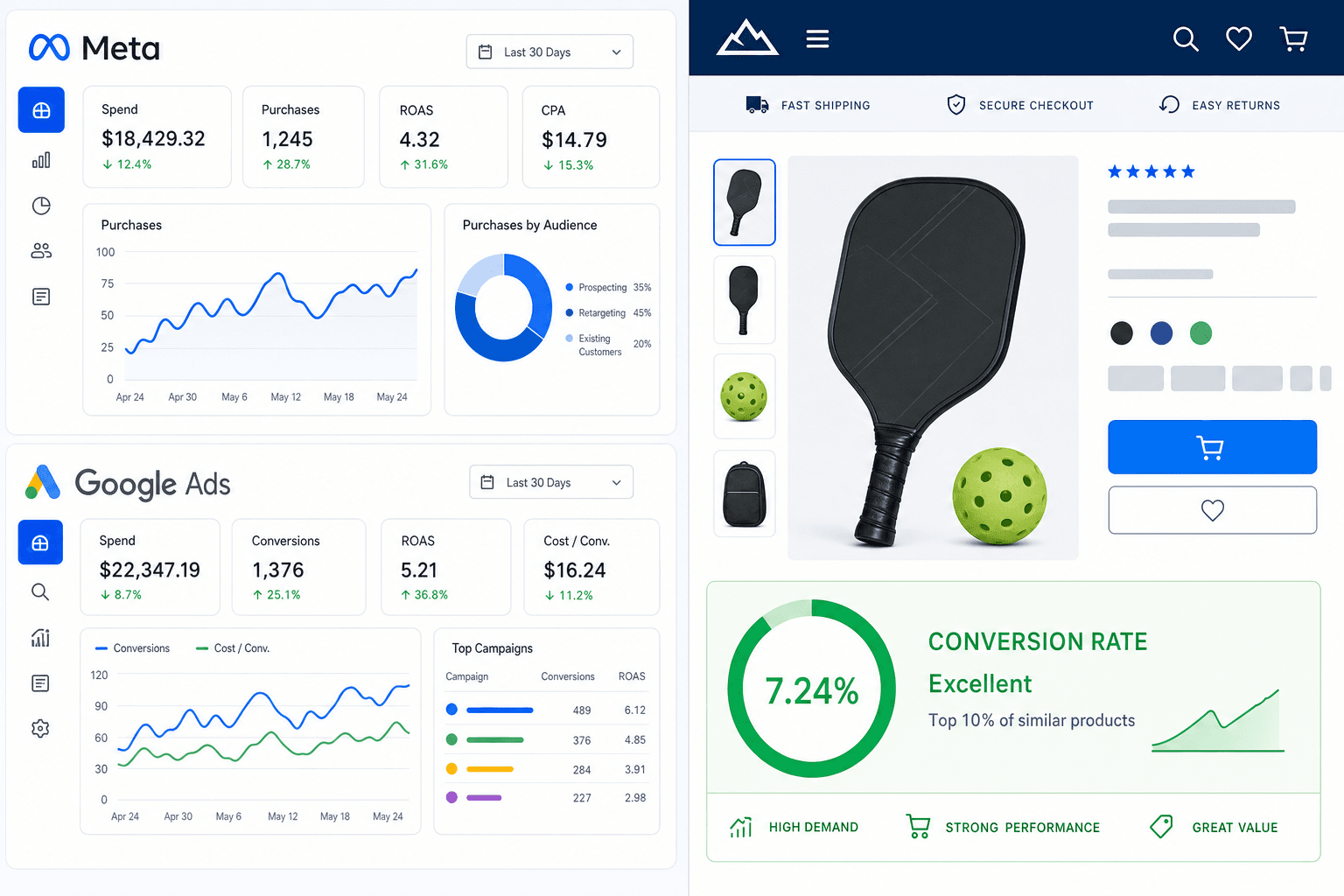
Ready to see what this looks like for your sporting goods brands business?
No obligation. A senior strategist will show you exactly where the wins are.

The Strategy
What a Purpose-Built Sporting Goods Marketing Strategy Actually Looks Like
The strategy starts with the channel that drives 58% of sales in this category: paid search. Google Shopping and Performance Max campaigns built around your actual product catalog, not generic category terms, with bids structured to reflect the margin difference between a $45 accessory and a $400 hard good. High-intent queries like 'best pickleball paddle under $150' or 'youth football shoulder pads size chart' convert at a different rate and deserve a different bid strategy than broad awareness terms. This isn't a single Shopping feed set live and left alone; it's a campaign architecture that's actively managed against your blended ROAS target.
Layered on top of search is social-driven discovery. Meta for retargeting and prospecting to the audiences most likely to buy in your sport categories, with creative that speaks to the specific buyer (the youth sports parent, the weekend warrior, the competitive athlete), not a generic sporting goods shopper. TikTok for brands with strong visual product stories or community-driven sports where organic content is already working. Micro-influencer partnerships in the 5k–100k follower range for the sport communities where peer trust drives purchase decisions more than polished brand creative.
Email and SMS run parallel to paid, not as an afterthought, but as the repeat-purchase engine. Sport-specific segmentation, seasonal promotional cadence tied to your actual demand calendar (back-to-school in July, fitness in January, clearance in April), and automated post-purchase flows designed to drive the second purchase and the review that makes the third buyer convert.
Attribution runs underneath all of it. Every channel tracked to blended ROAS and MER, not just what each platform claims it drove. Budget pacing tied to your seasonal demand calendar, not a flat monthly number. And conversion rate optimization on the product pages and checkout flow that your paid traffic is hitting, because acquiring traffic to a page that converts at 1.2% when it should convert at 3% is an expensive way to grow.
The one number that governs this
The number that governs everything: Blended ROAS and CAC payback period (total revenue divided by total spend, with new-customer acquisition cost recouped within 60 days). Channel-level ROAS is a diagnostic, not a success metric.
How We Help
Here's Specifically How We'd Execute This for Your Sporting Goods Brand
We'd start where the leverage is highest: fixing attribution so you trust your numbers, then building the paid search foundation that drives 58% of category sales, then layering in the creative testing and social infrastructure that compounds over time. Every service maps directly to a strategy point. Nothing is added because it sounds good; everything is there because it moves your ROAS or lowers your CAC.
Analytics & Attribution Audit
Before we spend a dollar, we verify that your pixel, GA4, and platform attribution are reporting accurately. A misfiring pixel, like the one that was inflating numbers for a DTC food brand we worked with before we caught it, distorts every spend decision downstream. You can't optimize toward blended ROAS if you don't trust the blended ROAS number.
Google Shopping & Performance Max
We build and manage your Shopping campaigns around your actual catalog, margin structure, and seasonal demand calendar, not a flat bid strategy. High-intent, high-ticket queries get the budget they deserve. Budget pacing shifts with your demand signals: heavier in July–August for back-to-school, heavier in November for gifting, lighter in the February dead zone.
Meta Ads (Prospecting + Retargeting)
Prospecting campaigns built around sport-specific audience segments and creative angles, not a single 'sporting goods' interest target. Retargeting sequences that address the specific objections killing conversion on your high-ticket pages: return policy clarity, review social proof, risk-reversal offers for items over $150.
Creative Production & Testing
AI-assisted creative production that lets us test 5–8 angles per week across sport categories, buyer personas, and seasonal hooks. We find the creative that converts before the seasonal window closes, not after you've spent three months running one concept.
TikTok Ads
For brands with strong visual product stories or sport communities where organic content is already building (pickleball, trail running, youth sports), TikTok prospecting paired with UGC-style creative and micro-influencer content that meets buyers where they discover new brands.
Email & SMS Automation
Sport-specific segmentation, seasonal promotional cadence tied to your actual demand calendar, post-purchase review request flows timed to actual product use, and replenishment sequences for consumable categories. We build the owned-channel infrastructure that reduces your paid dependency over time and drives the repeat purchases where LTV is made.
Conversion Rate Optimization
AI-assisted analysis of your highest-traffic product pages and checkout flow, identifying the trust gaps, missing review volume, shipping cost friction, and size/fit anxiety that are driving your 70%+ cart abandonment. Prioritized fixes and AOV-lift tests (bundles, upsells, free shipping thresholds) that improve what your paid traffic lands on.
Who's Behind This
Who we are, and what makes us different
Sagum is a performance marketing agency founded in January 2017 in St. George, Utah. We've spent 8+ years growing real brands and being judged on KPIs, not vanity metrics.
We deliberately limit how many clients we take so each one gets senior attention. We treat your numbers like our own, we never run generic playbooks, and your strategy is built for your business, because shouldn't your brand's marketing be custom to your brand?
Sagum.ai is our AI arm: the same proven operators now build AI into the work wherever it creates real edge, not as theater, but as leverage applied with discipline.
- 8+ years growing brands on performance KPIs, not vanity metrics
- Limited client roster, with senior attention on every account
- An extension of your team; your success is tied to ours
- Custom strategy per brand, never a generic playbook
- AI built in where it moves a number; judgment over hype
“Sagum is a performance marketing agency that's spent 8+ years growing brands by treating their numbers like our own. We take on few clients, never run generic playbooks, and now build AI into the work wherever it creates real edge, not hype. Your strategy is built for your business, and our success is tied to yours.”

“After six years, Sagum is our most important partner: trusted, communicative, and caring about our business as if it's their own.”
Proof
Reversed 3 years of decline to 237% YoY
Bisaddle
Challenge
A DTC sporting goods brand had watched three consecutive years of declining revenue, the kind of sustained decline that erodes confidence in every marketing decision and makes it hard to know whether the problem is the product, the market, or the execution.
What we did
We rebuilt the marketing infrastructure from the ground up: a full site redesign that doubled page speed, a conversion rate overhaul that addressed the trust and friction gaps killing purchase completion, and a paid and email strategy rebuilt around the brand's actual demand patterns and customer LTV math.
Result
The brand reversed three years of decline and hit 237% YoY growth. The site redesign alone lifted conversion by 122%. Email grew to drive 48% of total revenue, a compounding owned-channel asset that reduced paid dependency while ROAS improved across every paid channel. Full details at sagum.com/case-studies/.

Your Sporting Goods Brand Deserves Marketing Built Around How Buyers in This Category Actually Behave
No obligation. No generic playbook. We'll come to the session having done the work on your specific brand (your seasonality, your unit economics, your current channel mix) and show you exactly where we see the biggest opportunity to improve your blended ROAS and lower your CAC payback period.
Sagum · January 2017 · St. George, Utah · 8+ years