
8+ years growing brands on KPIs, now with AI
Break the supplement ROAS wall with real MER
We build growth systems for supplement brands fighting high ad costs and the churn that quietly eats LTV.
8+ years of performance marketing · Google, Meta & TikTok partner · Results judged on your Shopify revenue, not platform attribution



Get your free Growth Gap Analysis
Senior strategist review · response within one business day
Prefer to reach out directly?
The Challenge
The Supplement Market Is Brutally Competitive, and the Economics Are Less Forgiving Than They Look
You're operating in a $72.9 billion industry where every niche (magnesium, creatine, ashwagandha, electrolytes) has fifty-plus DTC brands bidding against each other on the same Meta audiences. Health and wellness CPMs on Meta run around $19.30, among the most expensive of any ecommerce vertical, because everyone is chasing the same affluent, health-conscious buyer.
Your gross margins look healthy on paper (55 to 70 percent is typical for branded DTC supplements), but the cash picture is messier. You have to buy inventory 60 to 90 days before revenue lands. That structural cash gap grows every time you scale, which means every agency retainer and every media dollar has to pay back fast enough to keep you out of a working capital bind.
The ROAS reality is harder than most agencies will tell you. Supplements are one of the lowest-ROAS ecommerce verticals: Google averages around 2.1x, Meta closer to 1.4x. A 3:1 blended ROAS is genuinely excellent for this category, not a failure to optimize. But that only works if your subscription attach rate is strong enough to make the 60-day LTV carry the CAC. If monthly churn is running at 18 percent, the math that looked workable on paper is quietly destroying your payback window.
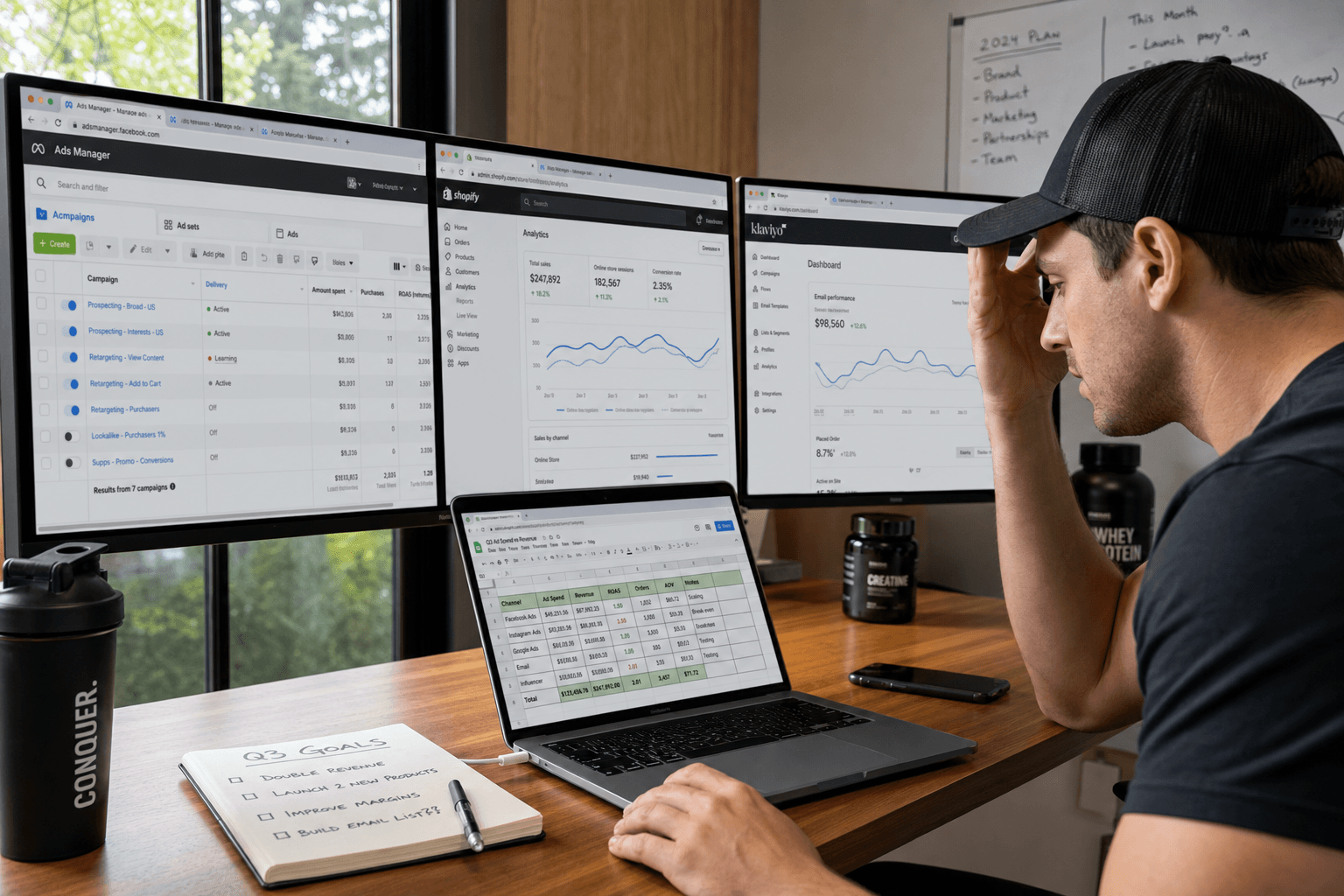
And then there is the attribution problem. Your Meta dashboard claims it drove 40 percent of revenue. A multi-touch tool says 22 percent. A media mix model says 31 percent. You do not know which number to trust, which means you do not know which channel to scale, and every agency you have talked to has quoted you their platform-attributed ROAS as if it were gospel.
This is the actual challenge of marketing a supplement brand: the unit economics are tight, the cash timing is punishing, the competitive environment is expensive, and the measurement is broken. A generic ecommerce agency that runs the same playbook they use for apparel will burn through your budget before they understand any of this.
The Opportunity
The Brands Winning in Supplements Right Now Are Doing Three Things Differently
TikTok Shop is the breakout channel almost no supplement brand has figured out yet. Vitamins and supplements are the largest product category on the platform, and TikTok Shop is growing at 71 percent in this vertical, but it still represents only 3 percent of total supplement market revenue. The brands that build a repeatable TikTok Shop creative and fulfillment system in the next 12 months will own a channel that their slower-moving competitors will be scrambling to enter two years from now.
Subscription economics are improving across the industry (repurchase rates hit 37.7 percent in early 2024, up from 33.1 percent the year prior), but most brands are leaving retention revenue on the table because their post-purchase email and SMS flows are generic. A winback sequence built specifically for a lapsed auto-ship customer is a different message than a standard abandoned cart email. Brands that treat subscription save flows as a dedicated revenue channel, not an afterthought, are recovering churn that used to be invisible.
The category-level opportunity is also uneven. Hydration and electrolytes are up nearly 29 percent. Beauty supplements up 28.5 percent. Calmative and mood support up 24 percent. If your product sits in one of these growing categories, there is real demand momentum behind you. The question is whether your paid and organic strategy is positioned to capture it before the category gets crowded. Energy supplements and traditional weight management formulas are declining, partly displaced by GLP-1 medication adoption, so the brands in those categories need a repositioning story, not just more ad spend.
The structural advantage that makes all of this work: your gross margins. At 60 percent contribution margin, you only need a 1.67:1 ROAS to break even on a first order. That means a disciplined LTV-first strategy (where you accept a tight first-order return and win on 12-month customer value) is genuinely viable in supplements in a way it is not in lower-margin categories. The brands that internalize this and build their channel mix around it grow. The ones that chase first-order ROAS benchmarks from other verticals stall.
What Most Get Wrong
What Most Supplement Brands (and the Agencies They Hire) Get Wrong
Optimizing for platform ROAS instead of MER
Meta says 4.2x. Google says 3.8x. Shopify revenue is flat. The platforms are double-counting returning customers and subscription renewals that would have happened anyway. When you optimize toward those numbers, you scale the channels that look best on a dashboard, not the ones actually driving new customer acquisition. Your nCAC climbs, your payback window stretches, and you wonder why growth feels so expensive.
Miscalculating true CAC by leaving out agency fees, creative costs, and influencer spend
A supplement brand that thought their CAC was $38 (rebuilt with all-in costs) found it was actually $61. That single recalculation changed which channels they were willing to scale and which subscription attach rate they needed to be profitable. Running on a understated CAC means you are scaling a model that does not work yet, just slowly enough that you do not notice until cash gets tight.
Treating subscription churn as a retention problem instead of a revenue channel
Moving monthly churn from 18 percent to 14 percent (a 20 percent relative improvement) can add roughly a million dollars in revenue at meaningful scale. Most brands have a cancellation email. Almost none have a dedicated subscription save flow that addresses the specific reason a customer is canceling: price, results, too much product on hand, or a competitor they saw on TikTok. Each of those is a different message and a different offer.
Running creative that makes health claims the FTC would flag
Beauty and wellness is the most FTC-scrutinized ecommerce category. Weight loss supplements, in particular, attract enforcement attention. An agency that writes ad copy without understanding claim substantiation requirements can expose you to an NAD challenge or FTC action. Beyond the legal risk, vague health claims also perform worse: consumers in this category have seen every 'burn fat fast' headline and are deeply skeptical of them. Specific, science-referenced claims with proper disclosure outperform hype.
Ignoring TikTok Shop because it feels operationally complex
TikTok Shop is growing at 71 percent in the supplement category and vitamins are its largest product vertical. Brands that dismiss it because of fulfillment complexity or creator management overhead are ceding a channel that is still early enough to enter without paying the premium that comes with a mature, competitive auction. In 18 months, the brands that built their TikTok Shop presence now will have the review velocity, creator relationships, and algorithm history that make it nearly impossible for late entrants to catch up.
Why Now
Why the Next 12 Months Are the Window, and Why Waiting Costs More Than You Think
The supplement market is in a category-level bifurcation right now. Hydration, beauty supplements, and mood support are growing fast. Energy drinks and traditional weight management are declining, partly displaced by GLP-1 medication adoption. The brands that reposition around the growing categories (and build the channel infrastructure to capture that demand) in the next 12 months will establish a cost and review advantage that compounds. The brands that wait will enter a more expensive, more crowded auction.
TikTok Shop specifically is at the inflection point that Meta was in 2018. It is large enough to be a real revenue channel (vitamins and supplements are the platform's largest product category) but early enough that organic discovery and creator economics are still favorable. CPMs are lower, creator rates are negotiable, and the algorithm rewards new entrants more generously than a mature platform does. That window closes as more supplement brands professionalize their presence there.
The AI inflection is the other timing factor. Most supplement brands are still running static creative: one or two ad concepts tested per month, the same Klaviyo flows they set up two years ago, attribution decisions made by eyeballing the Meta dashboard. An operator using AI to generate and test ten creative angles per week, model LTV cohorts by acquisition channel, and continuously optimize email sequences has a compounding operational advantage over a competitor doing this manually. That advantage grows every month it goes unmatched.
The brands that will be hardest to displace 18 months from now are the ones building these systems today, not because AI is magic, but because the data flywheel that comes from disciplined testing at speed takes time to spin up. Starting later means starting behind.
The Mechanism
Where AI Actually Creates a Marketing Edge for Supplement Brands
Real productivity, not AI theater. Here's where it actually moves a number for supplement brands.
Creative
What AI does: Generate, test, and iterate on significantly more ad creative angles per week (UGC-style scripts, static concepts, hook variations) across Meta and TikTok simultaneously, then use performance data to identify which creative elements (hook, claim type, visual format) drive the lowest nCAC, not just the highest CTR.
The result: Supplement brands typically test one or two creative concepts per month manually. With AI-assisted creative production, you can run eight to twelve variations per week, compress the time to finding a winning angle from months to weeks, and build a library of proven hooks that inform your influencer briefs.
Why it matters here: In a category where Health & Wellness CPMs run $19.30 and every competitor is bidding on the same audiences, creative is the primary lever you can actually control. The brand with the better hook wins the auction at the same CPM. And in supplements specifically, where FTC claim requirements constrain what you can say, finding the compliant angle that still converts is a creative problem, not just a media buying problem.
Analytics
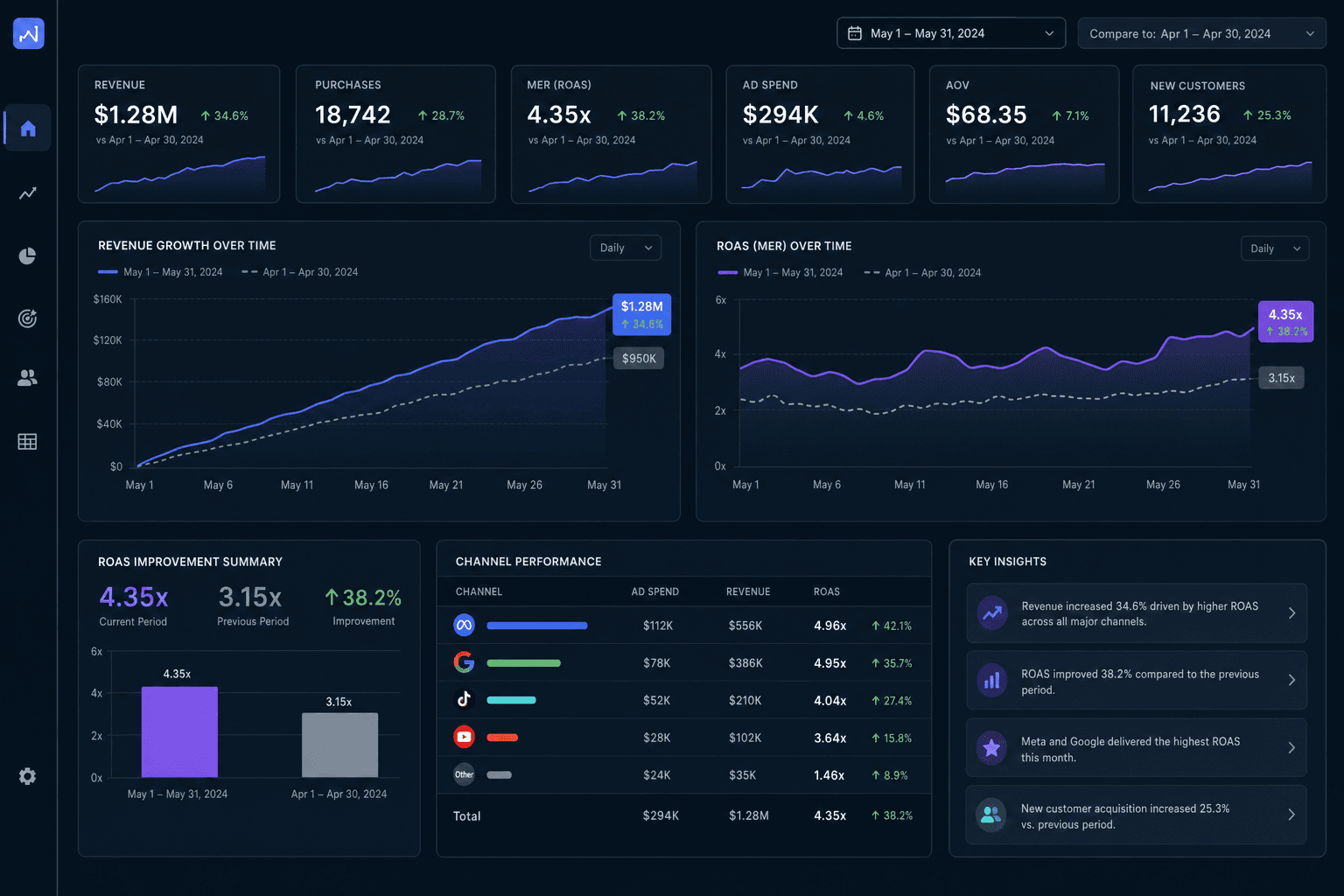
What AI does: Build a clean MER dashboard that pulls actual Shopify revenue against total marketing spend (not platform-attributed revenue) and model LTV cohorts by acquisition channel, creative type, and subscription attach rate so you know which channel is actually generating profitable new customers versus recycling existing ones.
The result: Replace the three conflicting attribution numbers (Meta says 40%, MTA says 22%, MMM says 31%) with a single source of truth built on your actual business data. Know your real nCAC by channel, your 60-day and 12-month LTV by cohort, and which subscription attach rate you need to make each channel's economics work.
Why it matters here: Supplement founders make scaling decisions based on platform dashboards that systematically overstate performance due to iOS tracking limitations and cross-channel double-counting. A brand that thought their CAC was $38 found it was $61 when rebuilt correctly. Running on a miscalculated CAC means scaling a model that does not work, just slowly enough that you do not notice until cash gets tight.
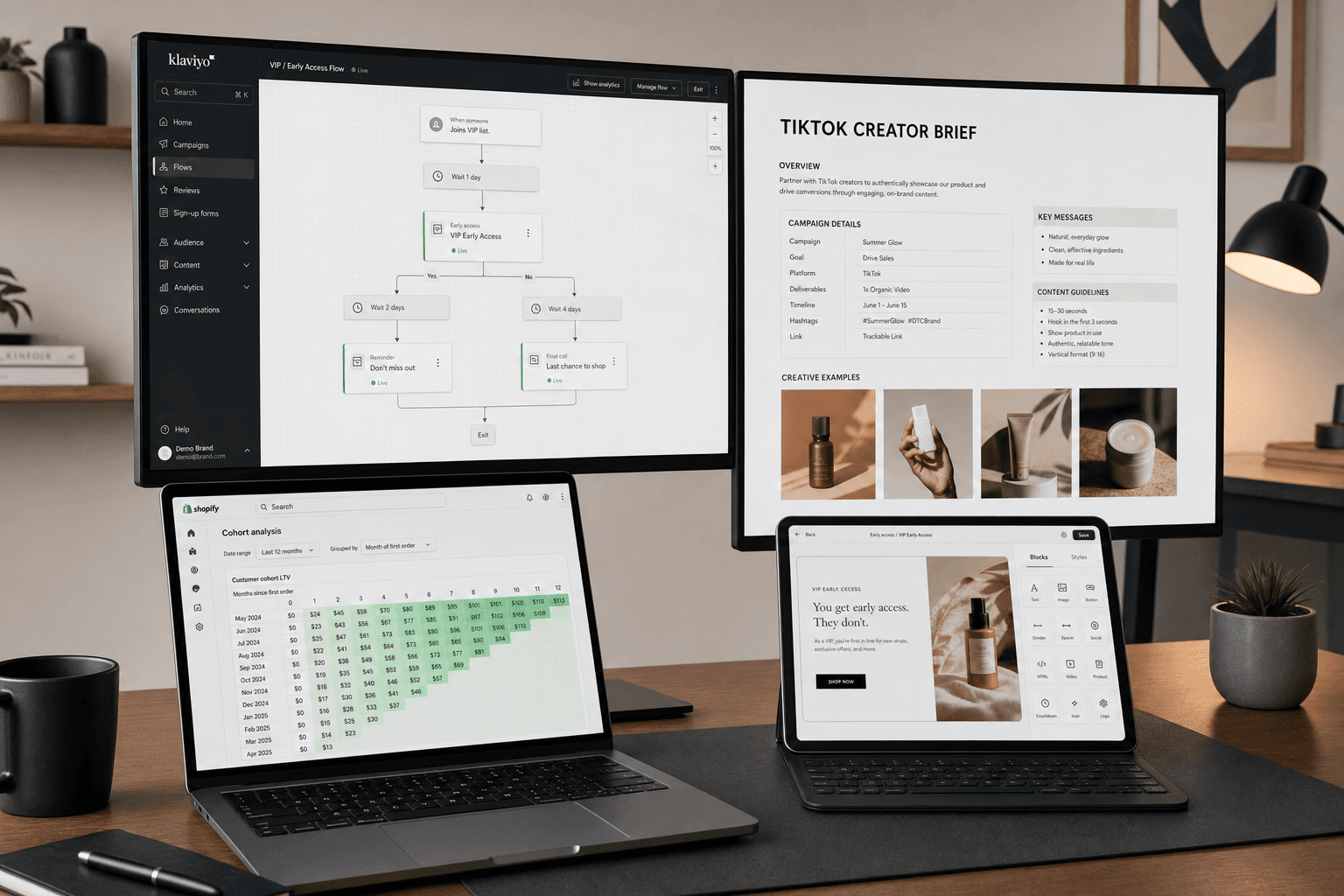
What AI does: Build and continuously optimize Klaviyo flows specifically designed for supplement subscription economics: post-purchase onboarding that increases first-60-day consumption and reorder intent, subscription save sequences that address the specific cancellation reason (price, results, inventory), and winback flows timed to the repurchase cycle of each product's usage duration.
The result: Email achieves an estimated 3.5:1 ROAS with minimal ongoing media cost in this category. AI-assisted sequence optimization (testing subject lines, send timing, and offer logic against actual subscription retention data) compounds that return over time without proportional cost increases.
Why it matters here: Moving monthly subscription churn from 18 percent to 14 percent can add roughly a million dollars in revenue at meaningful scale. Most supplement brands have a cancellation email. Almost none have a save flow that distinguishes between a customer who has too much product on hand (delay offer), one who doubts efficacy (social proof + usage coaching), and one who found a competitor on TikTok (comparison reframe). Each is a different message and a different outcome.
Social Media
What AI does: Build a systematic TikTok Shop creator program: identifying micro-influencers (10K–100K followers) in fitness, wellness, and biohacking niches, briefing them with AI-generated scripts built around compliant health claims and proven hook structures, and using performance data to scale spend behind the creators whose content drives actual purchases rather than views.
The result: A repeatable TikTok Shop content engine that generates affiliate-commission-driven revenue while simultaneously building organic discovery and review velocity, the two assets that compound over time and become harder for competitors to replicate.
Why it matters here: TikTok Shop is growing at 71 percent in the supplement category and vitamins are the platform's largest product vertical, but it still represents only 3 percent of total supplement market revenue. The brands building their creator infrastructure and review base now will have an algorithmic and social-proof advantage that makes the channel increasingly expensive for late entrants, the same dynamic that played out on Meta between 2016 and 2020.
Conversion Optimization
What AI does: Use AI-assisted testing to optimize the subscription offer presentation, bundle logic, and product page claim structure, specifically testing which subscription framing (save percentage vs. never-run-out vs. auto-ship flexibility) drives the highest attach rate at checkout, and which trust signals (third-party testing, certifications, clinical references) reduce bounce on high-intent landing pages.
The result: Higher subscription attach rate at the point of first purchase, the single highest-leverage moment in supplement economics, because a subscriber's 12-month LTV is typically 3 to 4 times that of a one-time buyer at the same AOV.
Why it matters here: In a category where first-order economics are often breakeven or negative and the entire model depends on LTV recovery, the checkout page is where the business model is won or lost. A one-percentage-point improvement in subscription attach rate at checkout compounds across every new customer you acquire. It is a permanent improvement to your unit economics, not a one-time campaign result.
Ready to see what this looks like for your supplement brands business?
No obligation. A senior strategist will show you exactly where the wins are.
The Strategy
What a Supplement Brand's Marketing Strategy Actually Needs to Look Like
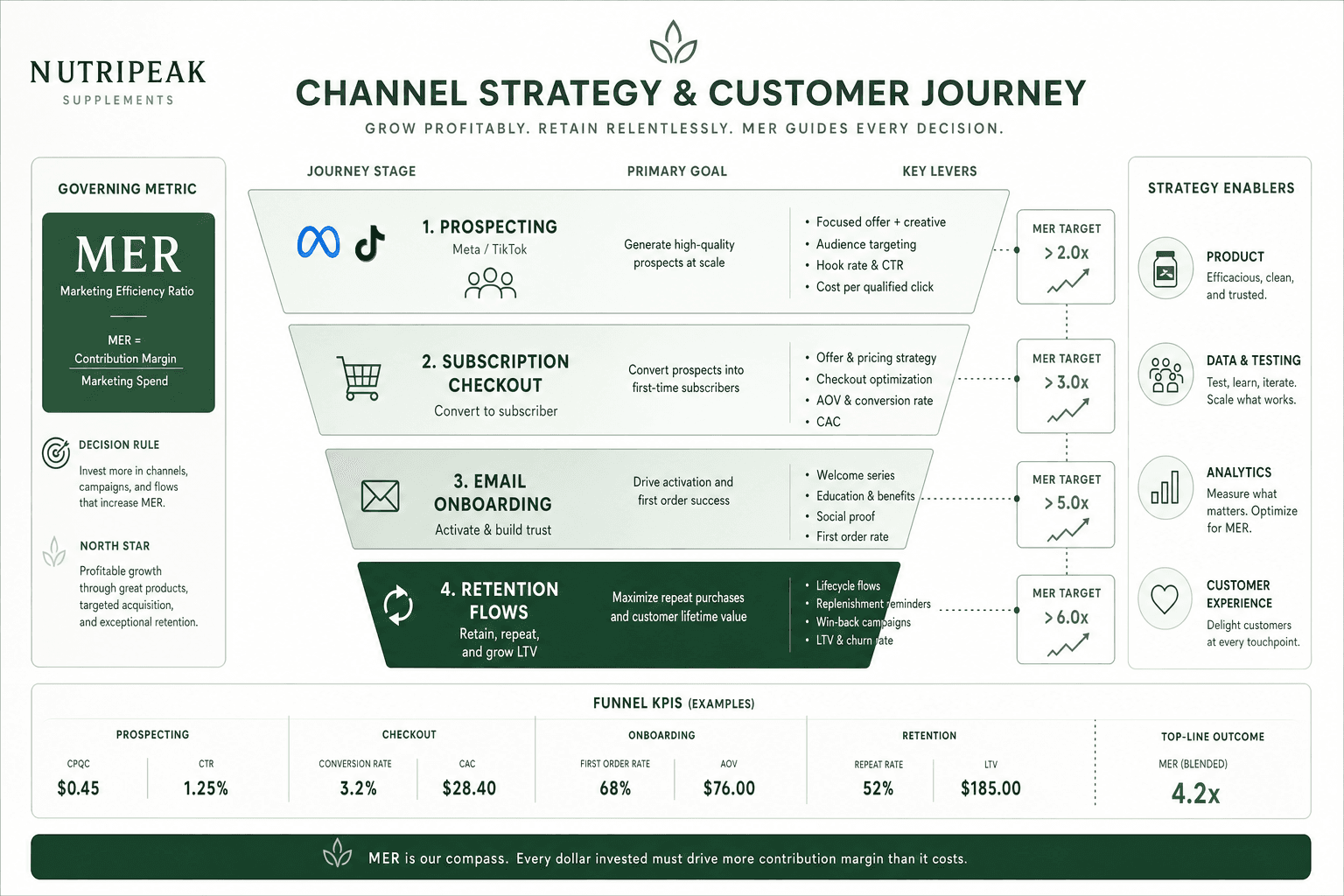
The governing principle: every channel decision is evaluated against blended MER (total Shopify revenue divided by total marketing spend), not platform-attributed ROAS. Platform numbers are inputs to the model, not the model. This matters especially in supplements because iOS tracking limitations and cross-channel attribution overlap mean Meta and Google are both claiming credit for the same purchase.
Channel priority for a DTC supplement brand at $1M–$10M ARR: Meta is the prospecting engine, but it is managed for nCAC and 60-day LTV cohort performance, not first-order ROAS. TikTok Shop is the growth channel to build now while creator economics and CPMs are still favorable. Google Search captures high-intent branded and ingredient-specific queries ('best creatine monohydrate,' 'magnesium glycinate vs oxide') where purchase intent is explicit and conversion rates are materially higher than cold social. Email and SMS are the retention engine, non-negotiable, not optional.
The funnel logic: cold prospecting on Meta and TikTok drives first purchase, ideally with a subscription offer at checkout. Post-purchase email onboarding increases consumption rate and reorder intent in the first 60 days, the window that determines whether a customer becomes a subscriber or a one-time buyer. Subscription save flows and winback sequences recover churn that would otherwise be invisible. Google retargeting and branded search close high-intent visitors who discovered you on social but did not convert immediately.
Creative strategy is built around compliant claim structures (specific, science-referenced, properly disclosed), not generic health aspirations. Micro-influencer UGC in fitness, wellness, and biohacking niches provides the social proof that supplements require, at CPM-adjusted costs that outperform celebrity partnerships. Creative is tested at volume: multiple hooks, multiple claim angles, multiple formats per week, with performance data feeding back into influencer briefs and landing page copy.
Seasonality is built into budget pacing, not ignored. January through mid-February is the highest-demand window for weight management and general wellness. Creative and inventory need to be ready in November. April through June drives hydration and sports nutrition. September through November is immune support season. Budget is weighted toward these windows; the trough months of mid-February through March and July are used for creative testing and infrastructure work, not heavy prospecting spend.
Attribution is cleaned up before scale decisions are made. A misfiring pixel or misconfigured conversion event can inflate reported ROAS by 30 to 50 percent and lead to scaling a channel that is actually losing money. We fix measurement first, then scale.
The one number that governs this
The governing KPI is blended MER (total Shopify revenue ÷ total marketing spend). A 3:1 MER is excellent for supplements given 55–70% gross margins. Channel-level ROAS is an input, not the metric we optimize toward.
How We Help
Here Is Specifically What We Would Do for a Supplement Brand Like Yours
We start where the strategy says to start: with measurement. Before we touch a campaign, we verify your pixel, confirm your Klaviyo conversion events are firing correctly, and build a clean MER dashboard so every decision we make together is based on your actual Shopify revenue, not what Meta claims it drove. Then we build the channel mix your stage of growth actually calls for, in the sequence that pays back fastest given your cash timing constraints.
Paid Media: Meta, TikTok, Google
We manage Meta for nCAC and 60-day LTV cohort performance, not first-order ROAS. We build and run your TikTok Shop creator program: identifying micro-influencers in fitness, wellness, and biohacking, briefing them with compliant claim structures, and scaling spend behind the content that drives actual purchases. Google Search captures high-intent ingredient and branded queries with campaigns structured around purchase intent, not awareness.
Creative Production and Testing
We generate and test significantly more creative angles per week than a brand can manage manually (UGC-style scripts, static concepts, hook variations) all built around FTC-compliant claim structures. Performance data from each test feeds back into influencer briefs and landing page copy, compressing the time to finding a winning angle from months to weeks.
Email and SMS: Klaviyo
We build and optimize the full retention stack: post-purchase onboarding sequence timed to your product's usage duration, subscription save flows segmented by cancellation reason, winback sequences timed to the repurchase cycle, and loyalty/referral triggers. Email is treated as a revenue channel with its own MER target, not a broadcast tool.
Analytics and Attribution
We build your MER dashboard, model LTV cohorts by acquisition channel and creative type, verify your pixel and conversion events, and give you a single source of truth for channel scaling decisions, replacing the three conflicting attribution numbers with one that is based on your actual Shopify revenue.
Conversion Optimization
We test subscription offer framing, bundle logic, and trust signal presentation on your product pages and checkout, specifically optimizing for subscription attach rate at first purchase, which is the single highest-leverage moment in supplement unit economics.
AI Systems
We build AI into the work where it creates real operational advantage: creative generation and testing at volume, LTV cohort modeling, email sequence optimization against actual retention data, and continuous performance monitoring that catches attribution errors and budget inefficiencies before they compound.
Who's Behind This
Who we are, and what makes us different
Sagum is a performance marketing agency founded in January 2017 in St. George, Utah. We've spent 8+ years growing real brands and being judged on KPIs, not vanity metrics.
We deliberately limit how many clients we take so each one gets senior attention. We treat your numbers like our own, we never run generic playbooks, and your strategy is built for your business, because shouldn't your brand's marketing be custom to your brand?
Sagum.ai is our AI arm: the same proven operators now build AI into the work wherever it creates real edge, not as theater, but as leverage applied with discipline.
- 8+ years growing brands on performance KPIs, not vanity metrics
- Limited client roster, with senior attention on every account
- An extension of your team; your success is tied to ours
- Custom strategy per brand, never a generic playbook
- AI built in where it moves a number; judgment over hype
“Sagum is a performance marketing agency that's spent 8+ years growing brands by treating their numbers like our own. We take on few clients, never run generic playbooks, and now build AI into the work wherever it creates real edge, not hype. Your strategy is built for your business, and our success is tied to yours.”

“After six years, Sagum is our most important partner: trusted, communicative, and caring about our business as if it's their own.”
Proof
95% growth in 6 months, 217% YoY after fixing a misfiring pixel
Ballerina Farm
Challenge
Ballerina Farm was spending across multiple channels on a misfiring pixel that inflated reported ROAS and hid what was actually working. Every scaling decision rested on numbers that did not match real revenue, the same broken-attribution trap that stalls supplement brands when Meta, a multi-touch tool, and a media mix model each report a different figure.
What we did
We fixed the measurement before touching budget: corrected the attribution error, verified the conversion events, and rebuilt the paid strategy on a clean view of real revenue. From there, channel mix and creative testing decisions were made against trustworthy numbers instead of platform-reported figures.
Result
95% revenue growth in 6 months and 217% year-over-year, with ROAS coming in 64% better than the original plan. The measurement fix was the unlock: it changed which channels were worth scaling and at what spend. Full details at sagum.com/case-studies/.
If Your Supplement Brand Is Ready to Grow on Real Numbers, Not Dashboard Flattery, Let's Talk
No obligation. We will come to the first conversation having already looked at your category, your current channel mix, and your seasonality, so we are talking about your business specifically, not a generic supplement playbook.
Sagum · January 2017 · St. George, Utah · 8+ years