

8+ years growing brands on KPIs, now with AI
Cut the creative guesswork from watch growth
Engineered around how buyers discover, deliberate, and choose a watch, so acquisition stays profitable.
8+ years growing ecommerce brands · Google, Meta & TikTok partner · judged on ROAS, not vanity metrics



Get your free Growth Gap Analysis
Senior strategist review · response within one business day
Prefer to reach out directly?
The Challenge
Watch Brand Marketing Is a Different Problem Than Most Ecommerce
Watches are a considered purchase, not a $30 impulse buy. Someone who finds you on Instagram Reels may buy two weeks later, after reviews, a YouTube unboxing, an abandoned cart, retargeting, and email. That window is costly and easily misread.
Your AOV is real ($150–$400 for most DTC positioning), but watches aren't reordered like supplements. Repeat revenue comes from gifting, strap and accessory upsells, and limited-edition drops, so LTV models can't assume organic repurchase.
Meta ads in your tier mimic what worked several seasons ago: wrist shot, lifestyle model, white background, 'built for the modern man' copy. Matching your five nearest competitors leaves you competing on price and spend volume. Founders at $1M–$10M ARR juggle creative, media buying, and retention, so accounts go months without proper testing.
Q4 (Black Friday through Christmas) can bring nearly a third of annual revenue. Valentine's Day, Father's Day, and graduation season spike and collapse within weeks; miss a ramp-up and prepared competitors take the margin. July and August go quiet while CPMs stay high.
The Opportunity
Watch Demand Is There, and Most Brands Capture It Sloppily
Meta's average ecommerce ROAS sat around 2.87× in 2025, down year over year. With disciplined creative testing and proper attribution, a watch brand can hit 3.5–4× on cold traffic and 5–7× on retargeting.
Most Meta-first watch brands underuse Google Shopping, whose ads drive 66% of Google retail clicks and reach buyers searching 'men's minimalist watch under $200' or 'best automatic watch gift for dad'.
Gifting dates never move; brands that prepare six to eight weeks ahead beat those scrambling two weeks out. A $200 watch buyer who adds two $35 NATO straps has a 35% higher 12-month LTV, and well-timed post-purchase email wins those orders at almost no cost.
Breaking the lifestyle format with mechanism close-ups, founder stories, watch-nerd UGC, or candid unboxings earns outsized attention at lower CPMs; the creative moat goes to whoever builds it first.
What Most Get Wrong
What Watch Brands and Their Agencies Keep Getting Wrong
Optimizing for blended ROAS instead of new-customer ROAS
If your 4× ROAS comes from retargeting people who'd buy anyway, your cold-traffic engine is dying, and you won't know until you scale spend, the worst time to find out.
Running the same three Meta creative formats all year
Creative fatigue is the primary driver of CAC creep for watch brands, lifting CPMs and cutting CTR. Most brands test one creative monthly; winners test five to ten angles weekly.
Ignoring Google Shopping or running Performance Max without guardrails
Without proper asset groups, negative keywords, and conversion value rules, Performance Max spends on low-intent queries and brand cannibalization, and you forfeit high-intent watch searches, among your most valuable clicks.
Treating all gifting peaks the same and starting too late
Father's Day watch searches start climbing five to six weeks before the holiday. Start four weeks out and you're already behind, paying peak CPMs for traffic competitors locked in cheaper.
No post-purchase email beyond a shipping notification
Ninety silent days mean no strap upsell, review request, referral, or second gifting touch. Email plus paid ads lifts repeat purchase rates by 33%, separating workable LTV from unprofitable CAC.
Why Now
Why Watch Brands Should Fix Creative and Measurement Before Q4
Meta's watch category is in a creative homogeneity trap. AI-assisted production lets a disciplined operator test five to ten angles a week while a competitor tests one a month, finding a winner before the category copies it.
Attribution is in flux: iOS changes, GA4 migrations, and channel proliferation leave most watch brand accounts on misread data, and brands fixing measurement now make better spend decisions than competitors flying blind.
Tariffs on Chinese and Swiss components can squeeze margins for brands that haven't adjusted pricing or supplier mix, so tighten acquisition efficiency now. Meta ROAS during Black Friday and Cyber Monday 2024 ran 17% higher than the rest of the year, with conversion rates up 32%. Q4 winners build creative, audiences, and email flows six to eight weeks before Black Friday.
The Mechanism
Where AI Moves the Numbers for Watch Brands
Real productivity, not AI theater. Here's where it actually moves a number for watch brands.
creative
What AI does: AI-assisted production generates concepts (mechanism close-ups, founder narrative, gifting-occasion hooks, UGC-style scripts) for Meta and TikTok, then uses thumb-stop rate and hook completion to spot attention-earning angles before significant spend.
The result: You test five to ten creative angles per week instead of one a month and break wrist-shot saturation faster, at lower CPM.
Why it matters here: A creative moat is the only lasting advantage in a category this uniform, and building one takes more testing than manual production can support.
analytics
What AI does: AI reconciles Meta-reported ROAS with Shopify revenue by cohort, separates new and returning buyers, and flags pixel or UTM errors that can make reported ROAS hide a broken funnel.
The result: You get a clean view of new-customer CAC and true cold-traffic ROAS, the numbers that govern profitability at scale.
Why it matters here: Multi-touch paths over a 3–14 day deliberation window make watch brands especially vulnerable to last-click attribution errors, and their damage to spend decisions compounds weekly.
What AI does: AI builds post-purchase flows: strap upsells at day 14, review requests at day 21, gifting reminders 45 days before Father's Day or Valentine's Day, and early access to drops for past buyers.
The result: You get a meaningful 90-day LTV lift from customers who don't repurchase organically, turning a low-repeat category into a retention channel.
Why it matters here: When new-customer CAC runs $50–$100, one extra transaction per customer, a strap or a gifted second watch, moves LTV:CAC from marginal to healthy.
digital ads
What AI does: AI pacing shifts spend across Meta, Google Shopping, and YouTube by live performance and gifting dates, ramping six weeks before Black Friday, Valentine's Day, and Father's Day, then pulling back in July–August.
The result: Budget follows demand instead of a flat monthly schedule, so peak windows get the most spend and slow months don't drain the account.
Why it matters here: Spending the same in August as November underfunds Q4 and wastes summer budget; a predictable calendar gives AI pacing a structural edge over set-and-forget competitors.
conversion optimization
What AI does: AI reviews pages for watch-buyer friction: thin movement or material detail for watch nerds, missing social proof for gift buyers, and unclear options for engraving or customization, primary purchase triggers around milestones.
The result: Paid traffic converts at a higher rate, especially on the return visits where most watch purchases happen.
Why it matters here: A 1-point lift in conversion rate on a $200 AOV product at 10,000 monthly sessions adds $20,000 a month at zero extra ad spend.
Ready to see what this looks like for your watch brands business?
No obligation. A senior strategist will show you exactly where the wins are.
The Strategy
How a DTC Watch Brand Should Run Its Marketing
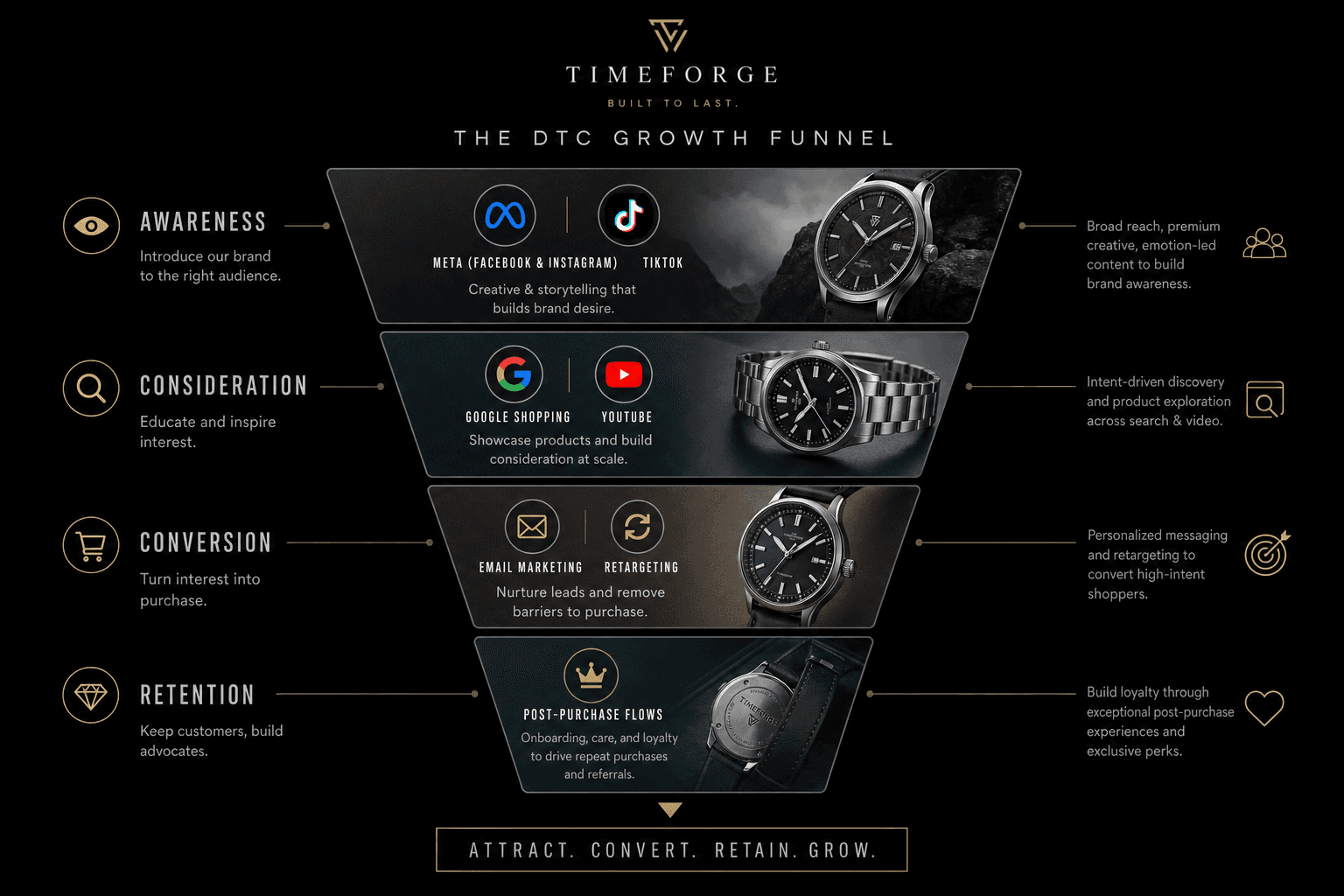
At $1M–$10M in revenue, put roughly 50–60% of paid spend on Meta, 25–35% on properly structured Google Shopping and Performance Max, and the rest on TikTok for sub-$150 SKUs or YouTube for $300+ pieces.
Meta is your discovery engine: cold creative on Instagram Reels and Stories earns the scroll-stop and first click, the product page builds consideration, and retargeting and email close 3–14 days later. Optimize cold campaigns for add-to-cart or initiate-checkout, not purchase.
Google Shopping clicks come from buyers already choosing between options and convert at a fundamentally different rate than cold social. Segment by price tier: 'men's automatic watch under $300' deserves a different landing experience than 'luxury minimalist watch'.
The gifting calendar is the spine of the annual plan. Six to eight weeks before Black Friday, Valentine's Day, and Father's Day, build audience segments, produce gifting creative (engraving deadlines, gift packaging, 'for him' messaging), and queue email. Raise budget six weeks out and max pressure in the final week.
Email and SMS earn the highest ROAS in the stack, not by acquiring new customers but by closing the multi-touch sale and driving strap and accessory LTV. In a low-repeat category, post-purchase flows, abandoned cart sequences, and pre-launch VIP lists are mandatory.
The one number that governs this
The governing KPI is new-customer ROAS on cold traffic, tracked apart from blended ROAS: aim for 3.5–4× on Meta prospecting.
How We Help
How We Would Run Marketing for Your Watch Brand
We start with measurement, because every later decision depends on clean new-customer numbers, then build in the order your strategy calls for.
Analytics & Attribution Audit
We first verify your pixel, UTMs, and conversion events and confirm blended ROAS isn't masking a broken cold-traffic funnel.
Meta Ads (Instagram & Facebook)
We rebuild campaigns around the prospecting-to-retargeting funnel with correct objectives per stage, gifting-occasion and intent audiences, and weekly creative testing.
Google Shopping & Performance Max
We segment Shopping campaigns by price tier and intent, with Performance Max guardrails, so high-intent watch queries convert instead of getting buried in broad traffic.
Creative Production & Testing
We produce and test new formats and pick winners on thumb-stop rate, hook completion, and add-to-cart rate before scaling spend.
Email & Post-Purchase Automation
We build post-purchase flows that lift 90-day LTV, from strap upsells to VIP early access for limited drops.
Gifting Calendar Strategy
We map your Q4, Valentine's Day, Father's Day, and graduation season campaigns in advance (segments, creative, budget pacing, email) so you enter each peak prepared.
Conversion Rate Optimization
We audit product pages for friction that stalls watch buyers and build variants that lift return-visit conversion.
Who's Behind This
Who we are, and what makes us different
Sagum is a performance marketing agency founded in January 2017 in St. George, Utah. We've spent 8+ years growing real brands and being judged on KPIs, not vanity metrics.
We deliberately limit how many clients we take so each one gets senior attention. We treat your numbers like our own, we never run generic playbooks, and your strategy is built for your business, because shouldn't your brand's marketing be custom to your brand?
Sagum.ai is our AI arm: the same proven operators now build AI into the work wherever it creates real edge, not as theater, but as leverage applied with discipline.
- 8+ years growing brands on performance KPIs, not vanity metrics
- Limited client roster, with senior attention on every account
- An extension of your team; your success is tied to ours
- Custom strategy per brand, never a generic playbook
- AI built in where it moves a number; judgment over hype
“Sagum is a performance marketing agency that's spent 8+ years growing brands by treating their numbers like our own. We take on few clients, never run generic playbooks, and now build AI into the work wherever it creates real edge, not hype. Your strategy is built for your business, and our success is tied to yours.”

“Sagum roughly doubled our bottom line. They treat the work like it's their own business.”
Rachel Nilsson
CEO, RAGS
Proof
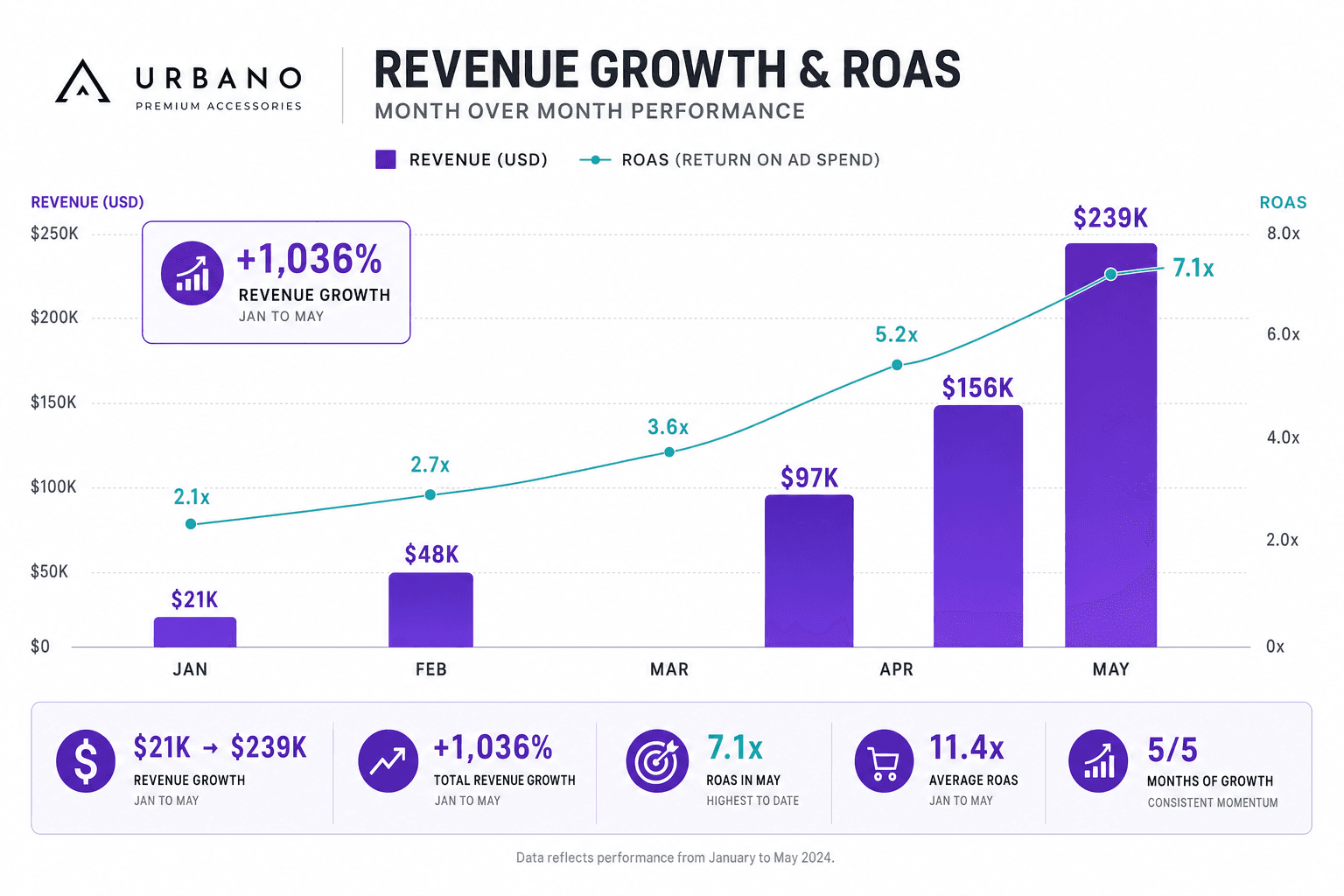
$255k → $555k in 2 months, ROAS 2.9x → 5.5x+
Nickel & Suede
Challenge
Nickel & Suede, an apparel and accessories brand, needed to scale paid social revenue profitably, the problem watch founders face when Meta spend stops scaling.
What we did
We ran Meta and TikTok creative testing at volume.
Result
Revenue went from $255K to $555K in two months. ROAS moved from 2.9x to 5.5x+, peaking at 7.95x, and site conversion rate lifted 34%. Your watch brand would get the same creative-testing discipline.
- Revenue
- $255k → $555k (2 mo)
- ROAS
- 2.9x → 5.5x+ (peak 7.95x)
- Site conversion
- +34%
Scale Your Watch Brand on New-Customer ROAS You Can Trust
No obligation. We'll come prepared with a read on your ad account and a clear view of where your new-customer ROAS has room to grow, built around your brand, AOV, and gifting calendar.
Sagum · January 2017 · St. George, Utah · 8+ years